1. Introduction and Need for Classification of Elements
Meaning of Periodic Classification
The periodic table is a systematic arrangement of elements in which elements with similar properties are placed in the same vertical columns. It helps in understanding, comparing and predicting the physical and chemical properties of elements.
Need for Classification
- The number of known elements increased from a few dozen in the nineteenth century to 118 known elements.
- Studying every element individually is difficult.
- Classification groups elements with similar properties and reveals regular trends.
- It helps predict the properties of undiscovered or newly synthesised elements.
Important Terms
Periodic table: Tabular arrangement of elements based on a fundamental property and recurring properties.
Periodicity: Repetition of similar properties at regular intervals when elements are arranged in increasing atomic number.
2. Earlier Attempts at Classification of Elements
Döbereiner’s Law of Triads
Johann Wolfgang Döbereiner grouped certain elements into sets of three called triads. The atomic mass of the middle element was approximately the arithmetic mean of the atomic masses of the other two elements, and their properties were similar.
Examples: Li (7), Na (23), K (39); Ca (40), Sr (88), Ba (137); Cl (35.5), Br (80), I (127).
For a triad, approximate atomic mass of middle element = (mass of first element + mass of third element) / 2.
Limitation: Only a few known elements could be arranged into triads.
De Chancourtois’ Telluric Screw
In 1862, A.E.B. de Chancourtois arranged elements in increasing order of atomic masses on a spiral drawn around a cylinder. Elements with similar properties appeared at regular intervals. This arrangement was not widely accepted because its relationship to chemical properties was not sufficiently clear.
Newlands’ Law of Octaves
In 1865, John Newlands arranged elements in increasing order of atomic masses. He observed that every eighth element had properties similar to the first, resembling the repetition of notes in a musical octave.
Limitations: The law worked reasonably well only for lighter elements, approximately up to calcium. It left no gaps for undiscovered elements and sometimes grouped dissimilar elements together.
Lothar Meyer’s Atomic Volume Curve
Julius Lothar Meyer plotted atomic volume against atomic mass and observed that elements with similar properties occupied similar positions on the curve. Alkali metals appeared near the peaks. His work independently demonstrated periodicity in elemental properties.
3. Mendeleev’s Periodic Law and Periodic Table
Mendeleev’s Periodic Law
Dmitri Mendeleev stated that the physical and chemical properties of elements are periodic functions of their atomic masses. He arranged elements mainly in increasing order of atomic mass while placing elements with similar chemical properties in the same groups.
Achievements and Merits
- Elements with similar properties were placed together.
- Gaps were left for elements that had not yet been discovered.
- He predicted the properties of undiscovered elements called eka-boron, eka-aluminium and eka-silicon.
- The later discovery of scandium, gallium and germanium broadly supported these predictions.
- Incorrect atomic masses of some elements could be questioned and revised.
Limitations of Mendeleev’s Table
- Position of hydrogen: Hydrogen resembles both alkali metals and halogens, so its position was uncertain.
- Isotopes: Isotopes have different atomic masses but the same atomic number; the mass-based table could not give them separate positions.
- Anomalous pairs: Some elements were placed out of increasing atomic-mass order, such as Ar–K, Co–Ni and Te–I, to preserve chemical similarity.
- Lanthanides and actinides: Their positions were not satisfactorily explained in the original table.
- Some chemically similar elements were separated, while some dissimilar elements were grouped together.
4. Modern Periodic Law and Long Form of the Periodic Table
Moseley’s Contribution
Henry Moseley showed that the frequency of characteristic X-rays emitted by elements is related to their atomic numbers. Atomic number, rather than atomic mass, is the more fundamental basis for arranging elements.
Modern Periodic Law
The physical and chemical properties of elements are periodic functions of their atomic numbers.
Structure of the Modern Periodic Table
- There are 7 periods (horizontal rows) and 18 groups (vertical columns).
- Elements in the same group generally have similar valence-shell electronic configurations and related chemical properties.
- The period number generally indicates the principal quantum number of the outermost occupied shell.
- Elements are divided into s-, p-, d- and f-blocks according to the subshell into which the differentiating electron enters.
Periods and Their Sizes
| Period | Number of elements | Type |
|---|---|---|
| 1 | 2 | Shortest |
| 2 | 8 | Short |
| 3 | 8 | Short |
| 4 | 18 | Long |
| 5 | 18 | Long |
| 6 | 32 | Longest |
| 7 | 32 | Incomplete in the traditional description; now contains 32 recognised elements |
The sixth period contains the lanthanoids and the seventh contains the actinoids. These 14-element series are usually shown separately at the bottom to keep the table compact.
Groups and Common Family Names
- Group 1: Alkali metals (hydrogen is not an alkali metal).
- Group 2: Alkaline earth metals.
- Groups 3–12: Transition elements.
- Group 15: Pnictogens; Group 16: Chalcogens.
- Group 17: Halogens; Group 18: Noble gases.
- Groups 1, 2 and 13–18 are commonly called representative or main-group elements.
Blocks of the Periodic Table
s-block: Groups 1 and 2 (with helium having 1s² configuration but placed in group 18 due to its properties).
p-block: Groups 13–18, except helium.
d-block: Groups 3–12; transition elements.
f-block: Lanthanoids and actinoids; inner-transition elements.
5. Nomenclature of Elements with Atomic Number Greater Than 100
IUPAC introduced a systematic temporary naming method based on the digits of an element’s atomic number. Each digit is represented by a numerical root, the roots are combined, and the suffix -ium is added.
| Digit | Root | Symbol |
|---|---|---|
| 0 | nil | n |
| 1 | un | u |
| 2 | bi | b |
| 3 | tri | t |
| 4 | quad | q |
| 5 | pent | p |
| 6 | hex | h |
| 7 | sept | s |
| 8 | oct | o |
| 9 | enn | e |
Example: Atomic number 120: un + bi + nil + ium = unbinilium; temporary symbol Ubn.
This systematic nomenclature is used until an element receives an approved official name and symbol. Many elements above 100 now have official names.
6. Electronic Configuration and the Periodic Table
The distribution of electrons among the orbitals of an atom is called its electronic configuration. The position of an element in the periodic table is closely related to the electronic configuration of its atom, especially the configuration of the differentiating electron and valence shell.
Connection Between Period and Electronic Configuration
The period number generally corresponds to the highest principal quantum number (n) occupied in the ground-state atom. Successive periods involve the filling of a new principal shell, although the order of subshell filling follows the Aufbau sequence.
Number of Elements in a Period
The number of elements in a period is related to the number of electrons accommodated in the subshells filled during that period:
- First period: 1s (2 elements).
- Second period: 2s and 2p (8 elements).
- Third period: 3s and 3p (8 elements).
- Fourth period: 4s, 3d and 4p (18 elements).
- Fifth period: 5s, 4d and 5p (18 elements).
- Sixth period: 6s, 4f, 5d and 6p (32 elements).
- Seventh period: 7s, 5f, 6d and 7p (32 elements).
Blocks and Differentiating Electrons
| Block | Last electron enters | General configuration |
|---|---|---|
| s | s-subshell | ns¹–² |
| p | p-subshell | ns² np¹–⁶ |
| d | (n−1)d-subshell | (n−1)d¹–¹⁰ ns⁰–² |
| f | (n−2)f-subshell | (n−2)f¹–¹⁴ (n−1)d⁰–¹ ns² |
7. Effective Nuclear Charge, Shielding and Atomic Radius
Effective Nuclear Charge
The attraction experienced by an electron from the nucleus after accounting for repulsion or screening by other electrons is called effective nuclear charge (Zeff). Inner-shell electrons shield outer electrons from the full nuclear charge.
Approximate relation: Zeff = Z − σ, where Z is the nuclear charge (atomic number) and σ is the screening constant.
Atomic Radius
Atomic size is not sharply defined because the electron cloud has no definite boundary. Atomic radius is estimated using inter-nuclear distances in bonded or closely packed atoms.
- Covalent radius: Half the distance between the nuclei of two identical atoms joined by a single covalent bond.
- Metallic radius: Half the distance between the nuclei of two adjacent metal atoms in a metallic crystal.
- van der Waals radius: Half the distance between the nuclei of two nearest non-bonded atoms of the same element.
Periodic Trend in Atomic Radius
- Across a period, atomic radius generally decreases from left to right because nuclear charge increases while electrons are added to the same principal shell.
- Down a group, atomic radius generally increases because new shells are added and shielding increases.
8. Ionic Radius and Ionisation Enthalpy
Ionic Radius
- Cations are generally smaller than their parent atoms because loss of electrons reduces electron–electron repulsion and may remove the outer shell.
- Anions are generally larger than their parent atoms because added electrons increase electron–electron repulsion.
- For an isoelectronic series, radius decreases as nuclear charge increases. Example: O²⁻ > F⁻ > Na⁺ > Mg²⁺ > Al³⁺.
Ionisation Enthalpy
Ionisation enthalpy is the enthalpy required to remove the most loosely bound electron from an isolated gaseous atom in its ground state.
X(g) → X⁺(g) + e⁻
Successive ionisation enthalpies are represented as ΔiH₁, ΔiH₂, ΔiH₃, and so on. Successive values generally increase because removal of each electron makes the remaining electrons more strongly attracted to the nucleus.
Factors Affecting Ionisation Enthalpy
- Atomic size: larger size generally lowers ionisation enthalpy.
- Nuclear charge: higher effective nuclear charge generally raises it.
- Shielding effect: greater shielding generally lowers it.
- Penetration: for the same shell, s-electrons are generally held more strongly than p, d and f electrons.
- Electronic configuration: half-filled and fully filled subshells can have extra stability.
Periodic Trend and Important Exceptions
Ionisation enthalpy generally increases across a period and decreases down a group. Small irregularities occur, notably Be > B and N > O, due to subshell energies and electron pairing.
9. Electron Gain Enthalpy and Electronegativity
Electron Gain Enthalpy
Electron gain enthalpy is the enthalpy change when an electron is added to an isolated gaseous atom to form a gaseous anion.
X(g) + e⁻ → X⁻(g)
It is often negative when energy is released. A more negative value indicates a more favourable addition of an electron under the stated conditions. The second electron gain enthalpy of an element is generally positive because an electron is added to an already negatively charged ion.
Periodic Trend
Across a period, electron gain enthalpy generally becomes more negative, with exceptions. Down a group, it generally becomes less negative, but the trend is not regular. Chlorine has a more negative first electron gain enthalpy than fluorine because the compact 2p subshell of fluorine has greater electron–electron repulsion.
Electronegativity
Electronegativity is the tendency of an atom in a molecule to attract the shared pair of electrons towards itself. It is a relative, dimensionless property and depends on the chemical environment.
- It generally increases across a period.
- It generally decreases down a group.
- Fluorine is the most electronegative element.
- Electronegativity helps explain bond polarity and the ionic or covalent character of bonds.
Electron Gain Enthalpy vs Electronegativity
Electron gain enthalpy is an energy change for an isolated gaseous atom, whereas electronegativity is the tendency of an atom in a chemical bond to attract shared electrons.
10. Valency, Oxidation States and Chemical Reactivity
Valency
Valency is the combining capacity of an element. For many main-group elements, it is related to the number of electrons lost, gained or shared to attain a stable configuration. Across a period, valency with respect to hydrogen often increases from 1 to 4 and then decreases from 3 to 0.
Oxidation State
Oxidation state is the apparent charge assigned to an atom in a compound or ion according to agreed electron-allocation rules. Many p-block elements show variable oxidation states. The inert pair effect can make the lower oxidation state more stable in heavier p-block elements.
Chemical Reactivity
- For alkali metals, reactivity generally increases down the group as the outer electron is lost more easily.
- For halogens, reactivity generally decreases down the group as the tendency to gain an electron decreases.
- Metallic character generally increases down a group and decreases across a period.
- Non-metallic character generally decreases down a group and increases across a period.
11. Periodic Trends – Quick Comparison and Exam Revision
| Property | Across a period (left to right) | Down a group |
|---|---|---|
| Atomic radius | Generally decreases | Generally increases |
| Ionisation enthalpy | Generally increases | Generally decreases |
| Electron gain enthalpy | Generally becomes more negative, with exceptions | Generally becomes less negative, with exceptions |
| Electronegativity | Generally increases | Generally decreases |
| Metallic character | Generally decreases | Generally increases |
| Non-metallic character | Generally increases | Generally decreases |
High-Value NEET and Board Exam Points
- Modern periodic law is based on atomic number, not atomic mass.
- There are 7 periods and 18 groups in the modern periodic table.
- Period number is associated with the highest occupied principal shell.
- Block is identified by the subshell receiving the differentiating electron.
- Across a period, effective nuclear charge generally increases.
- For isoelectronic species, greater nuclear charge means smaller radius.
- Successive ionisation enthalpies increase; a large jump follows removal of all valence electrons.
- Chlorine has a more negative electron gain enthalpy than fluorine.
- Fluorine is the most electronegative element.
12. Short-Answer Questions – 30 Questions
Questions
- Why is classification of elements necessary?
- State Döbereiner’s law of triads.
- Give one example of a Döbereiner triad and verify the arithmetic mean rule.
- What was the main limitation of Döbereiner’s classification?
- What is the telluric screw?
- State Newlands’ law of octaves.
- Mention two limitations of Newlands’ law of octaves.
- What did Lothar Meyer plot, and what did he observe?
- State Mendeleev’s periodic law.
- Mention two achievements of Mendeleev’s periodic table.
- What were eka-aluminium and eka-silicon later identified as?
- Why was the position of hydrogen uncertain in Mendeleev’s table?
- Why could isotopes not be placed satisfactorily in Mendeleev’s table?
- Give two examples of anomalous pairs in Mendeleev’s table.
- State the modern periodic law.
- What was Moseley’s important contribution to periodic classification?
- How many groups and periods are present in the modern periodic table?
- How many elements are present in the first, second and fourth periods?
- What is meant by a representative element?
- Define s-, p-, d- and f-block elements.
- What are lanthanoids and actinoids?
- What is the systematic IUPAC root for atomic number digit 7?
- Define effective nuclear charge.
- Define covalent radius.
- Why does atomic radius generally decrease across a period?
- Why are cations smaller than their parent atoms?
- Define first ionisation enthalpy.
- Why does ionisation enthalpy generally increase across a period?
- Define electron gain enthalpy and electronegativity.
- Why is chlorine’s first electron gain enthalpy more negative than that of fluorine?
Answers
- Classification makes the study of many elements easier by grouping elements with similar properties and revealing periodic trends.
- When three similar elements are arranged in increasing atomic mass, the atomic mass of the middle element is approximately the arithmetic mean of the other two.
- For Li, Na and K: (7 + 39)/2 = 23, which is the approximate atomic mass of Na.
- It could be applied to only a limited number of elements.
- It was a spiral arrangement of elements in increasing atomic mass around a cylinder, proposed by de Chancourtois.
- When elements are arranged in increasing atomic mass, every eighth element has properties similar to the first, for the range where the law applies.
- It worked mainly for lighter elements and did not leave gaps for undiscovered elements; it also grouped some dissimilar elements.
- Meyer plotted atomic volume against atomic mass and observed periodic repetition of properties and similar positions for related elements.
- The physical and chemical properties of elements are periodic functions of their atomic masses.
- He grouped similar elements, left gaps for undiscovered elements and predicted properties of several unknown elements.
- Eka-aluminium became gallium and eka-silicon became germanium.
- Hydrogen resembles both group 1 alkali metals and group 17 halogens in different properties.
- Isotopes have different atomic masses but the same atomic number and chemical properties, so an atomic-mass arrangement could not assign them appropriately.
- Ar–K, Co–Ni and Te–I are examples; any two are acceptable.
- The physical and chemical properties of elements are periodic functions of their atomic numbers.
- Moseley established the relationship between characteristic X-ray frequency and atomic number, showing atomic number to be the correct basis of classification.
- There are 18 groups and 7 periods.
- The first period has 2 elements, the second has 8 and the fourth has 18.
- Representative elements are the main-group elements of groups 1, 2 and 13–18.
- s-block elements have their differentiating electron in an s-subshell; p-block in p; d-block in d; and f-block in f.
- Lanthanoids are the 14 elements following lanthanum in the 4f series; actinoids are the 14 elements following actinium in the 5f series.
- The root is “sept” and its symbol is “s”.
- Effective nuclear charge is the net positive nuclear attraction experienced by an electron after shielding by other electrons.
- Covalent radius is half the internuclear distance between two identical atoms joined by a single covalent bond.
- Nuclear charge increases across the period while added electrons enter the same principal shell, increasing attraction and reducing size.
- A cation loses electron(s), reducing electron–electron repulsion and sometimes losing its outer shell; hence it is smaller.
- It is the enthalpy required to remove the most loosely bound electron from an isolated gaseous atom in its ground state.
- Effective nuclear charge generally increases and atomic size decreases across a period, so the outer electron is held more strongly.
- Electron gain enthalpy is the enthalpy change when an isolated gaseous atom gains an electron. Electronegativity is the tendency of a bonded atom to attract shared electrons.
- Fluorine’s very compact 2p subshell causes greater electron–electron repulsion for the incoming electron. Chlorine’s larger 3p subshell accommodates it with less repulsion, releasing more energy.
13. Long-Answer Questions – 15 Questions
Questions
- Explain the need for classification of elements and discuss Döbereiner’s triads, Newlands’ law of octaves and their limitations.
- Describe Lothar Meyer’s contribution and explain Mendeleev’s periodic law, achievements and limitations.
- Explain how Moseley’s work led to the modern periodic law. Compare the modern periodic law with Mendeleev’s periodic law.
- Describe the structure of the long form of the periodic table, including periods, groups and the number of elements in each period.
- Explain the four blocks of the periodic table with their general electronic configurations and examples.
- Explain the systematic IUPAC nomenclature for elements with atomic numbers above 100. Illustrate the naming of element 120.
- Explain the relationship between electronic configuration and the position of an element in the periodic table.
- Discuss the trends in atomic radius across a period and down a group with reasons.
- Explain ionic radii and compare the sizes of cations, anions and isoelectronic species.
- Define ionisation enthalpy. Explain its factors, periodic trends and the important exceptions Be/B and N/O.
- Define electron gain enthalpy. Discuss its periodic trends and explain why chlorine has a more negative value than fluorine.
- Define electronegativity and discuss its periodic variation and significance in chemical bonding.
- Explain effective nuclear charge and shielding effect and show how they influence periodic properties.
- Discuss the periodic trends in metallic character, non-metallic character, valency and chemical reactivity.
- Prepare a comparative account of the major periodic properties and explain the reasons for their variation across periods and down groups.
Detailed Answers
- Need and early classifications: As the number of known elements increased, individual study became difficult. Classification made it possible to group elements with related properties. Döbereiner arranged some elements in triads, where the middle atomic mass was approximately the mean of the other two; Li–Na–K is an example. The method covered only a few elements. Newlands arranged elements by increasing atomic mass and proposed that every eighth element repeated the properties of the first. The law worked mainly for lighter elements, failed beyond calcium in its original form, left no gaps for undiscovered elements and sometimes grouped dissimilar elements.
- Meyer and Mendeleev: Lothar Meyer plotted atomic volume against atomic mass and found periodic repetition in properties. Mendeleev stated that physical and chemical properties are periodic functions of atomic masses. He grouped similar elements, left gaps and predicted properties of undiscovered elements. Gallium and germanium later supported his predictions. Limitations included uncertain hydrogen position, isotope placement, anomalous pairs such as Ar–K and Te–I, and unsatisfactory placement of lanthanoids and actinoids.
- Moseley and modern law: Moseley showed that characteristic X-ray frequency is related to atomic number. This established atomic number as a more fundamental property than atomic mass. Modern periodic law states that physical and chemical properties are periodic functions of atomic numbers. Mendeleev used atomic mass, whereas the modern table uses atomic number. The modern arrangement resolves isotope placement and explains anomalous mass pairs because isotopes share the same atomic number and elements are arranged by Z.
- Long form: The table has seven horizontal periods and eighteen vertical groups. Period lengths are 2, 8, 8, 18, 18, 32 and 32 elements. The first is the shortest; the sixth and seventh are the longest. Period number generally indicates the highest occupied principal shell. Groups contain elements with related valence-shell configurations. Lanthanoids and actinoids are shown separately below the main table for compactness.
- Blocks: The block depends on the subshell receiving the differentiating electron. s-block: groups 1 and 2, general configuration ns¹–². p-block: groups 13–18 (except He), ns²np¹–⁶. d-block: groups 3–12, (n−1)d¹–¹⁰ns⁰–². f-block: inner-transition series, with filling of (n−2)f orbitals. These configurations explain the broad chemical similarities within blocks.
- IUPAC systematic nomenclature: The temporary naming system combines numerical roots for each digit in the atomic number, followed by “ium”. The roots are nil, un, bi, tri, quad, pent, hex, sept, oct and enn for digits 0–9. For Z = 120, the roots are un + bi + nil, giving unbinilium, symbol Ubn. This is a systematic temporary name; officially approved element names take precedence once adopted.
- Electronic configuration and position: The period is related to the highest occupied principal quantum number. The block identifies the subshell into which the differentiating electron enters. For main-group elements, the group is related to the number of valence electrons. For example, Na has [Ne]3s¹, so it is in period 3 and group 1; Cl has [Ne]3s²3p⁵, so it is in period 3 and group 17. Transition and inner-transition elements are classified by d- and f-subshell filling.
- Atomic radius: Across a period, atomic radius generally decreases because nuclear charge increases while electrons are added to the same shell; the stronger effective attraction pulls the electron cloud closer. Down a group, radius increases because a new principal shell is added at each step and shielding increases. The trend is general, and measured radii depend on whether covalent, metallic or van der Waals radii are considered.
- Ionic radii: Cations are smaller than their parent atoms because electron loss reduces repulsion and may remove the outer shell. Anions are larger because electron addition increases repulsion. In an isoelectronic series, all species have the same number of electrons; the species with the larger nuclear charge has the smaller radius. Thus O²⁻ is larger than F⁻, which is larger than Na⁺, Mg²⁺ and Al³⁺ in that order.
- Ionisation enthalpy: It is the enthalpy needed to remove an electron from an isolated gaseous atom. It depends on atomic size, effective nuclear charge, shielding, penetration and electronic configuration. It generally increases across a period and decreases down a group. Be has a higher first ionisation enthalpy than B because B loses a higher-energy 2p electron, whereas Be has a filled 2s subshell. N is higher than O because N has a relatively stable half-filled 2p³ configuration; O has paired electrons in one p orbital, making removal easier.
- Electron gain enthalpy: It is the enthalpy change when an isolated gaseous atom accepts an electron. Values are often negative when energy is released. Across a period they generally become more negative, though the trend has exceptions; down a group they generally become less negative. Chlorine has a more negative first electron gain enthalpy than fluorine because the incoming electron experiences less repulsion in the larger 3p orbital of chlorine than in fluorine’s compact 2p orbital. Addition of a second electron to an anion is generally endothermic.
- Electronegativity: It measures the tendency of an atom in a molecule to attract the shared electron pair. It is relative and dimensionless. It generally increases across a period due to increasing effective nuclear charge and decreases down a group due to increasing size and shielding. Fluorine is the most electronegative element. Electronegativity differences help predict bond polarity and the distribution of electron density in bonds.
- Effective nuclear charge and shielding: The nuclear charge is +Z, but an electron is partly shielded by other electrons. The net attraction is described approximately by Zeff = Z − σ, where σ is the screening constant. Inner electrons shield outer electrons more effectively than electrons in the same shell. Across a period, Z increases while shielding does not rise enough to cancel it, so effective nuclear charge generally increases. This explains decreasing atomic radius and increasing ionisation enthalpy and electronegativity.
- Metallic and non-metallic character: Metallic character is associated with the tendency to lose electrons and form cations. It generally decreases across a period and increases down a group. Non-metallic character, associated with attracting or sharing electrons, generally increases across a period and decreases down a group. Alkali-metal reactivity generally increases down the group because the outer electron is removed more easily. Halogen reactivity generally decreases down the group because the tendency to gain an electron becomes weaker.
- Comparative periodic trends: Across a period, effective nuclear charge generally increases, atomic radius decreases, ionisation enthalpy and electronegativity generally increase, metallic character decreases and non-metallic character increases. Down a group, additional shells increase atomic radius and shielding; ionisation enthalpy and electronegativity generally decrease, while metallic character increases. Electron gain enthalpy has notable exceptions and should not be treated as a perfectly regular trend. Ionic size depends on charge and electron count; for isoelectronic ions, greater nuclear charge gives smaller size.
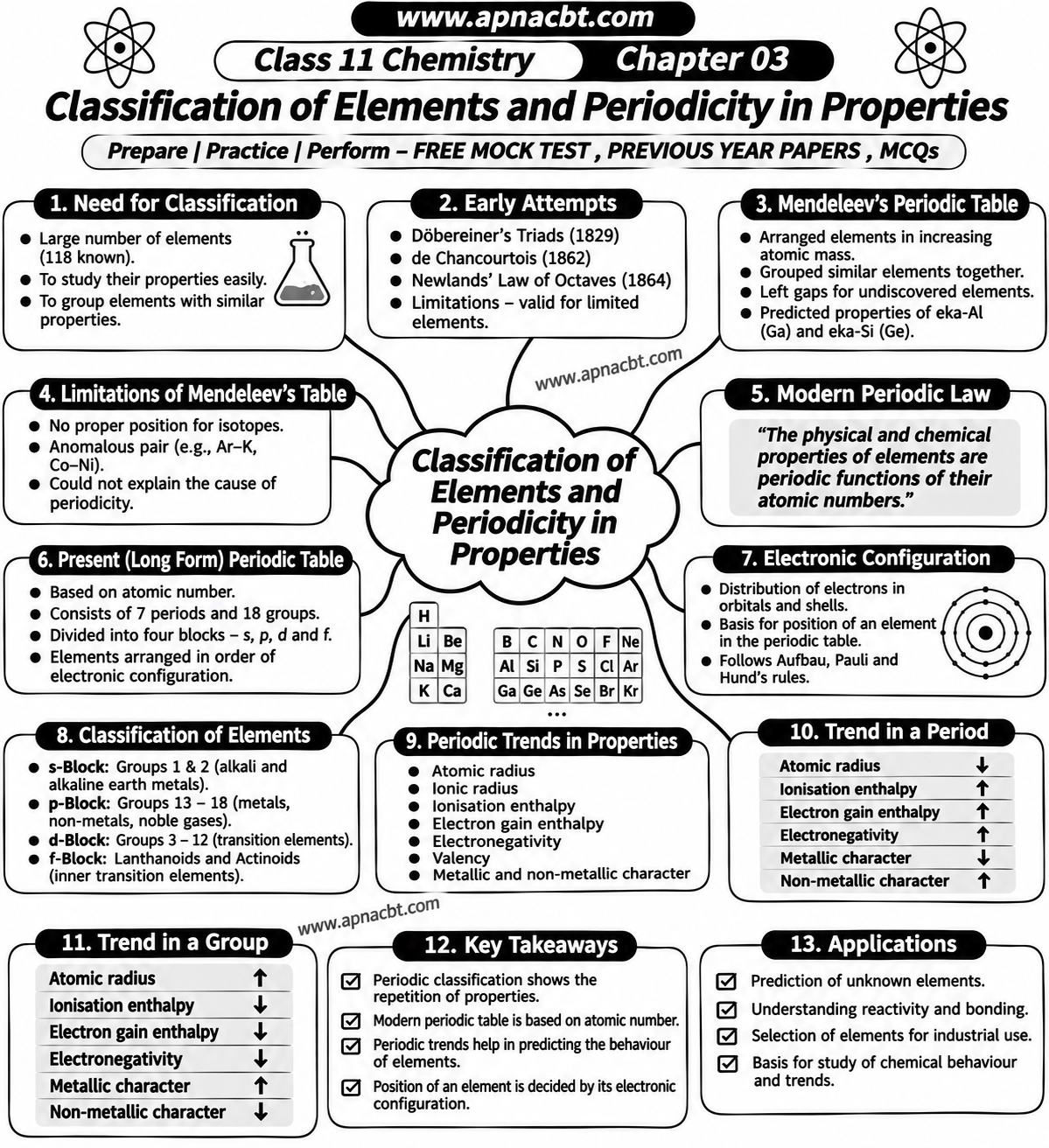
Classification of Elements and Periodicity Class 11 Chemistry – Chapter 03 Mind Map
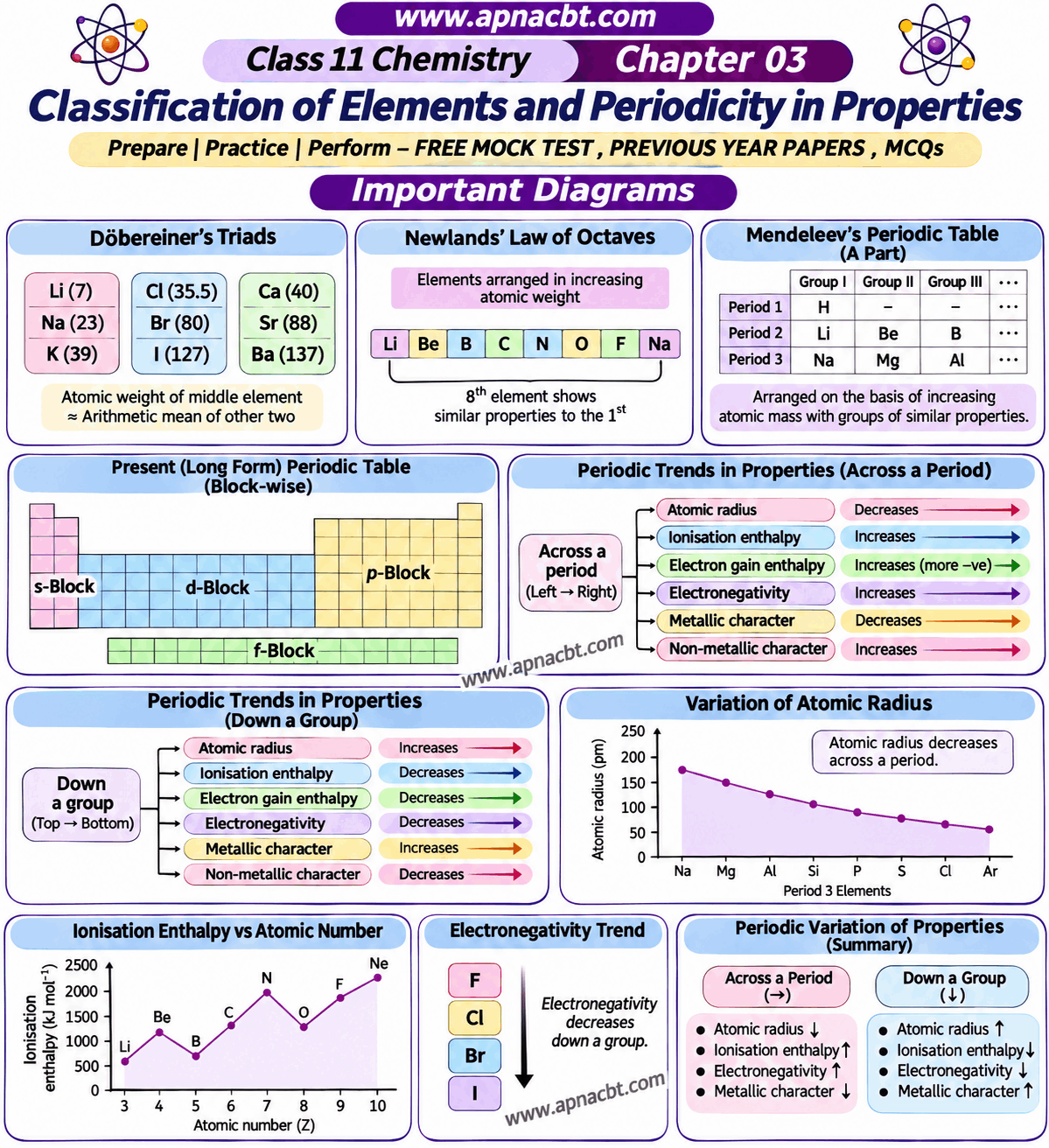
Classification of Elements and Periodicity Class 11 Chemistry – Important Diagrams
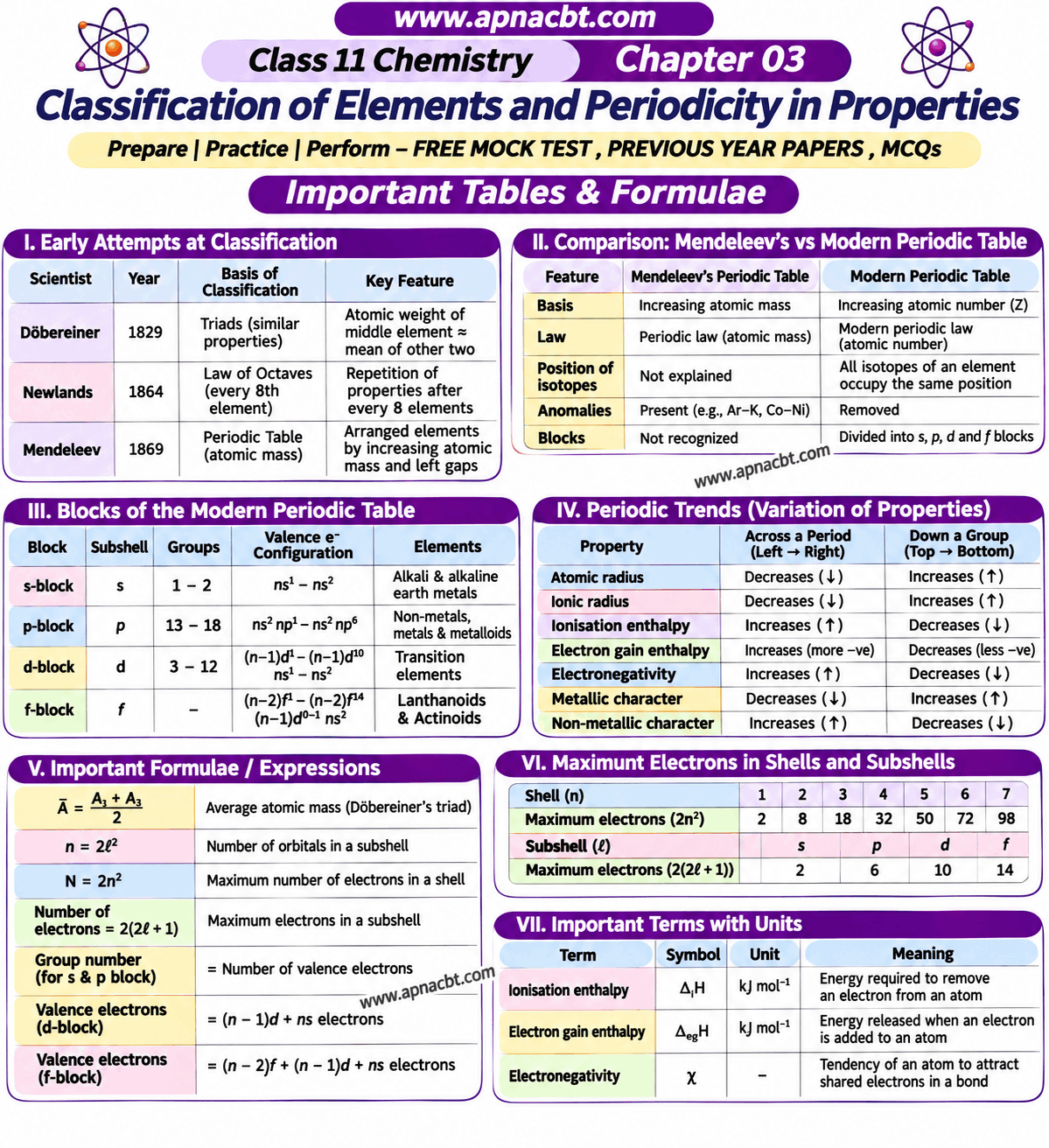
Classification of Elements and Periodicity Class 11 Chemistry – Important Tables and Formulae