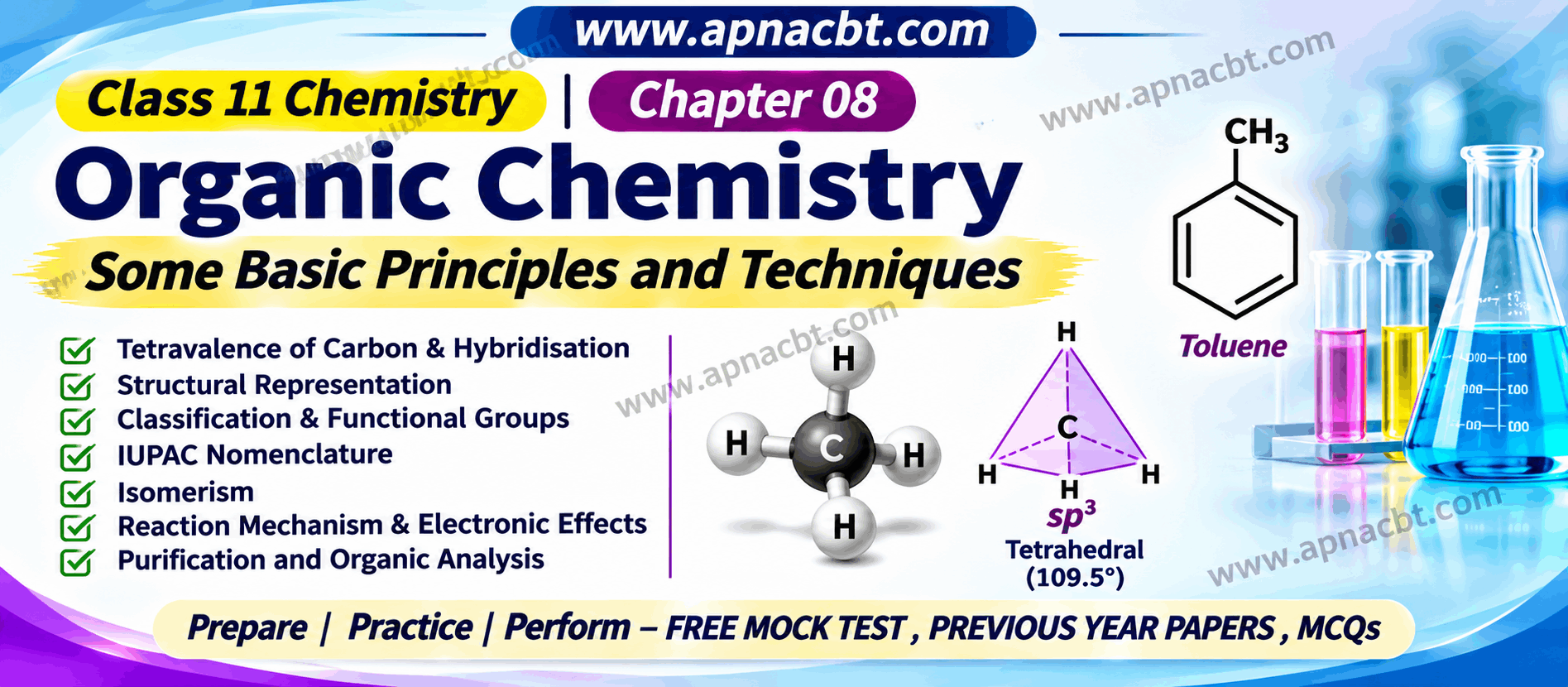
This chapter covers the basic language and principles of organic chemistry: carbon bonding and structure, classification and nomenclature, isomerism, reaction mechanisms, purification, and qualitative and quantitative analysis.
1. Organic Chemistry: Introduction and Scope
Organic chemistry is the branch of chemistry that deals with carbon compounds, particularly hydrocarbons and their derivatives. Carbon forms a very large number of compounds because of its tetravalency and ability to form stable carbon–carbon bonds (catenation).
Why carbon forms so many compounds
- Tetravalency: Carbon has four valence electrons and forms four covalent bonds.
- Catenation: Carbon atoms bond with one another to form straight chains, branched chains and rings.
- Multiple bonding: Carbon forms single, double and triple bonds.
- Stable covalent bonds: Carbon forms stable bonds with carbon, hydrogen, oxygen, nitrogen, sulphur and halogens.
Organic compounds occur in living systems and in materials such as fuels, medicines, polymers, dyes and many industrial products. The chapter develops the language used to represent, classify, name and explain their reactions, and introduces methods used to purify and analyse them.
2. Tetravalence of Carbon, Hybridisation and Shapes
In organic compounds, carbon commonly undergoes sp3, sp2 and sp hybridisation. Hybridisation helps explain the geometry and bond properties around a carbon atom.
| Hybridisation | Orbitals mixed | Geometry | Approx. bond angle | Typical example |
|---|---|---|---|---|
| sp3 | 1 s + 3 p | Tetrahedral | 109.5° | CH4, saturated carbon |
| sp2 | 1 s + 2 p | Trigonal planar | 120° | H2C=CH2 |
| sp | 1 s + 1 p | Linear | 180° | HC≡CH |
The s-character increases in the order sp3 (25%) < sp2 (33.3%) < sp (50%). Greater s-character holds the bonding electrons closer to the nucleus and is associated with shorter, stronger bonds.
Sigma and pi bonds
- A sigma (σ) bond is formed by head-on overlap of orbitals along the internuclear axis. It is generally stronger than a π bond.
- A pi (π) bond is formed by sideways overlap of parallel p orbitals. A double bond contains one σ and one π bond; a triple bond contains one σ and two π bonds.
Hybridisation also influences bond length and bond enthalpy. In comparable carbon–carbon bonds, C≡C is shorter than C=C, which is shorter than C–C.
3. Structural Representation of Organic Compounds
Organic molecules may be represented using complete structural formulae, condensed formulae and bond-line (skeletal) formulae.
- Complete structural formula: Shows atoms and the covalent bonds between them.
- Condensed structural formula: Groups atoms together, for example ethanol as CH3CH2OH.
- Bond-line formula: Carbon atoms are understood at line ends and corners; carbon-bound hydrogen atoms are omitted. Heteroatoms and hydrogens attached to them are shown.
In bond-line structures, each vertex and line end represents a carbon atom unless another atom is written. The number of bonds around each carbon must satisfy its valency.
Three-dimensional representation
- Wedge: A solid wedge represents a bond projecting out of the plane towards the observer.
- Dash: A dashed wedge represents a bond directed behind the plane, away from the observer.
- Normal line: Represents a bond in the plane of the paper.
Molecular models such as framework, ball-and-stick and space-filling models help visualise the three-dimensional arrangement of atoms.
4. Classification of Organic Compounds
Organic compounds are broadly classified according to their carbon skeleton and the presence or nature of rings.
- Acyclic or open-chain (aliphatic) compounds: Straight-chain or branched-chain compounds.
- Cyclic or closed-chain compounds: Compounds containing one or more rings.
Cyclic compounds include:
- Alicyclic compounds: Cyclic compounds that resemble aliphatic compounds in many properties; examples include cyclopropane and cyclohexane.
- Aromatic compounds: Special cyclic compounds such as benzene and its derivatives. Benzenoid compounds contain benzene rings; non-benzenoid aromatic compounds do not contain a benzene ring.
- Heterocyclic compounds: Ring compounds containing atoms other than carbon, such as oxygen, sulphur or nitrogen. Examples include furan, thiophene and pyridine.
Compounds may also be described as homocyclic when the ring contains only carbon atoms, or heterocyclic when at least one ring atom is a heteroatom.
5. Functional Groups and Homologous Series
A functional group is an atom or group of atoms that determines the characteristic chemical reactions of an organic compound. Compounds with the same functional group often show similar chemical properties.
| Class | Functional group | IUPAC prefix / suffix (as applicable) |
|---|---|---|
| Alkane | C–C single bonds | -ane |
| Alkene | C=C | -ene |
| Alkyne | C≡C | -yne |
| Halo compound | –X (F, Cl, Br, I) | fluoro-, chloro-, bromo-, iodo- |
| Alcohol | –OH | hydroxy- / -ol |
| Aldehyde | –CHO | -al |
| Ketone | >C=O | -one |
| Carboxylic acid | –COOH | -oic acid |
| Amine | –NH2 | amino- / -amine |
| Nitrile | –C≡N | cyano- / -nitrile |
| Ether | R–O–R′ | alkoxy- |
| Amide | –CONH2 | -amide |
A homologous series is a family of compounds with the same functional group and general formula, in which successive members differ by a –CH2– unit (a mass difference of 14 u). Members have similar chemical properties and show a gradual change in physical properties.
6. IUPAC Nomenclature: Parent Chain and Alkanes
IUPAC nomenclature provides a systematic method for naming organic compounds. The name is built from a parent (root) name, prefix(es) and suffix(es).
Basic procedure
- Select the longest continuous carbon chain as the parent chain. For compounds with a principal functional group or multiple bond, the parent chain must include it.
- Number the parent chain to give the lowest possible locant to the principal functional group, then multiple bond(s), and then substituents according to the applicable lowest-locant rules.
- Identify and name substituents such as methyl and ethyl; indicate their positions.
- Arrange different substituent prefixes alphabetically. Use di-, tri- and tetra- to show repeated substituents; these multiplicative prefixes are not used for alphabetising.
- Write the complete name with commas between numbers and hyphens between numbers and words.
Hydrocarbons: Saturated hydrocarbons contain only C–C single bonds and are called alkanes. Unsaturated hydrocarbons contain at least one C=C or C≡C bond.
| Number of carbon atoms | Prefix | Alkane | Formula |
|---|---|---|---|
| 1 | meth- | methane | CH4 |
| 2 | eth- | ethane | C2H6 |
| 3 | prop- | propane | C3H8 |
| 4 | but- | butane | C4H10 |
| 5 | pent- | pentane | C5H12 |
| 6 | hex- | hexane | C6H14 |
| 7 | hept- | heptane | C7H16 |
| 8 | oct- | octane | C8H18 |
| 9 | non- | nonane | C9H20 |
| 10 | dec- | decane | C10H22 |
For open-chain alkanes, the general formula is CnH2n+2. An alkyl group is obtained by removing one hydrogen atom from an alkane; its name is formed by replacing -ane with -yl (for example, methane → methyl).
7. IUPAC Nomenclature: Functional Groups and Substituted Benzene
When a compound contains a characteristic functional group, the parent chain is selected and numbered so that the principal functional group receives the lowest possible number. Its suffix is used in the name; other groups are generally written as prefixes.
The priority order shown in the NCERT text for selected groups is:
–COOH > –SO3H > –COOR > –COCl > –CONH2 > –CN > –CHO > >C=O > –OH > –NH2 > C=C > C≡C.
For example, an alcohol suffix is -ol, an aldehyde suffix is -al, a ketone suffix is -one, and a carboxylic acid suffix is -oic acid. When more than one identical functional group is present, di-, tri- and related prefixes are used where appropriate.
Substituted benzene compounds
- For a benzene ring with one substituent, name the substituent followed by benzene (for example, chlorobenzene).
- For two substituents, use locants to indicate their positions. The traditional prefixes o-, m- and p- correspond to 1,2-, 1,3- and 1,4-disubstitution, respectively.
- For three or more substituents, number the ring to obtain the lowest set of locants; write substituent names alphabetically where required.
- Some substituted benzenes have retained common names, such as toluene, phenol and aniline, which may be used as parent names in appropriate nomenclature.
8. Isomerism: Structural and Stereoisomerism
Isomerism is the phenomenon in which two or more compounds have the same molecular formula but different arrangements of atoms or different spatial arrangements.
Structural isomerism
- Chain isomerism: Different arrangements of the carbon skeleton.
- Position isomerism: Same carbon skeleton and functional group, but different positions of a substituent, functional group or multiple bond.
- Functional group isomerism: Same molecular formula but different functional groups, for example an aldehyde and a ketone with the same formula.
- Metamerism: Different alkyl groups on either side of a polyvalent functional group, such as –O– or –NH–.
Stereoisomerism
Stereoisomers have the same connectivity but differ in the spatial arrangement of atoms or groups. The chapter introduces geometrical and optical isomerism as types of stereoisomerism. Geometrical isomerism is associated with restricted rotation, commonly around a carbon–carbon double bond or within a ring.
9. Fundamental Concepts in Organic Reaction Mechanism
An organic reaction may be represented as: Substrate + Reagent → Product(s). The substrate is the organic molecule undergoing reaction; the reagent attacks or interacts with it. A reaction mechanism is the stepwise account of the bond breaking and bond formation, electron movement and intermediates involved in a reaction.
Fission of a covalent bond
- Homolytic cleavage: Each atom takes one electron from the shared pair, producing free radicals. It is represented by single-headed (fish-hook) arrows.
- Heterolytic cleavage: One atom takes both bonding electrons, producing ions (a cation and an anion). It is represented by a double-headed curved arrow.
Reactive intermediates
- Free radical: A species containing an unpaired electron.
- Carbocation: A carbon species bearing a positive charge.
- Carbanion: A carbon species bearing a negative charge.
Carbocations are classified as primary, secondary or tertiary according to the number of carbon groups attached to the positively charged carbon. In the simple alkyl series, stability generally increases from primary to secondary to tertiary due to electron-releasing effects and hyperconjugation. The corresponding order for simple alkyl carbanions is generally opposite.
Nucleophiles and electrophiles
- Nucleophile: An electron-rich species that donates an electron pair to an electron-deficient centre; examples include OH−, CN−, NH3 and H2O.
- Electrophile: An electron-deficient species that accepts an electron pair; examples include H+, NO2+ and electron-deficient carbon centres.
10. Electron Displacement Effects in Covalent Bonds
Electron displacement in covalent bonds influences the reactivity and stability of organic molecules. The chapter discusses inductive effect, resonance effect, electromeric effect and hyperconjugation.
Inductive effect (I effect)
The inductive effect is the permanent displacement of σ-electrons along a carbon chain due to electronegativity differences. It is transmitted through σ bonds and decreases rapidly with distance. Electron-withdrawing groups show a –I effect; electron-releasing groups show a +I effect.
Resonance and resonance effect
When a molecule cannot be adequately represented by a single Lewis structure, two or more canonical (contributing) structures are written. The actual molecule is a resonance hybrid; the canonical structures are not separate, interconverting molecules. Resonance stabilisation arises from electron delocalisation. Groups may show +R (electron donation by resonance) or –R (electron withdrawal by resonance) effects.
Electromeric effect (E effect)
The electromeric effect is a temporary complete transfer of the π-electron pair of a multiple bond to one of the bonded atoms under the influence of an attacking reagent. It disappears when the reagent is removed. It may be described as +E or –E depending on the direction of electron transfer.
Hyperconjugation
Hyperconjugation involves delocalisation of σ-electrons of a C–H bond (usually on a carbon adjacent to a π bond or electron-deficient centre) into an adjacent p orbital or π system. It helps explain the stability of carbocations and substituted alkenes.
11. Types of Organic Reactions
The chapter groups common organic reactions into four broad categories:
- Substitution reaction: An atom or group in a molecule is replaced by another atom or group.
- Addition reaction: Atoms or groups add across a multiple bond, reducing the degree of unsaturation.
- Elimination reaction: Atoms or groups are removed from a molecule, often forming a multiple bond.
- Rearrangement reaction: The carbon skeleton or arrangement of atoms changes to form an isomeric or rearranged product.
The reaction type and mechanism depend on the substrate, reagent and reaction conditions. Curved-arrow notation is used to show the movement of electron pairs; single-headed arrows indicate movement of one electron.
12. Methods of Purification of Organic Compounds
Organic compounds obtained from natural sources or prepared in the laboratory often contain impurities. Purification is necessary before studying their physical and chemical properties.
- Sublimation: Separates a sublimable solid from non-sublimable impurities by converting the solid directly into vapour and then condensing it.
- Crystallisation: Purifies a solid based on differences in solubility in a suitable solvent at different temperatures. The hot saturated solution is cooled; crystals separate and are collected by filtration.
- Simple distillation: Separates a volatile liquid from non-volatile impurities, or liquids with sufficiently different boiling points.
- Fractional distillation: Separates miscible liquids with closer boiling points using a fractionating column and repeated vaporisation–condensation.
- Distillation under reduced pressure: Used for liquids that decompose at or near their normal boiling points; lowering pressure lowers the boiling temperature.
- Steam distillation: Used for steam-volatile, water-immiscible substances. The compound distils with steam at a temperature below its normal boiling point.
- Differential extraction: Transfers a compound between two immiscible solvents in which it has different solubilities, commonly using a separating funnel.
- Chromatography: Separates components based on their different distribution/adsorption between a stationary phase and a mobile phase.
Types of chromatography
Examples include adsorption chromatography (column and thin-layer chromatography) and partition chromatography (including paper chromatography). In TLC, the retention factor is:
Rf = distance travelled by the component / distance travelled by the solvent front
Both distances are measured from the same baseline. Rf is characteristic only under specified experimental conditions.
13. Qualitative Analysis: Detection of Elements
Organic compounds commonly contain carbon and hydrogen and may also contain nitrogen, sulphur, halogens and phosphorus.
Detection of carbon and hydrogen
On heating an organic compound with copper(II) oxide, carbon is oxidised to carbon dioxide and hydrogen to water. Carbon dioxide turns limewater milky; water turns anhydrous copper(II) sulphate blue.
Lassaigne’s test (sodium fusion test)
Covalently bonded nitrogen, sulphur and halogens are converted into water-soluble ionic sodium salts by fusing the organic compound with metallic sodium. The aqueous extract is called Lassaigne’s extract.
- Nitrogen: Sodium fusion converts nitrogen into sodium cyanide. The extract is treated with freshly prepared ferrous sulphate and then acidified; formation of Prussian blue indicates nitrogen.
- Sulphur: Sodium fusion forms sodium sulphide. It may be detected by a violet colour with sodium nitroprusside or a black precipitate of lead sulphide with lead acetate.
- Halogens: The extract is boiled with nitric acid and then treated with silver nitrate. AgCl is white, AgBr is pale yellow and AgI is yellow. Nitric acid removes interfering cyanide and sulphide ions.
- Nitrogen and sulphur together: Sodium fusion may form sodium thiocyanate; treatment with ferric ions gives a blood-red complex.
- Phosphorus: The compound is oxidised to phosphate and treated with ammonium molybdate in nitric acid; a yellow precipitate indicates phosphorus.
14. Quantitative Analysis: Estimation of Elements
Quantitative analysis determines the percentage composition of elements in an organic compound. The NCERT chapter describes the following methods and relations.
Carbon and hydrogen (combustion method)
A known mass of compound is heated with copper(II) oxide. The CO2 formed is absorbed in KOH and water is absorbed in anhydrous calcium chloride.
% C = (12 × mass of CO2 × 100) / (44 × mass of sample)
% H = (2 × mass of H2O × 100) / (18 × mass of sample)
Nitrogen
- Dumas method: Nitrogen in the compound is converted into N2; its volume is measured and corrected to STP. At STP, 22,400 mL of N2 weighs 28 g.
- Kjeldahl method: Nitrogen is converted into ammonium sulphate by digestion with concentrated sulphuric acid. On treatment with alkali, ammonia is liberated, absorbed in a known amount of standard acid and estimated by titration. The method is not applicable to all forms of nitrogen, such as nitro and azo groups and ring nitrogen.
Halogens (Carius method)
The compound is heated with fuming nitric acid and silver nitrate in a sealed Carius tube. Halogen is converted into silver halide (AgX), which is filtered, dried and weighed.
% halogen = (atomic mass of X × mass of AgX × 100) / (molar mass of AgX × mass of sample)
Sulphur
Sulphur is oxidised to sulphuric acid and precipitated as barium sulphate.
% S = (32 × mass of BaSO4 × 100) / (233 × mass of sample)
Phosphorus
Phosphorus is oxidised to phosphate and precipitated as magnesium ammonium phosphate, which on ignition gives magnesium pyrophosphate (Mg2P2O7). The mass of this precipitate is used to calculate phosphorus.
Oxygen
Oxygen is generally estimated by difference: % O = 100 − sum of the percentages of all other elements determined in the compound.
15. Short-Answer Questions – 30 Questions
Questions
- What is catenation?
- Why is carbon tetravalent?
- State the geometry and bond angle of an sp³-hybridised carbon.
- What is the geometry of an sp²-hybridised carbon?
- What is the geometry of an sp-hybridised carbon?
- Differentiate between sigma and pi bonds.
- What is a bond-line formula?
- What does a solid wedge represent?
- Define a functional group.
- What is a homologous series?
- What is an alkyl group?
- Differentiate between saturated and unsaturated hydrocarbons.
- What are heterocyclic compounds?
- What is IUPAC nomenclature?
- Define chain isomerism.
- What is functional group isomerism?
- What is homolytic bond cleavage?
- What is heterolytic bond cleavage?
- Define a nucleophile.
- Define an electrophile.
- What is the inductive effect?
- What is resonance?
- What is the electromeric effect?
- What is hyperconjugation?
- Name four broad types of organic reactions in this chapter.
- What is crystallisation used for?
- When is fractional distillation preferred?
- What is the stationary phase in chromatography?
- What does a positive Lassaigne’s test for nitrogen produce?
- Write the expression for Rf in thin-layer chromatography.
Detailed Answers
- What is catenation?
Catenation is the ability of an element to form covalent bonds with atoms of the same element, producing chains or rings. Carbon shows extensive catenation because C–C bonds are stable. - Why is carbon tetravalent?
Carbon has four electrons in its valence shell and completes its octet by sharing four pairs of electrons, forming four covalent bonds. - State the geometry and bond angle of an sp³-hybridised carbon.
The geometry is tetrahedral and the ideal bond angle is approximately 109.5°. - What is the geometry of an sp²-hybridised carbon?
It is trigonal planar, with bond angles of approximately 120°. - What is the geometry of an sp-hybridised carbon?
It is linear, with a bond angle of 180°. - Differentiate between sigma and pi bonds.
A sigma bond is formed by head-on overlap along the internuclear axis. A pi bond is formed by sideways overlap of parallel orbitals. - What is a bond-line formula?
It is a skeletal representation in which carbon atoms are understood at line ends and vertices, and carbon-bound hydrogen atoms are generally omitted. - What does a solid wedge represent?
A solid wedge represents a bond projecting out of the plane of the paper towards the observer. - Define a functional group.
A functional group is an atom or group of atoms responsible for the characteristic chemical reactions of an organic compound. - What is a homologous series?
It is a family of organic compounds with the same functional group and general formula, in which successive members differ by –CH₂–. - What is an alkyl group?
An alkyl group is formed by removing one hydrogen atom from an alkane; for example, CH₄ gives –CH₃, the methyl group. - Differentiate between saturated and unsaturated hydrocarbons.
Saturated hydrocarbons contain only C–C single bonds. Unsaturated hydrocarbons contain at least one C=C or C≡C bond. - What are heterocyclic compounds?
They are cyclic compounds whose ring contains one or more atoms other than carbon, such as N, O or S. - What is IUPAC nomenclature?
It is a systematic method of naming chemical compounds according to rules established by the International Union of Pure and Applied Chemistry. - Define chain isomerism.
Chain isomerism occurs when compounds have the same molecular formula but different arrangements of the carbon skeleton. - What is functional group isomerism?
It is isomerism in which compounds have the same molecular formula but different functional groups. - What is homolytic bond cleavage?
It is bond fission in which each bonded atom takes one electron from the shared pair, forming free radicals. - What is heterolytic bond cleavage?
It is bond fission in which one atom takes both bonding electrons, forming a cation and an anion. - Define a nucleophile.
A nucleophile is an electron-rich species that donates an electron pair to an electron-deficient centre. - Define an electrophile.
An electrophile is an electron-deficient species that accepts an electron pair from a nucleophile. - What is the inductive effect?
It is the permanent displacement of sigma electrons along a chain due to electronegativity differences; its influence decreases with distance. - What is resonance?
Resonance is the description of a molecule by two or more canonical structures; the actual molecule is a resonance hybrid with delocalised electrons. - What is the electromeric effect?
It is the temporary complete transfer of a pi-electron pair of a multiple bond under the influence of an attacking reagent. - What is hyperconjugation?
It is delocalisation of sigma electrons, usually from a C–H bond, into an adjacent p orbital or pi system. - Name four broad types of organic reactions in this chapter.
Substitution, addition, elimination and rearrangement reactions. - What is crystallisation used for?
It is used to purify solids based on differences in their solubility in a suitable solvent at different temperatures. - When is fractional distillation preferred?
It is preferred for separating miscible liquids whose boiling points are relatively close. - What is the stationary phase in chromatography?
It is the phase that remains fixed while the mobile phase moves over or through it. - What does a positive Lassaigne’s test for nitrogen produce?
A Prussian blue colour or precipitate after the appropriate treatment of the sodium fusion extract. - Write the expression for Rf in thin-layer chromatography.
Rf = distance travelled by the component from the baseline divided by distance travelled by the solvent front from the same baseline.
16. Long-Answer Questions – 15 Questions
Questions
- Explain the tetravalency of carbon and the three common types of hybridisation.
- Explain sigma and pi bond formation in single, double and triple bonds.
- Describe the main structural representations of organic compounds.
- Classify organic compounds with suitable examples.
- Explain functional groups and homologous series.
- Describe a systematic method for naming branched-chain alkanes by IUPAC rules.
- Explain how organic compounds containing functional groups are named.
- Explain structural isomerism and its main types.
- Differentiate homolytic and heterolytic cleavage and describe the intermediates formed.
- Explain nucleophiles and electrophiles with examples.
- Explain inductive effect, resonance effect, electromeric effect and hyperconjugation.
- Describe the important methods used for purification of organic compounds.
- Explain chromatography and the principle of thin-layer chromatography.
- Describe Lassaigne’s test for the detection of nitrogen, sulphur and halogens.
- Explain the principles and key formulae used in quantitative estimation of carbon, hydrogen, nitrogen, halogens and sulphur.
Detailed Answers
- Explain the tetravalency of carbon and the three common types of hybridisation.
Carbon has four valence electrons and forms four covalent bonds. In sp³ hybridisation, one s and three p orbitals mix to form four equivalent sp³ orbitals arranged tetrahedrally (about 109.5°), as in methane. In sp² hybridisation, one s and two p orbitals form three coplanar orbitals at about 120°, leaving one unhybridised p orbital for π bonding, as in ethene. In sp hybridisation, one s and one p orbital form two orbitals arranged linearly at 180°, leaving two unhybridised p orbitals, as in ethyne. - Explain sigma and pi bond formation in single, double and triple bonds.
A sigma bond forms by head-on overlap along the internuclear axis. A pi bond forms by sideways overlap of parallel p orbitals. A single bond consists of one sigma bond; a double bond consists of one sigma and one pi bond; a triple bond consists of one sigma and two pi bonds. Sigma bonds permit greater freedom of rotation than pi bonds, because rotation would disrupt sideways overlap. - Describe the main structural representations of organic compounds.
Complete structural formulae show atoms and bonds explicitly. Condensed formulae group atoms, for example CH₃CH₂OH. Bond-line formulae show the carbon skeleton as lines; vertices and ends represent carbon atoms, and carbon-bound hydrogens are omitted unless needed for clarity. Three-dimensional wedge-dash notation uses solid wedges for bonds towards the observer, dashed wedges for bonds away, and ordinary lines for bonds in the plane. Molecular models can also represent molecular shape. - Classify organic compounds with suitable examples.
Open-chain or acyclic compounds may be straight or branched. Closed-chain or cyclic compounds contain rings. Cyclic compounds include alicyclic compounds such as cyclohexane, aromatic compounds such as benzene and heterocyclic compounds such as furan, thiophene and pyridine. Rings containing only carbon are homocyclic; rings containing heteroatoms are heterocyclic. Aromatic compounds may be benzenoid or non-benzenoid. - Explain functional groups and homologous series.
A functional group is the atom or group responsible for characteristic reactions, such as –OH in alcohols, –CHO in aldehydes and –COOH in carboxylic acids. A homologous series is a family with the same functional group and general formula. Successive members differ by –CH₂–, so their molar masses differ by 14 u. They show similar chemical properties and gradual changes in physical properties. - Describe a systematic method for naming branched-chain alkanes by IUPAC rules.
Choose the longest continuous carbon chain as the parent alkane. Number it from the end that gives substituents the lowest possible locants. Identify each alkyl substituent and its position. If the same substituent occurs more than once, use di-, tri- or tetra- and list all locants. Arrange different substituents alphabetically, ignoring multiplicative prefixes for alphabetisation. Write locants with commas and separate locants from words with hyphens; finish with the parent alkane name. - Explain how organic compounds containing functional groups are named.
Identify the principal functional group and select the longest parent chain containing it. Number the chain so that the principal functional group receives the lowest possible locant. Use the appropriate suffix for the principal group and prefixes for other substituents or functional groups. Indicate positions of multiple bonds and substituents. When more than one identical group occurs, use suitable multiplicative prefixes. The functional-group priority determines which group is expressed as the suffix. - Explain structural isomerism and its main types.
Structural isomers have the same molecular formula but different connectivity. Chain isomerism involves different carbon skeletons; position isomerism involves different positions of a functional group, substituent or multiple bond; functional-group isomerism involves different functional groups; metamerism arises from different alkyl groups on either side of a polyvalent atom or group. These differences can lead to different physical and chemical properties. - Differentiate homolytic and heterolytic cleavage and describe the intermediates formed.
In homolytic cleavage, each atom receives one electron from the bond and free radicals form; the movement is shown with single-headed fish-hook arrows. In heterolytic cleavage, one atom receives both bonding electrons and ions form; a double-headed curved arrow shows the electron pair movement. Important intermediates include free radicals, carbocations and carbanions. Their stability depends on structure and electron-displacement effects. - Explain nucleophiles and electrophiles with examples.
Nucleophiles are electron-rich species that donate an electron pair to an electron-deficient centre. Examples include OH⁻, CN⁻, NH₃ and H₂O. Electrophiles are electron-deficient species that accept an electron pair; examples include H⁺, NO₂⁺ and polarised carbon atoms in suitable substrates. In a polar organic reaction, the nucleophile attacks an electrophilic centre and forms a new covalent bond. - Explain inductive effect, resonance effect, electromeric effect and hyperconjugation.
The inductive effect is a permanent displacement of σ electrons through a chain due to electronegativity differences and decreases with distance. Resonance describes electron delocalisation using canonical structures; the actual molecule is a stabilised resonance hybrid. The electromeric effect is a temporary complete shift of π electrons under the influence of an attacking reagent. Hyperconjugation is delocalisation of σ electrons, commonly from an adjacent C–H bond, into a p orbital or π system. These effects influence stability and reactivity. - Describe the important methods used for purification of organic compounds.
Sublimation separates sublimable solids from non-sublimable impurities. Crystallisation uses temperature-dependent solubility to obtain pure crystals. Simple distillation separates a volatile liquid from non-volatile impurities or liquids with sufficiently different boiling points. Fractional distillation uses a fractionating column for liquids with closer boiling points. Reduced-pressure distillation lowers boiling temperature for heat-sensitive liquids. Steam distillation separates steam-volatile, water-immiscible compounds. Differential extraction uses different solubilities in immiscible solvents. Chromatography separates components by their distribution between stationary and mobile phases. - Explain chromatography and the principle of thin-layer chromatography.
Chromatography separates components because they distribute differently between a stationary phase and a mobile phase. In adsorption chromatography, components are adsorbed to different extents on a solid adsorbent. In TLC, a thin layer of adsorbent is coated on a plate; a sample spot is placed near the baseline and the solvent rises by capillary action. Components travel different distances. The retention factor is Rf = distance travelled by component / distance travelled by solvent front, both measured from the baseline. - Describe Lassaigne’s test for the detection of nitrogen, sulphur and halogens.
Fuse the organic compound with sodium so covalently bonded elements are converted into water-soluble sodium salts, then prepare the aqueous extract. For nitrogen, sodium cyanide formed in the fusion gives Prussian blue after treatment with ferrous sulphate and acidification. For sulphur, sodium sulphide gives a violet colour with sodium nitroprusside or black PbS with lead acetate. For halogens, acidify and boil the extract with nitric acid, then add AgNO₃: AgCl is white, AgBr pale yellow and AgI yellow. Nitric acid removes interfering cyanide and sulphide ions. - Explain the principles and key formulae used in quantitative estimation of carbon, hydrogen, nitrogen, halogens and sulphur.
Carbon and hydrogen are estimated by combustion: CO₂ is absorbed in KOH and water in anhydrous CaCl₂. %C = 12 × mass CO₂ × 100/(44 × sample mass); %H = 2 × mass H₂O × 100/(18 × sample mass). Nitrogen is estimated by Dumas or Kjeldahl methods. In Dumas, nitrogen gas volume is corrected to STP; 22,400 mL N₂ at STP weighs 28 g. In Kjeldahl, nitrogen is converted to ammonium sulphate, ammonia is liberated with alkali and measured by titration; the method has limitations for nitro, azo and some ring nitrogen. Halogens are estimated by Carius method as AgX: %X = atomic mass X × mass AgX × 100/(molar mass AgX × sample mass). Sulphur is precipitated as BaSO₄: %S = 32 × mass BaSO₄ × 100/(233 × sample mass).
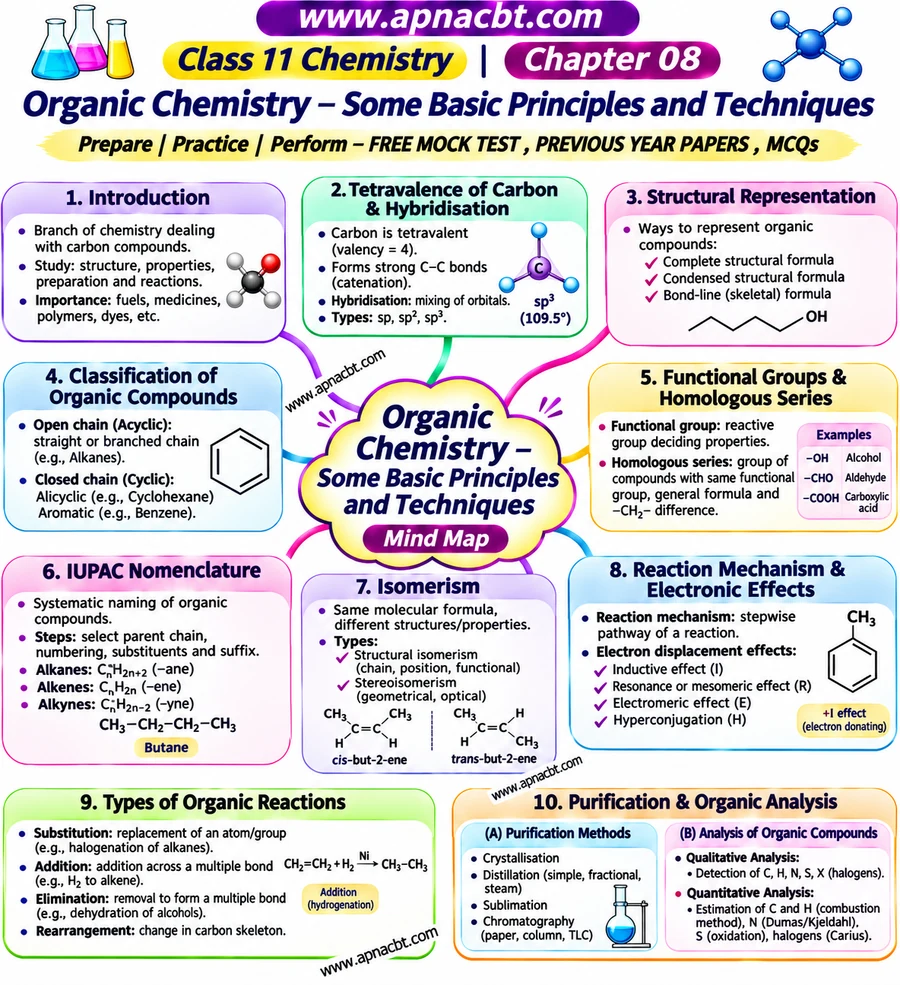
Organic Chemistry Class 11 – Basic Principles and Techniques Mind Map
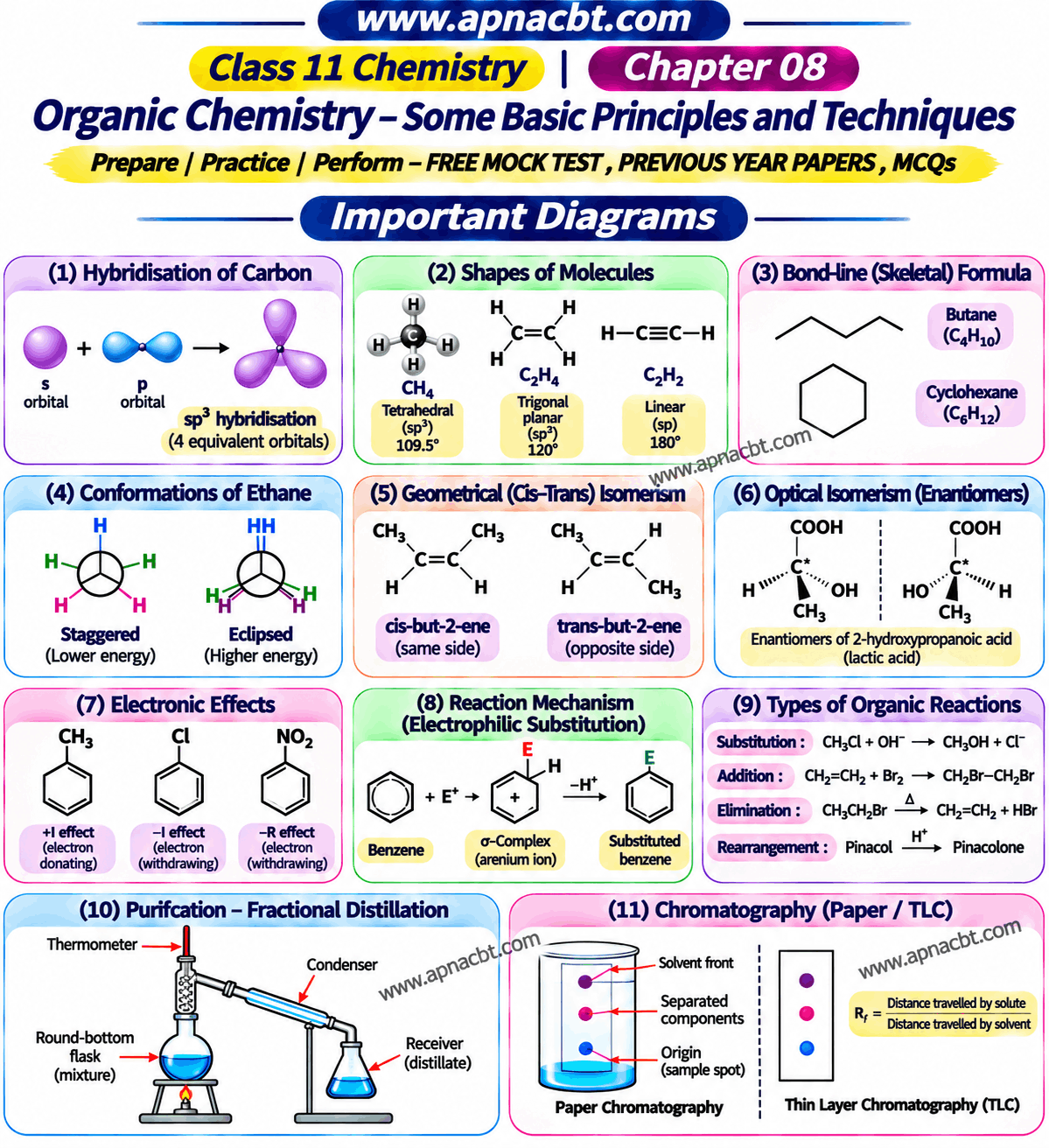
Organic Chemistry Class 11 – Important Diagrams
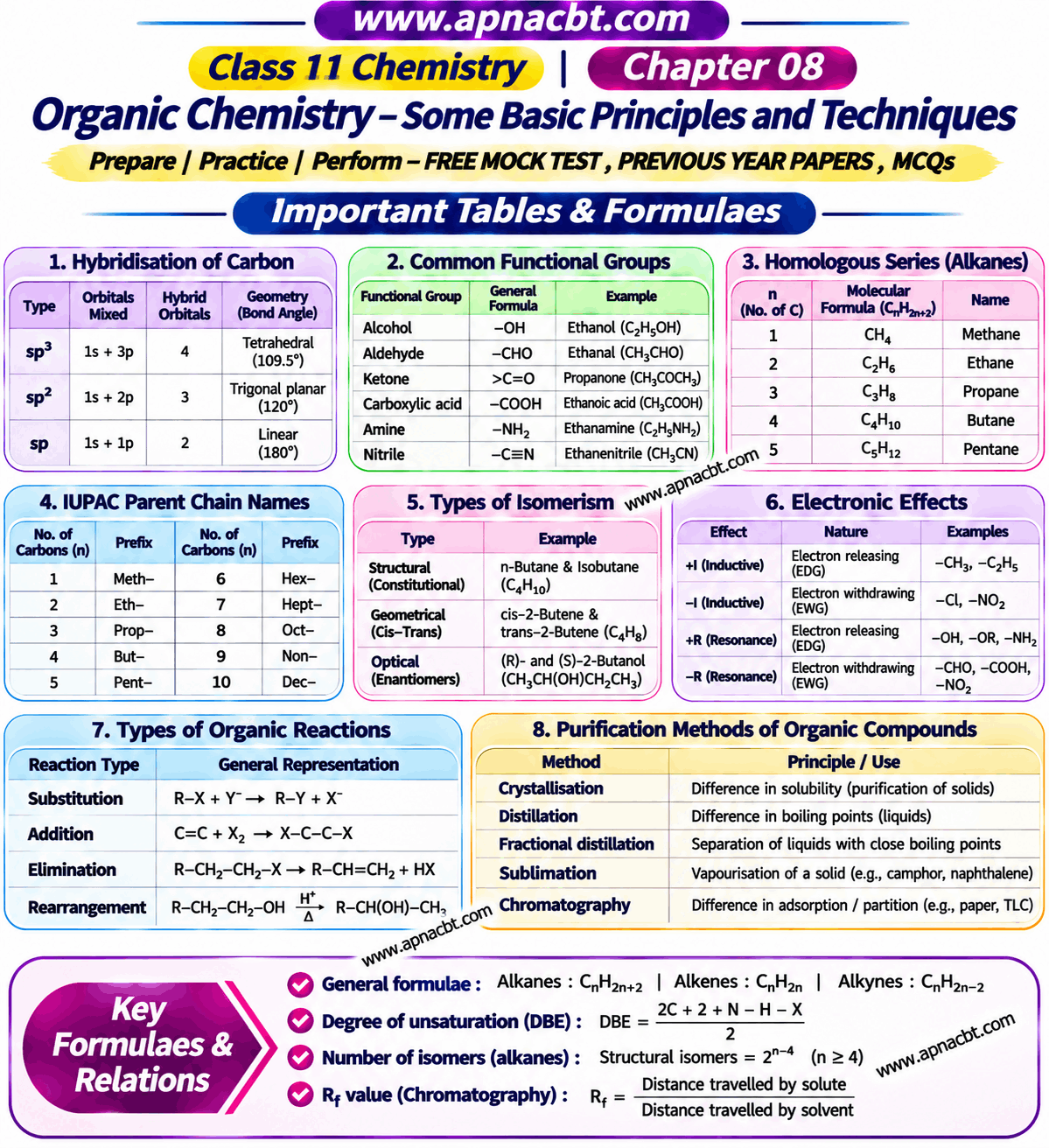
Organic Chemistry Class 11 – Important Tables and Formulae