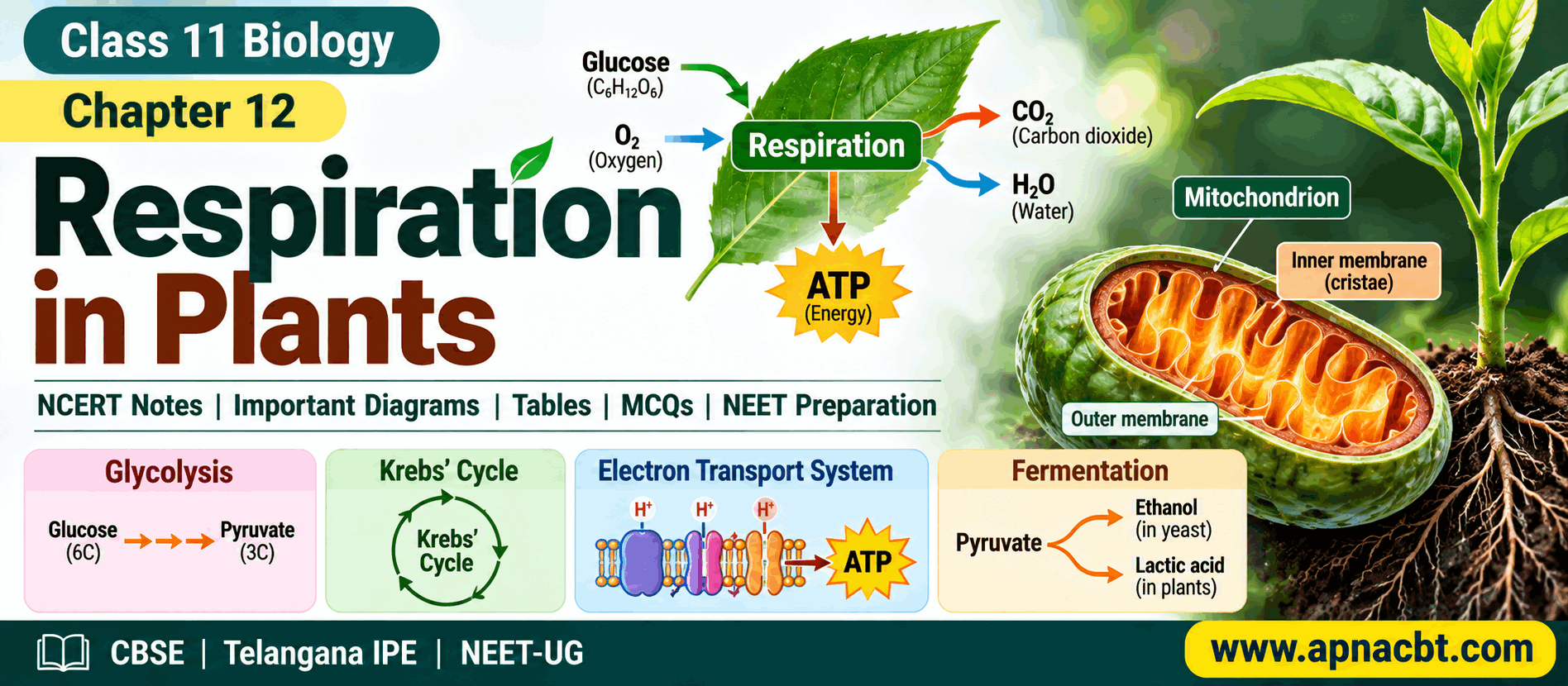
Respiration in Plants
NCERT Biology | Class 11 | CBSE • Telangana IPE • NEET-UG
1. Overview of Plant Respiration
All living organisms require energy for absorption, transport, movement, growth and reproduction. Plants prepare food by photosynthesis, but the energy stored in food becomes available to cells through cellular respiration.
Respiration is an enzymatically controlled process involving the step-wise oxidative breakdown of food substances inside living cells. Energy is released gradually and trapped mainly as ATP.
Overall aerobic equation: C6H12O6 + 6O2 → 6CO2 + 6H2O + 686 kcal (about 2870 kJ).
Plants have no specialised respiratory organs. Gaseous exchange occurs by diffusion through stomata, lenticels and epiblema cells. Interconnected air spaces in loose parenchyma facilitate gas exchange.
Respiration and combustion
| Respiration | Combustion |
|---|---|
| Biochemical, enzyme-controlled | Physico-chemical, non-enzymatic |
| Energy released stepwise | Energy released in one step |
| Energy largely conserved in ATP | ATP is not formed |
| Temperature remains controlled | High temperature is produced |
| Intermediates are formed | Intermediates are not formed |
| Light released in very few cases | Light commonly produced |
2. Respiratory Substrates and Protoplasmic Respiration
Respiratory substrates are organic substances oxidised or broken down in cells to release energy. The common substrates are carbohydrates, fats, proteins and organic acids.
- Carbohydrates: Glucose is the most common respiratory substrate. In plants it may be supplied from stored starch.
- Fats: Important in oily seeds such as castor. Fats split into glycerol and fatty acids. Glycerol enters glycolysis as a triose-phosphate intermediate; fatty acids are converted to acetyl-CoA and enter the Krebs’ cycle.
- Proteins: Used less commonly, for example during germination of protein-rich seeds or when other substrates are unavailable. Proteins are hydrolysed to amino acids; deamination produces carbon skeletons that enter respiration as organic-acid intermediates.
- Organic acids: May also be used as respiratory substrates and enter the pathway at different points.
Respiration using proteins as substrates is called protoplasmic respiration. Respiration using carbohydrates and fats is described in the source as floating respiration. Protoplasmic respiration cannot continue for long because it depletes structural and functional proteins and may release toxic ammonia.
3. Respiratory Quotient (RQ)
Respiratory quotient (RQ) is the ratio of the volume of carbon dioxide evolved to the volume of oxygen absorbed during respiration over a given period.
RQ = Volume of CO2 evolved ÷ Volume of O2 absorbed
| RQ | Substrate / condition | Key point |
|---|---|---|
| 1 | Carbohydrates | Aerobic oxidation |
| About 0.7 | Fats | Common fats; fatty seed germination |
| About 0.9 | Proteins / peptones | Approximate value |
| Zero | Some succulent tissues | CO2 is retained/used in carbon fixation in the described condition |
| More than 1 | Organic acids | Relatively more CO2 is evolved |
| Infinity | Anaerobic respiration | O2 consumption is zero while CO2 may be evolved |
Significance: RQ helps identify the respiratory substrate, indicates the type of respiration and gives information about transformations of food materials. A respirometer measures RQ and rate of respiration; Ganong’s respirometer is a commonly cited example.
4. Types of Respiration
Aerobic respiration
Complete oxidation of organic food in the presence of oxygen, producing CO2, water and energy. The major stages are glycolysis, link reaction, Krebs’ cycle and electron transport / oxidative phosphorylation.
Anaerobic respiration
Occurs without oxygen as terminal oxidant. The substrate is incompletely broken down and much less energy is released. It occurs in some microorganisms and in plant tissues under oxygen deficiency, such as waterlogged roots.
| Aerobic | Anaerobic |
|---|---|
| Oxygen is used | Oxygen is not used |
| Complete oxidation | Incomplete breakdown |
| CO2 and water are end products | Products depend on pathway; may include ethanol and CO2 |
| High energy yield | Very low energy yield |
| Krebs’ cycle and ETS operate | Usual aerobic Krebs’ cycle and ETS route is not followed |
Glycolysis is common to aerobic and anaerobic pathways. When oxygen is available, pyruvate can enter aerobic respiration; in its absence fermentation can regenerate NAD+.
5. Glycolysis: EMP Pathway
Glycolysis converts one six-carbon glucose molecule into two three-carbon pyruvate molecules. It occurs in the cytoplasm and does not directly require oxygen. It is called the EMP pathway after Embden, Meyerhof and Parnas.
Phases
- Preparatory / energy-investment phase: Glucose is phosphorylated and rearranged; two ATP are used.
- Pay-off phase: The triose molecules are oxidised and converted to pyruvate; ATP and NADH are produced.
Net yield per glucose
| Product | Net amount |
|---|---|
| Pyruvate | 2 |
| ATP | 2 (4 formed − 2 used) |
| NADH | 2 |
ATP is consumed in early phosphorylation steps. ATP is generated by substrate-level phosphorylation during conversion of 1,3-bisphosphoglycerate to 3-phosphoglycerate and phosphoenolpyruvate to pyruvate. NADH is formed during oxidation of glyceraldehyde-3-phosphate.
6. Oxidative Decarboxylation of Pyruvate (Link Reaction)
Under aerobic conditions, pyruvate formed in the cytoplasm enters the mitochondrial matrix. It undergoes oxidative decarboxylation to form acetyl-CoA, linking glycolysis with the Krebs’ cycle.
Pyruvate + CoA + NAD+ → Acetyl-CoA + CO2 + NADH
For each glucose, two pyruvate molecules are formed; therefore, the link reaction produces two acetyl-CoA, two CO2 and two NADH.
7. Krebs’ Cycle / Citric Acid Cycle / TCA Cycle
The Krebs’ cycle occurs in the mitochondrial matrix. Acetyl-CoA (two-carbon) combines with oxaloacetic acid (OAA, four-carbon) to form citrate (six-carbon). A series of reactions regenerates OAA.
- Acetyl-CoA + OAA → citrate.
- Citrate is rearranged to isocitrate.
- Isocitrate is oxidatively decarboxylated to α-ketoglutarate, releasing CO2 and producing NADH.
- α-Ketoglutarate is converted to succinyl-CoA, releasing CO2 and producing NADH.
- Succinyl-CoA is converted to succinate; substrate-level phosphorylation produces ATP/GTP.
- Succinate is oxidised to fumarate, producing FADH2.
- Fumarate is hydrated to malate.
- Malate is oxidised to regenerate OAA, producing NADH.
Yield per turn (per acetyl-CoA)
| Product | Quantity |
|---|---|
| NADH | 3 |
| FADH2 | 1 |
| ATP / GTP | 1 |
| CO2 | 2 |
One glucose produces two acetyl-CoA, so the cycle turns twice: 6 NADH, 2 FADH2, 2 ATP/GTP and 4 CO2.
8. Electron Transport System (ETS) and Oxidative Phosphorylation
The electron transport system is located on the inner mitochondrial membrane. Electrons from NADH and FADH2 pass through carriers. The released energy pumps protons across the membrane, creating an electrochemical gradient.
- Complex I: NADH dehydrogenase; transfers electrons from NADH to ubiquinone.
- Complex II: Succinate dehydrogenase; transfers electrons from FADH2 to ubiquinone.
- Ubiquinone (CoQ): Mobile carrier transferring electrons to Complex III.
- Complex III: Cytochrome bc1 complex; transfers electrons to cytochrome c.
- Cytochrome c: Mobile carrier transferring electrons to Complex IV.
- Complex IV: Cytochrome c oxidase; transfers electrons to oxygen, forming water.
- ATP synthase (Complex V): Allows protons to flow back and uses the energy to synthesise ATP.
Oxidative phosphorylation is ATP formation using energy released during oxidation of reduced coenzymes through the ETS. ATP synthase has an F0 membrane component that forms the proton channel and an F1 component that catalyses ATP synthesis. Oxygen is the final electron acceptor in aerobic respiration.
9. ATP Yield and Net Gain in Aerobic Respiration
ATP is formed directly by substrate-level phosphorylation in glycolysis and the Krebs’ cycle, and through oxidative phosphorylation in the ETS.
Traditional theoretical accounting
| Stage | Products per glucose | Traditional ATP equivalent |
|---|---|---|
| Glycolysis | 2 ATP + 2 NADH | 2 + 6 = 8 |
| Link reaction | 2 NADH | 6 |
| Krebs’ cycle (two turns) | 2 ATP + 6 NADH + 2 FADH2 | 2 + 18 + 4 = 24 |
| Total (traditional convention) | 38 ATP |
Important: This is a simplified theoretical calculation using the traditional assumptions (3 ATP per NADH and 2 ATP per FADH2). Actual ATP yield in eukaryotic cells can be lower and is not a fixed universal number. Follow the convention specified in the question or textbook context.
Assumptions
- Pathway reactions proceed sequentially and in an orderly manner.
- Glycolytic NADH is transferred into mitochondria.
- Intermediates are not withdrawn for biosynthesis.
- All NADH and FADH2 are oxidised through ETS.
- ATP synthesis is efficiently coupled to electron transport.
10. Fermentation
Fermentation is an anaerobic pathway in which pyruvate formed during glycolysis is converted into ethanol or lactic acid. The ETS does not operate. NADH is oxidised to regenerate NAD+, allowing glycolysis to continue.
Alcoholic fermentation
- Pyruvate is decarboxylated to acetaldehyde, releasing CO2; enzyme: pyruvate decarboxylase.
- Acetaldehyde is reduced to ethanol by NADH; enzyme: alcohol dehydrogenase. NAD+ is regenerated.
It occurs in yeast and some fungi and bacteria. CO2 released during fermentation makes bread dough rise and become spongy.
Lactic acid fermentation
Pyruvate is reduced directly to lactate by lactate dehydrogenase, using NADH and regenerating NAD+. It occurs in lactic acid bacteria such as Lactobacillus and in animal muscle cells when oxygen supply is insufficient.
Why is energy yield low?
- Glucose is incompletely oxidised.
- Organic end products retain chemical energy.
- ETS and oxidative phosphorylation are absent.
- NADH is used to regenerate NAD+.
Net ATP gain in fermentation is the 2 ATP formed during glycolysis per glucose.
11. Amphibolic Pathway and Integration of Respiratory Substrates
The respiratory pathway is called an amphibolic pathway because it participates in both catabolism (breakdown) and anabolism (synthesis).
Entry of fats
Fats split into glycerol and fatty acids. Glycerol is converted into a glycolytic intermediate (PGAL / glyceraldehyde-3-phosphate), while fatty acids are converted to acetyl-CoA and enter the Krebs’ cycle.
Entry of proteins
Proteins are hydrolysed into amino acids. After deamination, carbon skeletons can enter as pyruvate or Krebs’ cycle intermediates such as oxaloacetate and α-ketoglutarate.
Intermediates in biosynthesis
- Acetyl-CoA supports synthesis of fatty acids, steroids, terpenes, aromatic compounds and carotenoids.
- α-Ketoglutarate can form glutamate by amination.
- Oxaloacetate can form aspartate by amination.
- Succinyl-CoA contributes to synthesis of cytochromes and chlorophyll.
- Respiratory intermediates can be withdrawn to synthesise carbohydrates, fats and proteins.
Thus, respiration supplies both energy and carbon skeletons for biosynthesis.
12. High-Yield Revision Tables and Key Facts
| Feature | Glycolysis | Krebs’ cycle |
|---|---|---|
| Location | Cytoplasm | Mitochondrial matrix |
| Main event | Glucose → 2 pyruvate | Acetyl-CoA oxidised; OAA regenerated |
| Direct ATP/GTP per glucose | Net 2 ATP | 2 ATP/GTP |
| Reduced coenzymes per glucose | 2 NADH | 6 NADH + 2 FADH2 |
| Fermentation step | Conversion | Enzyme |
|---|---|---|
| Alcoholic 1 | Pyruvate → acetaldehyde + CO2 | Pyruvate decarboxylase |
| Alcoholic 2 | Acetaldehyde → ethanol | Alcohol dehydrogenase |
| Lactic | Pyruvate → lactate | Lactate dehydrogenase |
Must-remember facts
- Glycolysis occurs in cytoplasm and is common to aerobic and anaerobic respiration.
- Net glycolytic yield: 2 ATP and 2 NADH per glucose.
- Krebs’ cycle occurs in the mitochondrial matrix.
- FADH2 forms during succinate → fumarate.
- Oxygen is the final electron acceptor in aerobic ETS.
- ATP synthase is Complex V.
- RQ = CO2 evolved / O2 absorbed.
- The respiratory pathway is amphibolic.
12. Short-Answer Questions (30)
Attempt all questions first. Answers are listed after the complete set of questions.
- Define respiration.
- What are respiratory substrates?
- Name the most common respiratory substrate.
- Define respiratory quotient (RQ).
- What is the RQ value for carbohydrates?
- Give the approximate RQ values for fats and proteins.
- Why may RQ be zero in succulent plants?
- What is the RQ during anaerobic respiration?
- Name an instrument used to measure RQ.
- What is protoplasmic respiration?
- Where does glycolysis occur?
- Why is glycolysis called the EMP pathway?
- What is the end product of glycolysis?
- What is the net ATP gain in glycolysis?
- How many NADH are formed in glycolysis per glucose?
- What is the link reaction?
- Where does the Krebs’ cycle occur?
- What is the first six-carbon compound in the Krebs’ cycle?
- During which step of Krebs’ cycle is FADH₂ formed?
- How many NADH are formed in one turn of Krebs’ cycle?
- What is oxidative phosphorylation?
- Where is the ETS located?
- What is the terminal electron acceptor in aerobic respiration?
- What is ATP synthase called in the ETS?
- Which enzyme converts pyruvate to acetaldehyde?
- Which enzyme converts acetaldehyde to ethanol?
- Which enzyme catalyses lactic acid fermentation?
- Why does fermentation release little energy?
- Why is the respiratory pathway amphibolic?
- How do fats enter respiration?
Detailed Answers
Respiration is an enzyme-controlled, step-wise oxidative breakdown of food substances inside living cells, releasing energy conserved mainly in ATP.
They are organic substances oxidised or broken down to release energy during cellular respiration, such as carbohydrates, fats, proteins and organic acids.
Glucose is the most common respiratory substrate.
RQ is the ratio of the volume of CO₂ evolved to the volume of O₂ absorbed during respiration.
It is 1 during complete aerobic oxidation of carbohydrates.
About 0.7 for common fats and about 0.9 for proteins and peptones.
In the condition described in the source, CO₂ is retained or used in carbon fixation while oxygen is consumed.
It is theoretically infinity if CO₂ is evolved while oxygen consumption is zero.
A respirometer; Ganong’s respirometer is a common example.
Respiration in which proteins are used as respiratory substrates.
In the cytoplasm.
It is named after Embden, Meyerhof and Parnas.
Two molecules of pyruvate are formed from one glucose molecule.
Two ATP per glucose; four are formed and two are consumed.
Two NADH molecules.
Oxidative decarboxylation of pyruvate to acetyl-CoA in the mitochondrial matrix, producing CO₂ and NADH.
In the mitochondrial matrix.
Citrate, formed from acetyl-CoA and oxaloacetate.
During oxidation of succinate to fumarate by succinate dehydrogenase.
Three NADH per acetyl-CoA.
ATP synthesis using energy released during oxidation of NADH and FADH₂ through the ETS.
On the inner mitochondrial membrane.
Oxygen, which accepts electrons and protons to form water.
Complex V.
Pyruvate decarboxylase.
Alcohol dehydrogenase.
Lactate dehydrogenase.
Glucose is incompletely oxidised and the ETS / oxidative phosphorylation does not operate.
It takes part in both breakdown of substrates and synthesis of complex molecules using pathway intermediates.
Glycerol enters glycolysis after conversion to a triose-phosphate intermediate; fatty acids are converted to acetyl-CoA and enter the Krebs’ cycle.
13. Long-Answer Questions (15)
Attempt the questions before checking the model answers.
- Explain the significance of step-wise release of energy during respiration.
- Describe respiratory substrates and their entry into respiration.
- Define RQ and explain its values for different substrates.
- Differentiate between respiration and combustion.
- Differentiate between aerobic and anaerobic respiration.
- Explain glycolysis with its location, phases and net products.
- Explain the link reaction.
- Describe the Krebs’ cycle and its yield.
- Explain the electron transport system.
- What is oxidative phosphorylation? Explain ATP synthase.
- Discuss assumptions used in theoretical ATP calculation.
- Describe alcoholic and lactic acid fermentation with enzymes.
- Why does fermentation release much less energy than aerobic respiration?
- Explain why the respiratory pathway is amphibolic.
- Compare glycolysis and Krebs’ cycle.
Detailed Answers
Energy is released through a sequence of enzyme-controlled reactions rather than suddenly. This limits loss as heat, allows energy to be trapped in ATP in a controlled way, supplies usable energy to cellular activities and forms intermediates that can be used in biosynthesis.
Respiratory substrates are cellular organic substances oxidised to release energy. Glucose enters glycolysis. Fats split into glycerol and fatty acids; glycerol enters glycolysis as a triose-phosphate intermediate and fatty acids are converted to acetyl-CoA. Proteins are hydrolysed to amino acids; after deamination their carbon skeletons enter as pyruvate or Krebs’ cycle intermediates. Organic acids may also enter at different points.
RQ = CO₂ evolved / O₂ absorbed. It is 1 for aerobic carbohydrate oxidation, about 0.7 for common fats, about 0.9 for proteins and peptones, zero in the succulent condition described where CO₂ is retained/used in carbon fixation, and greater than 1 for some organic acids. In anaerobic respiration, oxygen is not consumed, so the quotient is theoretically infinite if CO₂ is evolved.
Respiration is biochemical and enzyme-controlled; energy is released stepwise and conserved in ATP, temperature is controlled and intermediates are formed. Combustion is a physico-chemical, non-enzymatic process; energy is released rapidly in one step, mostly as heat and light, ATP is not formed and intermediates are not produced.
Aerobic respiration uses oxygen as terminal oxidant and completely oxidises food to CO₂ and water, releasing much energy. Anaerobic respiration occurs without oxygen, involves incomplete breakdown and releases much less energy; products depend on the pathway. Glycolysis is common to both.
Glycolysis occurs in the cytoplasm and converts one glucose into two pyruvate molecules. In the preparatory phase, two ATP are used to phosphorylate and rearrange the sugar before it is split into triose phosphates. In the pay-off phase, triose phosphates are oxidised; NADH and ATP are produced by substrate-level phosphorylation. Net yield per glucose is 2 pyruvate, 2 ATP and 2 NADH.
Under aerobic conditions pyruvate enters the mitochondrial matrix. Each pyruvate undergoes oxidative decarboxylation: one carbon is released as CO₂, the two-carbon acetyl group combines with coenzyme A to form acetyl-CoA, and NAD⁺ is reduced to NADH. Per glucose, two acetyl-CoA, two CO₂ and two NADH are formed.
Acetyl-CoA combines with oxaloacetate to form citrate. Citrate is rearranged to isocitrate, then oxidatively decarboxylated to α-ketoglutarate and succinyl-CoA, producing CO₂ and NADH. Succinyl-CoA forms succinate with substrate-level phosphorylation. Succinate is oxidised to fumarate producing FADH₂; fumarate becomes malate, and malate is oxidised to regenerate oxaloacetate and produce NADH. Per turn: 3 NADH, 1 FADH₂, 1 ATP/GTP and 2 CO₂. The cycle turns twice per glucose.
The ETS is on the inner mitochondrial membrane. NADH donates electrons to Complex I and FADH₂ through Complex II. Electrons pass to ubiquinone, Complex III, cytochrome c and Complex IV. Electron transfer pumps protons across the membrane, creating a gradient. At Complex IV, oxygen accepts electrons and protons to form water. Protons return through ATP synthase, driving ATP formation.
Oxidative phosphorylation is ATP formation coupled to electron transport and oxidation of reduced coenzymes. Electron transfer creates a proton gradient across the inner mitochondrial membrane. ATP synthase has an F₀ portion embedded in the membrane that provides a proton channel and an F₁ portion that catalyses ATP synthesis from ADP and inorganic phosphate as protons flow back into the matrix.
The simplified calculation assumes that pathway reactions proceed sequentially, all NADH and FADH₂ are oxidised through ETS, glycolytic NADH is transferred into mitochondria, intermediates are not withdrawn for biosynthesis and oxidative phosphorylation is efficiently coupled to electron transport. The total also depends on the ATP equivalents assigned to NADH and FADH₂. Actual cellular yield can be lower because transport and coupling efficiencies vary.
In alcoholic fermentation, pyruvate decarboxylase converts pyruvate to acetaldehyde and CO₂. Alcohol dehydrogenase then reduces acetaldehyde to ethanol using NADH, regenerating NAD⁺. In lactic fermentation, lactate dehydrogenase directly reduces pyruvate to lactate using NADH and regenerates NAD⁺. Alcoholic fermentation occurs in yeast and some microbes; lactic fermentation occurs in Lactobacillus and oxygen-limited muscle cells.
Fermentation incompletely oxidises glucose, so ethanol or lactate retains chemical energy. The electron transport chain and oxidative phosphorylation are absent. NADH generated in glycolysis is used to reduce pyruvate-derived compounds and regenerate NAD⁺. Net ATP gain is only the 2 ATP formed in glycolysis per glucose.
It is catabolic because glucose, fats and proteins can be broken down through glycolysis and the Krebs’ cycle to release energy. It is anabolic because intermediates are withdrawn for synthesis. Glycerol enters glycolysis; fatty acids form acetyl-CoA; amino-acid carbon skeletons enter as pyruvate or cycle intermediates. Acetyl-CoA supports lipid synthesis; α-ketoglutarate and oxaloacetate contribute to amino-acid synthesis; succinyl-CoA contributes to cytochromes and chlorophyll-related synthesis.
Glycolysis occurs in cytoplasm and converts glucose into two pyruvate; it is common to aerobic and anaerobic pathways and yields net 2 ATP and 2 NADH per glucose. Krebs’ cycle occurs in the mitochondrial matrix; acetyl-CoA is oxidised and oxaloacetate regenerated. Per glucose (two turns), it produces 2 ATP/GTP, 6 NADH, 2 FADH₂ and 4 CO₂. Glycolysis is linear; Krebs’ cycle is cyclic.
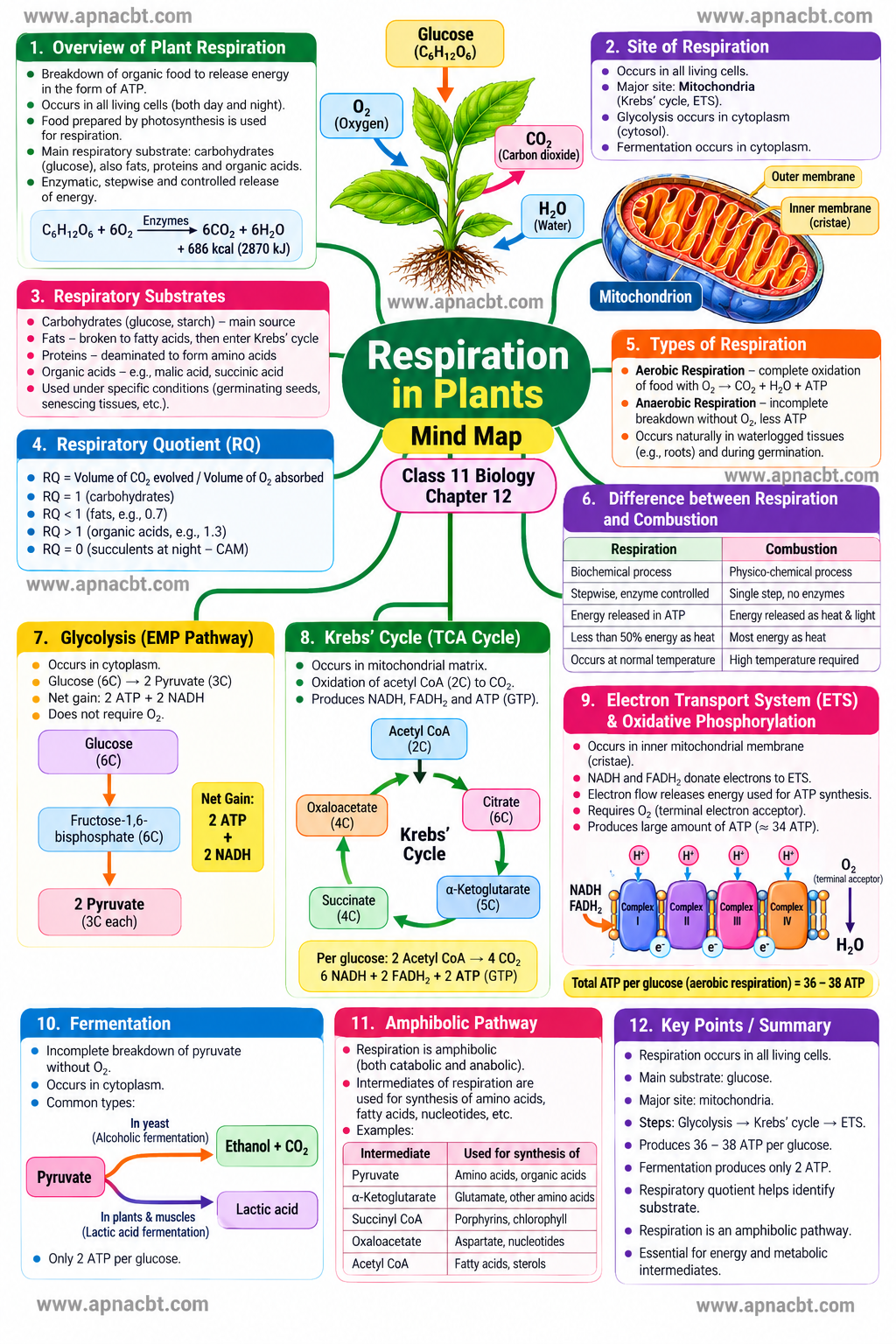
Respiration in Plants Class 11 Biology – Complete Mind Map
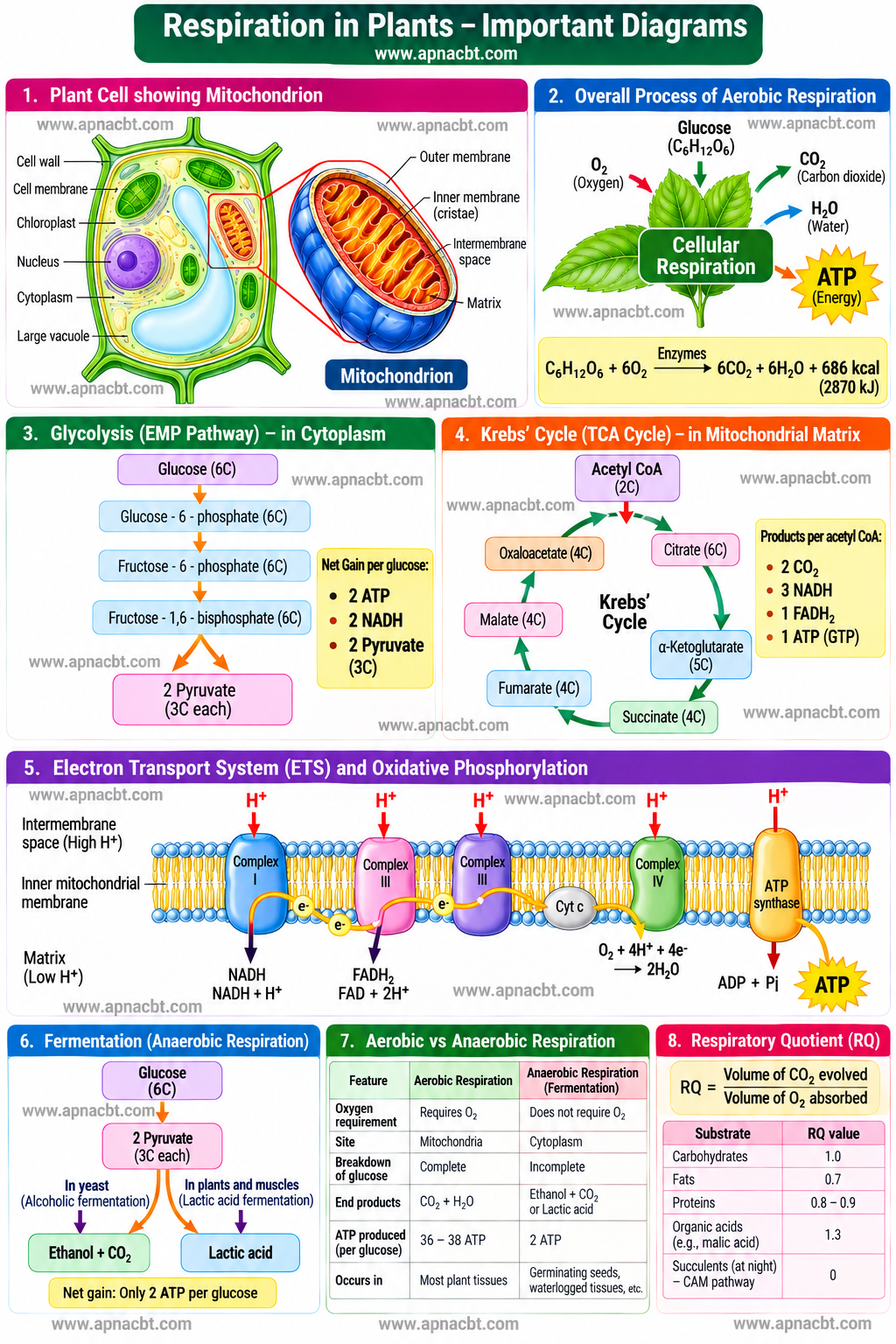
Respiration in Plants Class 11 – Important Diagrams
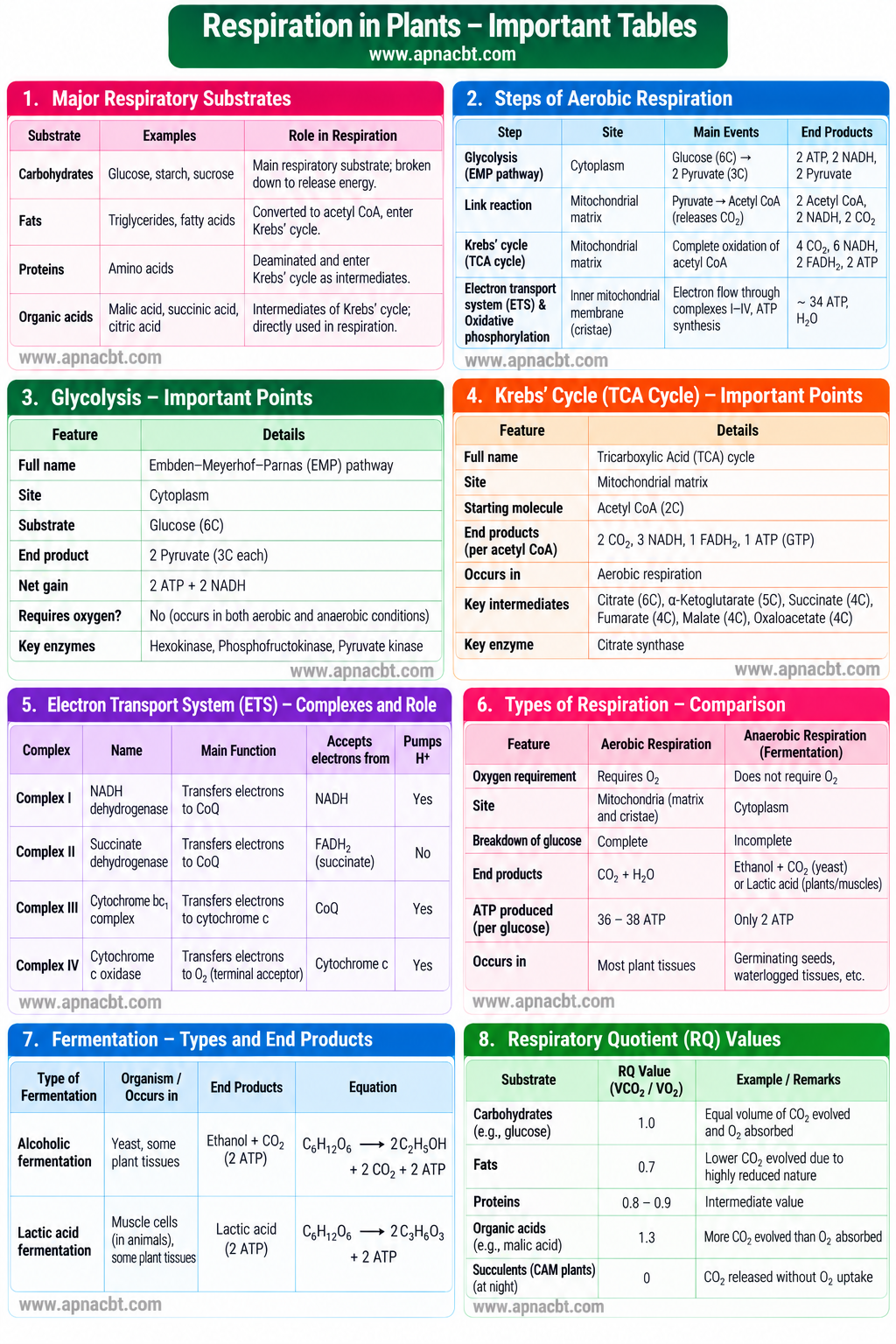
Respiration in Plants – Important Tables