1. Introduction, Seed Germination and Types of Germination
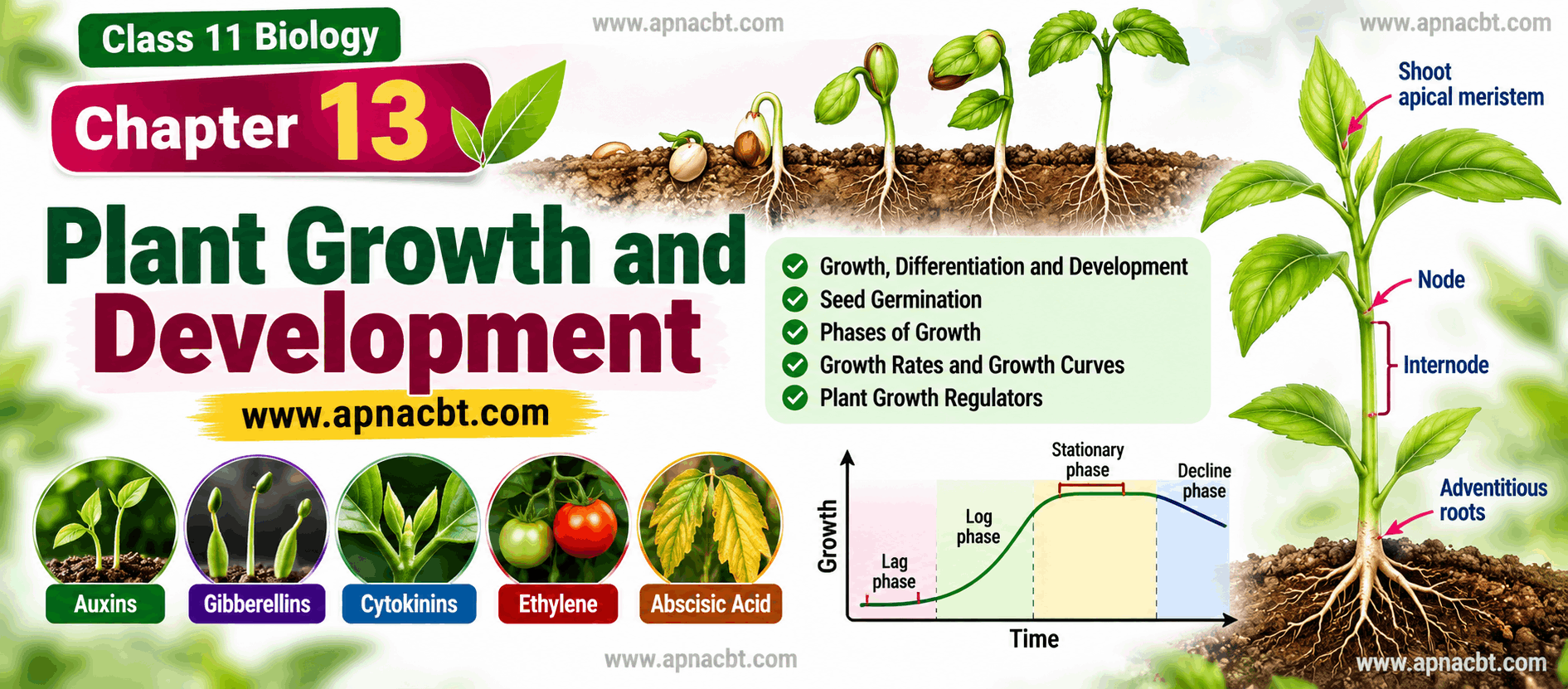
Plant Growth and Development
Plant development is the sum of two processes: growth and differentiation. The development of a mature plant from a zygote follows an ordered succession of events that results in the formation of roots, leaves, branches, flowers, fruits and seeds.
Seed Germination
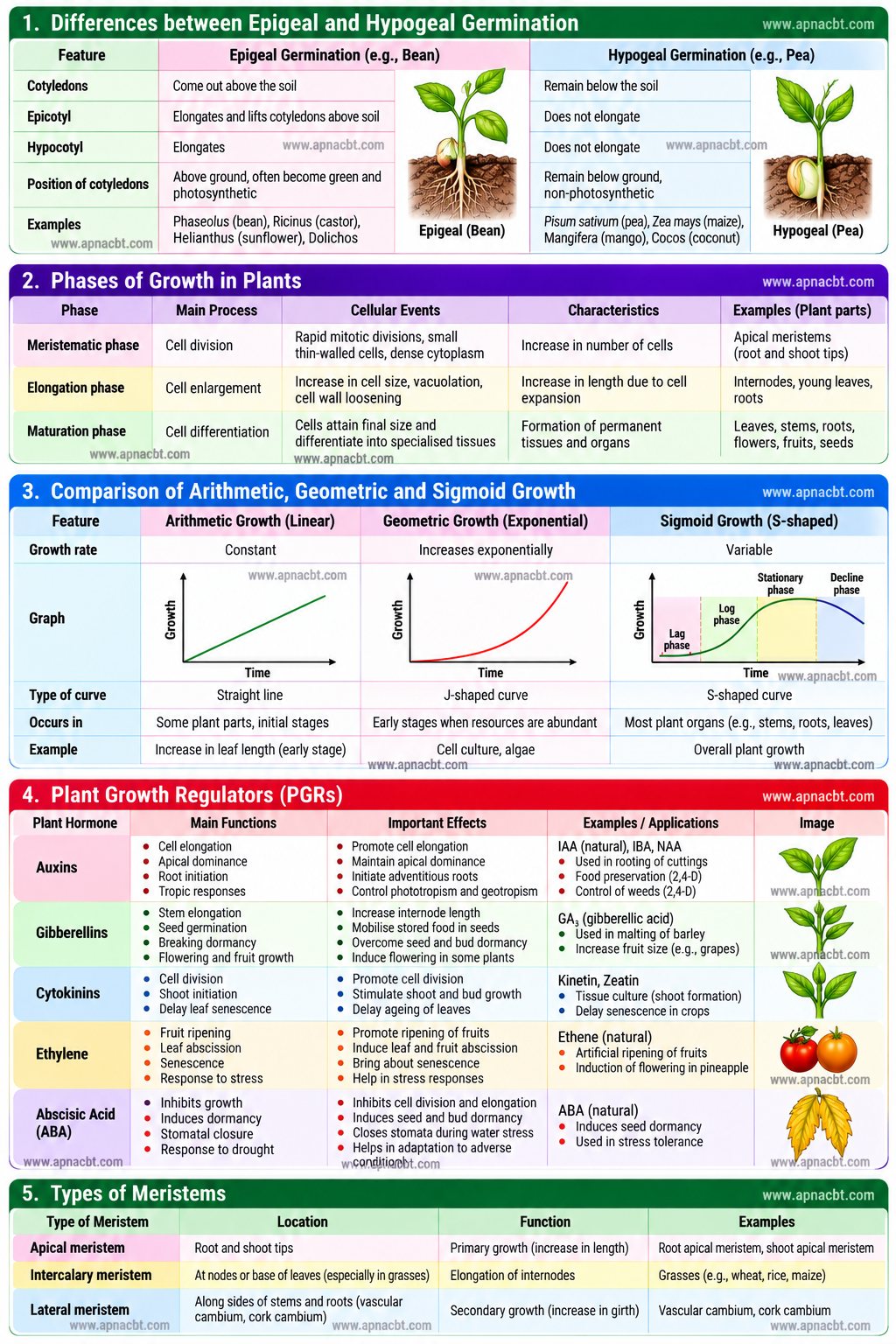
Seed germination is the process by which the embryo in a seed resumes growth and develops into a seedling under favourable conditions. The seed absorbs water through the micropyle. Enzymes such as amylase, lipase and proteinase become active and mobilise stored food, which is transported to the embryo. The radicle usually emerges first, followed by the growth of the epicotyl or hypocotyl and then the plumule.
Types of Seed Germination
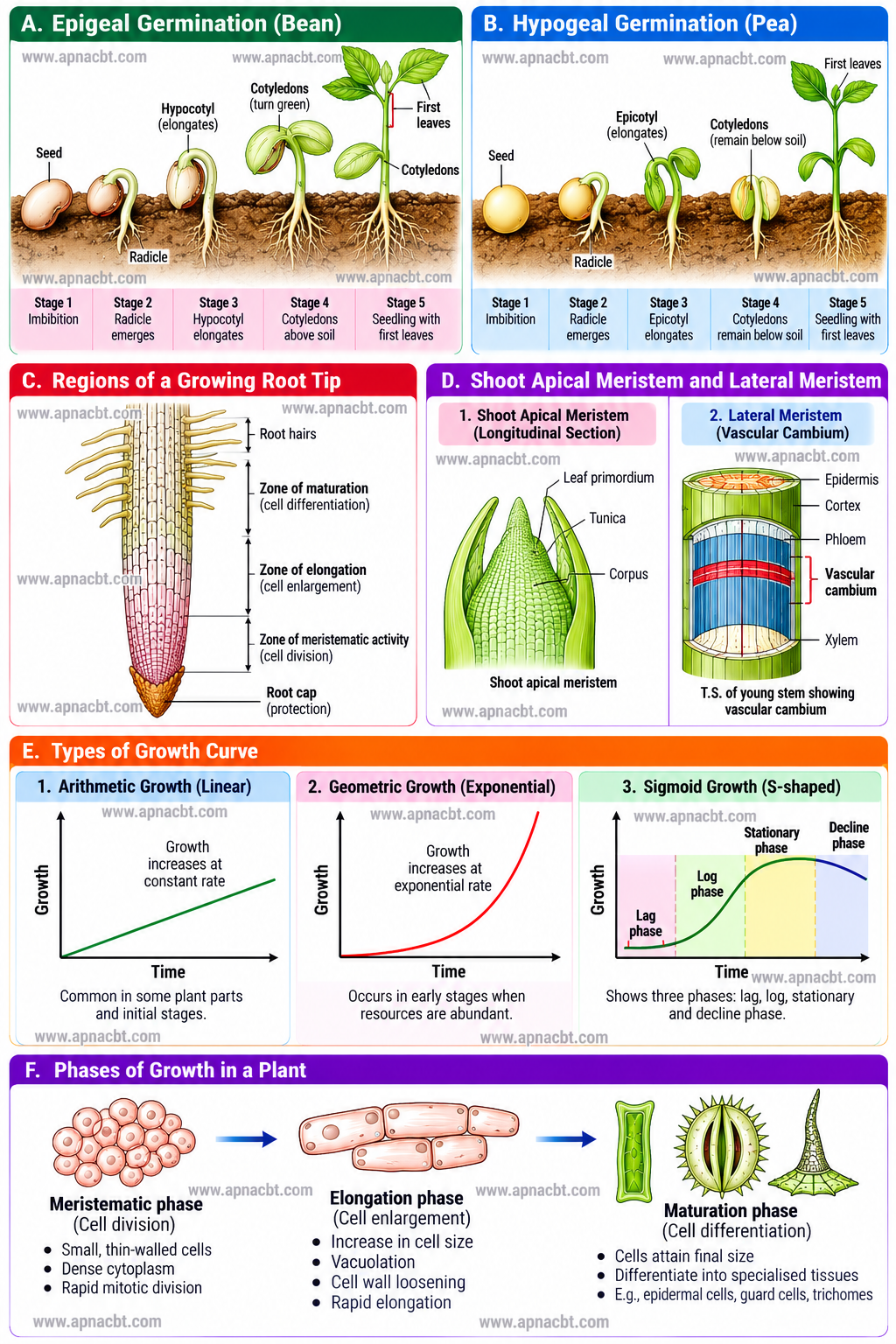
- Epigeal germination: The hypocotyl elongates rapidly and pushes the cotyledons above the soil. The cotyledons may become green and photosynthetic. Examples: Phaseolus (bean), Ricinus (castor) and Dolichos.
- Hypogeal germination: The epicotyl elongates faster, keeping the cotyledons below the soil or close to the soil surface. Examples: pea, mango, coconut, maize and rice.
- Vivipary: Germination of a seed inside the fruit while it is still attached to the parent plant. Example given in the source: Agave.
Important Differences
| Epigeal germination | Hypogeal germination |
|---|---|
| Hypocotyl elongates rapidly. | Epicotyl elongates rapidly. |
| Cotyledons are pushed above the soil. | Cotyledons remain below or near the soil surface. |
| Examples: bean, castor. | Examples: pea, maize, rice. |
2. Growth: Definition, Characteristics and Phases
Definition of Growth
Growth is an irreversible increase in size, weight and volume of an organism or its parts. In plants, it generally occurs in meristems and involves an increase in cell size and/or cell number. Growth is a quantitative phenomenon and can be measured in relation to time.
Plant growth is generally indeterminate because meristematic cells retain the capacity to divide throughout the life of the plant. Continuous addition of new cells by meristems is called the open form of growth.
Meristems and Plant Growth
- Apical meristems: Present at the shoot and root tips; responsible for primary growth and increase in length.
- Vascular cambium: Present in the vascular regions of stems and roots of dicot plants; contributes to increase in thickness during secondary growth.
- Cork cambium: May occur below the epidermis and above the cortex and contributes to the formation of protective tissues.
Three Phases of Growth
- Meristematic phase (cell division): Cells are metabolically active and divide by mitosis. Genetic material is replicated and daughter cells are formed.
- Elongation phase (cell enlargement): Cells increase in size mainly due to water absorption and vacuolation. A large central vacuole develops, and new cell-wall material is synthesised.
- Maturation phase: Cells differentiate and become specialised mature tissues. Their final structure is related to their function and position in the plant.
Zones in a Growing Root
The growing root has a region of cell formation near the tip, a region of maximum cell elongation behind it, a region of differentiation and a region of mature cells where growth has stopped.
3. Growth Rates and Growth Curves
Growth Rate
Growth rate is the increase in growth per unit time. Plant growth may show arithmetic or geometric patterns.
Arithmetic Growth
In arithmetic growth, the rate of growth is constant and the increase occurs in arithmetic progression. One daughter cell retains the capacity to divide, while the other enlarges and differentiates. The growth curve is linear.
Equation: \(L_t = L_0 + rt\), where \(L_t\) is length after time \(t\), \(L_0\) is the initial length and \(r\) is the rate of growth.
Geometric Growth
In geometric growth, both daughter cells retain the capacity to divide. The number of cells increases rapidly and growth becomes exponential. It is common during early embryo development and in rapidly multiplying cells. The growth curve is J-shaped.
Exponential equation: \(W_t = W_0 e^{rt}\), where \(W_t\) is final size, \(W_0\) is initial size, \(r\) is the growth rate, \(t\) is time and \(e\) is the base of natural logarithms.
Sigmoid (S-shaped) Growth Curve
Geometric growth cannot continue indefinitely because resources become limited. Growth slows and may reach a stationary phase. When growth is plotted against time under typical conditions, an S-shaped or sigmoid curve is obtained. The curve includes an initial lag period, a period of rapid growth and a stationary phase.
Absolute and Relative Growth Rates
- Absolute growth rate: Total growth per unit time.
- Relative growth rate: Growth of a given system per unit time expressed per unit of its initial size or parameter.
For example, if two leaves each increase their area by 5 cm² in one day, their absolute growth is equal. If one leaf started at 5 cm² and the other at 50 cm², the relative growth rate is greater in the smaller leaf.
4. Conditions for Growth and Development
Growth involves synthesis of protoplasm, cell division, cell enlargement and differentiation. It is influenced by internal and external factors.
Internal Factors
- Genetic factors: Heredity determines many features and patterns of plant growth.
- Plant hormones (phytohormones): Auxins, gibberellins, cytokinins, abscisic acid and ethylene regulate growth and other plant functions. They may promote or inhibit growth and can act at sites away from where they are produced.
- Nutrients: Inorganic nutrients supply essential elements for synthesis of carbohydrates, amino acids, proteins, nucleic acids and other cellular components.
External Factors
- Water: Required for cell elongation, maintenance of turgidity and enzyme activity. Water deficiency reduces growth; severe water stress can stop it.
- Oxygen: Required by actively growing cells for respiration and energy supply. An optimum oxygen concentration is necessary.
- Light: Its intensity, quality and duration influence plant growth. Plants grown without light may become etiolated: yellowish, weak and tall, with long internodes.
- Temperature: The source identifies about 28–30°C as optimum for proper growth in many plants. High temperatures may increase transpiration and damage enzymes; low temperatures reduce enzyme activity.
- Nutrient availability and food supply: Growth is affected by the availability of essential elements and products of photosynthesis.
The ratio of carbohydrates to nitrogenous compounds can influence the pattern of growth. A relatively high supply of nitrogenous compounds favours vigorous vegetative growth, while a higher carbohydrate proportion favours the development of more mechanical tissues.
5. Differentiation, Dedifferentiation, Redifferentiation and Development
Differentiation
Differentiation is the process by which cells become specialised in structure and function. During differentiation, cells may undergo structural changes in their cell walls and protoplasm. For example, tracheary elements lose their protoplasm and develop strong, elastic, lignocellulosic secondary walls for water transport.
Dedifferentiation
Dedifferentiation is the process by which differentiated cells regain the capacity to divide. Examples include the formation of cork cambium, wound cambium and interfascicular cambium.
Redifferentiation
Redifferentiation occurs when the products of dedifferentiated cells lose their capacity to divide and mature to perform specific functions. Examples include secondary cortex and cork.
Development
Development is the phenomenon of growth and differentiation of cells into tissues, organs and the whole organism. It includes growth, differentiation, maturation and senescence.
The major phases of plant development are:
- Seed germination and vegetative growth.
- Maturation or reproductive phase, including flowering.
- Senescence and death.
Plasticity and Heterophylly
Plasticity is the ability of a plant to change its growth or form in response to internal or external stimuli. Heterophylly refers to the presence of leaves of different shapes on the same plant or in different growth conditions.
- Developmental (intrinsic) plasticity: Different leaf forms occur at different stages of the plant’s life. Examples include cotton, coriander and larkspur.
- Environmental plasticity: Leaf forms differ according to environmental conditions. Example: Ranunculus (buttercup), which may show different leaf forms in aquatic and aerial conditions.
Development is controlled by intrinsic factors such as genes and growth regulators, and extrinsic factors such as light, temperature, water, oxygen and nutrition.
6. Plant Growth Regulators: Introduction and Auxins
Plant Growth Regulators (PGRs)
Plant growth regulators, also called phytohormones, are naturally occurring organic substances that regulate plant growth and development. They are produced in minute quantities and may promote or inhibit growth.
The five major groups discussed in this chapter are auxins, gibberellins, cytokinins, ethylene and abscisic acid (ABA).
Auxins
Auxins are growth-promoting substances associated particularly with cell elongation. Indole-3-acetic acid (IAA) is a naturally occurring auxin. Other naturally occurring auxins include indole-3-butyric acid (IBA). Synthetic auxins include NAA and 2,4-D.
Discovery
Experiments by Charles Darwin and Francis Darwin on coleoptiles showed that the tip perceives light and transmits a signal that causes bending. Later investigations established the role of a growth-promoting substance. The term auxin was introduced by F.W. Went.
Physiological Roles of Auxins
- Cell elongation: Auxins promote cell elongation, particularly in stems and coleoptiles.
- Phototropism: Unequal distribution of auxin in a shoot exposed to unilateral light causes greater elongation on the shaded side, bending the shoot towards light.
- Apical dominance: Auxin produced by the apical bud inhibits the growth of nearby lateral buds. Removal of the apical bud allows lateral buds to grow, producing bushier growth.
- Root initiation: Auxins promote adventitious root formation and are used in vegetative propagation.
- Parthenocarpy: Auxins can induce fruit development without fertilisation; tomato is an example mentioned in the chapter.
- Abscission and senescence: IAA can delay premature senescence and abscission in young organs by counteracting ethylene effects.
- Weed control: Synthetic auxins such as 2,4-D are used to control dicot weeds without generally harming mature monocot crops when appropriately applied.
Applications: Auxins are used for rooting of cuttings, induction of parthenocarpy, prevention of premature fruit drop in certain crops and selective control of dicot weeds.
7. Gibberellins and Cytokinins
Gibberellins
Gibberellins are weakly acidic growth hormones with a gibbane ring structure. They promote cell elongation in intact plants and increase internodal length, particularly in genetically dwarf plants. More than 100 gibberellins have been reported; GA₃ is one of the best studied.
Discovery of Gibberellins
The discovery followed observations of the bakanae or foolish-seedling disease of rice in Japan. The disease was associated with the fungus Gibberella fujikuroi. E. Kurosawa (1926) showed that sterile fungal filtrates produced disease symptoms in rice seedlings.
Bioassays
- Dwarf pea bioassay: GA is applied to dwarf pea seedlings and epicotyl growth is measured.
- Barley endosperm bioassay: Gibberellin stimulates the production of hydrolytic enzymes, resulting in an increase in reducing sugars.
Physiological Roles of Gibberellins
- Promote stem and internode elongation.
- Reverse genetic dwarfism in several plants.
- Promote bolting in rosette plants such as beet and cabbage.
- Promote flowering in some long-day plants under non-inductive conditions.
- Promote synthesis and activity of hydrolytic enzymes during seed germination, including enzymes that mobilise stored food.
- Break dormancy in buds and seeds.
- Promote leaf expansion and can increase crop yield; gibberellin application in sugarcane increases stem length.
Cytokinins
Cytokinins are plant growth regulators that promote cell division. They are commonly associated with actively dividing tissues, developing seeds and fruits, and root regions. Zeatin is a naturally occurring cytokinin; kinetin was among the early cytokinins identified.
Physiological Roles of Cytokinins
- Promote cell division, especially in the presence of auxins.
- Promote growth of lateral buds and help overcome apical dominance.
- Delay leaf senescence by maintaining cellular components and chlorophyll.
- Promote nutrient mobilisation and influence the movement of nutrients towards treated regions.
- In tissue culture, the ratio of cytokinin to auxin influences shoot and root formation. A relatively high cytokinin level favours shoot bud formation, while a relatively high auxin level favours root formation.
8. Ethylene, Abscisic Acid and Hormone Interactions
Ethylene
Ethylene (C₂H₄) is a gaseous plant growth regulator. It is produced by many plant parts and is associated with fruit ripening, abscission and several growth responses. It is notable among plant hormones because it is gaseous.
Physiological Roles of Ethylene
- Fruit ripening: Accelerates ripening in many fruits. Climacteric fruits show a marked rise in respiration associated with ripening and increased ethylene production. Examples include apple, banana and tomato.
- Abscission: Promotes shedding of leaves, flowers and fruits by stimulating enzymes that contribute to formation of the abscission layer.
- Flowering: Induces and synchronises flowering in pineapple.
- Sex expression: Can promote the formation of female flowers in certain monoecious plants, such as cucumber.
- Epinasty: Causes downward curvature of leaves when the upper side grows faster than the lower side.
- Root growth: Promotes root growth and root-hair formation in certain conditions.
- Stem response: Inhibits stem elongation while increasing stem thickening, producing a horizontal growth habit in some responses.
Climacteric and Non-climacteric Fruits
| Climacteric fruits | Non-climacteric fruits |
|---|---|
| Show a respiratory rise during ripening. | Do not show the characteristic respiratory rise. |
| Ethylene production rises during ripening. | Do not show the same marked rise in endogenous ethylene. |
| Examples include apple, banana and tomato. | Examples commonly include citrus fruits and grapes. |
Abscisic Acid (ABA)
Abscisic acid is a growth-inhibiting plant hormone and is often called the stress hormone because its production is stimulated under unfavourable conditions such as drought, waterlogging, excessive temperature and salinity. It generally acts antagonistically to gibberellins.
Physiological Roles of ABA
- Induces dormancy in buds and seeds.
- Inhibits growth and can act antagonistically to gibberellins.
- Promotes stomatal closure by affecting ion movement in guard cells, reducing their turgidity.
- Helps plants tolerate drought, cold and salt stress.
- May influence abscission and senescence through interactions with other hormones.
Interactions Between Plant Growth Regulators
Plant growth regulators often act together. Their effects may be synergistic (working in the same direction) or antagonistic (opposing each other).
- ABA promotes seed and bud dormancy, while gibberellins help break dormancy.
- Auxin promotes apical dominance, while cytokinins promote lateral bud growth and can overcome it.
- Auxins and cytokinins act together in promoting cell division in suitable conditions.
- Auxins and cytokinins can delay senescence, whereas ethylene promotes senescence and abscission.
9. Quick Revision: Key Terms, Comparisons and Exam Points
Important Definitions
- Growth: Irreversible increase in size, weight and volume.
- Open growth: Continuous addition of new cells by meristematic activity.
- Differentiation: Specialisation of cells in structure and function.
- Dedifferentiation: Regaining the capacity to divide by differentiated cells.
- Redifferentiation: Maturation of dedifferentiated cells into specialised cells that lose the capacity to divide.
- Development: Growth and differentiation of cells into tissues, organs and the organism.
- Plasticity: Ability to change in response to internal or external stimuli.
- Apical dominance: Suppression of lateral bud growth by the apical bud.
- Bolting: Rapid elongation of the stem or internodes in rosette plants before flowering.
- Abscission: Shedding of leaves, flowers, fruits or other plant organs.
- Climacteric: Respiratory rise associated with ripening in certain fruits.
Plant Growth Regulators at a Glance
| Regulator | Main actions |
|---|---|
| Auxins | Cell elongation, phototropism, apical dominance, rooting, parthenocarpy. |
| Gibberellins | Stem elongation, reversal of dwarfism, bolting, enzyme synthesis, breaking dormancy. |
| Cytokinins | Cell division, lateral bud growth, delay of senescence, nutrient mobilisation. |
| Ethylene | Fruit ripening, abscission, pineapple flowering, epinasty, sex expression. |
| ABA | Growth inhibition, seed and bud dormancy, stomatal closure, stress tolerance. |
Important Examples to Remember
- Epigeal germination: bean and castor.
- Hypogeal germination: pea, maize and rice.
- Vivipary: Agave (as stated in the source material).
- Environmental heterophylly: Ranunculus.
- Bakanae disease: Gibberella fujikuroi.
- 2,4-D: synthetic auxin used to control dicot weeds.
- Ethylene: fruit ripening and synchronised flowering in pineapple.
- ABA: stress hormone and promoter of dormancy.
10. Short-Answer Questions (30 Questions)
Questions
- Define seed germination.
- What is epigeal germination? Give two examples.
- What is hypogeal germination? Give two examples.
- Define vivipary and give an example.
- Define growth in plants.
- Why is plant growth generally described as indeterminate?
- What is meant by open form of growth?
- Name the three phases of plant growth.
- What happens during the meristematic phase?
- Why do cells enlarge during the elongation phase?
- What is the maturation phase?
- Define arithmetic growth.
- What is geometric growth?
- What type of curve is obtained in geometric growth?
- What is a sigmoid growth curve?
- Differentiate between absolute and relative growth rates.
- Name two internal factors that influence plant growth.
- Mention four external factors affecting plant growth.
- Define differentiation.
- What is dedifferentiation? Give one example.
- Define redifferentiation with one example.
- What is plant development?
- Name the three broad phases of plant development.
- Define plasticity.
- What is heterophylly? Give one example.
- Name the five major groups of plant growth regulators.
- What is apical dominance?
- Mention two physiological roles of gibberellins.
- Why is ethylene important in fruit ripening?
- Why is abscisic acid called the stress hormone?
Answers
- Seed germination is the process by which the embryo resumes growth and develops into a seedling under favourable conditions.
- Epigeal germination occurs when rapid hypocotyl elongation pushes the cotyledons above the soil. Examples: bean and castor.
- Hypogeal germination occurs when the epicotyl elongates faster and the cotyledons remain below or near the soil surface. Examples: pea and maize.
- Vivipary is the germination of a seed inside the fruit while it remains attached to the parent plant. The source gives Agave as an example.
- Growth is an irreversible increase in the size, weight and volume of an organism or its parts.
- Plants retain meristematic cells that can continue dividing throughout life, allowing continued growth.
- Open growth is the continuous addition of new cells to the plant body through meristematic activity.
- The three phases are meristematic (cell division), elongation (cell enlargement) and maturation.
- Cells divide by mitosis, replicate genetic material and produce daughter cells during the meristematic phase.
- Cells absorb water, develop large vacuoles and synthesise additional cell-wall material, causing an increase in size.
- It is the phase in which cells differentiate and become specialised mature tissues.
- Arithmetic growth is growth at a constant rate in which the increase follows an arithmetic progression and the growth curve is linear.
- Geometric growth occurs when both daughter cells retain the ability to divide, producing rapid exponential increase.
- A J-shaped curve is obtained during geometric or exponential growth.
- A sigmoid growth curve is an S-shaped curve showing an initial slow phase, rapid growth and a stationary phase.
- Absolute growth rate is total growth per unit time. Relative growth rate is growth per unit time relative to the initial size or parameter.
- Genetic factors and plant hormones are internal factors. Nutrient status is also an important internal influence described in the chapter.
- Water, oxygen, light, temperature and nutrient availability are external factors.
- Differentiation is the specialisation of cells in structure and function.
- Dedifferentiation is the regaining of the capacity to divide by differentiated cells. Formation of cork cambium is an example.
- Redifferentiation is the maturation of dedifferentiated cells into specialised cells that lose the capacity to divide. Cork and secondary cortex are examples.
- Development is the process involving growth and differentiation of cells into tissues, organs and the complete organism.
- Seed germination and vegetative growth; maturation or reproductive phase; and senescence and death.
- Plasticity is the ability of a plant to change under the influence of internal or external stimuli.
- Heterophylly is the occurrence of different leaf forms. Ranunculus shows different leaf forms in aquatic and aerial conditions.
- Auxins, gibberellins, cytokinins, ethylene and abscisic acid.
- Apical dominance is the inhibition of nearby lateral bud growth by the apical bud.
- Gibberellins promote stem elongation and bolting; they can also reverse genetic dwarfism and break seed or bud dormancy.
- Ethylene accelerates the ripening process in many fruits and is associated with the respiratory rise in climacteric fruits.
- ABA production is stimulated under stress conditions such as drought and salinity; it helps regulate stomatal closure and stress responses.
11. Long-Answer Questions (15 Questions)
Questions
- Explain seed germination and describe epigeal, hypogeal and viviparous germination with examples.
- Define plant growth. Explain why plant growth is indeterminate and describe the role of meristems.
- Describe the three phases of plant growth in detail.
- Explain arithmetic and geometric growth with their growth curves and equations.
- Describe sigmoid growth and distinguish between absolute and relative growth rates.
- Explain the internal and external factors that influence plant growth.
- Define differentiation, dedifferentiation and redifferentiation with suitable examples.
- Define development and explain its major phases in the life cycle of a plant.
- What is plasticity? Explain developmental and environmental plasticity with examples.
- What are plant growth regulators? Name the five major groups and explain their general significance.
- Describe the physiological roles and agricultural applications of auxins.
- Explain the discovery, bioassays and physiological roles of gibberellins.
- Describe the physiological roles of cytokinins and explain their interaction with auxins in tissue culture.
- Explain the major physiological roles of ethylene. Differentiate between climacteric and non-climacteric fruits.
- Describe the physiological roles of abscisic acid and explain the interaction between different plant growth regulators.
Answers
- Seed germination: It is the resumption of embryo growth to form a seedling. The seed absorbs water through the micropyle; enzymes such as amylase, lipase and proteinase mobilise stored food. The radicle emerges first, followed by the epicotyl or hypocotyl and plumule. In epigeal germination, the hypocotyl elongates and pushes cotyledons above the soil, as in bean and castor. In hypogeal germination, the epicotyl elongates and cotyledons remain below or near the soil surface, as in pea and maize. Vivipary is germination inside a fruit attached to the parent plant; the source gives Agave as an example.
- Plant growth is an irreversible increase in size, weight and volume. It is indeterminate because plants retain meristematic tissues with cells capable of repeated division. Apical meristems increase length, while vascular cambium contributes to increase in thickness during secondary growth. Continuous addition of cells by meristems is called open growth.
- The three phases are: (1) Meristematic phase: cells are metabolically active and divide by mitosis; genetic material is replicated. (2) Elongation phase: cells enlarge through water absorption, vacuolation and synthesis of new cell-wall material. (3) Maturation phase: cells differentiate and acquire specialised structures and functions, forming mature tissues.
- Arithmetic growth occurs at a constant rate; one daughter cell continues dividing while the other differentiates. Its curve is linear and is represented by \(L_t=L_0+rt\). Geometric growth occurs when both daughter cells continue dividing, producing exponential increase and a J-shaped curve. It is represented by \(W_t=W_0e^{rt}\), where \(W_0\) is initial size, \(W_t\) is final size, \(r\) is growth rate, \(t\) is time and \(e\) is the base of natural logarithms.
- A sigmoid curve is S-shaped. Growth begins slowly, increases rapidly and finally slows as resources become limiting, reaching a stationary phase. Absolute growth rate is the total increase per unit time. Relative growth rate is the increase per unit time relative to the initial size. Two organs may have equal absolute growth but different relative growth rates.
- Internal factors: genetic constitution, plant hormones and nutrient status. Genes influence the growth pattern; phytohormones regulate promotion and inhibition; nutrients provide elements needed to synthesise cellular materials. External factors: water supports turgidity, elongation and enzyme activity; oxygen supports respiration and energy production; light influences growth and its absence may cause etiolation; temperature affects enzyme activity and metabolism; and nutrient availability affects biosynthesis and growth.
- Differentiation is the specialisation of cells, often involving structural changes. Tracheary elements, for example, lose protoplasm and develop lignocellulosic walls. Dedifferentiation is the return of differentiated cells to a dividing state; cork cambium and interfascicular cambium are examples. Redifferentiation is the maturation of dedifferentiated cells into specialised cells that no longer divide; cork and secondary cortex are examples.
- Development is the sum of growth and differentiation, leading to formation of tissues, organs and the organism. It includes growth, differentiation, maturation and senescence. The broad phases are seed germination and vegetative growth; maturation or reproductive phase including flowering; and senescence followed by death.
- Plasticity is the ability to change under internal or external stimuli. Developmental plasticity occurs when a plant forms different structures at different life stages; examples include cotton, coriander and larkspur. Environmental plasticity occurs in response to environmental conditions. Ranunculus shows different leaf forms in aquatic and aerial environments. Heterophylly is an example of plasticity.
- Plant growth regulators are naturally occurring organic substances that control plant growth and development, often in minute quantities. The five major groups are auxins, gibberellins, cytokinins, ethylene and ABA. They regulate cell division, cell elongation, differentiation, flowering, fruit development, dormancy, senescence and responses to environmental stress. Their effects may be promotive or inhibitory.
- Auxins promote cell elongation, phototropic bending, adventitious root formation and parthenocarpy. Auxin in the shoot apex contributes to apical dominance by inhibiting lateral buds. IAA can delay premature senescence and abscission in young organs. Synthetic auxins such as 2,4-D are used to control dicot weeds, while auxins are also used in rooting cuttings and inducing seedless fruit development in suitable crops.
- Gibberellins were discovered through studies of bakanae or foolish-seedling disease of rice caused by Gibberella fujikuroi. E. Kurosawa (1926) showed that sterile fungal filtrates caused the symptoms. Dwarf pea and barley endosperm are bioassays. Gibberellins promote stem and internode elongation, reverse genetic dwarfism, induce bolting in rosette plants, promote flowering in some long-day plants, stimulate hydrolytic enzyme production during germination, break dormancy and promote leaf expansion. Their application can increase stem length in sugarcane.
- Cytokinins promote cell division, lateral bud growth and nutrient mobilisation, and delay leaf senescence. In tissue culture, the balance between auxin and cytokinin influences organ formation. A relatively high cytokinin-to-auxin ratio favours shoot bud formation, while a relatively high auxin-to-cytokinin ratio favours root formation. Auxins and cytokinins can also act together in promoting cell division.
- Ethylene is a gaseous plant growth regulator. It accelerates fruit ripening, promotes abscission, induces and synchronises flowering in pineapple, influences sex expression in certain plants, causes epinasty, and can promote root and root-hair formation. It inhibits stem elongation while increasing stem thickening. Climacteric fruits show a respiratory rise and increased ethylene production during ripening; examples include apple, banana and tomato. Non-climacteric fruits do not show the same characteristic respiratory rise.
- ABA is a growth inhibitor and stress hormone. It induces seed and bud dormancy, inhibits growth, promotes stomatal closure and helps plants tolerate drought, cold and salt stress. Plant hormones interact synergistically or antagonistically. ABA promotes dormancy while gibberellins break it; auxin promotes apical dominance while cytokinins encourage lateral bud growth; auxins and cytokinins may act together in cell division; and ethylene promotes ripening and abscission while auxin can delay premature abscission.
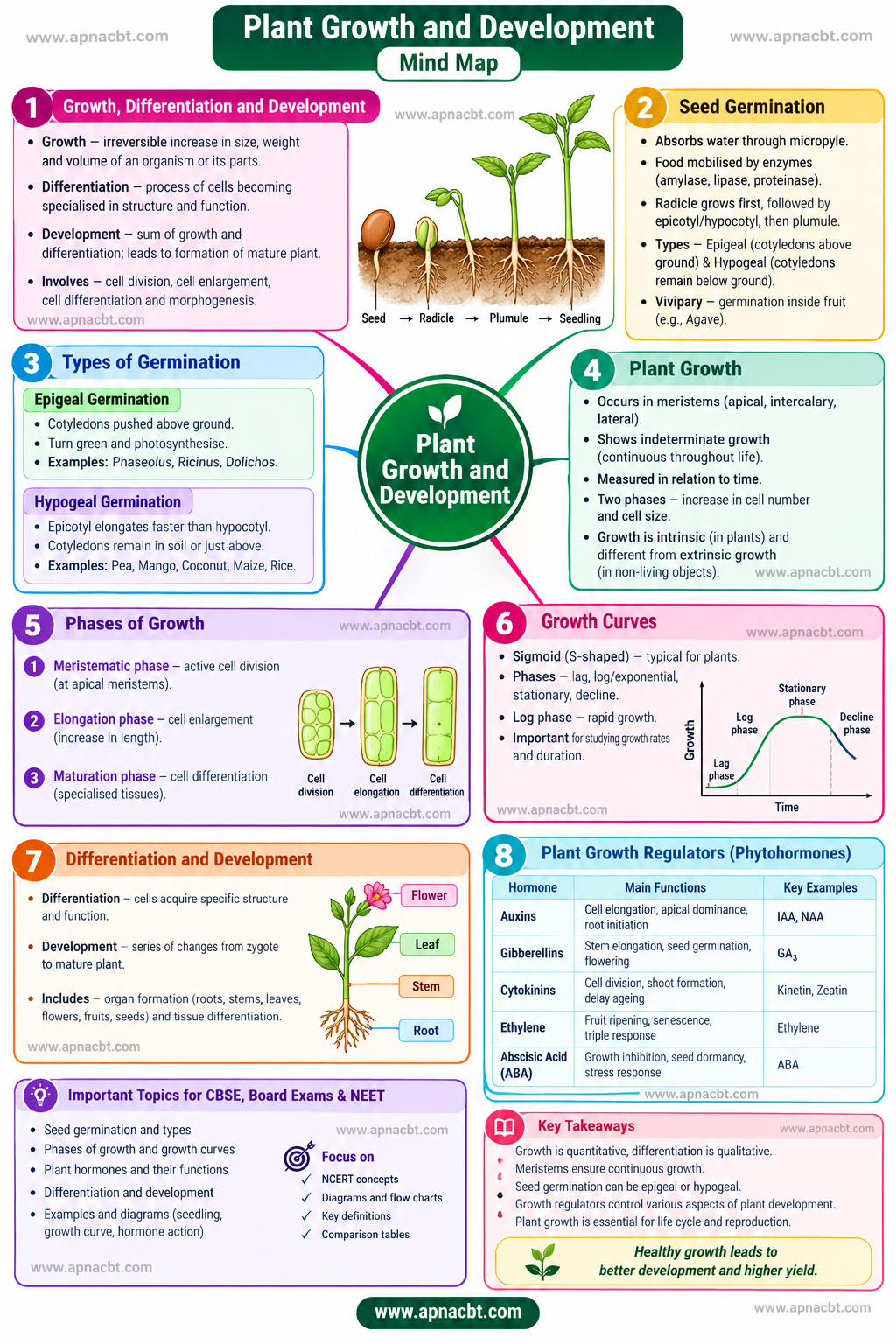
Plant Growth and Development Mind Map Class
Plant Growth and Development Important Diagrams
Plant Growth and Development Important Tables