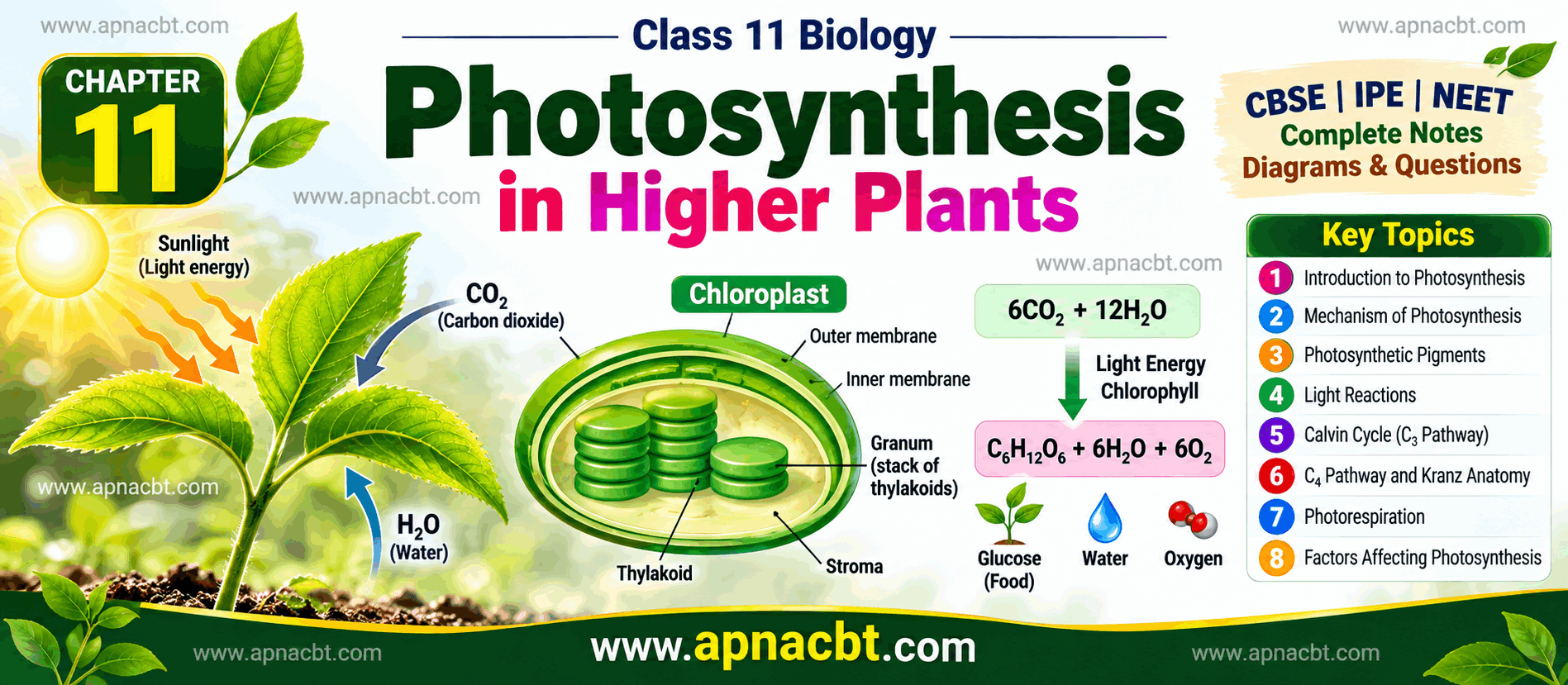
Chapter 11: Photosynthesis in Higher Plants – Class 11 Biology
Exam-focused lesson prepared from the supplied 28-page PDF for CBSE, Telangana IPE and NEET. It covers photosynthesis, experiments, chloroplast structure, pigments, photosystems, light reactions, photophosphorylation, Calvin cycle, C₄ pathway, photorespiration and factors affecting photosynthesis.
Study focus: Learn the sites and sequence of reactions, compare cyclic and non-cyclic photophosphorylation, C₃ and C₄ pathways, and practise the chloroplast, Z-scheme, Calvin cycle, Kranz anatomy and photorespiration diagrams.
1. Introduction to Photosynthesis
Photosynthesis is the anabolic, physico-chemical process by which green plants capture solar energy and use it to synthesise carbohydrates from carbon dioxide and water in the presence of chlorophyll. Oxygen is released as a by-product.
Overall equation: 6CO₂ + 12H₂O + light energy → C₆H₁₂O₆ + 6H₂O + 6O₂.
- Converts solar energy into chemical energy.
- Forms the primary source of organic food for most ecosystems.
- Releases oxygen and removes atmospheric carbon dioxide.
- Supports the carbon cycle and, over geological time, contributed to fossil fuel formation.
Photosynthesis is an oxidation-reduction process: water is oxidised to oxygen and carbon dioxide is reduced to carbohydrates.
2. Raw Materials and Experiments
Carbon dioxide, water, light and chlorophyll are essential for photosynthesis.
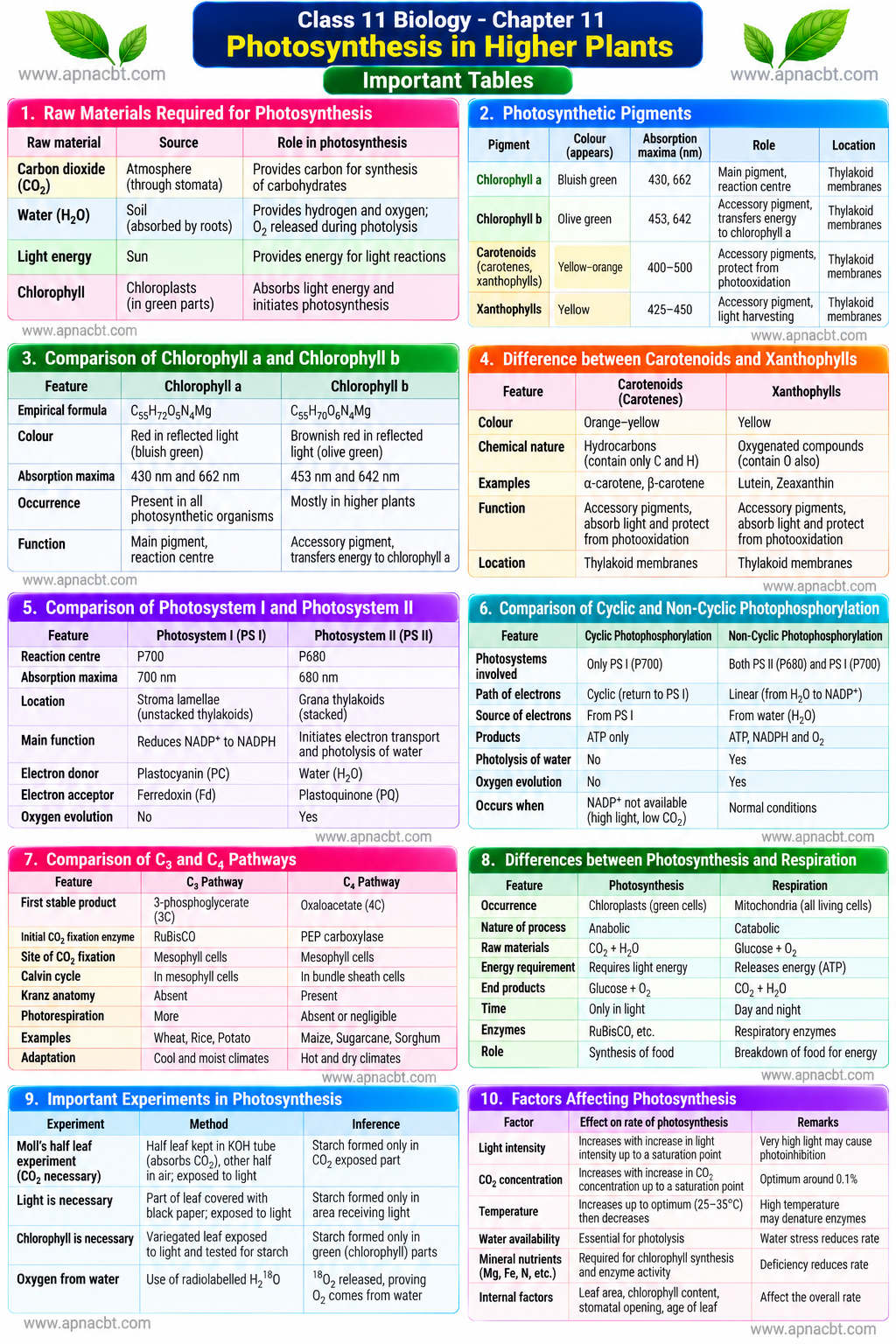
| Requirement | Experiment / observation | Inference |
|---|---|---|
| CO₂ | Moll’s half-leaf experiment: KOH-soaked cotton absorbs CO₂ from the enclosed part of a destarched leaf. Only the exposed part forms starch. | CO₂ is necessary. |
| Light | Part of a destarched leaf is covered with black paper. Only the illuminated region turns blue-black with iodine. | Light is necessary. |
| Chlorophyll | In a variegated leaf, only green regions form starch after exposure to light. | Chlorophyll is necessary. |
| Water | Oxygen-isotope labelling shows released O₂ comes from water, not CO₂. | Water supplies electrons and protons; O₂ originates from water. |
Moll’s experiment: Destarch a potted plant for 2–3 days, enclose part of a leaf in a tube with KOH-soaked cotton, expose to sunlight, then test with iodine. The region with CO₂ turns blue-black; the enclosed region does not.
KOH absorbs CO₂. Iodine detects starch by turning it blue-black.
3. Site of Photosynthesis: Chloroplast
Photosynthesis occurs mainly in leaf mesophyll cells, inside chloroplasts. A chloroplast is a double-membrane, DNA-containing, semi-autonomous organelle.
| Structure | Features and functions |
|---|---|
| Outer and inner membranes | Enclose the chloroplast and regulate exchange. |
| Stroma | Fluid matrix containing enzymes for carbon fixation, including RuBisCO; Calvin cycle occurs here. |
| Thylakoids | Flattened membrane sacs containing pigments, photosystems and electron carriers. |
| Grana | Stacks of thylakoids; provide extensive membrane surface for light reactions. |
| Stroma lamellae | Connect grana and contain components of the photosynthetic electron transport system. |
| Thylakoid lumen | Internal space where protons accumulate during light reactions. |
Division of labour: Light-dependent reactions occur on thylakoid membranes and produce ATP and NADPH. Carbon fixation occurs in the stroma and uses ATP and NADPH to reduce CO₂.
4. Photosynthetic Pigments
| Pigment | Colour / type | Importance |
|---|---|---|
| Chlorophyll a | Blue-green | Primary pigment and reaction-centre pigment of both photosystems. |
| Chlorophyll b | Yellow-green | Accessory pigment; broadens absorption and transfers energy to chlorophyll a. |
| Carotenes | Yellow-orange hydrocarbon carotenoids | Absorb mainly blue-green light; β-carotene can be converted to vitamin A. |
| Xanthophylls | Yellow oxygen-containing carotenoids | Accessory pigments; protect against photooxidative damage. |
| Phycobilins | Water-soluble pigments | Found in red algae and cyanobacteria; include phycoerythrin and phycocyanin. |
Chlorophyll has a porphyrin head with four pyrrole rings and a central magnesium atom, plus a hydrophobic phytol tail that anchors it in the thylakoid membrane.
- Accessory pigments absorb wavelengths less efficiently absorbed by chlorophyll a.
- They transfer excitation energy to chlorophyll a.
- Carotenoids dissipate excess energy and protect pigments from photooxidation.
5. Absorption Spectrum and Action Spectrum
Absorption spectrum: Graph showing the amount of light absorbed by a pigment at different wavelengths.
Action spectrum: Graph showing the relative rate of photosynthesis at different wavelengths.
| Feature | Absorption spectrum | Action spectrum |
|---|---|---|
| Measures | Light absorbed by a pigment | Photosynthetic effectiveness |
| Method | Spectrophotometer | Measure photosynthetic activity, often oxygen evolution |
| Typical result | Chlorophylls absorb strongly in blue-violet and red regions | Photosynthesis is most effective in blue-violet and red regions |
Engelmann (1882) used a filamentous green alga and aerobic bacteria to show that oxygen evolution, and hence photosynthesis, is greatest in blue and red light. The action spectrum broadly corresponds to the combined absorption spectra of photosynthetic pigments.
6. Photosystems and Reaction Centres
Photosynthetic pigments are arranged into photosystems consisting of a light-harvesting antenna complex and a reaction centre. Antenna pigments absorb photons and transfer excitation energy to reaction-centre chlorophyll a.
| Feature | PS I | PS II |
|---|---|---|
| Reaction centre | P700 | P680 |
| Main role | Transfers electrons to ferredoxin; supports NADP⁺ reduction or cyclic flow. | Receives replacement electrons from water through the oxygen-evolving complex. |
| Typical location | Mainly stroma lamellae and non-appressed grana regions. | Mainly appressed grana thylakoids. |
Although numbered PS I and PS II, PS II functions before PS I in non-cyclic electron transport.
7. Light Reactions and Photolysis of Water
Light-dependent reactions occur on thylakoid membranes. Light excites electrons in photosystems; electron transport builds a proton gradient, ATP is synthesised, and NADP⁺ is reduced to NADPH.
Photolysis: 2H₂O → 4H⁺ + 4e⁻ + O₂.
- Electrons replace those lost by P680 of PS II.
- Protons contribute to the lumen proton concentration.
- Oxygen is released as a by-product.
Non-cyclic electron sequence: H₂O → PS II (P680) → primary acceptor → plastoquinone → cytochrome b₆f → plastocyanin → PS I (P700) → ferredoxin → NADP⁺ reductase → NADPH.
Remember the order: PS II operates before PS I in non-cyclic electron flow.
8. Chemiosmosis and Photophosphorylation
Electron transport establishes a proton gradient across the thylakoid membrane. Protons accumulate in the lumen and move back to the stroma through ATP synthase, driving ATP formation.
- Photolysis releases protons into the lumen.
- Plastoquinone and cytochrome b₆f contribute to proton accumulation in the lumen.
- NADP⁺ reduction consumes protons from the stroma, helping establish the gradient.
ATP synthase: CF₀ is the membrane-embedded proton channel; CF₁ is the stroma-facing catalytic head that forms ATP from ADP and inorganic phosphate.
Photophosphorylation: Formation of ATP from ADP and inorganic phosphate using light energy.
| Feature | Cyclic photophosphorylation | Non-cyclic photophosphorylation |
|---|---|---|
| Photosystems | PS I only | PS II and PS I |
| Electron pathway | Electrons return to PSI | Electrons move from water through both photosystems to NADP⁺ |
| Photolysis / O₂ | Absent; no oxygen | Present; oxygen released |
| Products | ATP only | ATP, NADPH and O₂ |
| Role | Provides extra ATP when needed | Supplies ATP and NADPH for carbon fixation |
9. Calvin Cycle (C₃ Pathway)
The Calvin cycle occurs in the chloroplast stroma. It fixes CO₂ into organic molecules using ATP and NADPH. It is called the C₃ pathway because its first stable product is 3-phosphoglycerate (3-PGA).
| Phase | Events | Key point |
|---|---|---|
| Carboxylation | CO₂ combines with RuBP; the unstable six-carbon intermediate splits into two 3-PGA molecules. | RuBisCO catalyses the reaction. |
| Reduction | 3-PGA is phosphorylated by ATP and reduced by NADPH to triose phosphate (PGAL / G3P). | Consumes ATP and NADPH. |
| Regeneration | Most triose phosphate is rearranged to regenerate RuBP. | ATP is required. |
- CO₂ acceptor: RuBP.
- Carboxylating enzyme: RuBisCO.
- First stable product: 3-PGA.
- For one glucose equivalent (six CO₂), the cycle requires 18 ATP and 12 NADPH.
10. C₄ Pathway and Kranz Anatomy
C₄ plants initially fix CO₂ into the four-carbon compound oxaloacetic acid (OAA). The pathway is also called the Hatch–Slack pathway. Examples include maize, sugarcane, sorghum and pearl millet.
Kranz anatomy: Bundle-sheath cells form a wreath-like arrangement around vascular bundles. Initial CO₂ fixation occurs in mesophyll cells; the Calvin cycle occurs in bundle-sheath cells.
- In mesophyll cells, PEP combines with CO₂ through PEP carboxylase to form OAA.
- OAA is converted to malate or aspartate and transported to bundle-sheath cells.
- Decarboxylation releases CO₂ around RuBisCO.
- RuBisCO fixes the released CO₂ through the Calvin cycle.
- Pyruvate returns to mesophyll cells and ATP is used to regenerate PEP.
| Feature | C₃ plants | C₄ plants |
|---|---|---|
| First stable product | 3-PGA (3C) | OAA (4C) |
| Primary CO₂ acceptor | RuBP | PEP |
| Initial enzyme | RuBisCO | PEP carboxylase |
| Calvin cycle site | Mesophyll | Bundle sheath |
| Kranz anatomy | Absent | Present |
| Photorespiration | Can occur | Very low / effectively suppressed |
| Energy cost | Lower | Higher due to extra ATP for PEP regeneration |
C₄ plants concentrate CO₂ around RuBisCO, suppress photorespiration and perform well in high light and high temperature.
11. Photorespiration (C₂ Cycle)
Photorespiration is initiated when RuBisCO acts as an oxygenase and adds O₂ to RuBP. It is prominent in C₃ plants under high temperature, high O₂ and low CO₂. It involves chloroplasts, peroxisomes and mitochondria.
- In chloroplasts, oxygenation of RuBP forms 3-PGA and 2-phosphoglycolate.
- 2-phosphoglycolate is converted to glycolate, which moves to peroxisomes.
- Glycolate is converted through glyoxylate to glycine.
- Glycine enters mitochondria; two glycine molecules form serine, releasing CO₂ and ammonia.
- Serine returns to peroxisomes and is converted to glycerate.
- Glycerate returns to chloroplasts and becomes 3-PGA.
Photorespiration consumes energy and releases CO₂ without producing sugar, reducing net photosynthetic efficiency. It may, however, help protect plants from photooxidative damage under excess light and limited CO₂.
12. Factors Affecting Photosynthesis and Blackman’s Law
Blackman’s law of limiting factors: When a process depends on several factors, its rate is limited by the factor that is nearest its minimum value.
| Factor | Effect |
|---|---|
| Light | PAR is about 400–700 nm. Rate rises with intensity up to saturation; excessive light may cause photoinhibition / photooxidation. |
| Temperature | Enzyme-controlled carbon reactions are temperature-sensitive. Tropical and C₄ plants generally have higher temperature optima. |
| CO₂ | A major substrate and limiting factor. Increasing CO₂ raises photosynthesis until saturation. |
| Water | Deficit causes stomatal closure, reduces CO₂ entry and limits leaf expansion. |
| Oxygen | High O₂ promotes RuBisCO oxygenase activity and photorespiration in C₃ plants; high-O₂ inhibition is called the Warburg effect. |
| Minerals and nitrogen | Mg, Fe, Mn, Cu and other elements support pigment synthesis and photosynthetic reactions; nitrogen is needed for chlorophyll and enzymes. |
| Internal factors | Leaf number, size, age and orientation; mesophyll and chloroplast features; chlorophyll content and genotype. |
Light saturation point: Light intensity beyond which further increase does not increase the photosynthetic rate. Compensation point: Light intensity or CO₂ concentration at which photosynthetic CO₂ uptake equals respiratory CO₂ release, giving no net gas exchange.
13. High-Yield Revision Tables and Exam Facts
| Topic | Key fact |
|---|---|
| Light reaction site | Thylakoid membrane |
| Calvin cycle site | Stroma |
| PS I / PS II | P700 / P680 |
| Source of released oxygen | Water |
| Calvin cycle acceptor / enzyme | RuBP / RuBisCO |
| C₃ first stable product | 3-PGA |
| C₄ first stable product | OAA |
| C₄ acceptor / enzyme | PEP / PEP carboxylase |
| Cyclic photophosphorylation | PS I only; ATP; no NADPH or O₂ |
| Non-cyclic photophosphorylation | PS II + PS I; ATP, NADPH and O₂ |
| Photorespiration organelles | Chloroplast, peroxisome, mitochondrion |
| PAR | Approximately 400–700 nm |
| Law of limiting factors | Blackman |
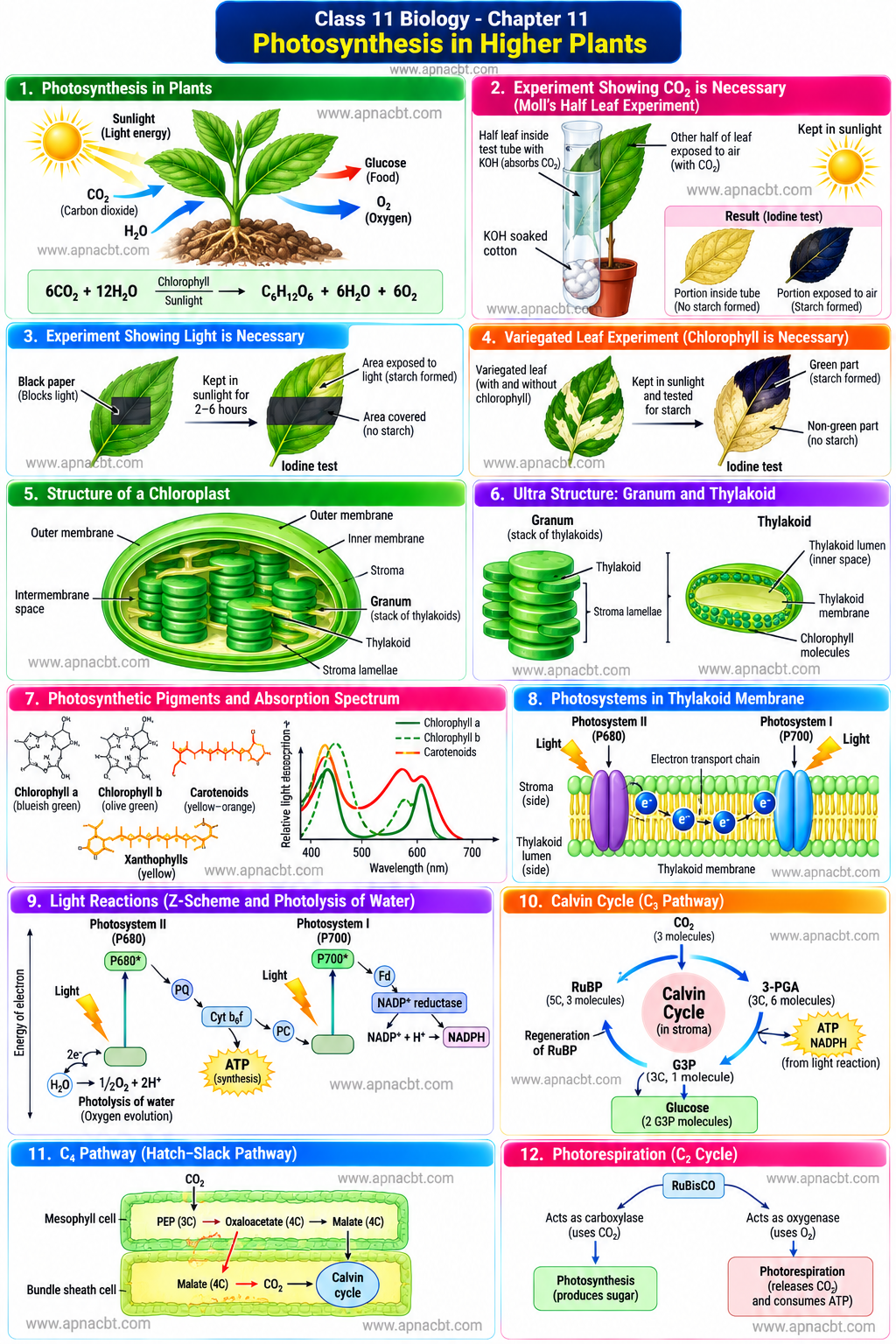
Diagram practice: Chloroplast structure, absorption and action spectra, Z-scheme, cyclic and non-cyclic photophosphorylation, Calvin cycle, C₄ pathway / Kranz anatomy and photorespiration pathway.
14. Short-Answer Questions (30)
Questions
- Define photosynthesis.
- Why is photosynthesis anabolic?
- Write the overall simplified equation.
- Who performed the half-leaf experiment and what did it prove?
- What is the role of KOH in Moll’s experiment?
- What does the variegated leaf experiment prove?
- What is the source of oxygen released during photosynthesis?
- Where does photosynthesis occur in plant cells?
- State one function of grana.
- Name the primary photosynthetic pigment.
- What are accessory pigments? Give examples.
- Define absorption spectrum.
- Define action spectrum.
- Name the reaction centres of PSI and PSII.
- What is photolysis of water? Give its equation.
- Define photophosphorylation.
- What is cyclic photophosphorylation?
- Give two differences between cyclic and non-cyclic photophosphorylation.
- What is chemiosmosis?
- Where does the Calvin cycle occur?
- Name the CO₂ acceptor, enzyme and first stable product of the Calvin cycle.
- Why is the Calvin cycle called C₃ pathway?
- What is the first stable product of the C₄ pathway?
- Expand PEP and name its CO₂-fixing enzyme.
- What is Kranz anatomy?
- Name two C₄ plants.
- Define photorespiration.
- Name the organelles involved in photorespiration.
- State Blackman’s law of limiting factors.
- What is PAR?
Detailed Answers
- Define photosynthesis.
Photosynthesis is the process by which green plants use light energy to synthesise organic food from CO₂ and water in the presence of photosynthetic pigments.
- Why is photosynthesis anabolic?
It builds complex organic carbohydrates from simpler inorganic substances, CO₂ and water.
- Write the overall simplified equation.
6CO₂ + 12H₂O + light → C₆H₁₂O₆ + 6H₂O + 6O₂.
- Who performed the half-leaf experiment and what did it prove?
Moll performed it; it proved that CO₂ is necessary for photosynthesis.
- What is the role of KOH in Moll’s experiment?
KOH absorbs CO₂ from the air inside the tube, depriving the enclosed leaf portion of carbon dioxide.
- What does the variegated leaf experiment prove?
It proves chlorophyll is necessary because only green parts form starch in light.
- What is the source of oxygen released during photosynthesis?
Water, as shown by oxygen-isotope labelling.
- Where does photosynthesis occur in plant cells?
Mainly in chloroplasts of leaf mesophyll cells.
- State one function of grana.
Grana provide thylakoid membrane surface containing pigments and components of light-dependent reactions.
- Name the primary photosynthetic pigment.
Chlorophyll a.
- What are accessory pigments? Give examples.
Pigments that absorb additional wavelengths and transfer energy to chlorophyll a; examples are chlorophyll b and carotenoids.
- Define absorption spectrum.
A graph showing the amount of light absorbed by a pigment at different wavelengths.
- Define action spectrum.
A graph showing the relative rate of photosynthesis at different wavelengths.
- Name the reaction centres of PSI and PSII.
P700 in PSI and P680 in PSII.
- What is photolysis of water? Give its equation.
Light-driven splitting of water: 2H₂O → 4H⁺ + 4e⁻ + O₂.
- Define photophosphorylation.
Formation of ATP from ADP and inorganic phosphate using light energy.
- What is cyclic photophosphorylation?
ATP formation in which excited electrons from PSI pass through carriers and return to PSI.
- Give two differences between cyclic and non-cyclic photophosphorylation.
Cyclic uses PSI only and forms ATP without O₂ or NADPH; non-cyclic uses PSI and PSII and forms ATP, NADPH and O₂.
- What is chemiosmosis?
ATP synthesis driven by proton movement down an electrochemical gradient through ATP synthase.
- Where does the Calvin cycle occur?
In the chloroplast stroma.
- Name the CO₂ acceptor, enzyme and first stable product of the Calvin cycle.
RuBP, RuBisCO and 3-PGA, respectively.
- Why is the Calvin cycle called C₃ pathway?
Because its first stable product is the three-carbon compound 3-PGA.
- What is the first stable product of the C₄ pathway?
Oxaloacetic acid (OAA), a four-carbon compound.
- Expand PEP and name its CO₂-fixing enzyme.
Phosphoenolpyruvate; PEP carboxylase.
- What is Kranz anatomy?
Wreath-like arrangement of bundle-sheath cells around vascular bundles in many C₄ leaves.
- Name two C₄ plants.
Maize and sugarcane.
- Define photorespiration.
A light-dependent pathway initiated by RuBisCO oxygenation of RuBP and involving chloroplasts, peroxisomes and mitochondria.
- Name the organelles involved in photorespiration.
Chloroplasts, peroxisomes and mitochondria.
- State Blackman’s law of limiting factors.
The rate of a process depending on several factors is limited by the factor nearest its minimum.
- What is PAR?
Photosynthetically active radiation, approximately 400–700 nm.
15. Long-Answer Questions (15)
Questions
- Explain the experiments proving the necessity of CO₂, light and chlorophyll.
- Describe chloroplast structure and division of labour.
- Describe photosynthetic pigments and their functions.
- Differentiate between absorption and action spectra. Describe Engelmann’s experiment.
- Explain the structure and roles of photosystems I and II.
- Explain light-dependent reactions and non-cyclic electron flow.
- Explain chemiosmosis and ATP synthesis in chloroplasts.
- Compare cyclic and non-cyclic photophosphorylation.
- Describe the three phases of the Calvin cycle.
- Explain the C₄ pathway and Kranz anatomy.
- Differentiate between C₃ and C₄ plants.
- Describe photorespiration and explain its effect on photosynthesis.
- Explain Blackman’s law and the major factors affecting photosynthesis.
- Discuss the effects of light, temperature, CO₂ and water on photosynthesis.
- Explain why C₄ plants are adapted to hot, bright and dry environments.
Detailed Answers
- Explain the experiments proving the necessity of CO₂, light and chlorophyll.
CO₂: Moll’s half-leaf experiment uses a destarched plant. Part of a leaf is enclosed in a tube with KOH-soaked cotton, which absorbs CO₂. After exposure to sunlight, the exposed portion turns blue-black with iodine while the enclosed portion does not, proving CO₂ is necessary. Light: A portion of a destarched leaf is covered with opaque paper. After exposure to sunlight and iodine testing, only the illuminated region forms starch. Chlorophyll: A variegated leaf exposed to light forms starch only in green regions, showing chlorophyll is essential.
- Describe chloroplast structure and division of labour.
A chloroplast is a double-membrane, DNA-containing semi-autonomous organelle. Its inner membrane encloses the stroma, which contains enzymes for carbon fixation including RuBisCO. Flattened thylakoids form stacks called grana and are connected by stroma lamellae. Thylakoid membranes contain photosynthetic pigments, photosystems and electron carriers; the enclosed space is the lumen. Light reactions occur on thylakoid membranes and generate ATP and NADPH. The Calvin cycle occurs in the stroma and uses these products to fix CO₂.
- Describe photosynthetic pigments and their functions.
Chlorophyll a is the primary reaction-centre pigment. Chlorophyll b is an accessory pigment that broadens light absorption and transfers energy to chlorophyll a. Carotenes and xanthophylls are carotenoids; they absorb additional wavelengths and protect the photosynthetic apparatus from photooxidation. Phycobilins are water-soluble pigments in red algae and cyanobacteria, including phycoerythrin and phycocyanin. Pigments occur in pigment-protein complexes in thylakoid membranes.
- Differentiate between absorption and action spectra. Describe Engelmann’s experiment.
An absorption spectrum plots the light absorbed by a pigment at different wavelengths, usually measured with a spectrophotometer. An action spectrum plots the relative photosynthetic rate at different wavelengths. Engelmann illuminated a filamentous green alga with different wavelengths and observed aerobic bacteria gathering where oxygen release was greatest. Bacteria accumulated mainly in blue and red regions, demonstrating that these wavelengths are most effective for photosynthesis.
- Explain the structure and roles of photosystems I and II.
Each photosystem has an antenna complex and a reaction centre. Antenna pigments absorb light and transfer energy to reaction-centre chlorophyll a. PSI has P700 and transfers excited electrons to ferredoxin, supporting NADP⁺ reduction or cyclic flow. PSII has P680; when excited it transfers electrons to an acceptor and receives replacement electrons from water through the oxygen-evolving complex. Water splitting releases protons and oxygen. PSII functions before PSI in non-cyclic electron transport.
- Explain light-dependent reactions and non-cyclic electron flow.
Light excites P680 in PSII, and electrons pass to a primary acceptor. Water is split to replace the electrons, releasing oxygen and protons. Electrons move through plastoquinone, cytochrome b₆f and plastocyanin to PSI. Light excites P700 and electrons pass to ferredoxin. NADP⁺ reductase transfers electrons to NADP⁺ to form NADPH. Electron transport builds a proton gradient, which drives ATP synthesis through ATP synthase. The products are ATP, NADPH and oxygen.
- Explain chemiosmosis and ATP synthesis in chloroplasts.
Photolysis releases protons into the thylakoid lumen. Electron transport contributes to proton accumulation in the lumen, while NADP⁺ reduction consumes protons from the stroma. This creates an electrochemical gradient across the thylakoid membrane. Protons return to the stroma through ATP synthase. Its CF₀ component forms a membrane channel and CF₁ is the catalytic headpiece facing the stroma. Proton flow drives ATP formation from ADP and inorganic phosphate.
- Compare cyclic and non-cyclic photophosphorylation.
Cyclic photophosphorylation involves PSI alone; excited electrons return to PSI through carriers. It produces ATP but no NADPH or oxygen, and water is not split. Non-cyclic photophosphorylation involves PSII and PSI; electrons originate from water and ultimately reduce NADP⁺. It produces ATP, NADPH and oxygen. Cyclic flow can provide additional ATP when the chloroplast needs more ATP relative to NADPH.
- Describe the three phases of the Calvin cycle.
The Calvin cycle occurs in the stroma. During carboxylation, CO₂ combines with RuBP through RuBisCO; the unstable six-carbon intermediate splits into two 3-PGA molecules. During reduction, ATP phosphorylates 3-PGA and NADPH reduces it to triose phosphate. Some triose phosphate is used to form carbohydrates. During regeneration, the remaining triose phosphate is rearranged and ATP is used to regenerate RuBP. For one glucose equivalent, six CO₂, 18 ATP and 12 NADPH are required.
- Explain the C₄ pathway and Kranz anatomy.
In C₄ leaves, bundle-sheath cells form a wreath-like layer around vascular bundles. Mesophyll PEP combines with CO₂ through PEP carboxylase to form OAA. OAA is converted to malate or aspartate and transported to bundle-sheath cells. Decarboxylation releases CO₂ near RuBisCO, which fixes it through the Calvin cycle. The remaining three-carbon compound returns to mesophyll cells, where ATP helps regenerate PEP. This concentrates CO₂ around RuBisCO and suppresses photorespiration.
- Differentiate between C₃ and C₄ plants.
C₃ plants initially fix CO₂ through RuBisCO in mesophyll cells, producing 3-PGA; RuBP is the acceptor and Calvin cycle occurs in mesophyll cells. C₄ plants initially fix CO₂ through PEP carboxylase in mesophyll cells, producing OAA; PEP is the acceptor. They have Kranz anatomy and the Calvin cycle occurs in bundle-sheath cells. C₄ plants concentrate CO₂ around RuBisCO and suppress photorespiration but use extra ATP to regenerate PEP. Wheat and rice are C₃ examples; maize and sugarcane are C₄ examples.
- Describe photorespiration and explain its effect on photosynthesis.
Photorespiration begins when RuBisCO oxygenates RuBP, producing 3-PGA and 2-phosphoglycolate. In chloroplasts, phosphoglycolate becomes glycolate, which moves to peroxisomes and is converted to glycine. Glycine enters mitochondria; two glycine molecules form serine, releasing CO₂ and ammonia. Serine returns to peroxisomes and is converted to glycerate, which re-enters chloroplasts and becomes 3-PGA. The pathway consumes energy and releases CO₂ without making sugar, lowering net photosynthetic efficiency. It is favoured by high temperature, high oxygen and low CO₂.
- Explain Blackman’s law and the major factors affecting photosynthesis.
Blackman’s law states that the rate of a process depending on several factors is controlled by the factor nearest its minimum. Internal factors include leaf size, age, orientation, mesophyll, chloroplast and chlorophyll content, and genotype. External factors include light, temperature, CO₂, water, oxygen and minerals. Light increases photosynthesis up to saturation; excess light can cause photoinhibition. Temperature affects enzyme-controlled reactions. Increasing CO₂ can raise photosynthesis until saturation. Water shortage closes stomata and reduces CO₂ entry. High O₂ promotes photorespiration in C₃ plants. Nitrogen and minerals are needed for chlorophyll and enzymes.
- Discuss the effects of light, temperature, CO₂ and water on photosynthesis.
Blue and red light are most effective; PAR is about 400–700 nm. Increasing light intensity raises photosynthesis up to saturation, while excessive light can damage pigments. Temperature affects enzyme-controlled carbon reactions, and each plant has an optimum. CO₂ is a major substrate; enrichment can increase photosynthesis until saturation. Water is a raw material and electron donor, but water deficit causes stomatal closure, reduces CO₂ entry and limits leaf expansion, decreasing photosynthesis.
- Explain why C₄ plants are adapted to hot, bright and dry environments.
C₄ plants initially fix CO₂ with PEP carboxylase, forming four-carbon acids. These acids transport CO₂ to bundle-sheath cells and release it near RuBisCO, maintaining a high local CO₂ concentration. This suppresses oxygenation of RuBP and photorespiration. C₄ plants can maintain photosynthesis with partially closed stomata, conserving water, and often have high productivity under strong light and high temperature. The pathway costs extra ATP for PEP regeneration, but this is advantageous under hot, bright conditions.
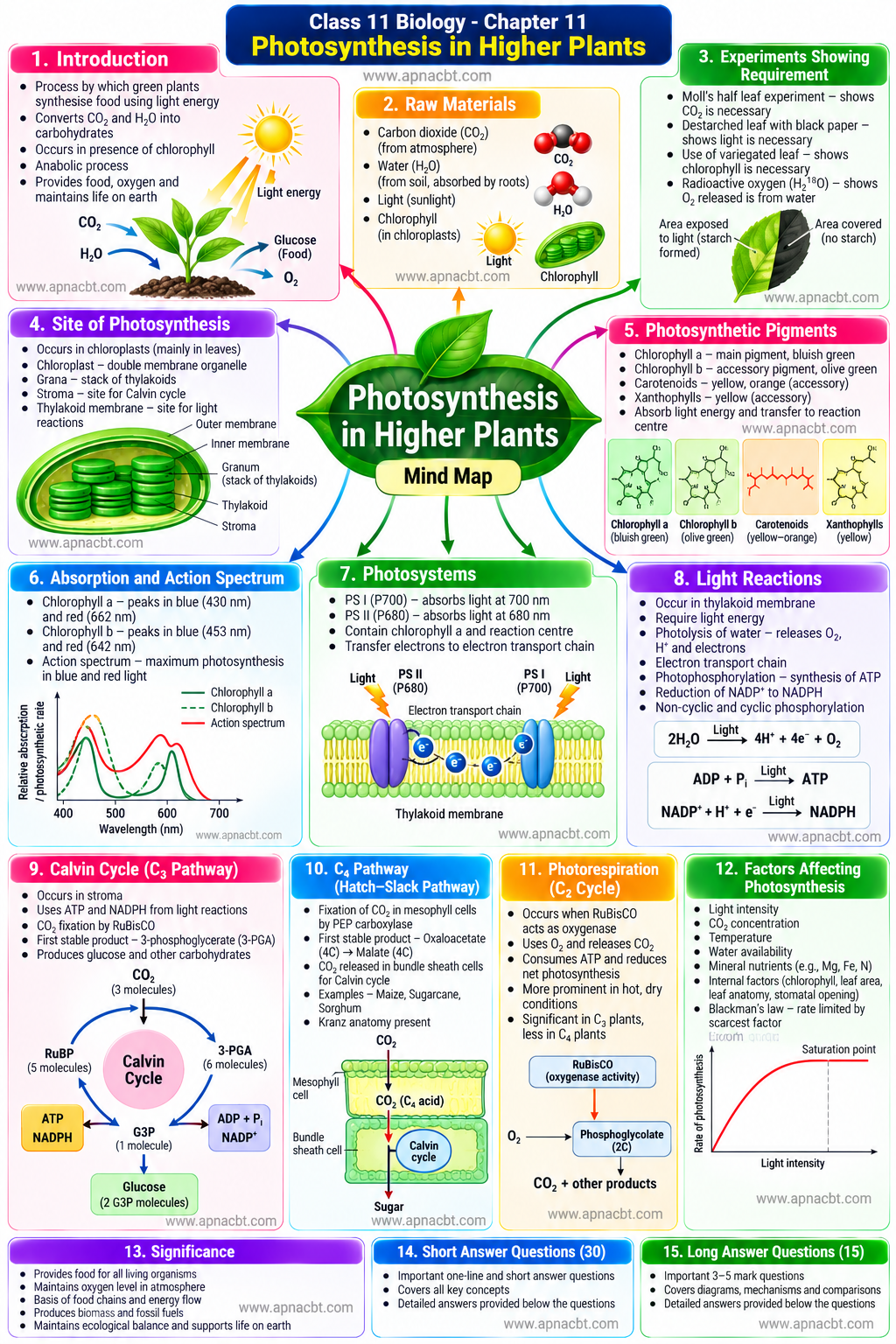
Mind Map – Photosynthesis in Higher Plants
Photosynthesis in Higher Plants – Important Diagrams
Cell Cycle and Cell Division Mind Map