


Chapter 3: Plant Kingdom – Class 11 Biology
Complete exam-oriented notes prepared from the supplied Plant Kingdom study PDF, organised for CBSE, IPE and NEET-UG. Expand each numbered section to study the topic, revise key facts and practise questions.
Coverage: Classification systems, algae, bryophytes, pteridophytes, gymnosperms, angiosperms, life cycles, comparisons and examination questions.
1. Introduction and Outline Classification of Kingdom Plantae
Kingdom Plantae includes multicellular, eukaryotic organisms that generally manufacture organic food by photosynthesis. Plants are major producers in terrestrial and aquatic ecosystems and release oxygen during photosynthesis.
Modern classification excludes fungi and prokaryotic organisms such as cyanobacteria from Plantae, even though some older systems grouped them with plants. The broad textbook outline divides plants into cryptogams (seedless plants) and phanerogams (seed plants).
| Major group | Meaning | Included groups |
|---|---|---|
| Cryptogams | Plants without seeds; reproductive structures are not conspicuous | Algae, Bryophytes, Pteridophytes |
| Phanerogams | Seed-bearing plants; reproductive structures are conspicuous | Gymnosperms, Angiosperms |
Remember: Algae are mainly thalloid and aquatic; bryophytes are non-vascular; pteridophytes are seedless vascular plants; gymnosperms bear naked seeds; angiosperms bear seeds enclosed in fruits.
2. Systems of Classification
Artificial system
Uses one or a few easily observed characters, such as habit, colour, leaf number or floral features. Pliny the Elder used an artificial system for plants and animals; Linnaeus also used sexual characters in plant classification.
- Advantages: simple, practical and convenient for identification.
- Limitations: unrelated organisms may be grouped together; vegetative characters are strongly influenced by the environment; natural and evolutionary relationships are not reliably represented.
Natural system
Uses many stable characters, including external morphology, anatomy, embryology and phytochemistry, to reveal natural affinities. Bentham and Hooker proposed an influential natural classification of seed plants in Genera Plantarum.
- Advantages: considers many characters, groups related organisms and indicates natural affinities.
- Limitations: does not always explain evolutionary history; classifications based on selected natural characters may still separate some related groups.
Phylogenetic system
Groups organisms according to common ancestry and evolutionary relationships. It uses fossil, morphological, anatomical, embryological, biochemical and genetic evidence. Eichler proposed an early phylogenetic system; Engler and Prantl published an influential phylogenetic arrangement.
- Advantages: reflects evolutionary relationships and integrates evidence from different fields.
- Limitations: may be difficult to use for routine identification and can change as new evidence appears.
Phenetic classification and modern taxonomic evidence
Phenetic classification compares overall similarities and differences among present-day organisms without necessarily reconstructing how each character evolved.
- Numerical taxonomy: uses many observable characters, codes and statistical/computer-based comparisons; each selected character is given comparable weight.
- Cytotaxonomy: uses chromosome number, structure and behaviour.
- Chemotaxonomy: uses chemical constituents such as proteins, amino acids, pigments, alkaloids and other metabolites.
- Cladistics: uses shared derived characters to infer branching evolutionary relationships, often represented by a cladogram.
Exam focus: Bentham and Hooker — natural system; Eichler — early phylogenetic system; numerical taxonomy — computer/statistical analysis; cytotaxonomy — chromosomes; chemotaxonomy — chemical constituents.
3. Algae: General Characteristics, Habitat and Thallus Organisation
Algae are chlorophyll-bearing, mostly aquatic, thalloid organisms. Their plant body is not differentiated into true roots, stems and leaves. They occur in freshwater, marine water, damp soil, on rocks and tree bark, and in associations with other organisms.
Algal thalli show wide variation: unicellular forms (Chlamydomonas, Chlorella), colonial forms (Volvox), unbranched filaments (Spirogyra), branched filaments and large seaweeds (Laminaria, Sargassum).
| Organisation | Example |
|---|---|
| Unicellular | Chlamydomonas, Chlorella |
| Colonial | Volvox |
| Filamentous | Ulothrix, Spirogyra |
| Large multicellular seaweed | Laminaria, Sargassum, Fucus |
Cell structure and pigments
Algal cells are eukaryotic and usually possess chloroplasts, mitochondria, endoplasmic reticulum, Golgi bodies and a nucleus. Common photosynthetic pigments include chlorophylls, carotenoids and group-specific accessory pigments.
Reproduction
- Vegetative: commonly by fragmentation or cell division.
- Asexual: by spores such as zoospores and other specialised spores.
- Sexual: by fusion of gametes; it may be isogamous, anisogamous or oogamous.
4. Reproduction and Life Cycles in Algae
- Isogamy: fusion of morphologically similar gametes; for example, in some species of Chlamydomonas and in Spirogyra.
- Anisogamy: fusion of dissimilar gametes, often differing in size or motility; Eudorina is a textbook example.
- Oogamy: fusion of a large, non-motile egg with a smaller male gamete; examples include Volvox and Fucus.
Algal life cycles may be haplontic, diplontic or haplodiplontic. In a haplodiplontic cycle, haploid gametophyte and diploid sporophyte generations alternate.
NEET distinction: Isogamy, anisogamy and oogamy describe the nature of gamete fusion; haplontic, diplontic and haplodiplontic describe the dominant/ploidy phases of the life cycle.
5. Economic Importance of Algae
- Algae contribute substantially to global carbon dioxide fixation and oxygen production.
- They are primary producers and form the base of many aquatic food chains.
- Porphyra, Laminaria and Sargassum are used as food in different regions.
- Algin is obtained from brown algae and is used as a hydrocolloid.
- Carrageenan is obtained from red algae and is used as a thickening/stabilising agent.
- Agar is obtained commercially from Gelidium and Gracilaria; it is used in microbial culture media and food products.
- Chlorella and Spirulina are protein-rich and used as food supplements.
6. Classification of Algae: Chlorophyceae, Phaeophyceae and Rhodophyceae
| Feature | Chlorophyceae (green) | Phaeophyceae (brown) | Rhodophyceae (red) |
|---|---|---|---|
| Habitat | Freshwater and marine; many habitats | Mostly marine | Mostly marine; some freshwater |
| Major pigments | Chlorophyll a, b; carotenoids | Chlorophyll a, c; fucoxanthin | Chlorophyll a, d; phycoerythrin and phycocyanin |
| Colour | Grass green | Olive/brown | Red |
| Cell wall | Cellulose, often pectose | Cellulose with gelatinous algin coating | Cellulose, pectin and polysulphate esters |
| Reserve food | Starch, often in association with pyrenoids | Laminarin and mannitol | Floridean starch |
| Flagella | Usually 2–8 equal, apical flagella in motile stages | Usually two unequal, laterally attached flagella | Flagellated stages absent |
| Examples | Chlamydomonas, Volvox, Ulothrix, Spirogyra, Chara | Ectocarpus, Dictyota, Laminaria, Sargassum, Fucus | Polysiphonia, Porphyra, Gracilaria, Gelidium, Batrachospermum |
Chlorophyceae
Green algae have chlorophyll a and b. Their cell wall commonly has an inner cellulose layer and an outer pectose layer. Chloroplasts may be cup-shaped, spiral, reticulate, plate-like or discoid. Pyrenoids occur in many members and are associated with food storage.
Phaeophyceae
Brown algae are mainly marine. Fucoxanthin masks the green pigments. The plant body may be differentiated into a holdfast, stipe and leaf-like frond. Reserve food is laminarin and mannitol. Motile reproductive cells commonly bear two unequal lateral flagella.
Rhodophyceae
Red algae contain phycoerythrin, which helps absorb blue-green light that penetrates deeper water. Their reserve food is floridean starch. Flagellated stages are absent. Batrachospermum is a freshwater red alga.
High-yield examples: Volvox — colonial green alga; Spirogyra — filamentous green alga; Sargassum — brown alga; Gelidium — agar source; Batrachospermum — freshwater red alga.
7. Bryophytes: General Features and Life Cycle
Bryophytes are small, non-vascular plants commonly found in moist and shady habitats. They are called the amphibians of the plant kingdom because they live on land but require water for fertilisation.
- True roots, stems and leaves are absent; rhizoids help in anchorage and absorption.
- Vascular tissues are absent.
- The dominant plant body is the haploid gametophyte.
- Sex organs are multicellular and jacketed: antheridia (male) and archegonia (female).
- Male antherozoids are motile and reach the egg through a film of water.
- The zygote remains within the archegonium and develops into a dependent diploid sporophyte.
- The sporophyte commonly has foot, seta and capsule; meiosis in the capsule produces haploid spores.
Life-cycle sequence: Spore (n) → gametophyte (n) → antheridia and archegonia → gametes → fertilisation → zygote (2n) → sporophyte (2n) → meiosis → spores (n).
8. Bryophytes: Liverworts, Hornworts and Mosses
| Group | Important characters | Examples |
|---|---|---|
| Hepaticopsida (liverworts) | Thalloid or leafy gametophyte; dorsiventral thallus in Marchantia; unicellular rhizoids; gemma cups may occur | Riccia, Marchantia, Porella |
| Anthocerotopsida (hornworts) | Thalloid gametophyte; long, horn-like sporophyte | Anthoceros |
| Bryopsida (mosses) | Leafy gametophyte; protonema stage; sporophyte differentiated into foot, seta and capsule | Funaria, Polytrichum, Sphagnum |
Liverworts
Marchantia has a dorsiventral, dichotomously branched thallus. Gemmae are multicellular asexual buds formed in gemma cups; after detachment they can grow into new plants. The sporophyte is dependent on the gametophyte.
Mosses
The moss life cycle begins with a spore that germinates into a green, branched protonema. Buds on the protonema develop into leafy gametophores. The sporophyte is usually differentiated into foot, seta and capsule.
Do not confuse: Protonema is characteristic of the moss life cycle; gemma cups are associated with Marchantia; horn-like sporophyte is characteristic of Anthoceros.
9. Economic and Ecological Importance of Bryophytes
- Peat: Sphagnum forms peat, which has been used as fuel.
- Water retention: Sphagnum can absorb and retain large quantities of water and is used in packing living plant material.
- Soil formation: mosses and lichens help colonise bare rocks and contribute to soil formation.
- Soil conservation: dense moss mats reduce the impact of rain and help prevent soil erosion.
- Ecological succession: bryophytes can act as pioneer vegetation in suitable habitats.
10. Pteridophytes: General Characteristics and Classification
Pteridophytes are seedless vascular plants, also called vascular cryptogams. They possess xylem and phloem and have a dominant, independent diploid sporophyte differentiated into true roots, stems and leaves.
- They commonly grow in moist, shady places, although some tolerate dry conditions; some are aquatic.
- Roots are generally adventitious. Leaves may be microphylls (e.g., Selaginella) or megaphylls/fronds (ferns).
- Sporangia occur on sporophylls; in some plants sporophylls form compact strobili or cones.
- Meiosis in spore mother cells produces haploid spores.
- Spores germinate into a small gametophyte called the prothallus in many ferns.
- The gametophyte bears antheridia and archegonia; water is required for fertilisation.
| Class/group | Diagnostic features | Examples |
|---|---|---|
| Psilopsida | Oldest known vascular plant group in traditional classification; simple aerial stems | Psilotum |
| Lycopsida | Microphyllous leaves; sporangia associated with sporophylls | Lycopodium, Selaginella |
| Sphenopsida | Jointed stems with nodes and internodes; whorled branches | Equisetum |
| Pteropsida | Large leaves/fronds; includes many ferns | Dryopteris, Pteris, Marsilea |
11. Homosporous and Heterosporous Pteridophytes; Seed Habit
Homosporous pteridophytes produce one kind of spore, generally giving rise to a bisexual gametophyte (e.g., Lycopodium and many ferns). Heterosporous pteridophytes produce two kinds of spores: small microspores and large megaspores (e.g., Selaginella and Salvinia).
| Feature | Homosporous | Heterosporous |
|---|---|---|
| Spore types | One type | Two types: microspores and megaspores |
| Gametophyte | Usually bisexual | Microspore forms male; megaspore forms female gametophyte |
| Examples | Lycopodium, Dryopteris | Selaginella, Salvinia |
Heterospory is evolutionarily important because retention and development of the female gametophyte within the megaspore, together with embryo development, represent steps towards the seed habit.
NEET focus: Selaginella and Salvinia are heterosporous. Heterospory is a key evolutionary precursor of seed habit, but these plants do not produce true seeds.
12. Pteridophytes: Reproduction, Life Cycle and Importance
The sporophyte bears sporangia on sporophylls. Spores germinate into gametophytes. The antheridium produces motile male gametes; the archegonium contains the egg. Water enables the male gamete to reach the egg. The zygote develops into an embryo and then a new sporophyte.
- Ferns are cultivated as ornamentals because of their attractive fronds.
- Equisetum has silica-rich stems and has been used for scouring and polishing.
- Azolla is used as a biofertiliser in rice fields because of its association with nitrogen-fixing cyanobacteria.
- Some pteridophytes help bind soil and reduce erosion; fossil pteridophyte vegetation contributed to coal deposits.
13. Gymnosperms: General Characteristics and Vegetative Features
Gymnosperms are seed-bearing plants in which ovules and seeds are not enclosed within an ovary; therefore, the seeds are described as naked seeds. They are mostly perennial woody trees or shrubs and are especially common in colder regions.
- The dominant plant body is the diploid sporophyte, differentiated into roots, stems and leaves.
- Roots are usually tap roots. Pinus roots may form mycorrhizal associations; Cycas has coralloid roots associated with nitrogen-fixing cyanobacteria.
- Stems may be unbranched (Cycas) or branched (Pinus, Cedrus).
- Leaves may be scale leaves and green foliage leaves. Needle-like leaves, thick cuticle and sunken stomata reduce water loss.
- Xylem generally contains tracheids; vessels occur in Gnetum, Ephedra and Welwitschia. Companion cells are absent from phloem.
14. Gymnosperms: Reproduction, Cones and Life Cycle
Gymnosperms are heterosporous. Microspores develop into pollen grains (male gametophytes) inside microsporangia. Megaspores develop within ovules and form the female gametophyte, which bears archegonia in many groups.
- Microsporophylls bearing microsporangia are arranged into male cones; megasporophylls bearing ovules form female reproductive structures.
- Cycas is dioecious: male and female reproductive structures occur on separate plants.
- Pinus is monoecious: male and female cones occur on the same plant.
- Pollination is generally by wind (anemophily). A pollen tube carries male gametes towards the archegonium; this is siphonogamy.
- After fertilisation, the zygote develops into an embryo and the ovule develops into a seed. No ovary or fruit is formed.
- The nutritive female gametophyte tissue commonly called endosperm in gymnosperms is haploid and develops before fertilisation.
Common question: Gymnosperm endosperm is haploid and pre-fertilisation in origin, unlike the typically triploid endosperm of angiosperms formed after double fertilisation.
15. Classification and Economic Importance of Gymnosperms
| Group | Representative | Key point |
|---|---|---|
| Cycadopsida | Cycas | Palm-like appearance; often unbranched stem; coralloid roots |
| Ginkgopsida | Ginkgo biloba | Only living representative; fan-shaped leaves; living fossil |
| Coniferopsida | Pinus, Cedrus, Sequoia | Conifers; commonly evergreen trees with needle-like leaves |
| Gnetopsida | Gnetum, Ephedra, Welwitschia | Vessels present in xylem; some features resemble angiosperms |
- Seeds of some gymnosperms are edible; Pinus yields pine nuts/chilgoza in certain species, and Cycas yields starch after appropriate processing.
- Softwood from Pinus, Cedrus and other conifers is used for timber and paper pulp.
- Resins and turpentine are obtained from conifers; Canada balsam is obtained from Abies.
- Ephedrine is obtained from Ephedra and taxol from Taxus; these have medicinal importance.
- Gymnosperm forests help stabilise soil on slopes and provide habitats.
16. Angiosperms: General Features and Monocot–Dicot Comparison
Angiosperms are flowering plants in which ovules are enclosed within an ovary and seeds are enclosed within fruits. They are the dominant group of plants in present-day terrestrial ecosystems and provide food, fodder, medicines, fibres, timber and other useful products.
| Character | Dicotyledons | Monocotyledons |
|---|---|---|
| Cotyledons | Two | One |
| Leaf venation | Usually reticulate | Usually parallel |
| Floral parts | Usually in 4s or 5s | Usually in 3s |
| Root system | Usually tap root | Usually fibrous/adventitious |
| Stem vascular bundles | Usually arranged in a ring; commonly open | Usually scattered; commonly closed |
| Examples | Pea, sunflower, mustard | Wheat, maize, lily |
Remember: These are general diagnostic trends. Use multiple characters together rather than relying on a single feature to identify a plant.
17. Alternation of Generations and Comparative Plant Kingdom Revision
| Group | Dominant generation | Vascular tissue | Reproductive unit / key feature |
|---|---|---|---|
| Algae | Variable; often gametophyte in haplontic forms | Absent | Thallus; spores or gametes |
| Bryophytes | Gametophyte | Absent | Spores; dependent sporophyte |
| Pteridophytes | Sporophyte | Present | Spores; independent prothallus in many forms |
| Gymnosperms | Sporophyte | Present | Naked seeds; cones; heterospory |
| Angiosperms | Sporophyte | Present | Flowers; seeds enclosed in fruits |
Alternation of generations is the succession of gametophyte and sporophyte phases in a plant life cycle. The gametophyte is haploid and produces gametes; the sporophyte is diploid and produces spores by meiosis.
Must-remember terms
- Thallus: plant body not differentiated into true root, stem and leaves.
- Protonema: juvenile, usually green filamentous stage of moss gametophyte.
- Prothallus: small gametophyte of many pteridophytes.
- Sporophyll: leaf or leaf-like structure bearing sporangia.
- Strobilus: compact arrangement of sporophylls.
- Heterospory: production of microspores and megaspores.
- Siphonogamy: delivery of male gametes to the archegonium through a pollen tube.
18. Short-Answer Questions (30)
Questions
- What are cryptogams and phanerogams?
- Name the three major groups of cryptogams.
- What is an artificial system of classification?
- Who proposed the natural classification of seed plants in Genera Plantarum?
- What is phylogenetic classification?
- Define numerical taxonomy.
- What is cytotaxonomy?
- What is chemotaxonomy?
- Define thallus.
- Name the three classes of algae described in the chapter.
- What is the reserve food in Chlorophyceae?
- What are the reserve foods in brown and red algae?
- Name the pigment responsible for the brown colour of brown algae.
- Why can red algae live at considerable depths in the sea?
- Give one freshwater red alga and one agar-producing alga.
- Why are bryophytes called amphibians of the plant kingdom?
- What are gemmae and where are they found?
- What is protonema?
- Name the three main groups of bryophytes.
- What is a prothallus?
- Differentiate homospory and heterospory.
- Name two heterosporous pteridophytes.
- Why is heterospory evolutionarily significant?
- What is a sporophyll?
- What are coralloid roots?
- Why are gymnosperms called naked-seeded plants?
- Distinguish monoecious and dioecious gymnosperms with examples.
- What is siphonogamy?
- State two differences between gymnosperm and angiosperm endosperm.
- Give two differences between monocots and dicots.
Answers
- What are cryptogams and phanerogams?
Cryptogams are seedless plants with inconspicuous reproductive structures; phanerogams are seed-bearing plants with conspicuous reproductive structures.
- Name the three major groups of cryptogams.
Algae, bryophytes and pteridophytes.
- What is an artificial system of classification?
A system based on one or a few superficial characters such as habit, colour or leaf features.
- Who proposed the natural classification of seed plants in Genera Plantarum?
George Bentham and Joseph Dalton Hooker.
- What is phylogenetic classification?
Classification based on evolutionary relationships and common ancestry.
- Define numerical taxonomy.
A method that compares many coded characters using statistical and computer-based analysis.
- What is cytotaxonomy?
Classification using chromosome number, structure and behaviour.
- What is chemotaxonomy?
Classification using chemical constituents such as proteins, amino acids, pigments and secondary metabolites.
- Define thallus.
A plant body not differentiated into true roots, stems and leaves.
- Name the three classes of algae described in the chapter.
Chlorophyceae, Phaeophyceae and Rhodophyceae.
- What is the reserve food in Chlorophyceae?
Mainly starch, often associated with pyrenoids.
- What are the reserve foods in brown and red algae?
Brown algae store laminarin and mannitol; red algae store floridean starch.
- Name the pigment responsible for the brown colour of brown algae.
Fucoxanthin.
- Why can red algae live at considerable depths in the sea?
Phycoerythrin absorbs blue-green wavelengths that penetrate deeper into water.
- Give one freshwater red alga and one agar-producing alga.
Batrachospermum is a freshwater red alga; Gelidium is an agar source.
- Why are bryophytes called amphibians of the plant kingdom?
They live on land but require water for fertilisation.
- What are gemmae and where are they found?
Gemmae are multicellular asexual buds found in gemma cups of Marchantia.
- What is protonema?
The green, filamentous juvenile stage formed when a moss spore germinates.
- Name the three main groups of bryophytes.
Liverworts (Hepaticopsida), hornworts (Anthocerotopsida) and mosses (Bryopsida).
- What is a prothallus?
The small, usually photosynthetic gametophyte of many pteridophytes.
- Differentiate homospory and heterospory.
Homospory produces one kind of spore; heterospory produces microspores and megaspores.
- Name two heterosporous pteridophytes.
Selaginella and Salvinia.
- Why is heterospory evolutionarily significant?
It is associated with separate male and female gametophytes and represents an important precursor to seed habit.
- What is a sporophyll?
A leaf or leaf-like structure that bears sporangia.
- What are coralloid roots?
Specialised roots of Cycas that house nitrogen-fixing cyanobacteria.
- Why are gymnosperms called naked-seeded plants?
Their ovules and seeds are not enclosed within an ovary or fruit.
- Distinguish monoecious and dioecious gymnosperms with examples.
Pinus is monoecious, with male and female cones on one plant; Cycas is dioecious, with reproductive structures on separate plants.
- What is siphonogamy?
The transfer of male gametes to the archegonium through a pollen tube.
- State two differences between gymnosperm and angiosperm endosperm.
Gymnosperm nutritive tissue is haploid and formed before fertilisation; angiosperm endosperm is usually triploid and formed after double fertilisation.
- Give two differences between monocots and dicots.
Monocots usually have one cotyledon and parallel venation; dicots usually have two cotyledons and reticulate venation.
19. Long-Answer Questions (15)
Questions
- Explain the major systems of plant classification and compare their merits.
- Describe the general characters, reproduction and economic importance of algae.
- Compare Chlorophyceae, Phaeophyceae and Rhodophyceae.
- Describe the bryophyte life cycle and explain why bryophytes depend on water.
- Differentiate liverworts, hornworts and mosses with examples.
- Explain the general characteristics, reproduction and importance of pteridophytes.
- What is heterospory? Explain its evolutionary significance.
- Describe the general characters and vegetative morphology of gymnosperms.
- Explain reproduction and the life cycle in gymnosperms.
- Compare gymnosperms and angiosperms.
- Explain the economic importance of gymnosperms with examples.
- Explain the main differences between monocotyledons and dicotyledons.
- Describe alternation of generations in plants and compare the dominant phases across major groups.
- Write an account of the evolutionary progression from bryophytes to seed plants.
Answers
- Explain the major systems of plant classification and compare their merits.
Artificial classification uses a few superficial characters and is simple but may group unrelated plants. Natural classification uses many stable characters, including morphology, anatomy and embryology, to show natural affinities; Bentham and Hooker are associated with this approach. Phylogenetic classification groups plants by common ancestry and evolutionary history using fossils, morphology, anatomy, embryology, biochemistry and genetics. Phenetic classification compares overall observable similarities, while numerical taxonomy applies statistical/computer methods to many characters. Cytotaxonomy uses chromosome evidence and chemotaxonomy uses chemical constituents. Modern classification combines multiple evidence sources.
- Describe the general characters, reproduction and economic importance of algae.
Algae are mainly aquatic, chlorophyll-bearing thalloid organisms without true roots, stems or leaves. Their forms range from unicellular Chlamydomonas and Chlorella to colonial Volvox, filamentous Spirogyra and large seaweeds. They reproduce vegetatively by fragmentation, asexually by spores and sexually by isogamy, anisogamy or oogamy. Life cycles may be haplontic, diplontic or haplodiplontic. Algae are major aquatic primary producers, fix carbon dioxide, release oxygen and provide food. Agar is obtained from Gelidium and Gracilaria; algin from brown algae; carrageenan from red algae; Chlorella and Spirulina are protein-rich supplements.
- Compare Chlorophyceae, Phaeophyceae and Rhodophyceae.
Chlorophyceae are green algae with chlorophyll a and b, cellulose/pectose walls and starch reserve; examples include Chlamydomonas, Volvox and Spirogyra. Phaeophyceae are mostly marine brown algae with chlorophyll a and c and fucoxanthin, cell walls with algin coating, laminarin and mannitol reserve, and often holdfast, stipe and frond; examples include Ectocarpus, Laminaria and Sargassum. Rhodophyceae are mostly marine red algae with chlorophyll a and d, phycoerythrin, floridean starch and no flagellated stages; examples include Polysiphonia, Porphyra and Gelidium.
- Describe the bryophyte life cycle and explain why bryophytes depend on water.
The dominant bryophyte plant is a haploid gametophyte bearing multicellular jacketed antheridia and archegonia. Antheridia produce motile antherozoids; the archegonium contains the egg. A film of water allows antherozoids to swim to the egg. Fertilisation forms a diploid zygote retained in the archegonium. It develops into a sporophyte, commonly differentiated into foot, seta and capsule. Meiosis in the capsule produces haploid spores, which germinate into new gametophytes. Water is essential for the movement of male gametes to the egg.
- Differentiate liverworts, hornworts and mosses with examples.
Liverworts (Hepaticopsida) often have a dorsiventral thallus or leafy body; Marchantia has gemma cups and unicellular rhizoids. Hornworts (Anthocerotopsida) have a thalloid gametophyte and a long horn-like sporophyte; Anthoceros is an example. Mosses (Bryopsida) have a protonema stage followed by leafy gametophores; their sporophyte is commonly differentiated into foot, seta and capsule. Examples include Funaria, Polytrichum and Sphagnum.
- Explain the general characteristics, reproduction and importance of pteridophytes.
Pteridophytes are seedless vascular plants with xylem and phloem. The dominant sporophyte is differentiated into roots, stems and leaves. Sporangia occur on sporophylls and produce haploid spores by meiosis. Spores germinate into gametophytes, often called prothalli, which bear antheridia and archegonia. Motile male gametes require water to reach the egg. Pteridophytes include ferns and horsetails. Ferns are ornamentals, Equisetum has silica-rich stems used for scouring, Azolla is a biofertiliser, and fossil forms contributed to coal deposits.
- What is heterospory? Explain its evolutionary significance.
Heterospory is the production of two kinds of spores: small microspores and large megaspores. Microspores develop into male gametophytes and megaspores into female gametophytes. Selaginella and Salvinia are examples. In some heterosporous plants, the megaspore is retained and the female gametophyte develops within it; embryo development occurs in association with the female gametophyte. These features represent important evolutionary steps towards the seed habit, although pteridophytes do not form true seeds.
- Describe the general characters and vegetative morphology of gymnosperms.
Gymnosperms are perennial seed plants with naked ovules and seeds. The dominant sporophyte is usually woody and differentiated into roots, stems and leaves. Roots are commonly tap roots; Pinus may have mycorrhiza and Cycas has coralloid roots with nitrogen-fixing cyanobacteria. Stems may be unbranched in Cycas or branched in Pinus. Leaves may be scale leaves and foliage leaves; needle-like leaves, thick cuticle and sunken stomata reduce water loss. Xylem generally has tracheids, with vessels in Gnetum, Ephedra and Welwitschia; companion cells are absent in phloem.
- Explain reproduction and the life cycle in gymnosperms.
Gymnosperms are heterosporous. Microsporangia produce microspores that develop into pollen grains, the reduced male gametophytes. Ovules contain the megasporangium; a megaspore develops into the female gametophyte, which commonly bears archegonia. Male and female reproductive structures occur in cones or cone-like arrangements. Pollination is usually by wind. A pollen tube carries male gametes towards the archegonium (siphonogamy). Fertilisation forms a zygote, which develops into an embryo; the ovule becomes a naked seed. No ovary or fruit is formed. The female gametophyte nutritive tissue is haploid and formed before fertilisation.
- Compare gymnosperms and angiosperms.
Both are vascular seed plants with a dominant sporophyte and reduced gametophytes. Gymnosperms have naked ovules/seeds, usually bear cones, lack flowers and fruits, and generally show wind pollination; their nutritive female gametophyte tissue is haploid and pre-fertilisation. Angiosperms bear flowers, enclose ovules in ovaries and seeds in fruits, and show double fertilisation; their endosperm is usually triploid and develops after fertilisation. Angiosperms include monocots and dicots and dominate most present-day terrestrial habitats.
- Explain the economic importance of gymnosperms with examples.
Gymnosperms provide timber and softwood for construction and paper pulp (Pinus, Cedrus and other conifers). Some produce edible seeds, including pine nuts/chilgoza. Cycas yields starch after suitable processing. Conifers provide resins and turpentine; Canada balsam is obtained from Abies. Ephedrine is obtained from Ephedra and taxol from Taxus. Gymnosperm forests also stabilise soil, protect watersheds and provide habitats.
- Explain the main differences between monocotyledons and dicotyledons.
Dicot seeds generally have two cotyledons, reticulate venation, floral parts in fours or fives, and usually a tap-root system. Monocot seeds have one cotyledon, parallel venation, floral parts in threes, and usually a fibrous/adventitious root system. In typical dicot stems, vascular bundles are arranged in a ring and are commonly open; in typical monocot stems, bundles are scattered and commonly closed. These are general patterns and should be assessed using several characters.
- Describe alternation of generations in plants and compare the dominant phases across major groups.
Alternation of generations is the succession of haploid gametophyte and diploid sporophyte phases. The gametophyte develops from a spore and produces gametes by mitosis. Fertilisation forms a diploid zygote that develops into the sporophyte. The sporophyte produces haploid spores by meiosis. In bryophytes, the gametophyte is dominant and the sporophyte is dependent. In pteridophytes, gymnosperms and angiosperms, the sporophyte is dominant; pteridophyte gametophytes may be independent, whereas seed-plant gametophytes are highly reduced and retained on or within sporophyte structures. Algal life cycles vary.
- Write an account of the evolutionary progression from bryophytes to seed plants.
Bryophytes are non-vascular and have a dominant gametophyte; they require water for fertilisation. Pteridophytes possess vascular tissues and a dominant independent sporophyte but reproduce by spores and still require water for fertilisation. Heterospory in some pteridophytes separates male and female gametophytes and represents a precursor to seed habit. Gymnosperms evolved seeds and pollen, reducing dependence on external water for fertilisation; their seeds are naked. Angiosperms evolved flowers, enclosed ovules, fruits and double fertilisation. These are broad evolutionary trends rather than a simple ladder of living groups.
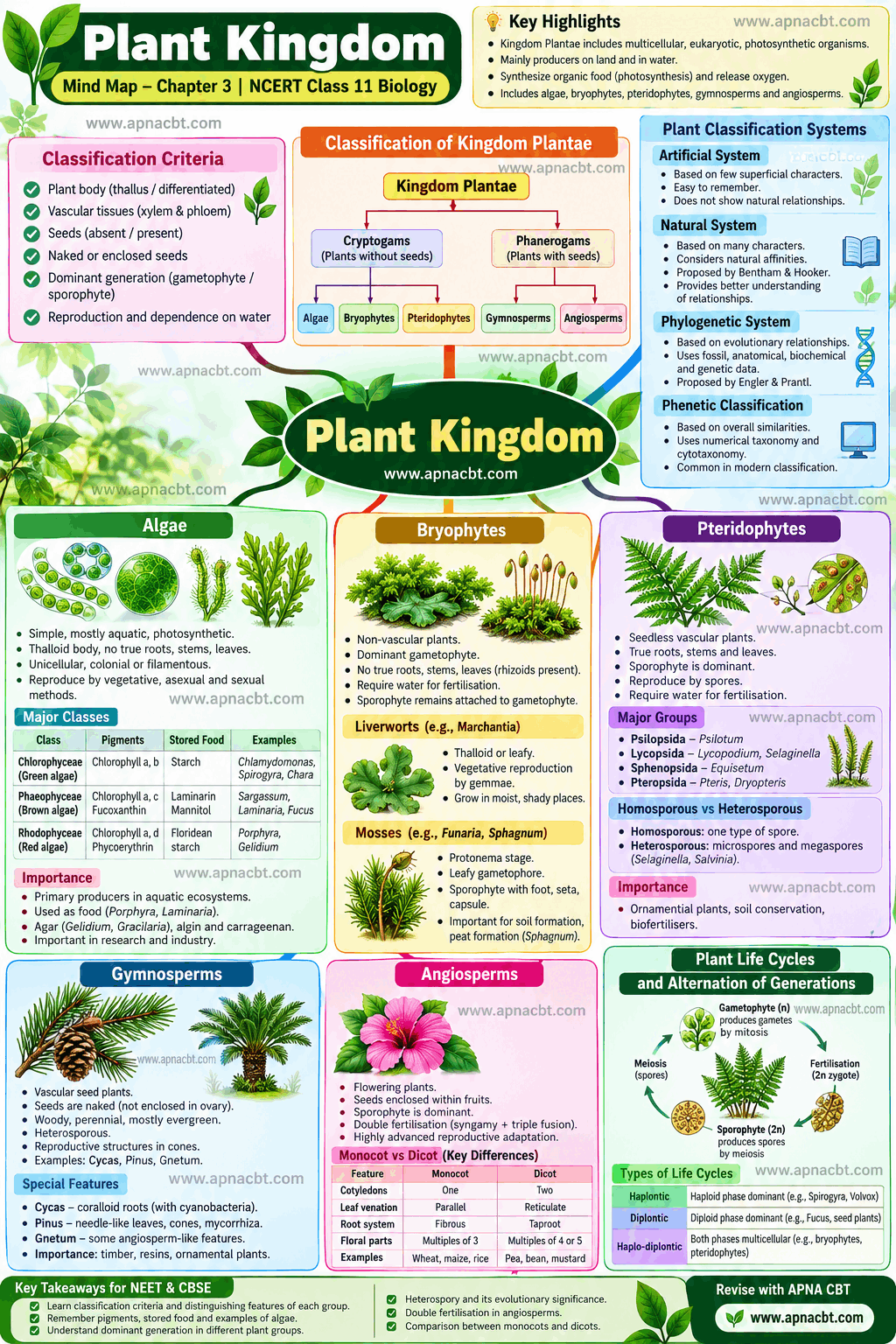
14. Plant Kingdom Mind Map – Class 11 Biology
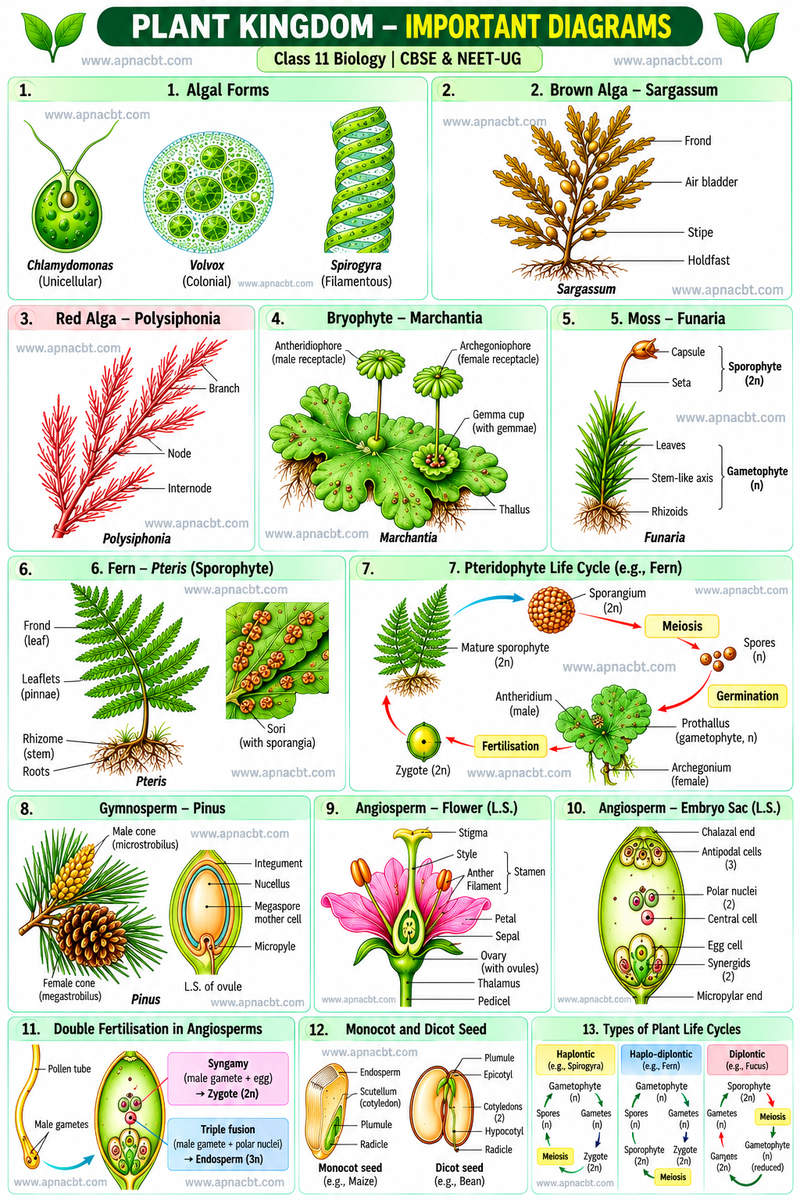
15. Plant Kingdom Important Diagrams
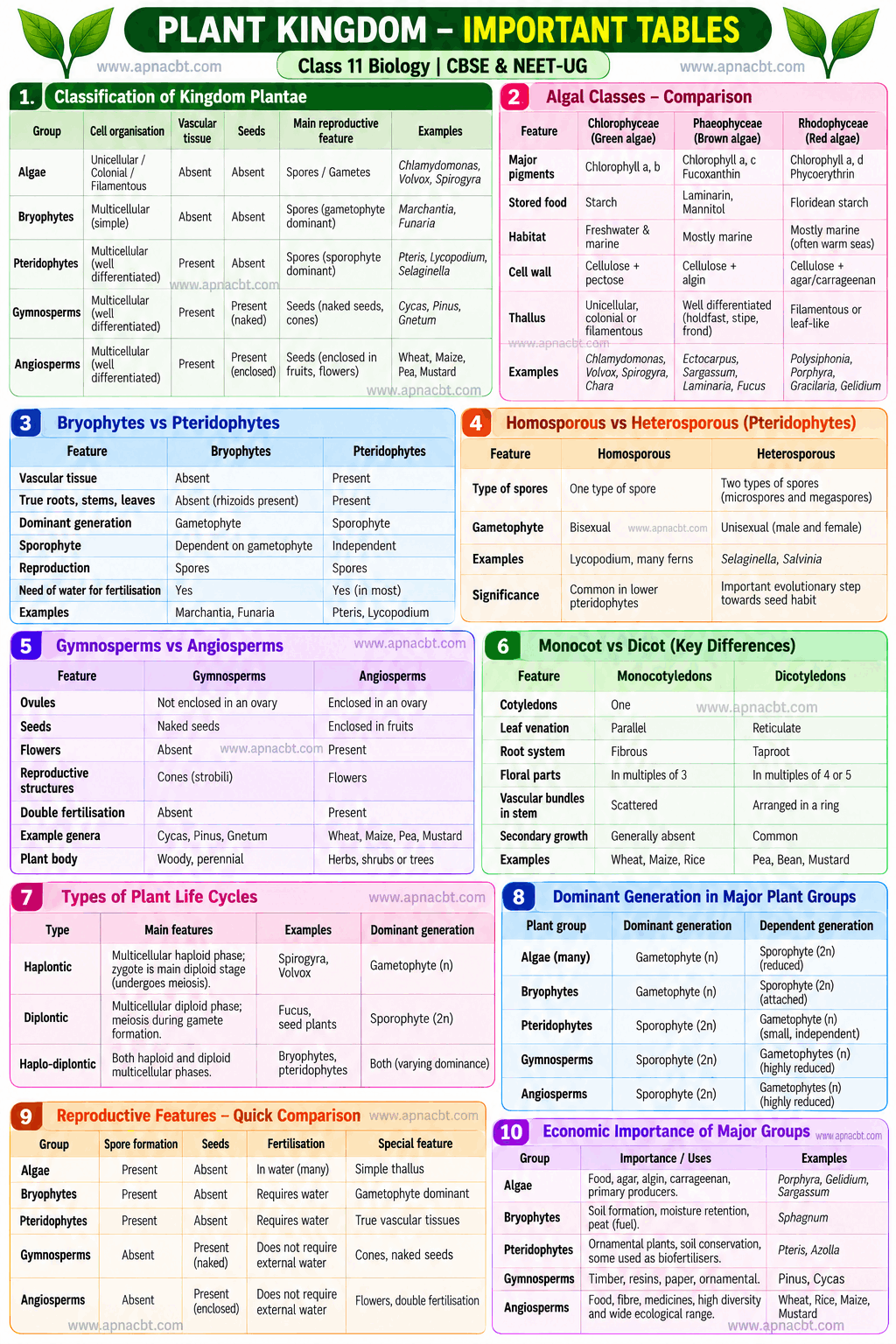
16. Plant Kingdom Important Tables
Final revision tip: For CBSE, practise explaining characteristics in complete sentences. For NEET, focus on examples, pigments, stored food, dominant generations, heterospory and double fertilisation. Cross-check detailed terminology and examples with your prescribed NCERT edition.

