


Chapter 2: Biological Classification
Class 11 Biology | NCERT-based lesson for CBSE, IPE and NEET-UG
This lesson explains the need and systems of classification, the five-kingdom system, Monera, Protista, Fungi, Plantae, Animalia, viruses, viroids, prions and lichens. It includes important definitions, comparisons, examples, diagrams to practise, high-yield facts and examination questions.
1. Biological Classification: Meaning, Need and Advantages
Biological classification is the scientific procedure of arranging organisms into groups in a hierarchical series on the basis of their similarities and differences. Groups are placed in categories such as species, genus, family, order, class, phylum or division, and kingdom.
Need for classification
- To recognise and precisely describe the basic units of classification.
- To devise an appropriate method of assigning species to a hierarchy based on similarities and relationships.
- To indicate evolutionary relationships among different organisms.
- To organise the enormous diversity of organisms so that it can be studied systematically.
Advantages of classification
- It makes the study of organisms systematic and convenient.
- It facilitates the identification of organisms.
- It is not practical to study every organism individually; studying representatives of each group helps us understand the group.
- It reveals relationships among various groups of organisms.
- It helps biologists interpret poorly visible structures of fossil organisms.
- It provides information about plants and animals from different regions.
- It reveals evolutionary trends.
2. History and Systems of Classification
Early classification was based mainly on the usefulness of organisms to humans, such as food, shelter and clothing. Gradually, scientific systems were developed using observable characters and relationships.
Important early contributions
- Aristotle: Made an early scientific attempt at classification. He grouped plants into trees, shrubs and herbs and divided animals into those with red blood (Enaima) and those without red blood (Anaima).
- Carolus Linnaeus: Proposed the two-kingdom classification system, placing organisms in Plantae and Animalia.
- Ernst Haeckel: Proposed the three-kingdom system and added Protista.
- H. F. Copeland: Proposed the four-kingdom system and separated Monera.
- R. H. Whittaker (1969): Proposed the five-kingdom classification system.
- Carl Woese and colleagues: Proposed the six-kingdom / three-domain approach based on molecular evidence, especially rRNA comparisons.
| System | Scientist | Kingdoms / main groups | Important point |
|---|---|---|---|
| Two-kingdom | Carolus Linnaeus | Plantae, Animalia | Did not separate prokaryotes from eukaryotes or fungi from plants. |
| Three-kingdom | Ernst Haeckel | Plantae, Animalia, Protista | Added Protista for many simple organisms. |
| Four-kingdom | H. F. Copeland | Monera, Protista, Plantae, Animalia | Separated prokaryotes as Monera. |
| Five-kingdom | R. H. Whittaker | Monera, Protista, Fungi, Plantae, Animalia | Separated fungi and considered several biological criteria. |
| Six-kingdom approach | Woese and colleagues | Archaebacteria, Eubacteria, Protista, Fungi, Plantae, Animalia | Separated Archaea from other bacteria using molecular evidence. |
Limitations of the two-kingdom system
- It did not distinguish prokaryotes from eukaryotes.
- It did not distinguish unicellular organisms from multicellular organisms.
- Fungi were placed with plants despite important differences in nutrition and cell-wall composition.
- It did not clearly separate photosynthetic and non-photosynthetic organisms.
- It did not adequately represent evolutionary relationships.
3. Five-Kingdom Classification: Criteria and Features
R. H. Whittaker proposed the five-kingdom classification in 1969. He used several criteria to arrange organisms into five kingdoms.
Criteria used by Whittaker
- Cell structure: Prokaryotic or eukaryotic organisation.
- Thallus/body organisation: Unicellular or multicellular organisation and degree of complexity.
- Mode of nutrition: Autotrophic or heterotrophic nutrition, including absorptive and ingestive modes.
- Reproduction: Asexual and sexual methods, including processes such as gamete formation and fusion.
- Ecological role: Producers, consumers and decomposers.
- Phylogenetic relationships: Evolutionary relationships among organisms.
| Kingdom | Cell type | Organisation | Cell wall | Nutrition | Examples |
|---|---|---|---|---|---|
| Monera | Prokaryotic | Unicellular | Usually present; absent in Mycoplasma | Autotrophic or heterotrophic | Bacteria, cyanobacteria, mycoplasma |
| Protista | Eukaryotic | Mainly unicellular | Present in many; absent in some | Autotrophic or heterotrophic | Amoeba, Euglena, diatoms |
| Fungi | Eukaryotic | Mostly multicellular; yeast unicellular | Usually chitin | Absorptive heterotrophs | Rhizopus, yeast, mushroom |
| Plantae | Eukaryotic | Mostly multicellular | Cellulose | Mostly photosynthetic autotrophs | Mosses, ferns, flowering plants |
| Animalia | Eukaryotic | Multicellular | Absent | Ingestive heterotrophs | Insects, fish, mammals |
Ecological roles
- Producers: Prepare organic food, usually by photosynthesis.
- Consumers: Obtain food by ingesting other organisms or organic matter.
- Decomposers: Break down dead organic matter and recycle nutrients.
4. Kingdom Monera: General Characteristics and Bacterial Cell Structure
Kingdom Monera includes all prokaryotic organisms. They are generally unicellular and lack a membrane-bound nucleus and membrane-bound organelles. Bacteria occur in soil, water, air, extreme habitats and inside other organisms.
General characteristics
- Cells are prokaryotic, usually small and unicellular.
- The genetic material is generally a naked, circular DNA molecule in the nucleoid; plasmids may also occur.
- Ribosomes are 70S, made of 50S and 30S subunits.
- Membrane-bound organelles such as mitochondria, chloroplasts, Golgi bodies and endoplasmic reticulum are absent.
- Nutrition may be autotrophic or heterotrophic.
- Reproduction is mainly asexual by binary fission; genetic recombination can occur through transformation, transduction and conjugation.
Important components of a bacterial cell
| Component | Structure / function |
|---|---|
| Glycocalyx | Outermost covering; may form a loose slime layer or a thick capsule. Protects against desiccation and other harmful conditions and may aid attachment and virulence. |
| Cell wall | Rigid covering that gives shape and prevents osmotic lysis; usually made of peptidoglycan (murein). |
| Plasma membrane | Selectively permeable phospholipid bilayer with proteins; carries out transport and several metabolic functions. |
| Cytoplasm | Semifluid matrix containing enzymes, ribosomes, reserve materials and other cell components. |
| Nucleoid | Region containing the bacterial chromosome; not surrounded by a nuclear membrane. |
| Plasmid | Small, self-replicating, extrachromosomal DNA molecule that may carry useful traits such as antibiotic resistance. |
| Ribosomes | 70S particles responsible for protein synthesis; consist of 50S and 30S subunits. |
| Flagellum | Locomotory structure consisting of filament, hook and basal body. |
| Pili / fimbriae | Hair-like structures involved in attachment; specialised sex pili participate in conjugation. |
| Inclusion bodies | Non-living reserve or storage structures such as phosphate, glycogen or gas inclusions. |
Mesosomes: Older textbook descriptions refer to mesosomes as infoldings of the plasma membrane associated with respiration and DNA-related functions. They are not recognised as genuine structures in modern bacterial cell biology; many were artefacts of chemical fixation.
5. Bacteria: Shapes, Nutrition, Respiration and Flagellation
Shapes of bacteria
| Shape | Description | Example |
|---|---|---|
| Coccus | Spherical | Staphylococcus |
| Bacillus | Rod-shaped | Bacillus |
| Vibrio | Comma-shaped | Vibrio cholerae |
| Spirillum | Spiral-shaped | Spirillum |
Nutrition in bacteria
Autotrophic bacteria synthesise organic food from inorganic substances.
- Photoautotrophs: Use light energy. Examples include Chlorobium, Chromatium and Rhodospirillum. Some use bacteriochlorophyll and do not release oxygen during photosynthesis.
- Chemoautotrophs: Obtain energy by oxidising inorganic substances such as ammonia, nitrite, hydrogen or sulphur compounds. Examples include Nitrosomonas and Nitrobacter.
Heterotrophic bacteria obtain organic food from other sources.
- Saprophytic: Feed on dead and decaying organic matter.
- Parasitic: Obtain food from living hosts and may cause disease.
- Symbiotic: Live in mutually beneficial association, e.g. Rhizobium in legume root nodules.
Respiration-based categories
| Type | Oxygen requirement | Example |
|---|---|---|
| Obligate aerobes | Require oxygen for growth and respiration | Many nitrifying bacteria |
| Obligate anaerobes | Oxygen is harmful; grow without it | Clostridium botulinum |
| Facultative anaerobes | Can grow with or without oxygen, switching metabolism | Escherichia coli |
| Microaerophiles | Require oxygen at lower-than-atmospheric concentration | Campylobacter species |
Flagellar arrangements
- Atrichous: No flagella.
- Monotrichous: One flagellum at one pole; e.g. Vibrio cholerae.
- Amphitrichous: Flagellum or tuft at both poles.
- Lophotrichous: A tuft of flagella at one pole.
- Peritrichous: Flagella distributed over the entire surface; e.g. Escherichia coli.
Gram staining
Gram-positive bacteria retain the primary stain and appear violet because of their thick peptidoglycan wall. Gram-negative bacteria do not retain the primary stain after decolourisation and take the counterstain, appearing pink or red; they have a thinner peptidoglycan layer and an outer membrane.
6. Bacterial Reproduction, Genetic Recombination and Economic Importance
Asexual reproduction
- Binary fission: The bacterial cell replicates its DNA and divides into two daughter cells. It is the common method under favourable conditions.
- Sporulation: Some bacteria form resistant structures, including endospores, under unfavourable conditions. Endospores are survival structures, not reproductive spores; one cell generally forms one endospore, which can germinate when conditions improve.
Genetic recombination
Typical sexual reproduction involving meiosis and gamete formation is absent in bacteria. Genetic material can be exchanged through parasexual processes.
| Process | Meaning | Important scientist / example |
|---|---|---|
| Transformation | Uptake of free DNA from the surrounding environment by a competent bacterial cell. | Griffith’s experiment (1928); Avery, MacLeod and McCarty demonstrated DNA as the transforming principle (1944). |
| Transduction | Transfer of bacterial DNA from one cell to another through a bacteriophage. | Zinder and Lederberg (1952). |
| Conjugation | Direct transfer of DNA between bacterial cells through cell-to-cell contact, commonly involving a conjugative plasmid and pilus. | Lederberg and Tatum (1946), in Escherichia coli. |
Economic importance of bacteria
| Useful effects | Examples / uses |
|---|---|
| Decomposition | Recycle nutrients by breaking down dead plants, animals and wastes. |
| Food fermentation | Lactic acid bacteria help convert milk into curd and other fermented foods. |
| Industrial fermentation | Acetobacter species are used in vinegar production. |
| Antibiotics | Streptomyces species produce several antibiotics. |
| Nitrogen cycle | Azotobacter and Rhizobium fix nitrogen; Nitrosomonas and Nitrobacter participate in nitrification. |
| Fibre processing | Some bacteria help in retting plant fibres such as jute. |
| Sewage treatment | Microorganisms help break down organic wastes. |
Harmful effects
- Human diseases: tuberculosis—Mycobacterium tuberculosis; cholera—Vibrio cholerae; tetanus—Clostridium tetani; leprosy—Mycobacterium leprae.
- Animal diseases: anthrax—Bacillus anthracis.
- Plant diseases: citrus canker—Xanthomonas citri; bacterial blight of rice—Xanthomonas oryzae; crown gall—Agrobacterium tumefaciens.
- Food poisoning: toxins produced by Clostridium botulinum cause botulism.
7. Archaebacteria: Methanogens, Halophiles and Thermoacidophiles
Archaea are prokaryotes that differ from typical bacteria in cell-wall composition, membrane lipids and molecular characteristics. Their cell walls lack bacterial peptidoglycan. Many are adapted to extreme environments, although archaea also occur in ordinary habitats.
| Group | Habitat | Important features | Examples |
|---|---|---|---|
| Methanogens | Anaerobic marshes, sewage digesters and digestive tracts of ruminants | Produce methane from carbon dioxide and hydrogen or other substrates; strict anaerobes. | Methanobacterium, Methanococcus |
| Halophiles | Highly saline lakes, salt pans and salt marshes | Adapted to high salt concentrations; some use light-driven bacteriorhodopsin. | Halobacterium, Haloferax |
| Thermoacidophiles | Hot, acidic springs and other high-temperature acidic environments | Adapted to high temperatures and low pH; many oxidise sulphur compounds. | Sulfolobus, Thermoplasma |
Importance of archaea
- Methanogens are important in biogas production.
- Thermophilic enzymes are useful in biotechnology and industrial processes.
- Extremophilic archaea provide useful enzymes and biomolecules for research.
8. Eubacteria: Cyanobacteria and Mycoplasma
Cyanobacteria (blue-green algae)
Cyanobacteria are photosynthetic prokaryotes that carry out oxygenic photosynthesis. They contain chlorophyll a, carotenoids and phycobilin pigments. They may be unicellular, colonial or filamentous.
- They have a prokaryotic cell organisation, 70S ribosomes and a nucleoid.
- Photosynthetic thylakoid membranes contain pigments.
- Food reserves include cyanophycean starch and other storage materials.
- Filamentous forms may possess a mucilaginous sheath.
- Some filamentous cyanobacteria possess heterocysts, specialised cells that provide a low-oxygen environment for nitrogen fixation.
- Asexual reproduction in many filamentous forms occurs by fragmentation into hormogonia.
Heterocysts and nitrogen fixation
Heterocysts are specialised thick-walled cells in certain filamentous cyanobacteria. They protect nitrogenase from oxygen and are important sites of biological nitrogen fixation. Examples include Anabaena and Nostoc.
Economic importance of cyanobacteria
- Some colonise bare and barren land and contribute to soil formation.
- Nitrogen-fixing cyanobacteria enrich paddy fields and other soils.
- They contribute to aquatic food chains as primary producers.
- Some are used as food or supplements.
Mycoplasma / PPLO
Mycoplasmas are very small prokaryotic organisms that completely lack a cell wall. They are therefore pleomorphic, meaning they can vary in shape. They may survive in low-oxygen conditions, and some cause diseases in plants and animals.
- Discovered by Nocard and Roux (1898) in cattle suffering from pleuropneumonia.
- They are resistant to antibiotics that act on cell-wall synthesis, such as penicillin.
- They reproduce mainly by binary fission and other cell-division processes.
- Plant disease example: little leaf of brinjal; animal disease example: contagious bovine pleuropneumonia.
9. Kingdom Protista: General Characteristics and Nutrition
Kingdom Protista was proposed by Ernst Haeckel (1886). It includes mainly unicellular eukaryotic organisms. Protists form a diverse group and are commonly found in aquatic environments.
General characteristics
- Cells are eukaryotic, usually unicellular and microscopic.
- Many are aquatic or occur in moist habitats.
- Locomotion may occur by flagella, cilia or pseudopodia.
- When present, cilia and flagella generally have a 9 + 2 arrangement of microtubules.
- Nutrition may be photosynthetic, holozoic, saprobic, parasitic or mixotrophic.
- Asexual reproduction may occur by binary fission, multiple fission, budding or other methods; sexual reproduction may involve meiosis and syngamy.
- Protists include important aquatic producers, decomposers, parasites and symbionts.
Modes of nutrition
| Mode | Description | Examples |
|---|---|---|
| Photosynthetic / holophytic | Food is synthesised using light energy. | Diatoms, many dinoflagellates, Euglena |
| Holozoic | Food is captured and ingested as particles. | Amoeba, Paramecium |
| Saprobic / saprotrophic | Enzymes are released onto organic matter; soluble products are absorbed. | Slime moulds |
| Parasitic | Food is obtained from a living host. | Plasmodium, Entamoeba, Trypanosoma |
| Mixotrophic | More than one mode of nutrition is used. | Euglena |
| Symbiotic | Two organisms live in a mutually beneficial association. | Trichonympha in the gut of termites |
Reproduction in protists
Asexual reproduction commonly occurs by binary fission, multiple fission, budding, plasmotomy or spore formation. Sexual reproduction involves the formation and fusion of gametes or nuclei, producing genetic variation.
10. Protistan Algae: Chrysophytes, Diatoms and Desmids
Photosynthetic protists are mainly unicellular eukaryotic organisms. Many occur as phytoplankton and are major primary producers in aquatic ecosystems.
Chrysophytes
Chrysophytes include diatoms and golden algae such as desmids. They occur in freshwater and marine habitats. Many are planktonic; some occur at the bottom of water bodies or on moist soil.
Diatoms
- Mostly microscopic, unicellular and photosynthetic; occur in freshwater and marine environments.
- Their cell wall is impregnated with silica and forms a shell called a frustule.
- The frustule consists of two overlapping halves: the larger epitheca and smaller hypotheca, fitting together like a box and lid.
- They contain photosynthetic pigments including chlorophyll a, chlorophyll c and fucoxanthin.
- They reproduce mainly by binary fission; sexual reproduction also occurs.
- Their siliceous remains accumulate to form diatomaceous earth.
Economic importance of diatoms
- Diatomaceous earth is used in filtration and purification of oils, syrups and liquids.
- It is used as a mild abrasive and polishing material.
- It is used as an insulating and sound-absorbing material.
- Diatoms are important primary producers in aquatic ecosystems.
- Some diatoms are useful indicators of water quality.
Desmids / golden algae
Desmids are mostly freshwater unicellular algae. Their cells commonly show two symmetrical halves. They are associated with clean, unpolluted water and can be useful as indicators of water quality.
11. Dinoflagellates and Euglenoids
Dinoflagellates
- Mostly marine, unicellular and photosynthetic; many are planktonic.
- The cell is often covered by stiff cellulose plates, giving an armoured appearance.
- Two flagella are present: one transverse and one longitudinal, producing a spinning movement.
- Some species cause red tides when they multiply rapidly and pigment the water.
- Some are bioluminescent and produce visible light.
- Examples: Gonyaulax, Gymnodinium, Noctiluca, Ceratium and Pyrocystis.
Red tides: Dense blooms of certain dinoflagellates, such as Gonyaulax, can discolour water and may release toxins harmful to fish and other animals.
Euglenoids
- Mostly unicellular, freshwater organisms, commonly found in ponds, ditches and damp habitats.
- They lack a rigid cellulose cell wall; a flexible protein-rich covering called a pellicle surrounds the cell.
- They usually possess two flagella, often one long and one short.
- An eyespot or stigma containing light-sensitive pigment helps detect light.
- They contain chlorophyll a and b and can photosynthesise.
- They may also ingest or absorb organic food; therefore, they are mixotrophic.
- Food is stored as paramylon.
- Reproduction commonly occurs by longitudinal binary fission.
- Example: Euglena.
| Feature | Dinoflagellates | Euglenoids |
|---|---|---|
| Common habitat | Mostly marine | Mostly freshwater |
| Covering | Often cellulose plates | Flexible pellicle |
| Flagella | Two, usually transverse and longitudinal | Usually two, one long and one short |
| Special feature | Red tides and bioluminescence in some | Eyespot and mixotrophic nutrition |
| Example | Gonyaulax | Euglena |
12. Slime Moulds and Protozoan Protists
Slime moulds
- Slime moulds are consumer-decomposer protists that commonly grow on decaying leaves, twigs and other organic matter.
- Under suitable conditions they form an aggregation or plasmodium, which may spread over the substratum.
- The plasmodium is a multinucleate mass of protoplasm without distinct cell boundaries.
- During unfavourable conditions, they form fruiting structures that produce spores.
- Spores are often resistant and can survive adverse conditions.
Protozoan protists
Protozoans are heterotrophic protists. They may be free-living or parasitic and are traditionally grouped by their locomotory structures and life-history features.
| Group | Features | Examples |
|---|---|---|
| Amoeboid protozoans | Move and capture food using pseudopodia; many live in freshwater, seawater or moist soil; some are parasitic. | Amoeba, Entamoeba |
| Flagellated protozoans | Possess flagella; may be free-living or parasitic. | Trypanosoma, Giardia |
| Ciliated protozoans | Use numerous cilia for locomotion and food movement; have a definite body shape. | Paramecium |
| Sporozoans | Mostly parasitic; infectious stages or spores occur in the life cycle. | Plasmodium |
Important examples and diseases
- Entamoeba histolytica causes amoebic dysentery.
- Plasmodium causes malaria.
- Trypanosoma causes sleeping sickness in humans.
- Giardia causes giardiasis.
13. Kingdom Fungi: General Characteristics, Structure and Nutrition
Fungi are eukaryotic, achlorophyllous, heterotrophic organisms with absorptive nutrition. Most are multicellular, although yeast is unicellular. Their cell walls generally contain chitin and their reserve food is glycogen and oils.
General characteristics
- Fungi occur in soil, water, on decaying matter and on or inside living organisms.
- Most are terrestrial; some are aquatic.
- They may be saprophytic, parasitic or symbiotic.
- They lack chlorophyll and absorb dissolved nutrients from their surroundings.
- Most fungi grow well in warm, moist and slightly acidic conditions.
Fungal structure
- The body of most fungi consists of a network of fine thread-like structures called hyphae.
- The interwoven mass of hyphae is called the mycelium.
- Hyphae may be septate (with cross-walls) or aseptate/coenocytic (without regular septa and often multinucleate).
- Some fungi are unicellular, e.g. yeast.
- Hyphae may form compact structures such as rhizomorphs and sclerotia.
Types of fungal hyphae and mycelial organisation
| Term | Meaning |
|---|---|
| Septate hyphae | Hyphae divided by cross-walls called septa. |
| Coenocytic hyphae | Aseptate, multinucleate hyphae. |
| Prosenchyma | Loosely arranged hyphae in which individual hyphae remain distinguishable. |
| Pseudoparenchyma | Closely packed hyphae that resemble parenchymatous tissue. |
| Rhizomorph | Root-like strand of hyphae that helps in perennation and absorption. |
| Sclerotium | Compact, hardened resting structure formed by aggregated hyphae. |
Nutrition
- Saprotrophic: Secrete enzymes onto dead organic matter and absorb soluble products.
- Parasitic: Obtain nutrients from living hosts; specialised absorbing structures called haustoria may occur.
- Symbiotic: Live in mutually beneficial associations, such as lichens and mycorrhizae.
14. Reproduction in Fungi
Fungi reproduce by vegetative, asexual and sexual methods.
Vegetative reproduction
- Fragmentation: A piece of mycelium grows into a new individual.
- Fission: A cell divides into two daughter cells, as in some yeasts.
- Budding: A small outgrowth develops and separates, as in yeast.
- Sclerotia / rhizomorphs: Some resting or perennating structures can give rise to new growth.
Asexual reproduction
| Spore type | Characteristics | Examples |
|---|---|---|
| Zoospores | Motile, usually flagellated spores formed in zoosporangia. | Albugo, Phytophthora |
| Sporangiospores | Non-motile spores formed inside a sporangium. | Rhizopus, Mucor |
| Conidia | Non-motile spores produced externally on conidiophores. | Aspergillus, Penicillium |
| Chlamydospores | Thick-walled resting spores formed by enlargement and wall thickening of hyphal cells. | Several fungi |
| Arthrospores / oidia | Formed by fragmentation of hyphae into individual cells. | Some fungi and yeast-like forms |
Sexual reproduction
Sexual reproduction generally involves three stages:
- Plasmogamy: Fusion of the cytoplasm of two compatible cells.
- Karyogamy: Fusion of two nuclei to form a diploid nucleus.
- Meiosis: Reduction division that restores the haploid condition and produces genetically varied spores.
In many fungi, plasmogamy and karyogamy are separated by a dikaryotic stage in which two genetically distinct haploid nuclei coexist in one cell.
15. Major Classes of Fungi: Phycomycetes, Ascomycetes, Basidiomycetes and Deuteromycetes
Comparative overview
| Group | Mycelium | Asexual spores | Sexual spores / structures | Examples |
|---|---|---|---|---|
| Phycomycetes | Usually aseptate and coenocytic | Zoospores or aplanospores in sporangia | Oospores or zygospores, depending on group | Rhizopus, Mucor, Albugo |
| Ascomycetes | Branched, septate; yeast unicellular | Conidia | Ascospores inside asci; asci often arranged in ascocarps | Aspergillus, Penicillium, Neurospora, yeast |
| Basidiomycetes | Branched, septate; often dikaryotic secondary mycelium | Usually absent; fragmentation may occur | Basidiospores formed externally on basidia | Agaricus, Puccinia, Ustilago |
| Deuteromycetes | Usually branched and septate | Conidia | Sexual stage absent or unknown in the traditional grouping | Alternaria, Colletotrichum, Trichoderma |
Phycomycetes
- Commonly found in aquatic habitats, moist places or on decaying organic matter; some are plant parasites.
- Mycelium is generally aseptate and coenocytic.
- Asexual reproduction occurs through zoospores or aplanospores formed in sporangia.
- Sexual reproduction may be isogamous, anisogamous or oogamous, producing zygospores or oospores depending on the organism.
- Examples: Mucor, Rhizopus and Albugo.
Ascomycetes (sac fungi)
- Mostly multicellular and filamentous; yeast is unicellular.
- Mycelium is branched and septate.
- Asexual reproduction commonly occurs by conidia produced externally on conidiophores.
- Sexual spores called ascospores are formed inside sac-like structures called asci.
- Asci may be arranged in fruiting bodies called ascocarps.
- Examples: Aspergillus, Penicillium, Neurospora, Morchella, Claviceps and Saccharomyces.
Types of ascocarps
| Ascocarp | Shape / opening | Example |
|---|---|---|
| Cleistothecium | Closed, usually spherical | Penicillium (traditional textbook example) |
| Apothecium | Open, cup-shaped | Peziza |
| Perithecium | Flask-shaped with an opening | Neurospora |
Economic importance of Ascomycetes
- Penicillium notatum and P. chrysogenum are associated with penicillin production; Alexander Fleming discovered penicillin.
- Saccharomyces cerevisiae is baker’s yeast and is used in fermentation.
- Morels and truffles are edible fungi.
- Neurospora is used in genetics and biochemical research.
- Aspergillus flavus can produce aflatoxins, which are carcinogenic.
- Claviceps purpurea causes ergot disease in cereals such as rye.
Basidiomycetes (club fungi)
- Include mushrooms, bracket fungi, puffballs, rusts and smuts.
- Mycelium is branched and septate; the secondary mycelium is commonly dikaryotic.
- Sex organs are generally absent; plasmogamy occurs by fusion of compatible vegetative cells.
- Karyogamy and meiosis occur in the club-shaped basidium.
- Usually four haploid basidiospores are formed externally on each basidium.
- Basidia are arranged in fruiting bodies called basidiocarps.
- Examples: Agaricus, Puccinia and Ustilago.
Economic importance: Agaricus mushrooms and young puffballs are edible; Puccinia causes rust and Ustilago causes smut diseases of crops; some species decompose wood and form mycorrhizal associations.
Deuteromycetes (imperfect fungi)
- Traditional artificial group of fungi in which the sexual stage is not known or has not been observed.
- Mycelium is generally branched and septate.
- Asexual reproduction commonly occurs through conidia.
- When a sexual stage is discovered, the fungus is reclassified in the appropriate group, commonly Ascomycetes or Basidiomycetes.
- Examples: Alternaria, Colletotrichum and Trichoderma.
- Plant diseases include red rot of sugarcane (Colletotrichum falcatum), leaf spot of rice (Helminthosporium oryzae), tikka disease of groundnut (Cercospora personata) and early blight of potato (Alternaria solani).
16. Mycorrhiza, Lichens and Economic Importance of Fungi
Mycorrhiza
Mycorrhiza is a mutualistic association between a fungus and the roots of a higher plant.
- The fungus receives carbohydrates and other organic nutrients from the plant.
- The plant benefits from increased absorption of water and mineral nutrients, especially phosphate.
- Fungal hyphae extend the effective absorptive surface of roots.
- Mycorrhiza may be ectomycorrhizal (fungus forms a sheath around the root) or endomycorrhizal (fungal structures occur within root tissues).
- Examples include associations involving Pinus and many other plants.
Lichens
A lichen is a composite association between a fungus and a photosynthetic partner, which may be a green alga or a cyanobacterium.
| Partner | Name | Functions |
|---|---|---|
| Fungal partner | Mycobiont | Provides protection, attachment, water retention and mineral absorption. |
| Algal / cyanobacterial partner | Phycobiont (or photobiont) | Performs photosynthesis and provides organic food; cyanobacterial partners may fix nitrogen. |
Ecological importance of lichens
- Lichens are pioneer organisms on bare rocks and other harsh habitats.
- They help weather rocks and contribute organic matter, assisting soil formation and ecological succession.
- They can grow in extreme environments and tolerate desiccation.
- A decline in lichen abundance may indicate air pollution, especially sulphur dioxide pollution.
Forms of lichens
- Crustose: Crust-like thallus closely attached to the surface.
- Foliose: Leaf-like, flattened thallus.
- Fruticose: Shrubby or branched thallus.
- Leprose: Powdery thallus.
- Filamentous: Thread-like thallus.
Economic uses of lichens
- Some species are used as food, e.g. Cetraria islandica and Cladonia rangiferina.
- Orcein and other dyes are obtained from certain lichens.
- Litmus is obtained from lichen species such as Roccella.
- Some lichens are sources of aromatic compounds used in perfumery.
- Usnic acid from certain lichens has antimicrobial properties and has been investigated for medicinal use.
17. Viruses, Viroids and Prions
Viruses
Viruses are acellular infectious agents that reproduce only inside living host cells. Outside a host cell they are metabolically inactive and may be crystallised. A complete infectious virus particle is called a virion.
Basic structure
- Nucleic acid: DNA or RNA; a virus contains one type of nucleic acid as its genome.
- Capsid: Protein coat surrounding the nucleic acid; built from capsomeres.
- Envelope: Present in some viruses; derived mainly from host-cell membranes and containing viral proteins.
- Shape: Viruses may be helical, polyhedral, complex or other forms.
Examples
| Virus | Genetic material / feature | Host or disease |
|---|---|---|
| Tobacco mosaic virus (TMV) | Single-stranded RNA; helical capsid | Causes mosaic disease in tobacco and related plants. |
| Bacteriophage | Many textbook examples have DNA; complex head-tail structure | Infects bacteria. |
| HIV | Two copies of single-stranded RNA; reverse transcriptase | Infects human immune cells and causes AIDS. |
| Adenovirus | Double-stranded DNA | Can cause respiratory and other infections. |
| Influenza virus | Segmented single-stranded RNA | Causes influenza. |
Living and non-living characteristics of viruses
| Living characteristics | Non-living characteristics |
|---|---|
| Contain genetic material. | Acellular; no cytoplasm or organelles. |
| Replicate inside living host cells. | Cannot reproduce independently outside a host. |
| Show mutation and evolution. | No independent metabolism or respiration. |
| Interact with host-cell machinery. | Can be crystallised in the extracellular state. |
Virus replication
Viruses attach to host cells, enter or deliver their genome, use host machinery to synthesise viral components, assemble new particles and release them. Bacteriophages may follow a lytic cycle, in which new phages are produced and the host cell lyses, or a lysogenic cycle, in which the viral genome is maintained in the host genome or cell for a period before entering productive replication.
Viroids
- Discovered by T. O. Diener (1971) while studying potato spindle tuber disease.
- Small infectious agents consisting of naked, circular or linear single-stranded RNA.
- They lack a protein coat and are known mainly as plant pathogens.
Prions
- Infectious protein particles without nucleic acid.
- Associated with abnormal folding of the prion protein.
- Can cause degenerative diseases of the nervous system.
- Examples of prion diseases include scrapie in sheep, bovine spongiform encephalopathy (mad cow disease), Creutzfeldt-Jakob disease and kuru.
| Feature | Virus | Viroid | Prion |
|---|---|---|---|
| Basic material | DNA or RNA with protein coat | Naked RNA | Abnormally folded protein |
| Protein coat | Present | Absent | Not a capsid; infectious protein itself |
| Typical hosts / effects | Plants, animals, bacteria and other organisms | Mainly plants | Animals and humans; nervous-system diseases |
| Key scientist | Virus research developed through several scientists | T. O. Diener | Stanley Prusiner |
18. High-Yield Revision: Kingdom Comparisons, Examples and Important Diagrams
Quick comparison of Monera, Protista and Fungi
| Feature | Monera | Protista | Fungi |
|---|---|---|---|
| Nuclear organisation | Prokaryotic | Eukaryotic | Eukaryotic |
| Organisation | Unicellular | Mainly unicellular | Mostly multicellular; yeast unicellular |
| Cell wall | Usually peptidoglycan in typical bacteria; absent in Mycoplasma | Variable | Usually chitin |
| Nutrition | Autotrophic or heterotrophic | Autotrophic or heterotrophic | Absorptive heterotrophic |
| Examples | E. coli, Nostoc, Mycoplasma | Amoeba, Euglena, diatoms | Rhizopus, yeast, Agaricus |
Scientists and discoveries
| Scientist | Contribution |
|---|---|
| Aristotle | Early scientific classification of plants and animals. |
| Carolus Linnaeus | Two-kingdom system; binomial nomenclature. |
| Ernst Haeckel | Three-kingdom system; Protista. |
| H. F. Copeland | Four-kingdom system; Monera separated. |
| R. H. Whittaker | Five-kingdom classification (1969). |
| Carl Woese | Three-domain system based on molecular evidence. |
| T. O. Diener | Discovery of viroids. |
| Stanley Prusiner | Prions and prion diseases. |
| Frederick Griffith | Transformation experiment (1928). |
| Avery, MacLeod and McCarty | DNA identified as the transforming principle (1944). |
| Zinder and Lederberg | Transduction (1952). |
| Lederberg and Tatum | Bacterial conjugation (1946). |
Important diagrams to practise
- Ultrastructure of a bacterial cell with labels.
- Ultrastructure of a cyanobacterial cell and a heterocyst.
- Structure of Euglena and a dinoflagellate.
- Frustule of a diatom and its epitheca and hypotheca.
- Fungal hyphae: septate and coenocytic.
- Conidiophore of Aspergillus or Penicillium; Rhizopus sporangium.
- Ascocarp types: cleistothecium, apothecium and perithecium.
- Basidium with basidiospores.
- Tobacco mosaic virus and bacteriophage.
- Lichen thallus and mycorrhizal association.
19. Short-Answer Questions – 30 Important Questions
Questions
- Define biological classification and state any three objectives of classification.
- List four advantages of biological classification.
- How did Aristotle classify plants and animals?
- Name the scientists associated with the two-, three-, four- and five-kingdom systems.
- State any four limitations of the two-kingdom classification system.
- List the six criteria used by Whittaker for five-kingdom classification.
- Differentiate prokaryotic and eukaryotic cells with two points.
- Write any four general characteristics of Kingdom Monera.
- What are the functions of glycocalyx and bacterial cell wall?
- What is a plasmid? State one significance of plasmids.
- What are 70S ribosomes? Name their subunits.
- Differentiate photoautotrophic and chemoautotrophic bacteria with examples.
- Define obligate aerobes, obligate anaerobes and facultative anaerobes with examples.
- Explain any four types of bacterial flagellar arrangements.
- Differentiate transformation, transduction and conjugation.
- What are methanogens? Mention their habitat and importance.
- Differentiate halophiles and thermoacidophiles.
- What are cyanobacteria? Mention two important features.
- What are heterocysts? State their function and give two examples of cyanobacteria having them.
- Why are mycoplasmas called pleomorphic organisms?
- Write four general characteristics of Kingdom Protista.
- Explain any four modes of nutrition found in protists with examples.
- What is a diatom frustule? Name its two overlapping halves.
- Mention four economic uses of diatomaceous earth.
- Why do some dinoflagellates cause red tides? Give two examples.
- What is a pellicle? Mention its importance in Euglena.
- Differentiate septate and coenocytic fungal hyphae.
- Differentiate ascospores and basidiospores.
- What are mycorrhiza and lichen? Name the partners in a lichen.
- Differentiate viruses, viroids and prions on the basis of their basic composition.
Detailed Answers
- Biological classification is the scientific arrangement of organisms into hierarchical groups based on similarities and differences. Its objectives include recognising and describing organisms, assigning them to appropriate categories and indicating evolutionary relationships.
- It makes study systematic, facilitates identification, allows representative organisms to be used to understand groups, reveals relationships among organisms, helps interpret fossils and shows evolutionary trends.
- Aristotle classified plants into trees, shrubs and herbs using simple morphological characters. He divided animals into Enaima (animals with red blood) and Anaima (animals without red blood).
- Carolus Linnaeus—two kingdoms; Ernst Haeckel—three kingdoms; H. F. Copeland—four kingdoms; R. H. Whittaker—five kingdoms.
- The two-kingdom system did not distinguish prokaryotes from eukaryotes, unicellular from multicellular organisms, fungi from plants, or adequately reflect evolutionary relationships and different modes of nutrition.
- Whittaker used cell structure, body/thallus organisation, mode of nutrition, reproduction, ecological role and phylogenetic relationships.
- Prokaryotic cells lack a membrane-bound nucleus and membrane-bound organelles; eukaryotic cells possess a membrane-bound nucleus and organelles. Prokaryotic ribosomes are typically 70S, whereas cytoplasmic ribosomes in eukaryotes are typically 80S.
- Monerans are prokaryotic, generally unicellular, lack a membrane-bound nucleus, possess 70S ribosomes, show diverse nutrition and commonly reproduce by binary fission.
- Glycocalyx is the outer covering that protects the cell and can aid attachment and virulence. The cell wall gives shape, provides mechanical support and protects against osmotic lysis.
- A plasmid is a small, self-replicating extrachromosomal DNA molecule, usually circular and double-stranded. It may carry genes for antibiotic resistance or other advantageous traits and can sometimes be transferred between bacteria.
- 70S ribosomes are prokaryotic ribosomes made of a 50S large subunit and a 30S small subunit. They carry out protein synthesis.
- Photoautotrophic bacteria use light energy to synthesise organic food, e.g. Chlorobium and Chromatium. Chemoautotrophic bacteria obtain energy by oxidising inorganic substances, e.g. Nitrosomonas and Nitrobacter.
- Obligate aerobes require oxygen; obligate anaerobes are harmed by oxygen and grow without it, e.g. Clostridium botulinum; facultative anaerobes can grow with or without oxygen, e.g. Escherichia coli.
- Atrichous bacteria have no flagella; monotrichous bacteria have one polar flagellum; lophotrichous bacteria have a tuft at one pole; amphitrichous bacteria have flagella at both poles; peritrichous bacteria have flagella distributed over the surface.
- Transformation is uptake of free environmental DNA; transduction is DNA transfer through bacteriophages; conjugation is direct DNA transfer between bacterial cells through contact, commonly involving a conjugative plasmid and pilus.
- Methanogens are methane-producing archaea found in anaerobic habitats such as the rumen of cattle and other ruminants, marshes and biogas digesters. They help produce biogas from organic wastes.
- Halophiles are adapted to highly saline environments such as salt lakes. Thermoacidophiles live in hot, acidic environments such as acidic hot springs.
- Cyanobacteria are photosynthetic prokaryotes that perform oxygenic photosynthesis. They contain chlorophyll a and phycobilin pigments and may be unicellular, colonial or filamentous.
- Heterocysts are specialised thick-walled cells in some filamentous cyanobacteria. They provide a low-oxygen environment for nitrogen fixation. Examples include Anabaena and Nostoc.
- Mycoplasmas lack a rigid cell wall. Their cell membrane does not maintain one fixed shape, so the organisms can occur in different forms; this condition is called pleomorphism.
- Protists are eukaryotic, mostly unicellular organisms; many are aquatic; locomotion may occur by cilia, flagella or pseudopodia; nutrition is diverse; reproduction may be asexual or sexual.
- Photosynthetic nutrition occurs in diatoms and many dinoflagellates; holozoic nutrition occurs in Amoeba; saprobic nutrition occurs in slime moulds; parasitic nutrition occurs in Plasmodium and Entamoeba; mixotrophy occurs in Euglena.
- A frustule is the siliceous cell-wall covering of a diatom. It consists of two overlapping halves called the epitheca and hypotheca.
- Diatomaceous earth is used for filtration and purification of liquids, polishing and fine abrasion, insulation and sound absorption. It is also useful in some industrial processes.
- Rapid multiplication of certain dinoflagellates can produce dense blooms that discolour water; this is called a red tide. Examples include Gonyaulax and Gymnodinium.
- A pellicle is a flexible protein-rich covering around Euglena. It provides support and helps maintain cell shape while allowing flexibility because a rigid cellulose wall is absent.
- Septate hyphae have cross-walls called septa that divide the hypha into compartments. Coenocytic hyphae lack regular septa and contain a continuous multinucleate cytoplasm.
- Ascospores are sexual spores formed inside sac-like asci in Ascomycetes. Basidiospores are sexual spores formed externally on club-shaped basidia in Basidiomycetes.
- Mycorrhiza is a mutualistic association between fungi and plant roots. A lichen is an association between a fungus (mycobiont) and an alga or cyanobacterium (phycobiont).
- Viruses contain DNA or RNA enclosed in a protein capsid; viroids consist of naked infectious RNA without a protein coat; prions are infectious proteins without nucleic acid.
20. Long-Answer Questions – 15 Important Questions
Questions
- Explain the need and advantages of biological classification. Trace the development of classification systems from two kingdoms to five kingdoms.
- Describe Whittaker’s five-kingdom classification and explain the criteria used in proposing it.
- Give a detailed account of Kingdom Monera, including the structure of a typical bacterial cell.
- Explain the different modes of nutrition, respiration and flagellar arrangements in bacteria with suitable examples.
- Describe bacterial reproduction and explain transformation, transduction and conjugation.
- Discuss the useful and harmful effects of bacteria with suitable examples.
- Describe the three major groups of archaebacteria and explain their adaptations and importance.
- Describe the general characteristics, cell structure, heterocysts, reproduction and economic importance of cyanobacteria. Add a note on Mycoplasma.
- Explain the general characteristics, nutrition and reproduction of Kingdom Protista. Describe its major groups.
- Describe diatoms, dinoflagellates and euglenoids, highlighting their characteristic features and economic or ecological importance.
- Describe the general characteristics, structure, nutrition and methods of reproduction in fungi.
- Compare Phycomycetes, Ascomycetes, Basidiomycetes and Deuteromycetes with respect to mycelium, spores, reproduction and examples.
- Explain mycorrhiza and lichens, including the roles of their partners and their ecological and economic importance.
- Describe the structure, replication and living and non-living characteristics of viruses. Add notes on viroids and prions.
- Write a comprehensive comparison of Monera, Protista, Fungi, Plantae and Animalia, giving important examples and distinguishing characters.
Detailed Answers
- Need, advantages and history of classification: Biological classification is the systematic arrangement of organisms into hierarchical groups based on similarities and differences. It is needed to identify and describe organisms, organise biological diversity, assign species to appropriate categories and understand evolutionary relationships. It makes study convenient, helps identify organisms, allows representative species to explain group characteristics, reveals relationships and helps interpret fossil evidence. Early classification was practical and based on human use. Aristotle used simple morphology and divided plants into trees, shrubs and herbs and animals into those with and without red blood. Linnaeus proposed two kingdoms—Plantae and Animalia. Haeckel added Protista to form three kingdoms. Copeland separated Monera to form four kingdoms. Whittaker proposed five kingdoms—Monera, Protista, Fungi, Plantae and Animalia—in 1969. Later molecular studies, especially rRNA comparisons, supported the separation of Archaea and Bacteria.
- Whittaker’s five-kingdom classification: Whittaker divided organisms into Monera, Protista, Fungi, Plantae and Animalia. Monera includes prokaryotes; Protista includes mainly unicellular eukaryotes; Fungi includes absorptive heterotrophs with chitinous walls; Plantae includes mainly photosynthetic multicellular organisms with cellulose walls; and Animalia includes multicellular ingestive heterotrophs without cell walls. The six major criteria were cell structure, body/thallus organisation, mode of nutrition, reproduction, ecological role and phylogenetic relationships. The system recognised the fundamental difference between prokaryotes and eukaryotes, separated fungi from plants and considered ecological functions and evolutionary relationships.
- Kingdom Monera and bacterial cell structure: Monera includes prokaryotic organisms, generally unicellular, without a membrane-bound nucleus or membrane-bound organelles. Typical bacterial cells possess an outer glycocalyx, cell wall, plasma membrane and cytoplasm. The glycocalyx may be a loose slime layer or a thick capsule and protects the cell. The cell wall, usually containing peptidoglycan, maintains shape and prevents osmotic lysis. The plasma membrane controls transport and carries out metabolic activities. The cytoplasm contains 70S ribosomes, reserve inclusions and enzymes. Genetic material is present in a nucleoid as a generally circular DNA molecule; plasmids may carry additional genes. Flagella help in locomotion, pili help in attachment and specialised sex pili participate in conjugation. Bacteria may be cocci, bacilli, vibrios or spirilla. They show autotrophic or heterotrophic nutrition and commonly reproduce by binary fission.
- Bacterial nutrition, respiration and flagella: Autotrophic bacteria prepare organic food using light or chemical energy. Photoautotrophs use light; examples include Chlorobium and Chromatium. Chemoautotrophs oxidise inorganic substances; examples include Nitrosomonas and Nitrobacter. Heterotrophic bacteria may be saprophytic, parasitic or symbiotic; Rhizobium is a symbiotic nitrogen fixer. On the basis of oxygen requirement, bacteria may be obligate aerobes, obligate anaerobes, facultative anaerobes or microaerophiles. Flagellar arrangements include atrichous (no flagella), monotrichous (one polar flagellum), amphitrichous (at both poles), lophotrichous (tuft at one pole) and peritrichous (distributed over the surface). These features help describe and identify bacterial groups.
- Bacterial reproduction and genetic recombination: Binary fission is the common asexual method. The DNA replicates and the cell divides to form two daughter cells. Some bacteria form resistant endospores under unfavourable conditions; these are survival structures. Genetic recombination occurs through three major mechanisms. In transformation, a bacterium takes up free DNA from its surroundings; Griffith observed the phenomenon in 1928, and Avery, MacLeod and McCarty demonstrated DNA as the transforming principle. In transduction, a bacteriophage transfers DNA from one bacterium to another; it was studied by Zinder and Lederberg. In conjugation, DNA is transferred by direct contact between bacterial cells, commonly involving a conjugative plasmid and pilus; Lederberg and Tatum reported it in E. coli. These mechanisms create genetic variation without typical sexual reproduction.
- Economic importance of bacteria: Useful bacteria decompose organic matter and recycle nutrients; help in curd and fermented-food production; produce vinegar and other industrial products; contribute to sewage treatment; help in retting fibres; produce antibiotics such as those obtained from Streptomyces; and participate in the nitrogen cycle. Rhizobium and Azotobacter fix nitrogen, while Nitrosomonas and Nitrobacter carry out nitrification. Harmful bacteria cause diseases in humans, animals and plants. Examples include Mycobacterium tuberculosis (tuberculosis), Vibrio cholerae (cholera), Clostridium tetani (tetanus), Bacillus anthracis (anthrax), Xanthomonas citri (citrus canker) and Xanthomonas oryzae (bacterial blight of rice). Clostridium botulinum produces a toxin that causes botulism.
- Archaebacteria: Archaea are prokaryotes that differ from typical bacteria in cell-wall composition and membrane chemistry; their cell walls lack peptidoglycan. Methanogens are strict anaerobes found in marshes, biogas plants and the rumen of ruminants. They produce methane and are important in biogas generation. Halophiles live in highly saline environments such as salt lakes and salt pans; specialised membrane components and proteins help them tolerate high salt. Thermoacidophiles live in hot, acidic environments and possess heat- and acid-stable cellular components and enzymes. Archaea are useful in biotechnology because their enzymes and biomolecules can function under extreme conditions.
- Cyanobacteria and Mycoplasma: Cyanobacteria are photosynthetic prokaryotes containing chlorophyll a, carotenoids and phycobilins. They carry out oxygenic photosynthesis and may be unicellular, colonial or filamentous. Their cell structure is prokaryotic, with a nucleoid and 70S ribosomes. Some filamentous forms possess heterocysts, thick-walled specialised cells that provide a suitable low-oxygen environment for nitrogen fixation. Many filamentous cyanobacteria reproduce by fragmentation into hormogonia. Nostoc and Anabaena are examples. Cyanobacteria enrich soils, colonise barren areas and contribute to aquatic food chains. Mycoplasmas are very small, wall-less prokaryotes. Their lack of a rigid cell wall makes them pleomorphic; some cause plant and animal diseases. They are resistant to antibiotics that inhibit cell-wall synthesis.
- Protista: characteristics, nutrition and reproduction: Protista was proposed by Ernst Haeckel in 1886 and includes mainly unicellular eukaryotes. Most are aquatic or occur in moist habitats. Locomotion may occur through cilia, flagella or pseudopodia. Nutrition may be photosynthetic, holozoic, saprobic, parasitic, mixotrophic or symbiotic. Photosynthetic protists include diatoms and many dinoflagellates; Amoeba shows holozoic nutrition; slime moulds show saprobic nutrition; Plasmodium is parasitic; Euglena is mixotrophic. Asexual reproduction occurs through binary fission, multiple fission, budding and other methods. Sexual reproduction involves meiosis and fusion of gametes or nuclei. Major groups include photosynthetic protists, slime moulds and protozoans. Protozoans may be amoeboid, flagellated, ciliated or sporozoan.
- Diatoms, dinoflagellates and euglenoids: Diatoms are unicellular photosynthetic protists with siliceous cell walls called frustules, composed of epitheca and hypotheca. Their deposits form diatomaceous earth, used in filtration, polishing and insulation; diatoms are important aquatic producers. Dinoflagellates are mostly marine and possess two flagella, one transverse and one longitudinal. Their cellulose plates may give an armoured appearance. Blooms of Gonyaulax and related forms can cause red tides; some species are bioluminescent. Euglenoids such as Euglena are mostly freshwater organisms. They have a flexible pellicle instead of a cellulose wall, two flagella, an eyespot, chlorophyll a and b, and store paramylon. They can photosynthesise and also obtain organic food, showing mixotrophic nutrition.
- Fungi: structure, nutrition and reproduction: Fungi are eukaryotic, achlorophyllous, absorptive heterotrophs. Their cell walls generally contain chitin and their reserve food includes glycogen and oils. The body usually consists of hyphae; the network of hyphae is called mycelium. Hyphae may be septate or aseptate/coenocytic. Nutrition is saprotrophic, parasitic or symbiotic. Vegetative reproduction occurs by fragmentation, fission and budding. Asexual reproduction occurs through zoospores, sporangiospores, conidia and other spores. Sexual reproduction involves plasmogamy, karyogamy and meiosis. In some fungi a dikaryotic stage occurs between plasmogamy and karyogamy.
- Four traditional classes of fungi: Phycomycetes usually have aseptate coenocytic mycelium and form zoospores or aplanospores in sporangia; examples are Rhizopus, Mucor and Albugo. Ascomycetes have septate mycelium; conidia are common asexual spores, while ascospores form inside asci, often arranged in ascocarps; examples are Penicillium, Aspergillus, Neurospora and yeast. Basidiomycetes have septate mycelium, commonly with a dikaryotic secondary phase; basidiospores form externally on basidia; examples are Agaricus, Puccinia and Ustilago. Deuteromycetes are the traditional imperfect fungi in which the sexual stage is unknown; conidia are common; examples include Alternaria, Colletotrichum and Trichoderma. When a sexual stage is discovered, a fungus may be reassigned to its appropriate group.
- Mycorrhiza and lichens: Mycorrhiza is a mutualistic association between fungi and plant roots. The plant provides sugars to the fungus, while fungal hyphae increase the absorption of water and minerals, especially phosphate. A lichen is a composite association between a fungus and a photosynthetic alga or cyanobacterium. The fungal partner is the mycobiont and the photosynthetic partner is the phycobiont. The phycobiont provides food; the mycobiont provides protection, attachment, moisture and minerals. Lichens are pioneer colonisers, contribute to rock weathering and soil formation, and are sensitive indicators of air pollution. Some are used for dyes, litmus, perfumes and food.
- Viruses, viroids and prions: Viruses are acellular infectious agents containing DNA or RNA enclosed in a protein capsid; some have an envelope. They replicate only inside host cells and show both living and non-living characteristics. The complete infectious particle is a virion. Bacteriophages infect bacteria. A lytic cycle produces new virus particles and lyses the host; a lysogenic cycle maintains the viral genome in the host for a period. Viroids, discovered by T. O. Diener, are naked infectious RNA molecules without a protein coat and mainly infect plants. Prions are infectious proteins without nucleic acid and cause degenerative nervous-system diseases such as scrapie, mad cow disease and Creutzfeldt-Jakob disease.
- Comparison of the five kingdoms: Monera contains prokaryotic unicellular organisms; Protista contains mainly unicellular eukaryotes; Fungi contains absorptive heterotrophs with chitinous cell walls; Plantae contains mainly multicellular photosynthetic organisms with cellulose walls; Animalia contains multicellular ingestive heterotrophs without cell walls. Monera includes bacteria, archaea, cyanobacteria and mycoplasma in traditional textbook treatments. Protista includes Amoeba, Paramecium, Euglena, diatoms and dinoflagellates. Fungi includes Rhizopus, yeast, Penicillium and mushrooms. Plantae includes mosses, ferns, gymnosperms and angiosperms. Animalia includes invertebrates and vertebrates. The classification uses cell organisation, body organisation, nutrition, reproduction, ecology and evolutionary relationships.
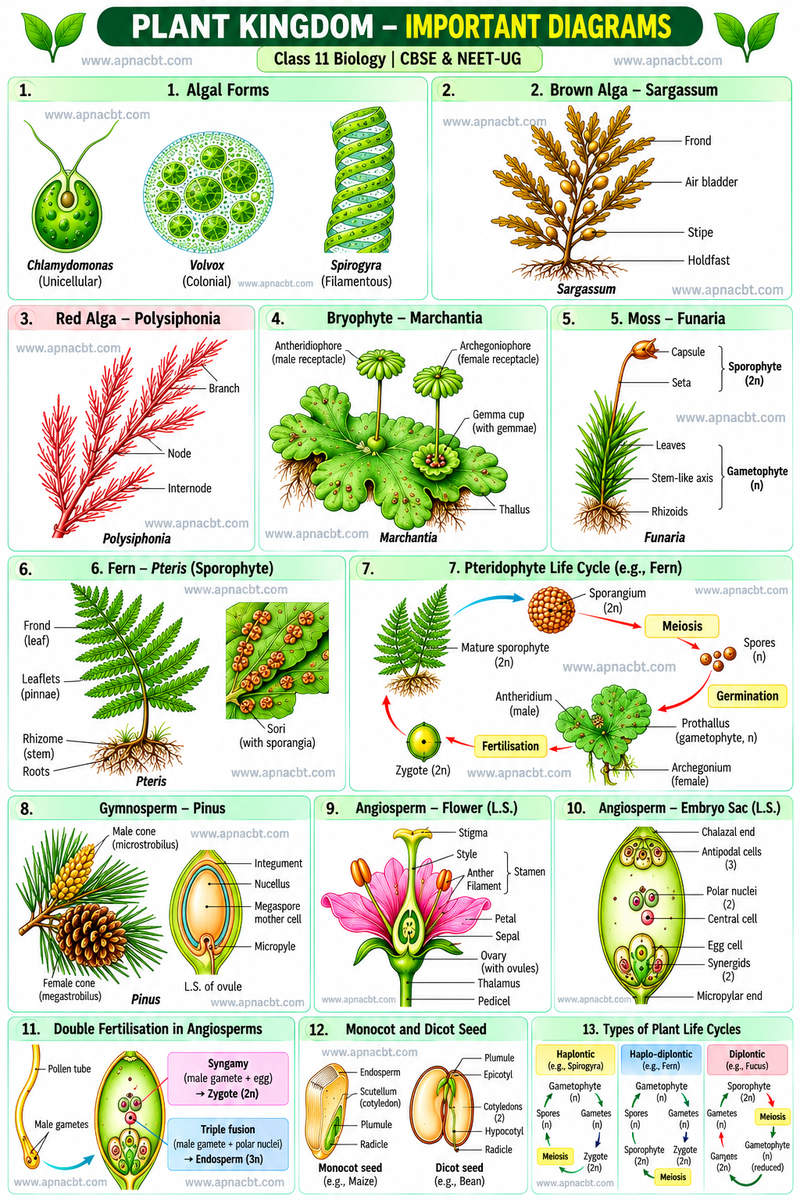
Mind Map, Important Diagrams and Tables
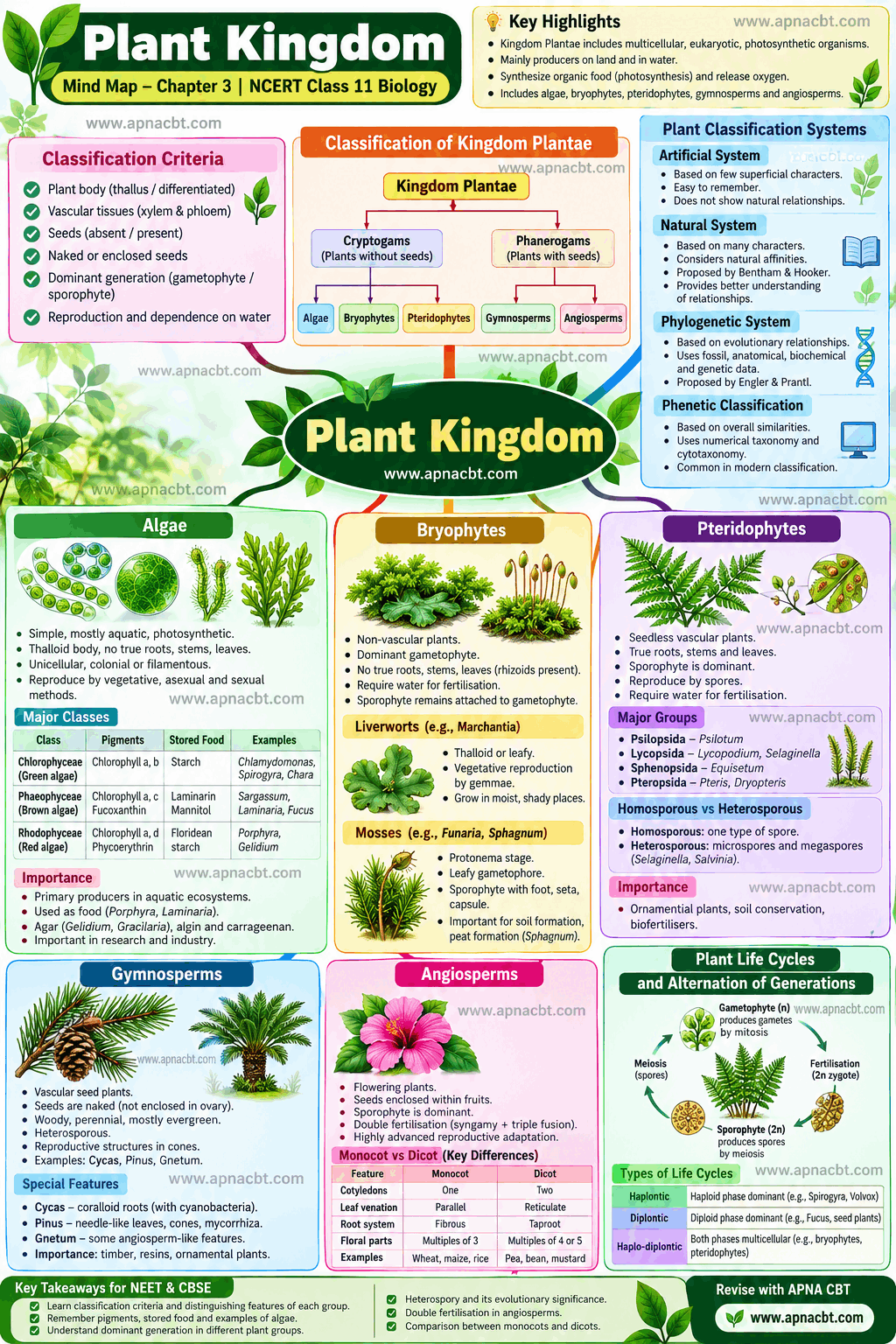
Plant Kingdom Important Diagrams
Plant Kingdom Important Tables
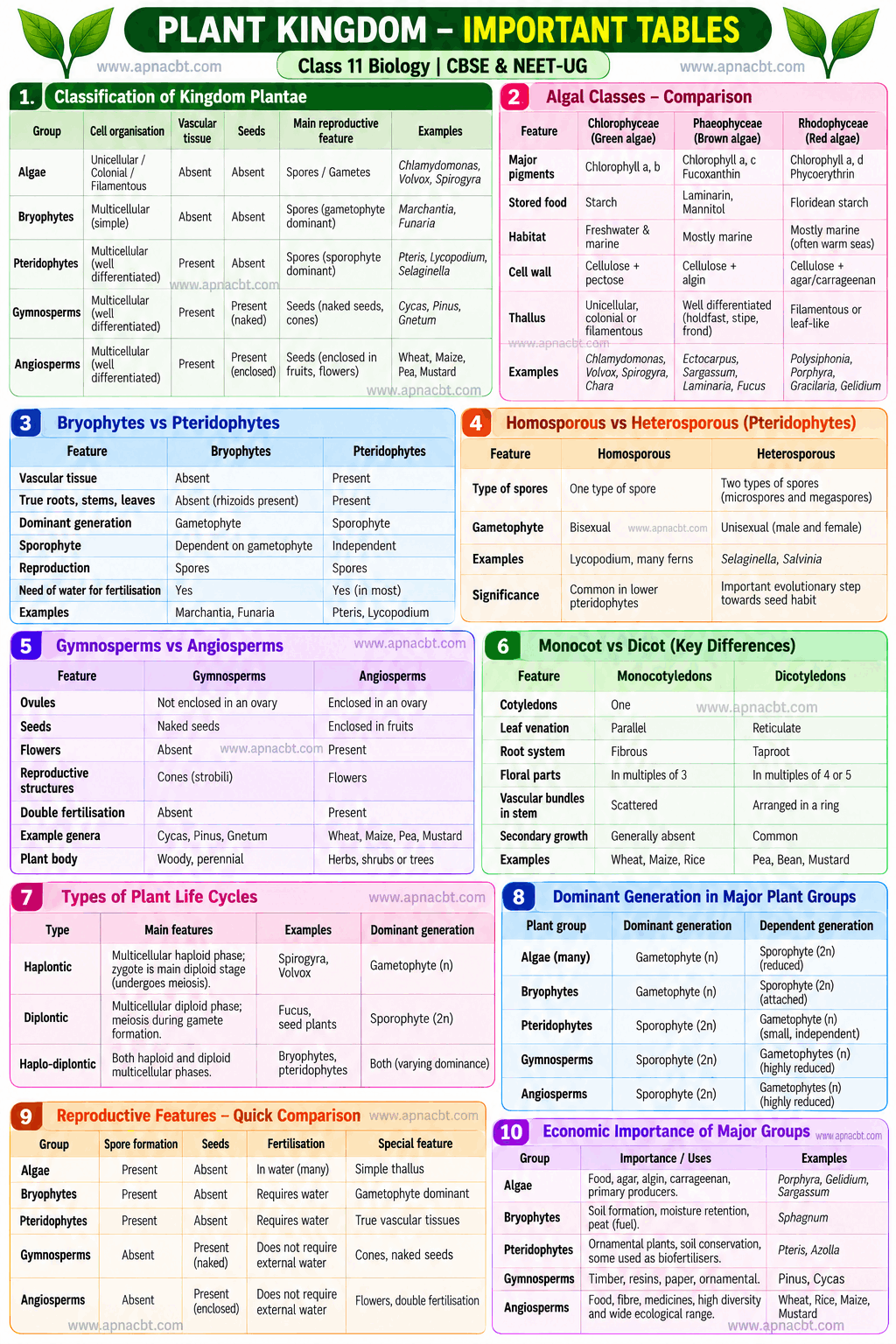
Final revision tip: For CBSE, practise explaining characteristics in complete sentences. For NEET, focus on examples, pigments, stored food, dominant generations, heterospory and double fertilisation. Cross-check detailed terminology and examples with your prescribed NCERT edition.

