Chapter 5: Morphology of Flowering Plants – Class 11 Biology
Exam-oriented lesson prepared from the supplied 24-page study PDF, with core concepts, definitions, comparison tables, examples, family characteristics and practice questions for CBSE, IPE and NEET-UG.
Study approach: Learn the diagnostic terms and examples, practise the labelled diagrams, and revise the three plant families before attempting the question sections.
1. Introduction, Morphology and Parts of a Flowering Plant
Morphology is the study of the external form and structure of organisms. Plant morphology helps in the recognition, identification and classification of flowering plants and is useful in plant breeding, horticulture, agriculture and evolutionary studies.
The flowering plant body is organised into two connected systems:
- Root system: develops from the radicle and is usually underground. It anchors the plant and absorbs water and minerals.
- Shoot system: develops from the plumule and includes stem, leaves, branches, buds, flowers, fruits and seeds.
Roots, stems and leaves are the principal vegetative organs. Flowers, fruits and seeds are associated with sexual reproduction.
Exam point: The root system develops from the radicle; the shoot system develops from the plumule. Morphological characters are important taxonomic features.
2. Root: Origin, Regions, Functions and Root Systems
The root usually develops from the radicle. A typical root is positively geotropic and hydrotropic and negatively phototropic. It generally lacks nodes, internodes, leaves and terminal buds.
Regions of a root tip
- Root cap: thimble-like protective structure covering the root apical meristem; mucilage helps the root move through soil.
- Region of meristematic activity: small, thin-walled cells with dense cytoplasm and prominent nuclei divide actively.
- Region of elongation: cells increase in length and enlarge, causing root growth.
- Region of maturation: cells differentiate; root hairs develop and increase the absorptive surface.
Root systems
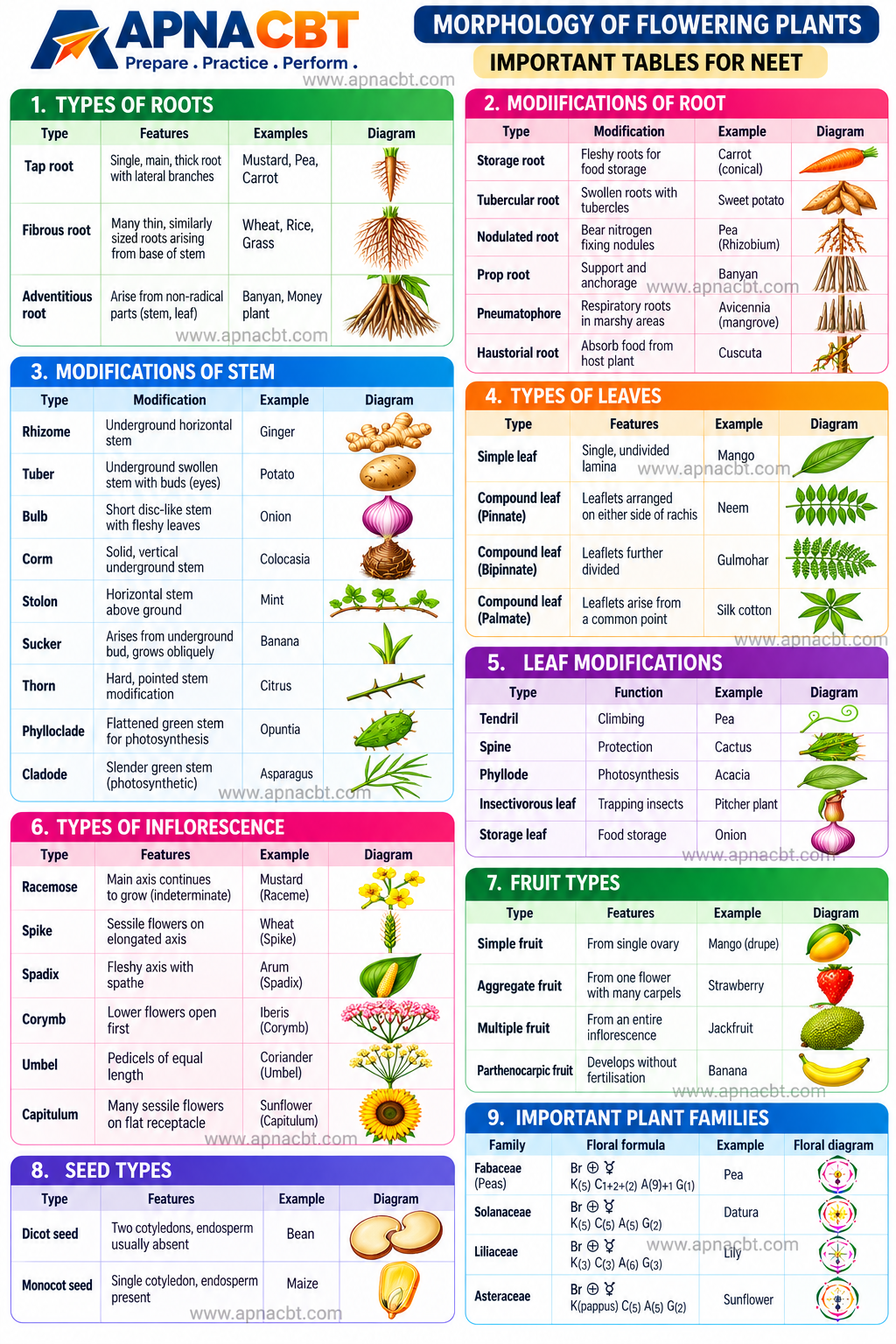
| Type | Description | Examples |
|---|---|---|
| Tap root system | Primary root persists and gives rise to lateral/secondary roots | Mustard, gram, pea |
| Fibrous root system | Primary root is short-lived; many roots arise from the base of the stem | Wheat, rice, grasses |
| Adventitious root system | Roots arise from parts other than the radicle, such as stem or leaves | Banyan, Monstera, grasses |
Functions
- Anchorage and absorption of water and minerals.
- Conduction of absorbed water and minerals to the shoot.
- Storage of food in modified roots such as carrot, turnip and sweet potato.
- Mechanical support in prop roots of banyan and stilt roots of maize and sugarcane.
- Specialised functions such as respiration in pneumatophores of mangroves and nitrogen fixation in nodulated roots of legumes.
3. Root Modifications
| Modification | Function / feature | Examples |
|---|---|---|
| Storage tap roots | Store reserve food; may be conical, fusiform or napiform | Carrot (conical), radish (fusiform), turnip/beet (napiform) |
| Storage adventitious roots | Store food in swollen roots | Sweet potato, Dahlia |
| Prop roots | Arise from branches and provide pillar-like support | Banyan |
| Stilt roots | Arise from lower stem nodes and support the plant | Maize, sugarcane, Pandanus |
| Climbing roots | Help the plant attach to a support | Betel, money plant, ivy |
| Respiratory roots (pneumatophores) | Grow upward in waterlogged soil to facilitate gaseous exchange | Avicennia and other mangroves |
| Nodulated roots | Contain nitrogen-fixing bacteria | Leguminous plants |
Do not confuse: Banyan has prop roots; maize has stilt roots; mangroves such as Avicennia have pneumatophores; sweet potato is a modified adventitious root, whereas potato is a stem tuber.
4. Stem: Structure, Functions and Modifications
The stem develops from the plumule. It is usually the ascending part of the plant axis, bears branches, leaves, flowers and fruits, and is differentiated into nodes and internodes. A bud is a condensed embryonic shoot; terminal buds occur at shoot tips and axillary buds occur in leaf axils.
Functions
- Supports and displays leaves, flowers and fruits.
- Conducts water, minerals and manufactured food.
- Stores food and water in specialised stems.
- Performs photosynthesis in green stems.
- Assists vegetative propagation and protection.
Stem modifications
| Type | Function | Examples |
|---|---|---|
| Rhizome | Underground horizontal stem; storage and perennation | Ginger, turmeric |
| Corm | Short, vertical, swollen underground stem | Colocasia, Amorphophallus, Gladiolus |
| Stem tuber | Swollen underground stem with nodes/eyes | Potato |
| Bulb | Short stem with fleshy scale leaves | Onion, garlic |
| Runner | Creeping stem that roots at nodes | Doob grass, Oxalis |
| Stolon | Lateral branch that arches and roots on contact with soil | Jasmine, strawberry |
| Offset | Short, one-internode branch, common in aquatic plants | Pistia, Eichhornia |
| Sucker | Underground branch that grows obliquely upward | Mint, Chrysanthemum |
| Stem tendril | Climbing support | Grapevine, Passiflora |
| Thorn | Protection | Bougainvillea, Citrus |
| Phylloclade / cladode | Green stem performs photosynthesis; may store water | Opuntia, Euphorbia; Asparagus (cladode) |
NEET distinction: Potato eyes are axillary buds on a stem tuber. Onion is a bulb with a reduced stem and fleshy leaf bases. Ginger is a rhizome.
5. Leaf: Parts, Venation, Simple and Compound Leaves
A leaf is a lateral, usually flattened structure borne at a node. An axillary bud is present in the axil of a leaf, not in the axil of an individual leaflet. Leaves arise from the shoot apical meristem and are arranged in acropetal succession.
Parts of a typical leaf
- Leaf base (hypopodium): attaches the leaf to the stem. It may be swollen as a pulvinus in legumes or form a sheath in many monocots.
- Petiole (mesopodium): stalk connecting the lamina to the stem.
- Lamina (epipodium): expanded green blade with midrib, veins and veinlets.
- Stipules: paired lateral appendages at the leaf base in stipulate leaves, e.g. Hibiscus.
| Character | Types / description | Examples |
|---|---|---|
| Venation | Reticulate: veins form a network | Usually dicots; mango, hibiscus |
| Venation | Parallel: veins run parallel | Usually monocots; wheat, banana |
| Leaf | Simple: lamina not divided into distinct leaflets | Mango, hibiscus |
| Leaf | Compound: lamina divided into distinct leaflets | Neem, rose, pea |
In a compound leaf, leaflets are attached to a rachis in pinnate leaves or arise from a common point at the petiole tip in palmate leaves. A bud occurs in the axil of the whole leaf, not at the base of each leaflet.
6. Compound Leaves, Phyllotaxy and Leaf Adaptations
Types of compound leaves
- Pinnately compound: leaflets are arranged along an elongated rachis. Examples: neem, rose, Cassia.
- Palmately compound: leaflets arise from a common point at the tip of the petiole; examples include silk cotton (Bombax) and lupin.
Pinnate leaves may be unipinnate, bipinnate or tripinnate. Palmate leaves may be unifoliate, bifoliate, trifoliate, quadrifoliate or multifoliate, depending on leaflet number.
Phyllotaxy
| Type | Arrangement | Examples |
|---|---|---|
| Alternate | One leaf at each node, alternating sides | China rose, mustard, sunflower |
| Opposite | Two leaves at each node, opposite one another | Calotropis, guava |
| Whorled | More than two leaves at a node | Alstonia |
Leaf modifications
- Leaf tendrils help climbing, e.g. pea.
- Spines provide protection and reduce water loss, e.g. cactus.
- Fleshy leaves store water or food, e.g. Aloe and onion.
- Insectivorous leaves trap insects, e.g. Nepenthes and Drosera.
Quick recall: Hibiscus — alternate phyllotaxy; Calotropis — opposite; Alstonia — whorled; pea — leaf tendrils; Nepenthes — insectivorous leaf.
7. Inflorescence: Racemose and Cymose Types
Inflorescence is the arrangement of flowers on the floral axis. The main axis bearing a cluster of flowers is the peduncle; the stalk of an individual flower is the pedicel.
| Feature | Racemose | Cymose |
|---|---|---|
| Growth of main axis | Indefinite; apex does not normally terminate in a flower | Definite; main axis terminates in a flower |
| Flower arrangement | Acropetal: older flowers at base, younger towards apex | Usually basipetal: older flowers towards apex, younger towards base |
| Opening | Generally centripetal | Generally centrifugal |
| Examples | Mustard (raceme), sunflower (capitulum) | Jasmine (dichasial example in some texts), Heliotropium (scorpioid cyme) |
Common forms
- Racemose: raceme, spike, catkin, spadix, corymb, umbel and capitulum/head; compound forms include panicle and compound umbel.
- Cymose: uniparous/monochasial, biparous/d dichasial and multiparous/polychasial cyme.
In a uniparous cyme, one lateral branch continues growth; in a biparous cyme, two lateral branches develop; in a multiparous cyme, several lateral branches develop.
8. Flower: Structure, Symmetry, Sex and Whorls
A flower is a specialised, condensed reproductive shoot of angiosperms. A typical complete flower has four whorls: calyx, corolla, androecium and gynoecium.
- Calyx: outermost whorl, made of sepals; usually protects the flower bud.
- Corolla: petals; often coloured and helps attract pollinators.
- Androecium: male reproductive whorl made of stamens; each stamen usually has a filament and anther.
- Gynoecium: female reproductive whorl made of one or more carpels; each carpel has stigma, style and ovary.
| Term | Meaning / example |
|---|---|
| Complete flower | All four floral whorls present |
| Bisexual / hermaphrodite | Both androecium and gynoecium present; Hibiscus, mustard |
| Unisexual | Only one reproductive whorl present; maize, papaya |
| Actinomorphic | Radial symmetry; mustard, Datura, chilli |
| Zygomorphic | Bilateral symmetry; pea, bean, Cassia |
| Asymmetric | No plane divides flower into equal halves; Canna |
Plants are monoecious when male and female unisexual flowers occur on the same plant, e.g. maize and castor. They are dioecious when male and female flowers occur on separate plants, e.g. papaya and date palm.
9. Calyx, Corolla and Aestivation
Calyx
Sepals may be free (polysepalous) or fused (gamosepalous). Calyx may be modified into pappus (sunflower), spurred or petaloid forms in specialised flowers.
Corolla
Petals may be free (polypetalous) or fused (gamopetalous). Common polypetalous forms include cruciform (mustard), rosaceous (rose), caryophyllaceous (Dianthus) and papilionaceous (pea). Gamopetalous forms include tubular, funnel-shaped, rotate, bilabiate and campanulate.
Aestivation
Aestivation is the arrangement of sepals or petals in a floral bud in relation to members of the same whorl.
| Type | Description | Example |
|---|---|---|
| Valvate | Margins touch but do not overlap | Calotropis |
| Twisted | Each member overlaps the next and is overlapped by the previous | China rose, cotton, lady’s finger |
| Imbricate | Margins overlap irregularly; not in a consistent direction | Cassia, Gulmohar |
| Vexillary (descending imbricate) | Standard overlaps wings; wings overlap keel | Pea, bean |
Remember: China rose — twisted aestivation; Calotropis — valvate; pea — vexillary; Cassia — imbricate.
10. Androecium: Stamens and Their Arrangement
A stamen consists of a filament and anther. The anther commonly has two lobes and four pollen sacs (microsporangia) in a typical angiosperm. Stamens may be free or united.
- Epipetalous: stamens attached to petals, e.g. brinjal.
- Epiphyllous: stamens attached to perianth, e.g. lily.
- Monadelphous: filaments united into one bundle, e.g. China rose.
- Diadelphous: filaments united into two bundles, commonly 9+1 in pea.
- Polyadelphous: filaments united into more than two bundles, e.g. Citrus.
- Syngenesious: anthers united while filaments remain free, e.g. sunflower.
- Synandrous: both anthers and filaments united, e.g. Cucurbita.
A sterile or non-functional stamen is called a staminode.
11. Gynoecium: Carpels, Ovary Position and Placentation
The gynoecium consists of one or more carpels. A carpel typically has stigma (receives pollen), style (connects stigma to ovary) and ovary (contains ovules).
| Term | Description | Example |
|---|---|---|
| Apocarpous | Carpels free from one another | Lotus, rose |
| Syncarpous | Carpels fused | Tomato, mustard |
| Superior ovary / hypogynous | Other floral whorls arise below the ovary | Mustard, brinjal, China rose |
| Half-inferior / perigynous | Floral parts arise from the rim of a cup-shaped thalamus around ovary | Rose, plum, peach |
| Inferior ovary / epigynous | Other floral whorls appear above the ovary | Guava, cucumber, sunflower |
Placentation
Placentation is the arrangement of ovules within the ovary.
| Type | Arrangement | Example |
|---|---|---|
| Marginal | Ovules along the ventral suture of a monocarpellary ovary | Pea |
| Axile | Ovules attached to a central axis in a multilocular, syncarpous ovary | China rose, tomato, lemon |
| Parietal | Ovules attached to the inner wall/periphery of a unilocular ovary | Mustard, Argemone |
| Free-central | Ovules on a central column without septa | Dianthus, Primula |
| Basal | Placenta at the base; usually one/few ovules | Sunflower, marigold |
NEET high-yield: Pea — marginal; tomato — axile; mustard — parietal; Dianthus — free-central; sunflower — basal placentation.
12. Flower, Fruit and Seed: Development and Types
Fruit
A true fruit (eucarp) develops from the ovary after fertilisation. The ovary wall forms the pericarp and ovules form seeds. A false fruit (pseudocarp) includes other floral parts in fruit formation, e.g. apple and pear. A parthenocarpic fruit develops without fertilisation and is often seedless, e.g. banana.
Pericarp may be dry or fleshy. In fleshy fruits it may be differentiated into epicarp, mesocarp and endocarp. Mango and coconut are drupes; the edible part of mango is mesocarp, while the edible part of coconut is endosperm.
Fruit categories
- Simple fruits: develop from one ovary of one flower; may be dry or fleshy.
- Aggregate fruits: develop from several free carpels of one flower, e.g. strawberry, custard apple.
- Multiple/composite fruits: develop from an entire inflorescence, e.g. pineapple, jackfruit, mulberry.
Seed
A seed is a mature fertilised ovule. It generally consists of a seed coat, embryo and often endosperm. The embryo contains an embryonal axis and one or two cotyledons.
13. Dicot Seed and Monocot Seed: Structure and Differences
Dicot seed (gram/bean)
- Seed coat commonly has an outer testa and inner tegmen.
- Hilum is the scar where the funicle was attached; micropyle is a small pore near the hilum.
- Embryo has two cotyledons, plumule and radicle.
- Seeds may be non-endospermic (exalbuminous), as in pea and gram, when endosperm is consumed during embryo development; some dicots remain endospermic.
Monocot seed (maize)
- Maize grain is a caryopsis; seed coat is fused with the fruit wall.
- Endosperm forms the major food-storage tissue; the outer protein-rich aleurone layer surrounds it.
- Embryo is small and lateral, with one large shield-shaped cotyledon called scutellum.
- Plumule is protected by coleoptile; radicle is protected by coleorhiza.
| Feature | Dicot seed | Maize / monocot seed |
|---|---|---|
| Cotyledons | Two | One; scutellum |
| Food reserve | May be in cotyledons or endosperm | Usually in endosperm |
| Seed coat | Usually distinct from fruit wall | In maize, fused with fruit wall |
| Protective sheaths | No coleoptile/coleorhiza | Coleoptile protects plumule; coleorhiza protects radicle |
14. Semi-Technical Description of a Typical Flowering Plant
A semi-technical description records the key observable features of a plant in a standard sequence. The description commonly includes habit, root, stem, leaves, inflorescence, flower, calyx, corolla, androecium, gynoecium, fruit and seed.
- Habit and habitat.
- Root and stem characters.
- Leaf arrangement, type, venation and stipules.
- Inflorescence type.
- Flower: bracteate/ebracteate, complete/incomplete, bisexual/unisexual, symmetry and ovary position.
- Floral whorls: calyx, corolla/perianth, androecium and gynoecium.
- Fruit and seed characters.
Floral formula symbols
| Symbol | Meaning |
|---|---|
| Br / Ebr | Bracteate / ebracteate |
| ⊕ / % | Actinomorphic / zygomorphic |
| ⚥ / ♂ / ♀ | Bisexual / male / female |
| K, C, P, A, G | Calyx, corolla, perianth, androecium, gynoecium |
| ( ) | Fusion (cohesion) of members of the same whorl |
| G with line below / above | Superior / inferior ovary (as represented in the formula convention) |
Floral formula gives concise information about symmetry, sex, number and fusion of floral parts, and ovary position. A floral diagram represents the number, arrangement and relationship of floral parts in a transverse view.
15. Important Plant Families: Fabaceae (Papilionaceae)
Fabaceae (traditional subfamily Papilionoideae / Papilionaceae in school descriptions) includes pea, gram, bean, soybean, lentil and groundnut.
- Habit: herbs, shrubs or trees; roots commonly bear nitrogen-fixing nodules.
- Leaves: alternate, usually pinnately compound or trifoliate, stipulate; leaf base may be pulvinus.
- Inflorescence: commonly racemose.
- Flower: bisexual, zygomorphic, pentamerous, hypogynous.
- Calyx: five sepals, usually united.
- Corolla: five papilionaceous petals — standard (vexillum), two wings and two keel petals; vexillary aestivation.
- Androecium: usually ten stamens, commonly diadelphous (9)+1.
- Gynoecium: monocarpellary, superior ovary, unilocular, marginal placentation.
- Fruit: legume; seeds generally non-endospermic.
Family identification: Pea/bean — zygomorphic papilionaceous flower, vexillary aestivation, diadelphous stamens and marginal placentation.
16. Important Plant Families: Solanaceae
Solanaceae includes potato, tomato, brinjal, chilli, tobacco, petunia and Datura.
- Habit: herbs, shrubs or small trees.
- Leaves: alternate, simple, exstipulate; reticulate venation.
- Inflorescence: usually solitary axillary or cymose.
- Flower: bisexual, actinomorphic, pentamerous, hypogynous.
- Calyx: five united sepals, often persistent.
- Corolla: five united petals; usually rotate or funnel-shaped.
- Androecium: five epipetalous stamens, alternating with petals.
- Gynoecium: bicarpellary, syncarpous; superior ovary, usually bilocular with axile placentation.
- Fruit: berry (tomato, brinjal) or capsule (Datura); seeds usually numerous.
Family identification: Solanaceae — five epipetalous stamens, bicarpellary syncarpous superior ovary, axile placentation; fruit commonly berry or capsule.
17. Important Plant Families: Liliaceae
Liliaceae includes lily, tulip, Aloe, Asparagus and Gloriosa in the traditional school-level treatment.
- Habit: perennial herbs, often with underground bulbs, corms or rhizomes.
- Leaves: usually simple, alternate or whorled, parallel-veined, exstipulate; leaf base may be sheathing.
- Inflorescence: commonly racemose, sometimes solitary.
- Flower: bisexual, actinomorphic, trimerous, hypogynous.
- Perianth: six tepals in two whorls (3+3), often petaloid.
- Androecium: six stamens, usually epiphyllous.
- Gynoecium: tricarpellary, syncarpous; superior, trilocular ovary with axile placentation.
- Fruit: capsule or berry; seeds may be endospermic.
Family identification: Liliaceae — monocot characters, trimerous flower, six tepals, six epiphyllous stamens and tricarpellary syncarpous superior ovary.
18. Comparative Revision, Diagrams and High-Yield Exam Points
| Feature | Fabaceae | Solanaceae | Liliaceae |
|---|---|---|---|
| Symmetry | Zygomorphic | Actinomorphic | Actinomorphic |
| Flower | Bisexual, pentamerous | Bisexual, pentamerous | Bisexual, trimerous |
| Calyx / perianth | 5 united sepals | 5 united sepals | 6 tepals (3+3) |
| Corolla | 5 papilionaceous petals | 5 united petals | Petaloid perianth |
| Stamens | Usually 10, diadelphous 9+1 | 5, epipetalous | 6, epiphyllous |
| Gynoecium | Monocarpellary | Bicarpellary, syncarpous | Tricarpellary, syncarpous |
| Ovary / placentation | Superior; marginal | Superior; axile | Superior; axile |
| Fruit | Legume | Berry or capsule | Capsule or berry |
| Examples | Pea, gram, bean | Potato, tomato, brinjal | Lily, tulip, Aloe |
Must-practise labelled diagrams
- Root tip showing root cap, meristematic zone, elongation zone and maturation/root-hair zone.
- Tap, fibrous and adventitious root systems; root modifications.
- Stem modifications: rhizome, tuber, bulb, corm, tendril and thorn.
- Leaf parts, venation, simple/compound leaves and phyllotaxy.
- Racemose and cymose inflorescences.
- Typical flower showing four whorls; aestivation patterns.
- Placentation types; longitudinal section of flower.
- Dicot seed and maize grain (monocot seed).
- Floral diagrams/formulae of Fabaceae, Solanaceae and Liliaceae.
Very frequently tested distinctions
- Root tuber (sweet potato) versus stem tuber (potato).
- Racemose (indeterminate/acropetal) versus cymose (determinate/basipetal).
- Simple leaf versus compound leaf; leaflet has no axillary bud.
- Epipetalous versus epiphyllous; monadelphous, diadelphous and polyadelphous.
- Apocarpous versus syncarpous; superior versus inferior ovary.
- True fruit, false fruit and parthenocarpic fruit.
- Albuminous versus exalbuminous seeds; coleoptile versus coleorhiza.
19. Short-Answer Questions (30)
Questions
- Define plant morphology and state one use.
- Name the two main systems of a flowering plant.
- Which embryonic parts give rise to root and shoot systems?
- Name the four regions of a root tip in sequence from the tip upward.
- What is the function of the root cap?
- Differentiate tap root and fibrous root systems.
- Give two examples of adventitious roots.
- What are pneumatophores? Give an example.
- Differentiate prop roots and stilt roots with examples.
- What is a stem tuber? Give an example.
- What is a pulvinus?
- Define phyllotaxy and name its three main types.
- Differentiate reticulate and parallel venation.
- How can a simple leaf be distinguished from a compound leaf?
- What is the difference between a leaflet and a leaf?
- Define inflorescence.
- What is the main difference between racemose and cymose inflorescence?
- What is a complete flower?
- Define actinomorphic and zygomorphic flowers with examples.
- What is aestivation?
- Name the aestivation in China rose, Calotropis and pea.
- What is epipetalous condition? Give an example.
- Differentiate monadelphous and diadelphous stamens.
- Define apocarpous and syncarpous gynoecium.
- What is placentation? Name five types.
- Give one example each of marginal, axile and parietal placentation.
- Differentiate hypogynous and epigynous flowers.
- What is a parthenocarpic fruit? Give an example.
- What are coleoptile and coleorhiza?
- Name the three important families in this lesson and one example of each.
Answers
- Define plant morphology and state one use.
Plant morphology is the study of the external form and structure of plants. It helps in recognition, identification and classification.
- Name the two main systems of a flowering plant.
Root system and shoot system.
- Which embryonic parts give rise to root and shoot systems?
The radicle gives rise to the root system; the plumule gives rise to the shoot system.
- Name the four regions of a root tip in sequence from the tip upward.
Root cap, meristematic region, region of elongation and region of maturation/root-hair zone.
- What is the function of the root cap?
It protects the delicate root apical meristem and its mucilage lubricates the passage through soil.
- Differentiate tap root and fibrous root systems.
A tap root develops from a persistent primary root with lateral branches; a fibrous system has many roots arising from the stem base after the primary root becomes short-lived.
- Give two examples of adventitious roots.
Banyan and Monstera (also sweet potato).
- What are pneumatophores? Give an example.
Pneumatophores are negatively geotropic respiratory roots that project above waterlogged soil; they occur in mangroves such as Avicennia.
- Differentiate prop roots and stilt roots with examples.
Prop roots arise from branches and support them, as in banyan; stilt roots arise from lower stem nodes, as in maize and sugarcane.
- What is a stem tuber? Give an example.
A swollen underground stem used for storage and bearing nodes/eyes; potato is an example.
- What is a pulvinus?
A swollen leaf base, commonly found in leguminous plants.
- Define phyllotaxy and name its three main types.
Phyllotaxy is the arrangement of leaves on a stem or branch. It may be alternate, opposite or whorled.
- Differentiate reticulate and parallel venation.
Reticulate venation forms a network of veins, commonly in dicots; parallel venation has veins running parallel, commonly in monocots.
- How can a simple leaf be distinguished from a compound leaf?
A simple leaf has an undivided lamina or incisions that do not divide it into distinct leaflets; a compound leaf has the lamina divided into distinct leaflets.
- What is the difference between a leaflet and a leaf?
A leaflet is a division of a compound leaf and lacks an axillary bud at its base; a whole leaf bears an axillary bud.
- Define inflorescence.
Inflorescence is the arrangement of flowers on the floral axis.
- What is the main difference between racemose and cymose inflorescence?
Racemose has an indeterminate main axis and usually acropetal flower arrangement; cymose has a determinate axis ending in a flower and usually basipetal arrangement.
- What is a complete flower?
A flower having all four whorls: calyx, corolla, androecium and gynoecium.
- Define actinomorphic and zygomorphic flowers with examples.
Actinomorphic flowers can be divided into equal halves by several vertical planes, e.g. mustard; zygomorphic flowers can be divided into equal halves by only one vertical plane, e.g. pea.
- What is aestivation?
Aestivation is the arrangement of sepals or petals in a floral bud in relation to other members of the same whorl.
- Name the aestivation in China rose, Calotropis and pea.
China rose — twisted; Calotropis — valvate; pea — vexillary.
- What is epipetalous condition? Give an example.
Stamens attached to petals are epipetalous; brinjal is an example.
- Differentiate monadelphous and diadelphous stamens.
In monadelphous stamens, filaments unite into one bundle, as in China rose; in diadelphous stamens they unite into two bundles, commonly 9+1 in pea.
- Define apocarpous and syncarpous gynoecium.
Apocarpous gynoecium has free carpels, e.g. lotus; syncarpous gynoecium has fused carpels, e.g. tomato.
- What is placentation? Name five types.
Placentation is the arrangement of ovules within an ovary. Types include marginal, axile, parietal, free-central and basal.
- Give one example each of marginal, axile and parietal placentation.
Marginal — pea; axile — tomato; parietal — mustard.
- Differentiate hypogynous and epigynous flowers.
In hypogynous flowers other whorls arise below a superior ovary; in epigynous flowers other whorls arise above an inferior ovary.
- What is a parthenocarpic fruit? Give an example.
A fruit formed without fertilisation, usually seedless; banana is an example.
- What are coleoptile and coleorhiza?
Coleoptile is the protective sheath around the plumule in a monocot embryo; coleorhiza protects the radicle.
- Name the three important families in this lesson and one example of each.
Fabaceae — pea; Solanaceae — tomato; Liliaceae — lily.
20. Long-Answer Questions (15)
Questions
- Describe the regions of a typical root tip and explain their functions.
- Explain the three types of root systems and describe important root modifications.
- Describe the structure and functions of the stem. Add examples of stem modifications.
- Describe a typical leaf and explain venation, simple/compound leaves and phyllotaxy.
- Differentiate racemose and cymose inflorescences with examples.
- Describe the four floral whorls of a typical bisexual flower.
- Explain the major types of aestivation with suitable examples.
- Describe the different types of stamen cohesion and adhesion.
- Explain ovary position and distinguish hypogynous, perigynous and epigynous flowers.
- Describe the five major types of placentation with examples.
- Explain true fruits, false fruits, parthenocarpic fruits and the main fruit categories.
- Describe the structure of a dicot seed and a maize grain.
- Write a semi-technical description of a flowering plant and explain the importance of floral formula and floral diagram.
- Describe the diagnostic characters of Fabaceae.
- Describe the diagnostic characters of Solanaceae.
Answers
- Describe the regions of a typical root tip and explain their functions.
A root tip has four main regions. The root cap is a thimble-like protective covering over the apical meristem; mucilage reduces friction as the root moves through soil. Immediately behind it is the meristematic region, containing small, thin-walled cells with dense cytoplasm that divide actively. The region of elongation contains cells that enlarge and lengthen, pushing the root forward. In the region of maturation, cells differentiate into permanent tissues and root hairs develop. Root hairs greatly increase the surface area for absorption of water and minerals.
- Explain the three types of root systems and describe important root modifications.
The tap root system develops from a persistent primary root and its lateral branches, as in mustard and gram. In a fibrous root system the primary root is short-lived and numerous roots arise from the stem base, as in wheat and rice. Adventitious roots arise from parts other than the radicle, as in banyan and Monstera. Roots may be modified for storage (carrot, radish, turnip, sweet potato), support (prop roots of banyan; stilt roots of maize), climbing (betel), respiration (pneumatophores of Avicennia) and nitrogen fixation (legume root nodules).
- Describe the structure and functions of the stem. Add examples of stem modifications.
The stem develops from the plumule and usually forms the ascending axis. It bears nodes, internodes, leaves, branches, buds, flowers and fruits. The terminal and axillary buds contain growing points. The stem supports aerial organs, conducts water, minerals and food, stores food or water, performs photosynthesis when green and helps in vegetative propagation. Underground modifications include rhizomes (ginger), corms (Colocasia), stem tubers (potato) and bulbs (onion). Subaerial modifications include runners (grass), stolons (strawberry), offsets (Pistia) and suckers (mint). Aerial modifications include tendrils (grapevine), thorns (Bougainvillea) and photosynthetic phylloclades (Opuntia).
- Describe a typical leaf and explain venation, simple/compound leaves and phyllotaxy.
A typical leaf consists of leaf base, petiole and lamina. The leaf base attaches the leaf to the stem and may be swollen as a pulvinus or form a sheath. The petiole supports the lamina. The lamina bears a midrib, veins and veinlets. Venation is the arrangement of veins: reticulate venation forms a network and is common in dicots, whereas parallel venation has parallel veins and is common in monocots. A simple leaf has no distinct leaflets; a compound leaf is divided into leaflets and may be pinnate or palmate. Phyllotaxy is leaf arrangement: alternate (Hibiscus), opposite (Calotropis) or whorled (Alstonia).
- Differentiate racemose and cymose inflorescences with examples.
In racemose inflorescence the main axis continues to grow and does not terminate in a flower. Flowers develop laterally in acropetal order, with older flowers at the base and younger ones near the apex; opening is generally centripetal. In cymose inflorescence the main axis terminates in a flower and has limited growth. Older flowers are towards the apex or centre and younger flowers towards the base or periphery, giving a basipetal/centrifugal pattern. Cymose forms include uniparous, biparous and multiparous cymes.
- Describe the four floral whorls of a typical bisexual flower.
A typical bisexual flower has four whorls. The calyx is the outermost whorl of sepals and usually protects the bud; sepals may be free or fused. The corolla consists of petals, often coloured to attract pollinators; petals may be free or fused. The androecium is the male whorl of stamens, each commonly consisting of a filament and anther that produces pollen. The gynoecium is the female whorl of one or more carpels, each with stigma, style and ovary containing ovules. A flower with all four whorls is complete; one lacking a whorl is incomplete.
- Explain the major types of aestivation with suitable examples.
Aestivation is the arrangement of sepals or petals in a floral bud. In valvate aestivation, adjacent margins touch without overlapping, as in Calotropis. In twisted aestivation, each member overlaps the next and is overlapped by the previous one, as in China rose and cotton. In imbricate aestivation, margins overlap irregularly, as in Cassia and Gulmohar. In vexillary aestivation, the large standard petal overlaps the two wings, which in turn overlap the two keel petals; this occurs in pea and bean.
- Describe the different types of stamen cohesion and adhesion.
Cohesion refers to fusion among members of the same whorl. In monadelphous stamens, filaments unite into one bundle (China rose); in diadelphous, into two bundles (pea, usually 9+1); and in polyadelphous, into several bundles (Citrus). In syngenesious stamens, anthers are united while filaments are free (sunflower); in synandrous stamens both anthers and filaments are united (Cucurbita). Adhesion refers to attachment of one floral whorl to another: epipetalous stamens are attached to petals (brinjal), while epiphyllous stamens are attached to perianth (lily).
- Explain ovary position and distinguish hypogynous, perigynous and epigynous flowers.
In hypogynous flowers, sepals, petals and stamens arise below the ovary; the ovary is superior. Examples include mustard, brinjal and China rose. In perigynous flowers, the thalamus forms a cup around the ovary and the other floral parts arise from its rim; the ovary is described as half-superior in school-level descriptions. Examples include rose and plum. In epigynous flowers, the thalamus encloses/fuses with the ovary and the other floral parts arise above it; the ovary is inferior. Examples include guava, cucumber and sunflower.
- Describe the five major types of placentation with examples.
Placentation is the arrangement of ovules inside the ovary. Marginal placentation occurs along the ventral suture of a monocarpellary ovary, as in pea. Axile placentation occurs when ovules are attached to a central axis in a multilocular syncarpous ovary, as in tomato, China rose and lemon. Parietal placentation has ovules attached to the inner wall of a usually unilocular ovary, as in mustard. Free-central placentation has ovules borne on a central column without septa, as in Dianthus. Basal placentation has a placenta at the base of the ovary, usually bearing one/few ovules, as in sunflower and marigold.
- Explain true fruits, false fruits, parthenocarpic fruits and the main fruit categories.
A true fruit develops from the ovary after fertilisation; the ovary wall forms the pericarp and ovules form seeds. Examples include mango, tomato and pea. A false fruit includes other floral parts, such as the thalamus, in fruit formation; apple and pear are examples. A parthenocarpic fruit develops without fertilisation and is generally seedless; banana is a common example. Simple fruits develop from one ovary of one flower. Aggregate fruits develop from several free carpels of one flower. Multiple fruits develop from an entire inflorescence, as in pineapple and jackfruit.
- Describe the structure of a dicot seed and a maize grain.
A typical dicot seed such as gram has a seed coat, embryo and may or may not retain endosperm. The seed coat often has an outer testa and inner tegmen. The hilum marks the point of attachment of the funicle and the micropyle is a small pore. The embryo has two cotyledons, plumule, radicle and embryonal axis. In maize, the grain is a caryopsis with the seed coat fused to the fruit wall. Most food is stored in the endosperm, surrounded by an aleurone layer. The embryo is lateral and has one cotyledon called scutellum; the plumule is protected by coleoptile and radicle by coleorhiza.
- Write a semi-technical description of a flowering plant and explain the importance of floral formula and floral diagram.
A semi-technical description follows a standard order: habit, root, stem, leaves, inflorescence, flower, calyx, corolla/perianth, androecium, gynoecium, fruit and seed. Floral formula uses symbols and numbers to summarise symmetry, sex, number and fusion of floral parts and ovary position. Floral diagrams show the number, arrangement and relationship of floral organs in a flower. Together they provide concise, standardised descriptions useful for identification and classification.
- Describe the diagnostic characters of Fabaceae.
Fabaceae includes pea, gram, bean, soybean and groundnut. Plants may be herbs, shrubs or trees and roots commonly bear nitrogen-fixing nodules. Leaves are usually alternate, stipulate and pinnately compound or trifoliate. Inflorescence is commonly racemose. Flowers are bisexual, zygomorphic, pentamerous and hypogynous. The calyx has five usually united sepals. The corolla is papilionaceous with standard, wings and keel and shows vexillary aestivation. There are usually ten stamens, commonly diadelphous (9+1). The gynoecium is monocarpellary with a superior ovary and marginal placentation. Fruit is a legume.
- Describe the diagnostic characters of Solanaceae.
Solanaceae includes potato, tomato, brinjal, chilli, tobacco and Datura. Members are herbs, shrubs or small trees. Leaves are alternate, simple, exstipulate and reticulate-veined. Inflorescence is often solitary axillary or cymose. Flowers are bisexual, actinomorphic, pentamerous and hypogynous. The calyx has five united, often persistent sepals; the corolla has five united petals. There are five epipetalous stamens. The gynoecium is bicarpellary and syncarpous with a superior, usually bilocular ovary and axile placentation. Fruit is usually a berry or capsule.
11. Mind Map – Morphology of Flowering Plants
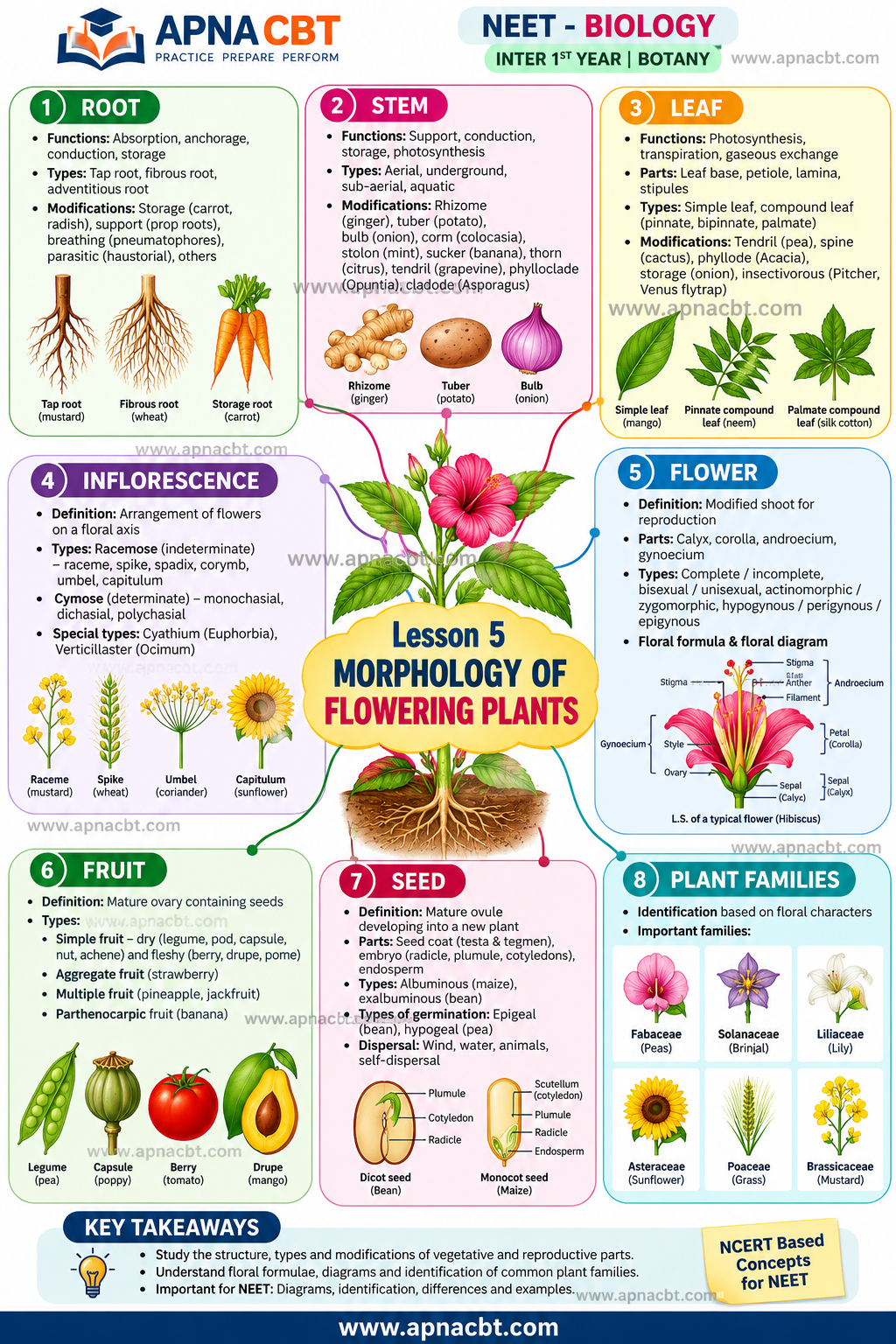
12. Important Diagrams – Morphology of Flowering Plants
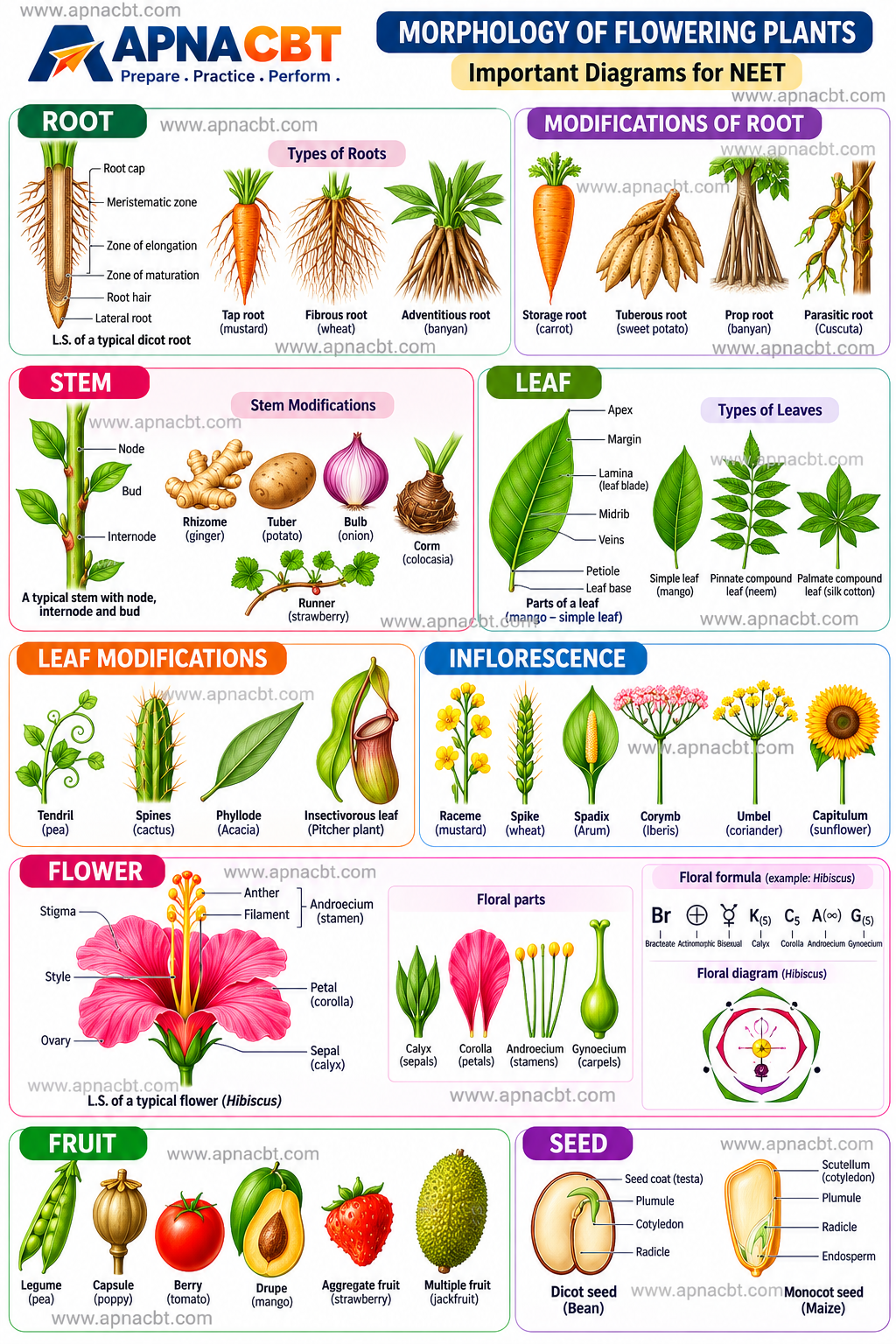
13. Important Tables – Morphology of Flowering Plants