



This Content Is Only For Subscribers
Chapter 1: The Living World
Class 11 Biology | NCERT-based important topics for CBSE, IPE and NEET-UG
Complete topic-wise revision based on the supplied 12-page PDF, including biodiversity, taxonomy, systematics, nomenclature, taxonomic hierarchy, examples and exam practice.
1. Diversity in the Living World and Biodiversity
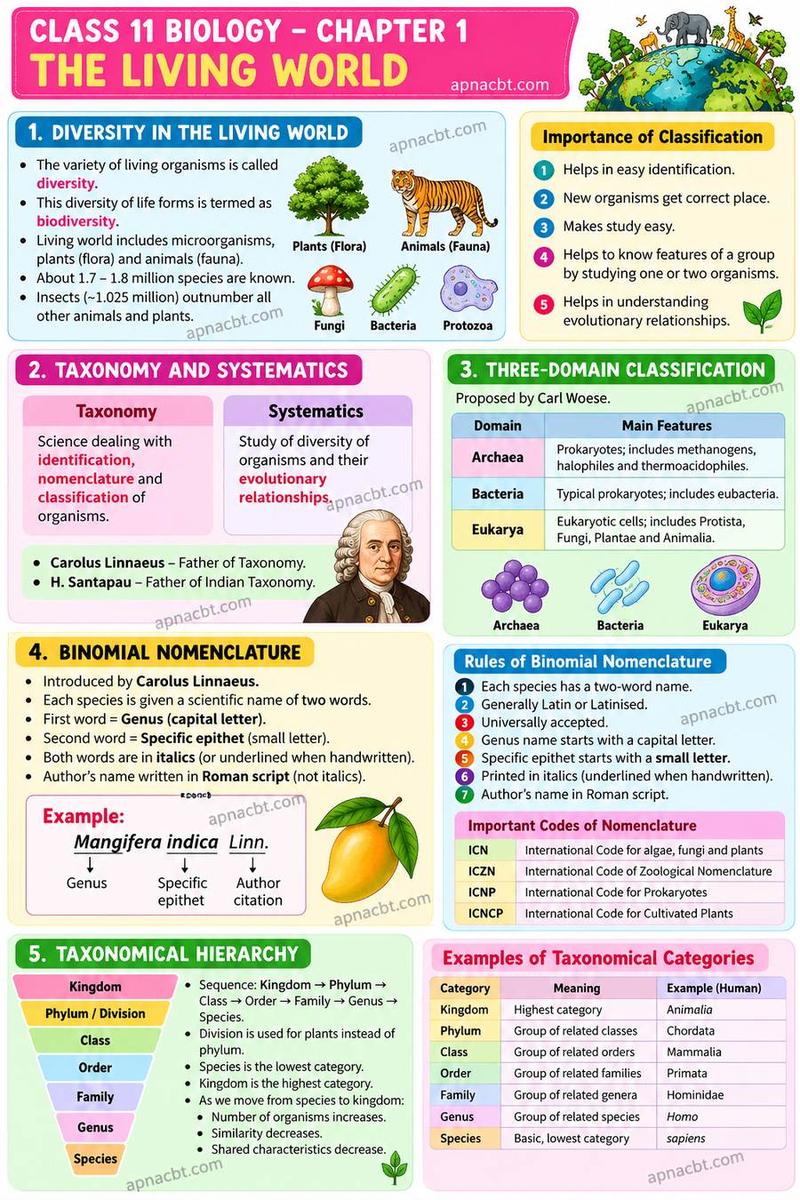
The living world contains an enormous variety of microorganisms, plants and animals in habitats such as mountains, forests, oceans, freshwater bodies, deserts and hot springs. The variety of living organisms in a region or on Earth is called biodiversity.
- Flora: Plant life of a region.
- Fauna: Animal life of a region.
- Biodiversity: Variety and variability of living organisms.
Need for classification
- Organises the enormous diversity of organisms into manageable groups.
- Helps identify and study organisms correctly.
- Makes comparison of similarities and differences easier.
- Helps understand relationships among groups and evolutionary history.
- Allows features of a group to be understood by studying representative organisms.
2. Systematics, Taxonomy and Classification
Systematics studies the diversity of organisms and their comparative and evolutionary relationships at every level, from species to kingdom. Taxonomy is the science of identification, nomenclature and classification. A. P. de Candolle coined the term taxonomy in 1813.
Classification is the arrangement of organisms into convenient groups based on similarities and differences.
| Term | Meaning |
|---|---|
| Systematics | Study of diversity and comparative/evolutionary relationships |
| Taxonomy | Identification, nomenclature and classification |
| Classification | Arrangement of organisms into groups |
| Nomenclature | Assignment of scientific names |
| Identification | Finding the correct identity of an organism |
Classification makes study systematic, supports identification, organises biological information, enables comparison and helps trace evolutionary pathways.
3. Fundamental Processes of Taxonomy
The main processes are characterisation, identification, classification and nomenclature.
| Process | Explanation |
|---|---|
| Characterisation | Recording morphological and other features of an organism. |
| Identification | Determining the correct identity and taxonomic position, often with keys. |
| Classification | Placing organisms into groups based on shared characters. |
| Nomenclature | Assigning a universally accepted scientific name. |
Characterisation supplies information for identification; identification supports correct classification; nomenclature gives the recognised taxon its standard name.
4. Classical Taxonomy and Modern Taxonomy
Classical taxonomy mainly uses observable morphological characters and often compares selected specimens. Modern taxonomy, also called new systematics or biosystematics, studies populations and integrates many kinds of evidence.
| Classical taxonomy | Modern taxonomy |
|---|---|
| Mainly morphology | Morphology, anatomy, cytology, physiology, biochemistry, ecology, genetics, embryology and behaviour |
| Often selected representative specimens | Studies populations and intraspecific variation |
| Traditional typological approach | Considers variation and evolutionary relationships |
Julien Huxley coined the term new systematics. Modern taxonomy provides a broader understanding of organismal relationships.
5. Three-Domain Classification
Carl Woese proposed the three-domain system, dividing cellular organisms into Archaea, Bacteria and Eukarya, substantially using molecular evidence such as ribosomal RNA.
| Domain | Cell type | Important features |
|---|---|---|
| Archaea | Prokaryotic | Distinctive membrane and molecular features; includes methanogens, halophiles and thermoacidophiles. |
| Bacteria | Prokaryotic | Typical bacteria; cell walls commonly contain peptidoglycan; nucleoid and 70S ribosomes. |
| Eukarya | Eukaryotic | Includes Protista, Fungi, Plantae and Animalia. |
- Methanogens: Produce methane, often in anaerobic habitats.
- Halophiles: Live in highly saline environments.
- Thermoacidophiles: Live in hot, acidic environments.
- Cyanobacteria: Photosynthetic bacteria.
6. Nomenclature and the Need for Scientific Names
Nomenclature is the system of assigning distinct, standard names to organisms. Vernacular names differ among languages and regions, and one local name may refer to different organisms. Scientific names support clear communication worldwide.
Binomial nomenclature, established and popularised by Carolus Linnaeus, gives each species a two-word name:
- Generic name: First word; indicates genus and begins with a capital letter.
- Specific epithet: Second word; identifies the species within its genus and begins with a lowercase letter.
Example: Mangifera indica. Mangifera is the genus and indica is the specific epithet. Both words together form the species name.
7. Rules of Binomial Nomenclature
- Each species is given a two-word name: generic name followed by specific epithet.
- Scientific names are generally Latin or latinised.
- Both words are italicised when printed.
- When handwritten, the two words are underlined separately.
- The generic name begins with a capital letter; the specific epithet begins with lowercase.
- The author’s citation, if included, is written in ordinary Roman type, not italics; e.g. Mangifera indica Linn.
- Names of categories above genus are not italicised.
- When a species is transferred or revised, the original author’s name may be retained in parentheses according to nomenclatural rules.
| Correct | Incorrect | Reason |
|---|---|---|
| Mangifera indica | Mangifera Indica | Specific epithet begins with lowercase. |
| Homo sapiens | homo Sapiens | Genus capitalised; epithet lowercase. |
Latin is traditionally used because it is a stable, no-longer-spoken language and is less subject to everyday linguistic change.
8. International Codes of Nomenclature
International codes provide common rules for naming organisms.
| Code | Area covered |
|---|---|
| ICN (formerly ICBN) | Nomenclature of algae, fungi and plants |
| ICZN | Zoological nomenclature |
| ICNCP | Nomenclature of cultivated plants |
| ICBacN / ICVN | Historical abbreviations listed in the supplied material for bacteriological / viral nomenclature |
The botanical code formerly called ICBN is now the International Code of Nomenclature for algae, fungi, and plants (ICN); the name was updated following the International Botanical Congress in Melbourne in 2011.
9. Taxonomic Categories, Taxa and Taxonomic Hierarchy
A taxonomic category is a rank such as species, genus or family. A taxon is an actual group of organisms recognised at any rank. The arrangement of categories in a definite sequence is the taxonomic hierarchy or Linnaean hierarchy.
- Moving from species towards kingdom, the number of organisms generally increases.
- The number of characters shared by all members generally decreases.
- Organisms at higher ranks are less closely related than organisms at lower ranks.
10. Species: The Basic and Lowest Taxonomic Category
Species is the lowest and basic taxonomic category. The biological species concept, associated with Ernst Mayr, describes a species as natural populations whose members can potentially interbreed and are reproductively isolated from other such groups.
Principles used in delimiting a species
- Members resemble one another more closely than members of other species.
- They share common ancestry and a gene pool.
- They can potentially interbreed under natural conditions and produce fertile offspring.
- They are reproductively isolated from other species.
- Species show variation and are dynamic, not permanently static units.
Examples: Homo sapiens, Mangifera indica, Solanum tuberosum and Panthera leo.
11. Genus and Family
Genus
A genus is a group of closely related species sharing several correlated characters and presumed to have evolved from a common ancestor.
- Solanum: Potato (S. tuberosum), tomato (S. lycopersicum) and brinjal (S. melongena).
- Panthera: Lion (P. leo), tiger (P. tigris) and leopard (P. pardus).
Monotypic genus: Contains one species. Polytypic genus: Contains more than one species; examples include Solanum and Panthera.
Family
A family is a group of related genera. In plants, vegetative and reproductive characters are used. Examples: Solanaceae includes Solanum, Petunia and Datura; Felidae includes Panthera and Felis; Canidae includes dogs and foxes.
12. Order, Class, Phylum and Kingdom
| Category | Definition | Example |
|---|---|---|
| Order | Group of related families | Carnivora includes Felidae and Canidae |
| Class | Group of related orders | Mammalia includes Primates and Carnivora |
| Phylum | Group of related classes in animals | Chordata |
| Division | Plant equivalent of phylum | Angiospermae |
| Kingdom | Highest of seven obligate categories | Animalia or Plantae |
Similarities become broader and fewer as we move upward. Carnivora groups families such as Felidae and Canidae. Mammalia groups orders such as Primates, Carnivora and Rodentia. Chordata includes animals with chordate features such as a notochord at some stage of development.
13. Intermediate Categories and Botanical Suffixes
Intermediate categories are added between the seven obligate categories when more precise taxonomic placement is needed.
| Obligate category | Intermediate examples |
|---|---|
| Kingdom | Sub-kingdom |
| Phylum / Division | Sub-phylum / Sub-division, super-class |
| Class | Sub-class, infra-class |
| Order | Superorder, suborder |
| Family | Subfamily, tribe |
| Genus | Subgenus |
| Species | Subspecies, variety or race |
Common botanical suffixes in the supplied chapter
| Category | Suffix |
|---|---|
| Division | -phyta |
| Class | -opsida |
| Subclass | -idae |
| Superorder | -anae |
| Order | -ales |
| Suborder | -ineae |
| Family | -aceae |
| Subfamily | -oideae |
| Tribe | -eae |
| Subtribe | -inae |
14. Taxonomic Hierarchy: Human, Housefly, Mango and Wheat
Learn these examples for missing-category, match-the-column and sequence questions.
| Category | Human | Housefly | Mango | Wheat |
|---|---|---|---|---|
| Kingdom | Animalia | Animalia | Plantae | Plantae |
| Phylum / Division | Chordata | Arthropoda | Angiospermae | Angiospermae |
| Class | Mammalia | Insecta | Dicotyledonae | Monocotyledonae |
| Order | Primata | Diptera | Sapindales | Poales |
| Family | Hominidae | Muscidae | Anacardiaceae | Poaceae |
| Genus | Homo | Musca | Mangifera | Triticum |
| Species | Homo sapiens | Musca domestica | Mangifera indica | Triticum aestivum |
Additional examples
- Potato: Solanum tuberosum; Solanaceae.
- Tomato: Solanum lycopersicum; genus Solanum.
- Brinjal: Solanum melongena; genus Solanum.
- Lion: Panthera leo; Felidae.
- Tiger: Panthera tigris; Felidae.
- Leopard: Panthera pardus; Felidae.
- Tulsi: Ocimum sanctum (name used in the supplied material); Lamiaceae.
15. Monophyletic and Polyphyletic Taxa, Typification and Hybrids
- Monophyletic taxon: Includes a common ancestor and all its descendants; also called a clade.
- Polyphyletic group: Combines organisms from different evolutionary lineages and does not represent one complete ancestral group.
A nomenclatural type is the reference specimen or element to which a taxon’s name is attached. Typification is the process of selecting or designating that type. Types listed in the supplied PDF include holotype, isotype, syntype, paratype, lectotype, neotype, epitype and topotype.
| Hybrid | Parent combination | Fertility |
|---|---|---|
| Mule | Female horse × male donkey | Sterile |
| Hinny | Male horse × female donkey | Usually sterile |
| Liger | Male lion × female tiger | Fertility varies; males are generally sterile |
| Tigon | Male tiger × female lion | Fertility varies |
16. High-Yield Comparisons and Scientist Contributions
| Comparison | Key distinction |
|---|---|
| Taxonomy vs systematics | Identification, naming and grouping vs diversity and evolutionary relationships too. |
| Category vs taxon | Rank vs actual group recognised at that rank. |
| Species vs genus | Basic unit vs group of related species. |
| Monotypic vs polytypic genus | One species vs multiple species. |
| Phylum vs division | Usually animals vs plants. |
| Generic name vs specific epithet | First word, capitalised vs second word, lowercase. |
| Printed vs handwritten name | Italics vs separately underlined words. |
| Classical vs modern taxonomy | Mainly morphology vs integrated evidence from many disciplines. |
Scientists and contributions
- Carolus Linnaeus: Father of taxonomy; binomial nomenclature.
- A. P. de Candolle: Coined the term taxonomy in 1813.
- John Ray: Associated with the species concept and early systematic classification.
- Carl Woese: Three-domain system.
- Julien Huxley: Coined new systematics.
- H. Santapau: Father of Indian taxonomy.
- Ernst Mayr: Biological species concept.
17. Short-Answer Questions – 30 Important Questions
Questions
- Define biodiversity. Why is classification necessary?
- Define taxonomy and name the scientist who coined the term.
- What is systematics? How is it broader than taxonomy?
- List the four fundamental processes of taxonomy.
- What is characterisation?
- What is identification? Mention the role of taxonomic keys.
- State four advantages of classification.
- Differentiate classical and modern taxonomy.
- Who proposed the three-domain system? Name the domains.
- Give one difference between Archaea and Bacteria.
- Define methanogens, halophiles and thermoacidophiles.
- Define nomenclature. Why are scientific names needed?
- What is binomial nomenclature? Who introduced it?
- Identify the generic name and specific epithet in Mangifera indica.
- State four rules of binomial nomenclature.
- Why are scientific names generally Latin or latinised?
- How should a scientific name be written by hand?
- Expand ICN, ICZN and ICNCP.
- What is a taxonomic category? What is a taxon?
- Define taxonomic hierarchy and list the seven categories in ascending order.
- What happens to the number of organisms and shared characters from species to kingdom?
- Define species according to the biological species concept.
- State three principles used in delimiting a species.
- Define genus. Give two examples of polytypic genera.
- Differentiate monotypic and polytypic genera.
- What is a family? Give one plant and one animal example.
- Define order and class with examples.
- Why is the term division used in plant classification?
- What are intermediate categories? Give four examples.
- What is a nomenclatural type? Define typification.
Detailed Answers
- Biodiversity is the variety of living organisms in a region or on Earth. Classification is needed to organise the enormous diversity, identify organisms, compare groups and understand relationships and evolution.
- Taxonomy is the science of identification, nomenclature and classification. A. P. de Candolle coined the term in 1813.
- Systematics studies organismal diversity and comparative and evolutionary relationships at all taxonomic levels. Taxonomy focuses on identification, naming and classification; systematics also interprets evolutionary relationships.
- The four processes are characterisation, identification, classification and nomenclature. They respectively record features, determine identity, place organisms in groups and assign scientific names.
- Characterisation is recording morphological and other characteristics of an organism for comparison and classification.
- Identification determines the correct identity and taxonomic position of an organism. Keys use contrasting character choices to guide the user to an identification.
- Classification makes study systematic, supports identification, places organisms in appropriate groups, simplifies comparison and helps trace evolutionary pathways.
- Classical taxonomy mainly uses observable morphology and selected specimens. Modern taxonomy studies populations and integrates morphology, anatomy, cytology, physiology, biochemistry, ecology, genetics, embryology and behaviour.
- Carl Woese proposed the three-domain system: Archaea, Bacteria and Eukarya.
- Archaea have distinctive membrane and molecular features and include extremophiles. Typical Bacteria are prokaryotes whose cell walls commonly contain peptidoglycan.
- Methanogens produce methane; halophiles live in highly saline environments; thermoacidophiles live in hot, acidic environments.
- Nomenclature assigns standard names to organisms. Scientific names avoid confusion caused by different regional and local names and enable universal communication.
- Binomial nomenclature gives each species a two-word name: generic name and specific epithet. It was established and popularised by Carolus Linnaeus.
- In Mangifera indica, Mangifera is the generic name and indica is the specific epithet.
- Scientific names have two words; the genus begins with a capital; the specific epithet begins with lowercase; and both words are italicised in print or underlined separately by hand. Names are Latin or latinised.
- Latin is a stable language no longer used as an everyday spoken language, so it is less likely to change through ordinary language development.
- Underline the generic name and specific epithet separately when writing by hand.
- ICN: International Code of Nomenclature for algae, fungi and plants; ICZN: International Code of Zoological Nomenclature; ICNCP: International Code of Nomenclature for Cultivated Plants.
- A taxonomic category is a rank such as species or genus. A taxon is the actual group of organisms recognised at that rank.
- Ascending order: species → genus → family → order → class → phylum/division → kingdom.
- Moving from species to kingdom, the number of organisms generally increases and the number of shared characters generally decreases.
- A species is a group of natural populations whose members can potentially interbreed and are reproductively isolated from other such groups.
- Members of a species resemble each other, share common ancestry and can potentially interbreed to produce fertile offspring under natural conditions.
- A genus is a group of related species sharing correlated characters. Solanum and Panthera are polytypic genera.
- A monotypic genus contains one species; a polytypic genus contains more than one species. Solanum is polytypic.
- A family groups related genera. Solanaceae is a plant family and Felidae is an animal family.
- An order groups related families; Carnivora includes Felidae and Canidae. A class groups related orders; Mammalia includes Primates and Carnivora.
- Division is the term commonly used for the plant category corresponding to phylum in animals.
- Intermediate categories are additional ranks between obligate categories, such as subclass, suborder, subfamily and subgenus.
- A nomenclatural type is the reference specimen or element to which a taxon’s name is attached. Typification is selecting or designating that reference.
18. Long-Answer Questions – 15 Important Questions
Questions
- Explain biodiversity and discuss the need and advantages of classification.
- Define taxonomy and systematics. Explain the fundamental processes of taxonomy.
- Compare classical taxonomy with modern taxonomy or biosystematics.
- Describe the three-domain system and the main characteristics of each domain.
- Explain binomial nomenclature and its universal rules with examples.
- What are international codes of nomenclature? Explain their importance and list major codes.
- Define taxonomic category, taxon and taxonomic hierarchy. Explain the seven obligate categories.
- Explain the biological species concept and principles used for delimiting species.
- Describe genus and family. Explain monotypic and polytypic genera with examples.
- Explain order, class, phylum/division and kingdom with examples.
- What are intermediate categories? Explain their position and give examples.
- Explain the taxonomic hierarchy of humans and housefly from kingdom to species.
- Explain the taxonomic hierarchy of mango and wheat from kingdom to species.
- Discuss monophyletic and polyphyletic taxa, nomenclatural types and typification.
- Write an integrated account of important terms, scientists, examples and exam facts from The Living World.
Detailed Answers
- Biodiversity and classification: Biodiversity is the variety of living organisms in a habitat or on Earth, including microorganisms, plants and animals. Many species remain undescribed, making the living world extremely diverse. Classification is essential because every organism cannot be studied individually. It groups organisms by similarities and differences, makes identification easier, organises information, supports comparison, allows representative organisms to illustrate group features and helps trace evolutionary relationships.
- Taxonomy and systematics: Taxonomy is the science of identification, nomenclature and classification. Systematics studies diversity and comparative and evolutionary relationships at all levels. The four processes are: characterisation—recording morphological and other features; identification—determining the correct identity, often using keys; classification—placing organisms into groups based on shared characters; and nomenclature—assigning standard scientific names. Together these processes make the study of biodiversity systematic and reproducible.
- Classical and modern taxonomy: Classical taxonomy relies mainly on observable morphology and often compares selected representative specimens. Modern taxonomy, also called new systematics or biosystematics, studies populations and their variation. It integrates morphology, anatomy, cytology, physiology, biochemistry, ecology, genetics, embryology and behaviour. Modern taxonomy therefore provides broader evidence for identifying organisms and interpreting their evolutionary relationships. Julien Huxley coined the term new systematics.
- Three-domain system: Carl Woese proposed Archaea, Bacteria and Eukarya. Archaea are prokaryotes with distinctive molecular and membrane features and include methanogens, halophiles and thermoacidophiles. Bacteria are typical prokaryotes; their cell walls commonly contain peptidoglycan, and they possess a nucleoid and 70S ribosomes. Eukarya includes eukaryotic organisms and the kingdoms Protista, Fungi, Plantae and Animalia. The system reflects major molecular differences, especially those revealed by ribosomal RNA comparisons.
- Binomial nomenclature: Each species receives a two-word scientific name. The first word is the generic name, beginning with a capital letter; the second is the specific epithet, beginning with lowercase. In Mangifera indica, Mangifera is the genus and indica the specific epithet. Both words are italicised in print and underlined separately when handwritten. Names are Latin or latinised. An author’s citation, when present, is written in ordinary Roman type. Higher taxonomic categories are not italicised. These rules ensure universal, unambiguous naming.
- International codes: Codes provide common principles for naming organisms. ICN governs algae, fungi and plants and was formerly called ICBN. ICZN governs animals. ICNCP governs cultivated plants. The supplied PDF also lists historical abbreviations for bacteriological and viral nomenclature. Standard codes prevent competing names, support accurate identification and allow scientists worldwide to communicate consistently.
- Categories and hierarchy: A category is a rank; a taxon is an actual group recognised at that rank. The seven obligate categories in ascending order are species, genus, family, order, class, phylum/division and kingdom. Species is the basic unit. Genus groups related species; family groups related genera; order groups related families; class groups related orders; phylum in animals or division in plants groups related classes; kingdom is the highest obligate category. Higher ranks include more organisms but share fewer characters.
- Species concept: Species is the basic unit of classification. Under the biological species concept, a species comprises natural populations whose members can potentially interbreed and are reproductively isolated from other such groups. Members resemble one another more closely than members of other species, share common ancestry and a gene pool, and can produce fertile offspring under natural conditions. Reproductive isolation limits gene exchange with other species. Species are dynamic and may change through evolution.
- Genus and family: A genus is a group of closely related species sharing correlated characters and presumed to have evolved from a common ancestor. Solanum includes potato, tomato and brinjal; Panthera includes lion, tiger and leopard. A monotypic genus has one species; a polytypic genus has several. A family groups related genera. Solanaceae includes Solanum, Petunia and Datura; Felidae includes Panthera and Felis. Similarities are broader and less numerous at family level than at genus level.
- Higher categories: An order groups related families; Carnivora includes Felidae and Canidae. A class groups related orders; Mammalia includes Primates, Carnivora and Rodentia. Phylum is the animal category containing related classes; the corresponding plant category is commonly called division. Chordata includes organisms with a notochord at some developmental stage. Kingdom is the highest of the seven obligate categories, with Plantae and Animalia as examples.
- Intermediate categories: These are extra ranks inserted between obligate categories for more precise placement. Examples include sub-kingdom, sub-phylum, subdivision, subclass, superorder, suborder, subfamily, tribe, subgenus, subspecies and variety. They allow taxonomists to express additional degrees of relationship where the seven main ranks are insufficient.
- Human and housefly: Human—Kingdom Animalia, Phylum Chordata, Class Mammalia, Order Primata, Family Hominidae, Genus Homo, Species Homo sapiens. Housefly—Kingdom Animalia, Phylum Arthropoda, Class Insecta, Order Diptera, Family Muscidae, Genus Musca, Species Musca domestica. Both belong to Animalia but differ from phylum onwards. The example shows how ranks become increasingly specific.
- Mango and wheat: Mango—Plantae, Angiospermae, Dicotyledonae, Sapindales, Anacardiaceae, Mangifera, Mangifera indica. Wheat—Plantae, Angiospermae, Monocotyledonae, Poales, Poaceae, Triticum, Triticum aestivum. Both are flowering plants, but differ at class and the lower ranks. These examples are important for tables, matching and missing-category questions.
- Taxa and typification: A monophyletic taxon includes a common ancestor and all descendants and is also called a clade. A polyphyletic group combines organisms from separate evolutionary lineages. A nomenclatural type is the reference specimen or element to which a taxon’s name is attached. Typification is its designation. Types include holotype, isotype, syntype, paratype, lectotype, neotype, epitype and topotype. A type provides a stable reference for applying a scientific name.
- Integrated revision: Biodiversity is the variety of life. Taxonomy involves identification, nomenclature and classification; systematics also considers evolutionary relationships. The four processes are characterisation, identification, classification and nomenclature. Linnaeus is associated with binomial nomenclature and is called the father of taxonomy; de Candolle coined taxonomy; Woese proposed the three-domain system; Huxley coined new systematics; Mayr developed the biological species concept; Santapau is known as the father of Indian taxonomy. Revise the seven ranks, organism examples, naming rules and botanical suffixes such as -aceae for family and -ales for order.
Mindmap Chapter 1: The Living World
Chapter Completion
You have completed the learning content for Chapter 01: The Living World.
Continue to Level 2 for chapter-wise preparation resources and Level 3 for mock tests, as organised on APNA CBT.

