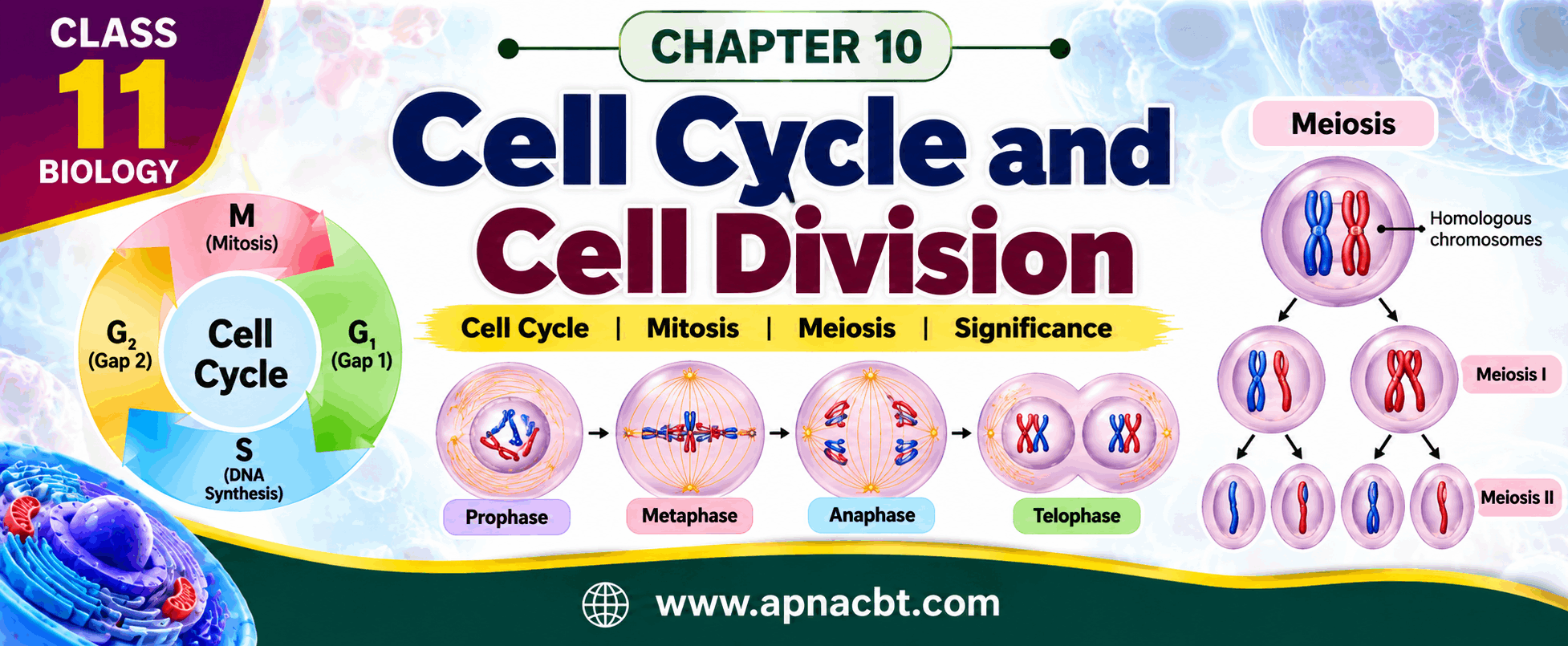
Chapter 10: Cell Cycle and Cell Division – Class 11 Biology
Exam-focused lesson prepared from the supplied Chapter 10 PDF for CBSE, Telangana IPE and NEET. It covers the cell cycle, interphase, mitosis, meiosis, chromosome behaviour, cytokinesis, cell-cycle regulation and the significance of cell division.
How to study: Learn the sequence of stages, compare mitosis and meiosis, practise labelled diagrams of mitosis and meiosis, and pay special attention to prophase I substages and chromosome behaviour.
1. Introduction to Cell Cycle and Cell Division
The cell cycle is the genetically controlled sequence of events through which a cell grows, duplicates its DNA and other cell components, and divides to form daughter cells. Cell division enables growth, development, repair, replacement and reproduction.
Rudolf Virchow proposed that new cells arise from pre-existing cells. In eukaryotes, cell division is a coordinated process involving DNA replication, chromosome segregation and division of the cytoplasm.
Cell cycle: The sequence of events by which a cell duplicates its genome, synthesises cellular constituents, grows and eventually divides into daughter cells.
The duration varies among organisms. The PDF gives examples of approximately 24 hours for a human cell cycle and 90 minutes for yeast.
Two broad phases
| Interphase | M-phase |
|---|---|
| Long, metabolically active, non-dividing/growing period | Shorter phase in which nuclear division and usually cytoplasmic division occur |
| Includes G₁, S and G₂ phases | Includes karyokinesis and cytokinesis |
Exam focus: Interphase is not an inactive period. It is metabolically active and occupies most of the cell cycle.
2. Interphase: G₁, S and G₂ Phases
Interphase is the longest part of the cell cycle and accounts for more than 95% of its duration in many cells. It prepares the cell for division and is divided into three phases.
| Phase | Major events | Key point |
|---|---|---|
| G₁ (Gap 1) | Cell grows; active metabolism; synthesis of RNA, proteins, nucleotides and energy-rich compounds | DNA replication has not yet occurred; generally the longest interphase phase |
| S (Synthesis) | DNA replication occurs; DNA amount doubles; in animal cells centrioles duplicate | Chromosome number remains unchanged; each chromosome has two sister chromatids |
| G₂ (Gap 2) | Further cell growth; RNA and proteins required for mitosis are synthesised; organelles multiply | DNA synthesis has stopped; cell prepares for M-phase |
For a diploid cell, DNA content typically changes from 2C in G₁ to 4C after S-phase, while the chromosome number remains 2n. Each chromosome now consists of two sister chromatids joined at the centromere.
In animal cells, DNA replication occurs in the nucleus and centriole duplication occurs in the cytoplasm.
3. G₀ Phase, Cell-Cycle Checkpoints and Regulation
Some cells leave the active cell cycle and enter G₀, also called the quiescent stage. They remain metabolically active but stop proliferating. Depending on the cell type and signals, some may re-enter the cycle.
- Many mature nerve cells remain in G₀ for the life of the individual.
- Some cells divide only occasionally to replace cells lost through injury or cell death.
- The supplied text mentions heart cells as examples of cells that may remain in a quiescent state.
Cell-cycle progression is regulated by cyclins and cyclin-dependent kinases (CDKs). CDKs are enzymes that phosphorylate target proteins using ATP.
| Regulatory point | Location / role |
|---|---|
| G₁/S checkpoint | Controls transition from G₁ to S-phase; checks whether conditions are suitable for DNA replication |
| G₂/M checkpoint | Controls entry into mitosis after DNA replication and preparation are complete |
| Cyclins and CDKs | Regulate progression by activating or inhibiting proteins involved in cell-cycle transitions |
Remember: G₀ is quiescent but metabolically active; S-phase duplicates DNA, not chromosome number.
4. M-Phase: Karyokinesis and Cytokinesis
M-phase is the division phase of the cell cycle. It consists of two coordinated events:
- Karyokinesis: division of the nucleus to form two daughter nuclei.
- Cytokinesis: division of the cytoplasm to form two daughter cells.
Karyokinesis in mitosis proceeds through prophase, metaphase, anaphase and telophase. Cytokinesis generally follows nuclear division.
| Karyokinesis | Cytokinesis |
|---|---|
| Division of nucleus into two daughter nuclei | Division of cytoplasm into two daughter cells |
| Involves chromosome condensation, alignment, separation and nuclear re-formation | Involves partitioning of cytoplasm and organelles |
| First major event of M-phase | Usually the final event of M-phase |
5. Mitosis: Definition and Prophase
Mitosis is an equational division in which the chromosome number is maintained in the daughter nuclei. It occurs in somatic cells and supports growth, repair and replacement. Strasburger first observed mitosis in plant cells in 1875; Flemming coined the term mitosis in 1882.
Mitosis: A type of cell division in which replicated chromosomes are equally distributed to two daughter nuclei, each retaining the same chromosome number as the parent nucleus.
Prophase
- Chromatin condenses into short, thick, visible chromosomes.
- Each chromosome consists of two sister chromatids joined at the centromere.
- Mitotic spindle begins to form from microtubules.
- Nucleolus disappears.
- In late prophase, the nuclear envelope breaks down; Golgi complexes and endoplasmic reticulum are no longer seen as distinct structures under the microscope.
Chromosome condensation involves shortening and thickening of chromatin fibres through coiling and organisation with scaffold proteins. Condensin proteins assist chromosome compaction.
6. Mitosis: Metaphase and Anaphase
Metaphase
- Chromosomes are maximally condensed and clearly visible.
- They align at the equatorial plane, called the metaphase plate.
- Spindle microtubules attach to kinetochores, disc-shaped structures at the centromere.
- Kinetochores of sister chromatids are connected to spindle fibres from opposite poles.
Metaphase is the best stage to study chromosome number and morphology because chromosomes are highly condensed and aligned.
Anaphase
- Centromeres split and sister chromatids separate simultaneously.
- Each separated chromatid is now considered a daughter chromosome.
- Chromosomes move towards opposite spindle poles, with centromeres leading.
- Two groups of chromosomes form at opposite poles.
| Chromosome type | Centromere position | Typical shape |
|---|---|---|
| Metacentric | Median | V-shaped |
| Submetacentric | Submedian | L-shaped |
| Acrocentric | Sub-terminal | J-shaped |
| Telocentric | Terminal | I-shaped |
7. Mitosis: Telophase and Cytokinesis
Telophase
- Chromosomes reach opposite poles and begin to decondense.
- They lose their distinct appearance as individual compact chromosomes.
- Nuclear envelopes re-form around each chromosome group, producing two daughter nuclei.
- Nucleoli, Golgi complexes and endoplasmic reticulum reappear.
- Events of prophase are largely reversed.
Cytokinesis
Cytokinesis divides the cytoplasm. In animal cells, a cleavage furrow forms at the cell surface and deepens centripetally until the cell is divided. In plant cells, Golgi-derived vesicles fuse at the centre to form a cell plate, which grows centrifugally and develops into the new separating wall.
| Plant cytokinesis | Animal cytokinesis |
|---|---|
| Usually by cell-plate formation | By cleavage furrow |
| Cell plate begins at the centre and grows centrifugally | Furrow deepens from the periphery towards the centre (centripetally) |
| Golgi-derived vesicles contribute to the cell plate and new membrane | Cleavage furrow forms by constriction of the plasma membrane |
| Phragmoplast helps guide vesicles and cell-plate formation | Phragmoplast is absent |
If karyokinesis occurs without cytokinesis, a multinucleate condition called a syncytium may form. The liquid endosperm of coconut is a textbook example.
8. Significance of Mitosis and Applications
- Essential for growth and development of multicellular organisms.
- Maintains chromosome number and genetic continuity in somatic cells.
- Helps restore and maintain the nucleocytoplasmic ratio.
- Replaces worn-out, damaged or dead cells, including epidermal and blood cells.
- Meristematic mitosis enables continuous growth in plants.
- Provides a basis for asexual reproduction in many organisms.
Uncontrolled cell division is associated with tumour formation and cancer. Mitosis itself is a normal process; its regulation is essential for healthy tissue growth.
9. Meiosis: Definition, Occurrence and Significance
Meiosis is a specialised type of cell division in which one diploid cell undergoes two successive nuclear divisions after a single round of DNA replication, producing four haploid daughter cells. It occurs in meiocytes during sexual reproduction.
Meiosis: A reduction division in which chromosome number is reduced to half, producing haploid cells from a diploid parent cell.
- Meiosis I is the reductional division: homologous chromosomes separate.
- Meiosis II is the equational division: sister chromatids separate.
- DNA replication occurs before meiosis I, during the pre-meiotic S-phase; there is no DNA replication between meiosis I and meiosis II.
Significance
- Maintains a constant chromosome number across generations when haploid gametes fuse at fertilisation.
- Produces haploid reproductive cells.
- Creates genetic variation through crossing over and independent assortment.
- Genetic variation contributes to adaptation and evolution.
10. Meiosis I: Prophase I and Its Five Substages
Prophase I is longer and more complex than mitotic prophase. Homologous chromosomes pair, exchange segments and prepare for separation. It has five substages.
| Substage | Main events | Exam keywords |
|---|---|---|
| Leptotene | Chromosomes begin to condense and appear as long thin threads | Chromosome condensation; bouquet arrangement may be observed |
| Zygotene | Homologous chromosomes pair (synapsis); synaptonemal complex forms | Bivalents; each paired homologous pair has two chromosomes |
| Pachytene | Chromosomes become more condensed; crossing over occurs between non-sister chromatids of homologous chromosomes | Recombination nodules; exchange of chromatid segments |
| Diplotene | Synaptonemal complex dissolves; homologues begin to separate but remain connected at chiasmata | Chiasmata become visible |
| Diakinesis | Chromosomes condense further; chiasmata undergo terminalisation; nucleolus and nuclear envelope disappear | Terminalisation; preparation for metaphase I |
A pair of synapsed homologous chromosomes is a bivalent. Since it contains four chromatids, it is also called a tetrad.
Crossing over is the exchange of corresponding segments between non-sister chromatids of homologous chromosomes during pachytene. Recombination nodules are associated with this process.
11. Meiosis I: Metaphase I, Anaphase I and Telophase I
Metaphase I
- Bivalents align at the equatorial plate.
- Spindle fibres from opposite poles attach to the homologous chromosomes of each pair.
- The orientation of each homologous pair contributes to independent assortment.
Anaphase I
- Homologous chromosomes separate and move to opposite poles.
- Centromeres do not divide at this stage.
- Sister chromatids remain joined, so each moving chromosome is still a dyad.
- Chromosome number is reduced to half at each pole.
Telophase I
Chromosomes reach the poles. Nuclear membranes and nucleoli may reappear, and cytokinesis may occur. Two haploid daughter cells are produced, each chromosome still consisting of two chromatids.
12. Interkinesis and Meiosis II
The short interval between meiosis I and meiosis II is called interkinesis. It is not followed by DNA replication.
Meiosis II resembles mitosis and is called equational or homotypic division because sister chromatids separate without a further reduction in chromosome number.
- Prophase II: chromosomes condense; spindle forms and nuclear envelope, if present, breaks down.
- Metaphase II: chromosomes align singly at the equatorial plate; spindle fibres attach to kinetochores from opposite poles.
- Anaphase II: centromeres divide and sister chromatids separate, moving to opposite poles.
- Telophase II: chromosomes decondense, nuclear envelopes re-form and cytokinesis produces four haploid cells in total.
13. Mitosis and Meiosis: Important Differences
| Feature | Mitosis | Meiosis |
|---|---|---|
| Number of divisions | One | Two successive divisions |
| DNA replication | Once before mitosis | Once before meiosis I; none between I and II |
| Synapsis | Absent | Occurs in prophase I |
| Crossing over | Normally absent | Occurs in pachytene of prophase I |
| What separates first | Sister chromatids | Homologous chromosomes in meiosis I |
| Centromere division | During anaphase | Not in anaphase I; divides in anaphase II |
| Chromosome number | Maintained | Reduced to half after meiosis I |
| Products | Usually two daughter cells | Usually four haploid cells |
| Genetic similarity | Daughter cells generally genetically similar to parent cell | Products are genetically varied |
NEET distinction: Anaphase I separates homologous chromosomes without centromere division; anaphase II separates sister chromatids after centromere division.
14. Key Terms, Experimental Material and High-Yield Facts
| Term | Meaning |
|---|---|
| Chromosome | DNA-protein structure carrying genes |
| Chromatid | One of the two copies of a replicated chromosome |
| Centromere | Region joining sister chromatids |
| Kinetochore | Protein structure at the centromere where spindle microtubules attach |
| Bivalent | Pair of synapsed homologous chromosomes |
| Tetrad | Bivalent containing four chromatids |
| Synapsis | Pairing of homologous chromosomes during zygotene |
| Crossing over | Exchange of segments between non-sister chromatids during pachytene |
| Chiasma | Visible point of connection between homologues where crossing over occurred |
| Terminalisation | Movement of chiasmata towards chromosome ends during late prophase I |
| Dyad | A chromosome consisting of two sister chromatids |
| Syncytium | Multinucleate condition due to nuclear division without cytokinesis |
| Interkinesis | Interval between meiosis I and meiosis II without DNA replication |
Useful plant materials for observing cell division
- Onion root tips are commonly used to observe mitosis because their meristem contains actively dividing cells.
- Young anthers contain meiocytes and are useful for observing meiosis.
- Metaphase is especially suitable for counting and studying chromosome morphology.
NEET quick facts
- Colchicine inhibits spindle fibre formation.
- Recombinase participates in crossing over during prophase I.
- Bouquet arrangement is associated with early prophase I, particularly leptotene in the supplied study material.
- Chiasmata become visible in diplotene; terminalisation is prominent in diakinesis.
- Meiosis I is reductional; meiosis II is equational.
15. Short-Answer Questions (30)
Questions
- Define cell cycle.
- Name the two main phases of the cell cycle.
- Why is interphase not called a true resting phase?
- Name the three phases of interphase.
- What occurs during G₁ phase?
- What is the major event of S-phase?
- Does chromosome number double during S-phase? Explain.
- What is G₀ phase?
- What are cyclins and CDKs?
- Define karyokinesis and cytokinesis.
- Why is mitosis called equational division?
- What is a kinetochore?
- What is the metaphase plate?
- Why is metaphase suitable for studying chromosome morphology?
- What happens to centromeres during anaphase of mitosis?
- What is a syncytium? Give an example.
- How does cytokinesis occur in animal cells?
- How does cytokinesis occur in plant cells?
- What is the significance of mitosis?
- Define meiosis.
- Why is meiosis called reduction division?
- What is synapsis?
- What is a bivalent or tetrad?
- Define crossing over.
- In which stage do chiasmata become visible?
- What is terminalisation of chiasmata?
- What separates during anaphase I?
- What is interkinesis?
- Why is meiosis II called equational division?
- Name one chemical that inhibits spindle formation.
Detailed Answers
- Define cell cycle.
The cell cycle is the genetically controlled sequence of events in which a cell grows, duplicates its genome and other constituents, and divides into daughter cells.
- Name the two main phases of the cell cycle.
Interphase and M-phase (mitotic or dividing phase).
- Why is interphase not called a true resting phase?
The cell is metabolically active during interphase. It grows, synthesises RNA and proteins, duplicates DNA in S-phase and prepares for division.
- Name the three phases of interphase.
G₁ phase, S phase and G₂ phase.
- What occurs during G₁ phase?
The cell grows and carries out active metabolism, synthesising RNA, proteins, nucleotides and energy-rich compounds. DNA replication has not yet begun.
- What is the major event of S-phase?
DNA replication occurs and the DNA content doubles. In animal cells, centrioles also duplicate.
- Does chromosome number double during S-phase? Explain.
No. DNA content doubles, but chromosome number remains the same because each chromosome becomes composed of two sister chromatids joined at the centromere.
- What is G₀ phase?
G₀ is the quiescent stage in which a cell remains metabolically active but stops proliferating; some cells can re-enter the cycle when required.
- What are cyclins and CDKs?
Cyclins are regulatory proteins and CDKs are cyclin-dependent kinases that phosphorylate target proteins and regulate cell-cycle progression.
- Define karyokinesis and cytokinesis.
Karyokinesis is division of the nucleus into two daughter nuclei. Cytokinesis is division of the cytoplasm to form two daughter cells.
- Why is mitosis called equational division?
Because the daughter nuclei receive the same number and type of chromosomes as the parent nucleus.
- What is a kinetochore?
A disc-shaped protein structure at the centromere that serves as the attachment site for spindle microtubules.
- What is the metaphase plate?
The imaginary equatorial plane along which chromosomes align during metaphase.
- Why is metaphase suitable for studying chromosome morphology?
Chromosomes are maximally condensed, clearly visible and aligned at the equator during metaphase.
- What happens to centromeres during anaphase of mitosis?
Centromeres split, sister chromatids separate and move towards opposite poles as daughter chromosomes.
- What is a syncytium? Give an example.
A multinucleate condition formed when nuclear division occurs without cytokinesis. Liquid endosperm of coconut is an example.
- How does cytokinesis occur in animal cells?
A cleavage furrow forms at the plasma membrane and deepens centripetally until the cytoplasm is divided into two daughter cells.
- How does cytokinesis occur in plant cells?
Golgi-derived vesicles gather at the centre and fuse to form a cell plate, which grows centrifugally and develops into a new cell wall.
- What is the significance of mitosis?
Mitosis supports growth, development, repair and replacement of cells and maintains chromosome number in somatic cells.
- Define meiosis.
Meiosis is a specialised cell division involving two successive nuclear divisions after one DNA replication, producing four haploid cells from a diploid cell.
- Why is meiosis called reduction division?
During meiosis I, homologous chromosomes separate, reducing the chromosome number from diploid to haploid.
- What is synapsis?
Synapsis is the pairing of homologous chromosomes during zygotene of prophase I.
- What is a bivalent or tetrad?
A pair of synapsed homologous chromosomes is a bivalent; because it contains four chromatids, it is also called a tetrad.
- Define crossing over.
Crossing over is the exchange of corresponding segments between non-sister chromatids of homologous chromosomes during pachytene of prophase I.
- In which stage do chiasmata become visible?
Chiasmata become visible during diplotene of prophase I.
- What is terminalisation of chiasmata?
It is the apparent movement of chiasmata towards the ends of homologous chromosomes during diakinesis.
- What separates during anaphase I?
Homologous chromosomes separate and move to opposite poles; centromeres do not divide.
- What is interkinesis?
Interkinesis is the interval between meiosis I and meiosis II. DNA replication does not occur during it.
- Why is meiosis II called equational division?
Sister chromatids separate during meiosis II, so chromosome number remains the same as that in the cells formed after meiosis I.
- Name one chemical that inhibits spindle formation.
Colchicine inhibits spindle fibre formation.
16. Long-Answer Questions (15)
Questions
- Explain the cell cycle and describe the events of interphase.
- Describe G₀ phase and explain regulation of the cell cycle by cyclins and CDKs.
- Describe the stages of mitosis with their important events.
- Compare cytokinesis in plant and animal cells.
- Explain the significance of mitosis.
- Define meiosis and explain its significance in sexual reproduction.
- Describe the five substages of prophase I of meiosis.
- Explain crossing over and state its significance.
- Describe the events of meiosis I.
- Describe the stages of meiosis II.
- Differentiate between mitosis and meiosis.
- Explain the difference between meiosis I and meiosis II.
- What are bivalents, tetrads, chiasmata and dyads?
- Explain why meiosis is essential for maintaining chromosome number in sexually reproducing organisms.
- Describe how cell division can be studied in laboratory material and mention the role of inhibitors.
Detailed Answers
- Explain the cell cycle and describe the events of interphase.
The cell cycle is the sequence of events by which a cell grows, duplicates its DNA and cellular components, and divides. It has interphase and M-phase. Interphase is the longest, metabolically active phase and includes G₁, S and G₂. During G₁, the cell grows and synthesises RNA, proteins and other materials but does not replicate DNA. During S-phase, DNA replication doubles the DNA content; chromosome number remains unchanged because each chromosome consists of two sister chromatids. In animal cells, centrioles duplicate. During G₂, the cell continues to grow and synthesises proteins and RNA needed for mitosis. The cell then enters M-phase.
- Describe G₀ phase and explain regulation of the cell cycle by cyclins and CDKs.
Cells that leave the active cycle may enter G₀, the quiescent stage. They remain metabolically active but do not proliferate. Some cells, such as mature nerve cells, may remain in this state for a very long time, while others can re-enter the cycle when stimulated. Cell-cycle progression is controlled by cyclins and cyclin-dependent kinases (CDKs). Cyclins regulate CDK activity; activated CDKs phosphorylate target proteins using ATP. Checkpoints, including the G₁/S and G₂/M checkpoints, ensure that the cell is ready to replicate DNA or enter mitosis.
- Describe the stages of mitosis with their important events.
Mitosis consists of prophase, metaphase, anaphase and telophase. In prophase, chromatin condenses into visible chromosomes, each with two sister chromatids; the spindle forms, nucleolus disappears and the nuclear envelope breaks down in late prophase. In metaphase, chromosomes align at the equatorial plate and spindle microtubules attach to kinetochores. In anaphase, centromeres split and sister chromatids move to opposite poles as daughter chromosomes. In telophase, chromosomes decondense, nuclear envelopes re-form around each group, and nucleoli and other cell structures reappear. Cytokinesis then divides the cytoplasm.
- Compare cytokinesis in plant and animal cells.
In animal cells, cytokinesis occurs by cleavage. A furrow develops in the plasma membrane and deepens centripetally, dividing the cytoplasm. In plant cells, a rigid cell wall prevents cleavage furrow formation. Golgi-derived vesicles gather at the centre and fuse to form a cell plate. The cell plate grows centrifugally and develops into the new separating wall and membranes. The phragmoplast helps guide cell-plate formation in plant cells but is absent in animal cytokinesis.
- Explain the significance of mitosis.
Mitosis is essential for growth and development of multicellular organisms. It maintains the chromosome number and genetic continuity of somatic cells. It helps maintain the nucleocytoplasmic ratio and replaces worn-out, damaged or dead cells, including epidermal and blood cells. In plants, mitotic divisions in meristematic tissues support continuous growth. Mitosis also provides the basis for asexual reproduction in many organisms.
- Define meiosis and explain its significance in sexual reproduction.
Meiosis is a specialised cell division in which a diploid cell undergoes two successive nuclear divisions after one round of DNA replication, producing four haploid cells. It occurs in meiocytes during sexual reproduction. Meiosis reduces chromosome number to half so that fertilisation restores the diploid number and maintains chromosome constancy across generations. Crossing over and independent assortment generate genetic variation, which contributes to adaptation and evolution.
- Describe the five substages of prophase I of meiosis.
Prophase I has five substages. In leptotene, chromosomes begin to condense and appear as thin threads. In zygotene, homologous chromosomes pair by synapsis and the synaptonemal complex forms; paired homologues are bivalents. In pachytene, crossing over occurs between non-sister chromatids and recombination nodules are associated with the process. In diplotene, the synaptonemal complex dissolves and homologues begin to separate but remain attached at chiasmata. In diakinesis, chromosomes condense further, chiasmata undergo terminalisation, and the nucleolus and nuclear envelope disappear.
- Explain crossing over and state its significance.
Crossing over is the exchange of corresponding segments between non-sister chromatids of homologous chromosomes during pachytene of prophase I. It produces recombinant chromatids with new combinations of alleles. Chiasmata, visible during diplotene, mark the sites where crossing over has occurred. Crossing over increases genetic variation among gametes and offspring, providing raw material for natural selection and evolution.
- Describe the events of meiosis I.
Meiosis I is the reductional division. During prophase I, homologous chromosomes pair and crossing over occurs. At metaphase I, bivalents align at the equator and spindle fibres attach to homologous chromosomes. During anaphase I, homologous chromosomes separate and move to opposite poles; centromeres do not split, so sister chromatids remain joined. At telophase I, chromosomes reach the poles and nuclei may re-form. Cytokinesis generally produces two haploid cells, each chromosome still consisting of two chromatids.
- Describe the stages of meiosis II.
Meiosis II is an equational division similar to mitosis and is not preceded by DNA replication. In prophase II, chromosomes condense and a new spindle forms. In metaphase II, chromosomes align singly at the equator and spindle fibres attach to kinetochores. In anaphase II, centromeres divide and sister chromatids separate towards opposite poles. In telophase II, chromosomes decondense and nuclear envelopes re-form. Cytokinesis produces four haploid cells in total.
- Differentiate between mitosis and meiosis.
Mitosis consists of one division, whereas meiosis consists of two successive divisions. Mitosis generally produces two daughter cells with the same chromosome number as the parent; meiosis usually produces four haploid cells from a diploid parent. Synapsis and crossing over are absent in normal mitosis but occur during prophase I of meiosis. In mitosis, sister chromatids separate during anaphase. In meiosis I, homologous chromosomes separate without centromere division; sister chromatids separate during anaphase II. Mitosis maintains chromosome number, while meiosis halves it.
- Explain the difference between meiosis I and meiosis II.
Meiosis I is reductional: homologous chromosomes pair, crossing over may occur, and homologous chromosomes separate during anaphase I without centromere division. It reduces chromosome number to half. Meiosis II is equational: there is no DNA replication before it, chromosomes align singly and sister chromatids separate after centromeres divide. The chromosome number remains the same as in the cells produced after meiosis I.
- What are bivalents, tetrads, chiasmata and dyads?
A bivalent is a pair of homologous chromosomes that have undergone synapsis. Since each homologous chromosome has two chromatids, the pair contains four chromatids and is called a tetrad. A chiasma is the visible point of connection between homologous chromosomes where crossing over has occurred. A dyad is a chromosome consisting of two sister chromatids joined at a centromere, as seen after DNA replication and during meiosis I.
- Explain why meiosis is essential for maintaining chromosome number in sexually reproducing organisms.
Meiosis reduces the chromosome number from diploid to haploid during the formation of reproductive cells. At fertilisation, two haploid gametes fuse and restore the diploid chromosome number. Without meiosis, chromosome number would double in every generation after fertilisation. Meiosis therefore maintains the characteristic chromosome number of a species across generations. It also creates genetic variation through crossing over and independent assortment.
- Describe how cell division can be studied in laboratory material and mention the role of inhibitors.
Actively dividing onion root-tip meristem cells are commonly used to study mitosis because many cells are undergoing division. Young anthers contain meiocytes and are useful for observing meiosis. Chromosomes are particularly easy to count and study at metaphase because they are maximally condensed and aligned. Colchicine inhibits spindle fibre formation and can arrest cells at stages where chromosome separation is prevented. Proper staining and microscopic observation help identify the stages of division.
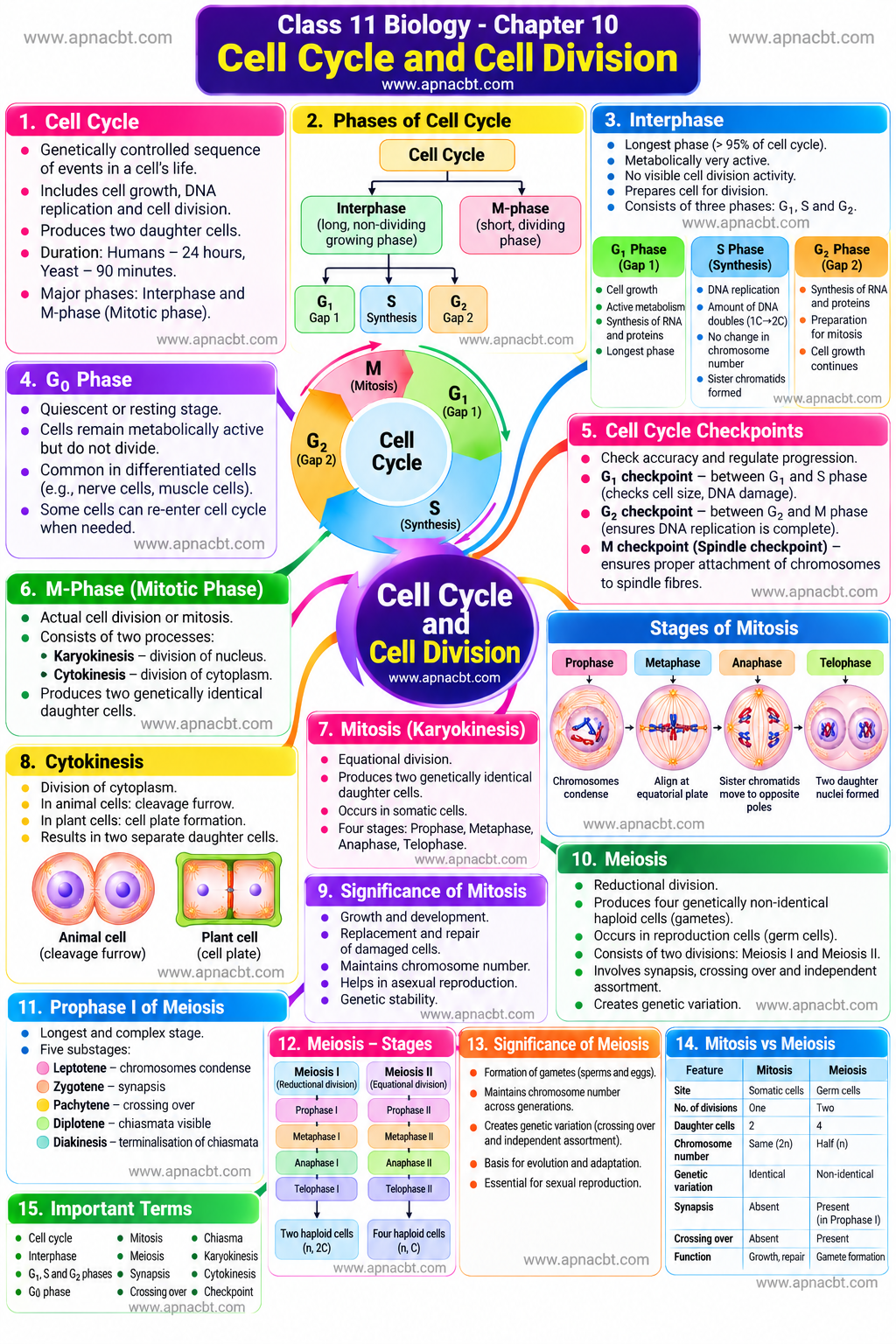
Cell Cycle and Cell Division Mind Map
Cell Cycle and Cell Division Important Diagrams
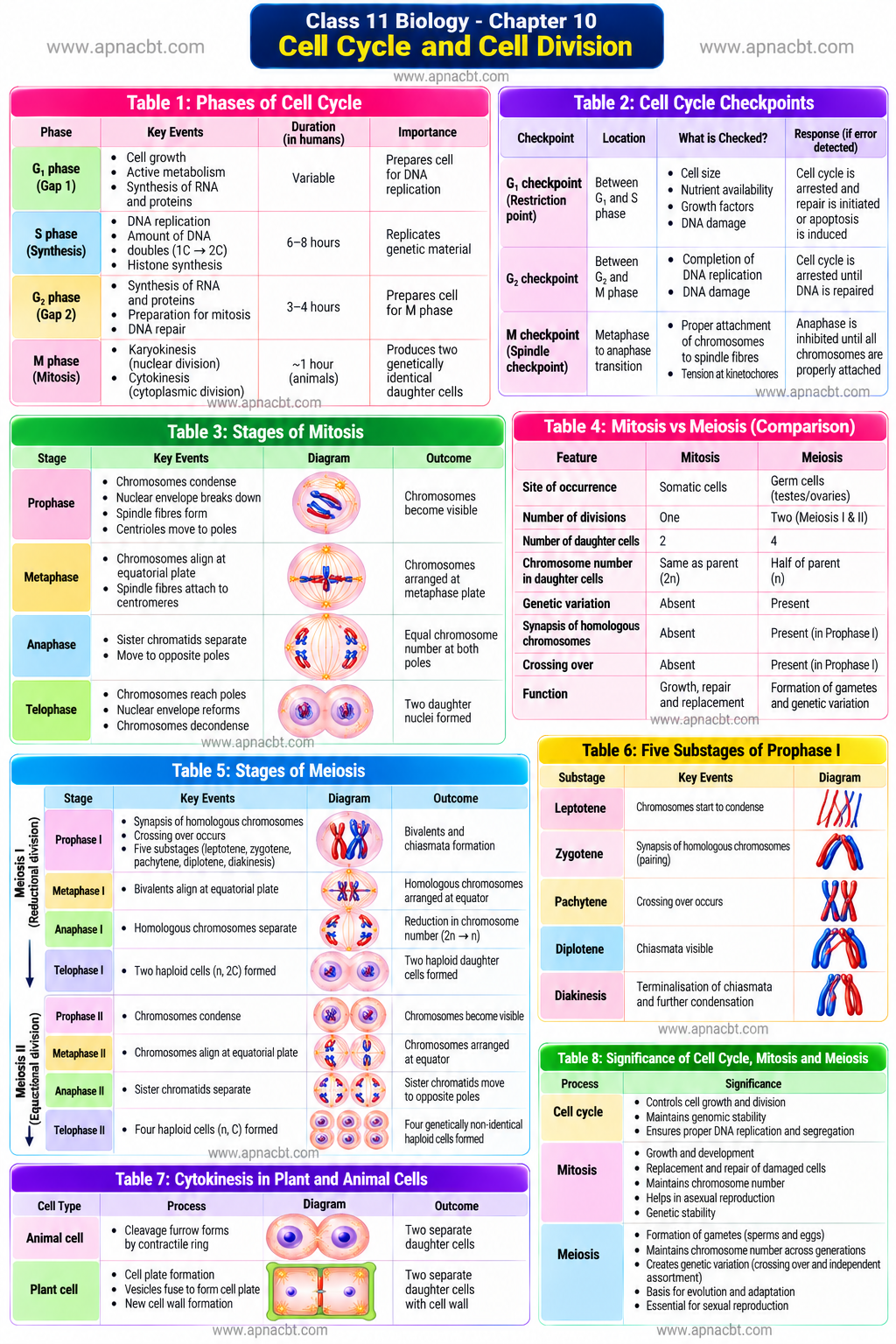
Cell Cycle and Cell Division – Important Tables for Class 11 Biology | APNA CBT