Chapter 9: Biomolecules – Class 11 Biology
Comprehensive, exam-focused lesson prepared from the supplied 30-page PDF for CBSE, Telangana IPE and NEET. Topics include chemical composition of living tissue, amino acids, lipids, nucleotides, metabolites, proteins, carbohydrates, nucleic acids and enzymes.
Study approach: Learn definitions and examples, practise structural diagrams and comparison tables, and revise enzyme mechanisms and protein/DNA structures carefully.
1. Introduction to Biomolecules and Chemical Composition of Living Tissue
Biomolecules are the chemical compounds present in living organisms. They form the structural framework of cells and carry out essential metabolic and physiological functions. The major classes include carbohydrates, proteins, lipids and nucleic acids.
Carbon, hydrogen, oxygen and nitrogen together make up the major proportion of living matter. Other important elements include phosphorus, sulphur, calcium, sodium, potassium, magnesium, iron and chlorine.
Analysis of chemical composition
- A small sample of living tissue is ground in trichloroacetic acid (TCA) using a mortar and pestle.
- The slurry is strained through cotton or cheesecloth.
- The filtrate is the acid-soluble pool, which contains mainly small molecules (micromolecules).
- The residue or retentate is the acid-insoluble fraction, which contains most large biomolecules (macromolecules).
To study inorganic constituents, tissue is dried to remove water and weighed. This is the dry weight. Complete burning oxidises organic matter; the remaining ash contains inorganic elements and salts.
| Term | Meaning |
|---|---|
| Wet weight | Weight of tissue with its natural water content |
| Dry weight | Weight after removal of water |
| Ash | Inorganic residue left after complete burning of dried tissue |
| Acid-soluble pool | Filtrate containing small molecules and ions |
| Acid-insoluble fraction | Residue containing most macromolecules and membrane fragments |
Exam focus: Know the TCA extraction steps and the difference between filtrate (acid-soluble pool) and retentate (acid-insoluble fraction).
2. Elements and Inorganic Constituents of Living Matter
Living tissues contain both organic and inorganic constituents. The elemental composition of living matter differs from that of the earth’s crust. Carbon and nitrogen are proportionally much more abundant in living matter, while silicon is abundant in the earth’s crust but negligible in the human body.
Important inorganic constituents include water, sodium, potassium, calcium, magnesium, chloride, phosphate and sulphate ions. These contribute to osmotic balance, membrane potentials, bone structure, enzyme function and cellular reactions.
| Element / component | Important biological role |
|---|---|
| Carbon, hydrogen, oxygen, nitrogen | Basic elements of most organic biomolecules |
| Calcium | Bones and teeth; muscle contraction and cell signalling |
| Sodium and potassium | Osmotic balance, nerve impulse and membrane potential |
| Magnesium | Enzyme cofactor; central atom of chlorophyll |
| Phosphorus | ATP, nucleic acids, phospholipids and bones |
| Sulphur | Present in amino acids such as cysteine and methionine |
| Water | Solvent, transport medium and participant in metabolic reactions |
3. Amino Acids: Structure and Classification
Amino acids are the building blocks of proteins. In the common α-amino acids, an amino group (–NH2) and a carboxyl group (–COOH) are attached to the same α-carbon. The α-carbon also carries a hydrogen atom and a variable side chain called the R group.
The R group determines the chemical properties of each amino acid. Glycine is the simplest amino acid because its R group is hydrogen. Examples of other amino acids include alanine, serine, valine and glutamic acid.
| Type | Basis / examples |
|---|---|
| Acidic | One amino group and two carboxyl groups; aspartic acid, glutamic acid |
| Basic | Two amino groups and one carboxyl group; lysine, arginine |
| Neutral | One amino and one carboxyl group; glycine, alanine, valine |
| Sulphur-containing | Cysteine and methionine |
| Hydroxy / alcoholic | Serine and threonine; contain –OH group |
| Aromatic | Phenylalanine, tyrosine and tryptophan |
| Heterocyclic | Histidine and proline; contain a ring with nitrogen |
Proline contains an imino group and is often described as an imino acid.
4. Zwitterions, Isoelectric Point and Nutritional Classification
Amino acids contain ionisable amino and carboxyl groups. Depending on pH, they can exist in cationic, anionic or zwitterionic forms. In the zwitterion, the amino group is protonated (–NH3+) and the carboxyl group is deprotonated (–COO−), so the molecule carries both positive and negative charges but has no net charge.
The isoelectric point (pI) is the pH at which an amino acid or protein has zero net electrical charge. At this pH, an amino acid commonly exists predominantly as a zwitterion.
| Nutritional group | Definition | Examples |
|---|---|---|
| Essential amino acids | Cannot be synthesised in sufficient amounts by the human body and must be supplied in the diet | Valine, leucine, isoleucine, lysine, methionine, phenylalanine, threonine, tryptophan |
| Non-essential amino acids | Can be synthesised by the body | Glycine, alanine, serine, aspartic acid, glutamic acid, asparagine, glutamine |
| Semi-essential / conditionally essential | May be required from the diet during growth or particular physiological conditions | Arginine and histidine are commonly highlighted for growing children in the supplied text |
5. Peptide Bond and Functions of Amino Acids
A peptide bond is the covalent amide linkage (–CO–NH–) formed between the carboxyl group of one amino acid and the amino group of another. Formation releases one molecule of water and is therefore a condensation (dehydration) reaction.
- Amino acids are the monomers of proteins and many enzymes.
- Glycine contributes carbon and nitrogen atoms to the synthesis of porphyrins and haem.
- Tyrosine is a precursor of thyroid hormones and catecholamines such as adrenaline.
- Histidine is the precursor of histamine.
- Some amino acids contribute to the synthesis of coenzymes, hormones and other biologically active compounds.
Remember: Peptide bond = –CO–NH–; it forms by condensation with elimination of water.
6. Lipids and Fatty Acids
Lipids are a diverse group of compounds that are insoluble or poorly soluble in water but soluble in non-polar organic solvents such as ether, chloroform and benzene. Fatty acids are important components of many lipids.
A fatty acid has a carboxyl group attached to a hydrocarbon chain. Fatty acids may be saturated (no carbon–carbon double bonds) or unsaturated (one or more carbon–carbon double bonds).
| Type | Characteristic | Examples |
|---|---|---|
| Saturated fatty acid | No C=C double bonds | Palmitic acid (C16), stearic acid (C18) |
| Monounsaturated fatty acid | One C=C double bond | Oleic acid |
| Polyunsaturated fatty acid (PUFA) | Two or more C=C double bonds | Linoleic, linolenic and arachidonic acids |
In many natural fats, fatty acids are esterified with glycerol. A triglyceride (triacylglycerol) consists of one glycerol molecule joined to three fatty acid molecules by ester bonds.
7. Classification of Lipids and Important Examples
| Class | Description / examples |
|---|---|
| Simple lipids | Esters of fatty acids with alcohol; fats and oils (triglycerides), waxes |
| Compound / conjugated lipids | Contain additional groups besides fatty acids and alcohol; phospholipids, glycolipids, lipoproteins |
| Derived lipids | Products of hydrolysis of simple or compound lipids; steroids and sterols such as cholesterol |
| Phospholipids | Glycerol, two fatty acid residues and phosphate-containing head group; major membrane components |
| Sphingolipids | Contain sphingosine; sphingomyelin occurs in the myelin sheath |
| Glycolipids | Lipids associated with carbohydrates; important in membrane stability and cell recognition |
| Lipoproteins | Lipid-protein complexes that transport hydrophobic lipids in aqueous blood plasma |
Phospholipids are amphipathic: they have a hydrophilic polar head and hydrophobic non-polar fatty acid tails. Lecithin (phosphatidylcholine) is found in egg yolk and soybean.
Cholesterol is a sterol and a precursor of steroid hormones such as progesterone, oestrogens, testosterone, aldosterone and cortisol.
8. Functions of Lipids
- Store energy in plants and animals.
- Provide insulation and help maintain body temperature.
- Cushion and protect vital organs from mechanical injury.
- Form structural components of cell and organelle membranes.
- Supply energy to the developing embryo in oil seeds during germination.
- Provide a medium for absorption and transport of fat-soluble vitamins A, D, E and K.
- Serve as precursors for steroid hormones and signalling molecules.
9. Nucleosides, Nucleotides and Nitrogenous Bases
Nucleic acids are polymers of nucleotides. A nucleotide consists of three components: a pentose sugar, a nitrogenous base and one or more phosphate groups. A nucleoside contains only a sugar and a nitrogenous base.
| Component | Description |
|---|---|
| Pentose sugar | Ribose in RNA; 2-deoxyribose in DNA |
| Purines | Double-ring bases: adenine (A) and guanine (G) |
| Pyrimidines | Single-ring bases: cytosine (C), thymine (T) and uracil (U) |
| Phosphate | One or more phosphate groups attached to the sugar; gives nucleotide acidic character |
DNA contains A, G, C and T. RNA contains A, G, C and U. Thymine is characteristic of DNA, while uracil is characteristic of RNA.
| Base | Nucleoside name | Common nucleotide |
|---|---|---|
| Adenine | Adenosine | AMP |
| Guanine | Guanosine | GMP |
| Cytosine | Cytidine | CMP |
| Thymine | Thymidine | TMP (or dTMP in DNA context) |
| Uracil | Uridine | UMP |
10. Phosphodiester Bond, ATP and Functions of Nucleotides
A phosphodiester bond links the 3′-OH group of the sugar of one nucleotide to the phosphate attached to the 5′ carbon of the next nucleotide. This forms the sugar-phosphate backbone of nucleic acids.
- Nucleotides are the monomeric units of DNA and RNA.
- ATP is a high-energy nucleotide that transfers energy for cellular work.
- Some nucleotides form parts of coenzymes such as NAD, FAD and coenzyme A.
- ADP and UDP participate in carbohydrate metabolism and polysaccharide synthesis.
- CTP and CDP participate in phospholipid synthesis.
ATP is adenosine triphosphate: adenine + ribose + three phosphate groups. The terminal phosphate bonds are commonly described as high-energy phosphate bonds.
11. Metabolites: Primary and Secondary
Metabolites are small molecules formed or used during metabolism. They may be intermediates or end products of enzyme-catalysed cellular reactions.
| Primary metabolites | Secondary metabolites |
|---|---|
| Directly involved in growth, development and reproduction | Not directly involved in basic growth, development or reproduction |
| Generally produced in relatively large amounts | Often produced in smaller amounts |
| Examples: amino acids, sugars, nucleotides, organic acids and vitamins | Examples: alkaloids, pigments, terpenoids, essential oils, toxins, lectins, drugs, gums and rubber |
Examples of secondary metabolites
- Alkaloids: morphine, codeine.
- Pigments: carotenoids, anthocyanins.
- Terpenoids: monoterpenes and diterpenes.
- Toxins: abrin and ricin.
- Lectins: concanavalin A.
- Drugs / plant products: vinblastine and curcumin.
- Polymeric products: natural rubber and gums.
12. Biomacromolecules and Cellular Composition
Biomolecules are often classified by molecular mass and solubility. Micromolecules generally have molecular masses below about 1,000 Da and occur in the acid-soluble pool. Macromolecules are larger, complex molecules generally found in the acid-insoluble fraction.
Lipids are a special case: many individual lipid molecules have relatively low molecular mass, but membrane fragments form insoluble vesicles during tissue extraction and therefore occur with the acid-insoluble fraction.
| Cell component | Approximate percentage of total cellular mass (as in the supplied text) |
|---|---|
| Water | 70–90% |
| Proteins | 10–15% |
| Carbohydrates | Around 3% |
| Lipids | Around 2% |
| Nucleic acids | 5–7% |
| Ions | Small proportion |
The acid-soluble pool roughly represents the small-molecule composition of cytoplasm, while the acid-insoluble fraction contains much of the macromolecular material from cytoplasm and organelles.
13. Proteins: Composition and Biological Importance
Proteins are abundant and diverse biomacromolecules. They are heteropolymers made of amino acids joined by peptide bonds. A polypeptide contains a specific sequence of amino acids; one or more polypeptide chains form a functional protein.
- Proteins provide structural support and form body-building material.
- Enzymes catalyse biochemical reactions.
- Some proteins transport molecules, defend the body, regulate processes or enable movement.
- Collagen is one of the most abundant proteins in the animal world.
- RuBisCO is the most abundant protein in the biosphere.
14. Four Levels of Protein Structure
| Level | Description | Stabilising interactions / examples |
|---|---|---|
| Primary | Linear sequence of amino acids in a polypeptide, written from N-terminus to C-terminus | Peptide bonds link amino acids |
| Secondary | Local regular folding of the polypeptide backbone into α-helix or β-pleated sheet | Hydrogen bonds between backbone C=O and N–H groups |
| Tertiary | Overall three-dimensional folding of a single polypeptide chain | Hydrogen bonds, ionic interactions, hydrophobic interactions, van der Waals forces and disulphide bonds |
| Quaternary | Association and spatial arrangement of two or more polypeptide subunits | Interactions between subunits; adult haemoglobin is a classic example |
α-helix: a coiled arrangement stabilised by intrachain hydrogen bonds. β-pleated sheet: extended strands held together by hydrogen bonds between neighbouring segments.
15. Fibrous and Globular Proteins; Conjugated Proteins
| Type | Features | Examples |
|---|---|---|
| Fibrous proteins | Elongated, strand-like, generally less soluble; mainly structural | Collagen, keratin, fibroin |
| Globular proteins | Compact, spherical, generally more soluble; diverse dynamic functions | Enzymes, haemoglobin, albumin, insulin |
| Simple proteins | Yield only amino acids on hydrolysis | Albumins, globulins (examples vary by classification) |
| Conjugated proteins | Contain a protein part plus a non-protein prosthetic group | Haemoglobin (heme), glycoproteins, lipoproteins, nucleoproteins |
The protein portion of a conjugated enzyme is the apoenzyme. The non-protein cofactor combines with it to form the active holoenzyme.
16. Carbohydrates: Monosaccharides and Oligosaccharides
Carbohydrates are polyhydroxy aldehydes or ketones, or compounds that yield them on hydrolysis. They serve as energy sources, storage materials and structural components.
- Monosaccharides: simplest carbohydrates that cannot be hydrolysed into smaller carbohydrate units; examples include glucose, fructose, ribose and deoxyribose.
- Oligosaccharides: formed by condensation of 2–10 monosaccharide units; examples include sucrose, maltose, lactose and raffinose.
- Polysaccharides: long chains of many monosaccharide units; examples include starch, glycogen, cellulose and chitin.
| Sugar | Constituent monosaccharides | Reducing nature |
|---|---|---|
| Maltose | Glucose + glucose | Reducing |
| Lactose | Glucose + galactose | Reducing |
| Sucrose | Glucose + fructose | Non-reducing |
| Raffinose | Galactose + glucose + fructose | Non-reducing |
A glycosidic bond joins monosaccharide units. Sucrose is non-reducing because the anomeric carbons of both component sugars are involved in the glycosidic linkage, leaving no free reducing group.
17. Polysaccharides: Classification and Functions
| Polysaccharide | Monomer / type | Major function or occurrence |
|---|---|---|
| Starch | Glucose homopolysaccharide | Storage carbohydrate in plants; amylose and amylopectin components |
| Glycogen | Glucose homopolysaccharide | Storage carbohydrate in animals and fungi; highly branched |
| Cellulose | Glucose homopolysaccharide | Structural component of plant cell walls |
| Chitin | Modified glucose derivative (N-acetylglucosamine) polymer | Exoskeleton of arthropods and cell wall of fungi |
| Peptidoglycan | Sugar chains cross-linked by short peptides | Bacterial cell wall |
| Mucopolysaccharides / glycosaminoglycans | Repeating amino sugar-containing units | Extracellular matrix and connective tissues |
- Homopolysaccharides contain only one type of monosaccharide monomer.
- Heteropolysaccharides contain more than one type of monosaccharide or derivative.
- Starch gives a blue-black colour with iodine due to iodine association with the helical amylose structure.
- Glycogen is more highly branched than starch and is a readily mobilised energy reserve.
18. Nucleic Acids: DNA and RNA
Nucleic acids are polynucleotide chains that store, transmit and express genetic information. DNA generally stores hereditary information, while RNA has roles in gene expression and protein synthesis.
- Each nucleotide contains a pentose sugar, nitrogenous base and phosphate group.
- DNA contains deoxyribose and bases A, G, C and T; RNA contains ribose and bases A, G, C and U.
- Adjacent nucleotides are joined by 3′–5′ phosphodiester bonds.
- DNA strands have polarity, with 5′ and 3′ ends, and complementary base pairing.
| DNA base pair | Hydrogen bonds |
|---|---|
| Adenine – Thymine (A–T) | 2 |
| Guanine – Cytosine (G–C) | 3 |
In the Watson–Crick model, DNA is a right-handed double helix. The two strands are antiparallel and complementary. The commonly taught B-DNA dimensions are about 0.34 nm between successive base pairs, about 3.4 nm per complete turn and approximately 10 base pairs per turn.
19. Enzymes: Definition, Properties and Active Site
Enzymes are biological catalysts. Most are proteins, although some RNA molecules also show catalytic activity. Enzymes accelerate reactions by lowering activation energy without being consumed in the reaction.
- Enzymes are highly specific for their substrates and reactions.
- They have an active site that binds the substrate and facilitates catalysis.
- They do not change the overall free-energy difference or equilibrium position of a reaction; they speed up the approach to equilibrium.
- Each enzyme has a characteristic optimum temperature and pH range.
- The turnover number is the number of substrate molecules converted into product per enzyme molecule per unit time under defined conditions.
The enzyme-substrate complex is transient. A simplified reaction is: E + S ⇌ ES → E + P.
20. Mechanism of Enzyme Action and Activation Energy
The substrate binds at the enzyme’s active site to form an enzyme-substrate (ES) complex. The enzyme stabilises the transition state, lowers the activation-energy barrier and helps convert substrate into product. Product is released and the enzyme can catalyse another reaction.
- Substrate approaches and binds to the active site.
- An ES complex forms; binding may induce a conformational adjustment.
- Catalytic groups facilitate bond breaking and bond formation.
- Product leaves the active site, releasing the unchanged enzyme.
Activation energy is the energy difference between the substrate state and the transition state. Enzymes lower this energy barrier.
21. Lock-and-Key and Induced-Fit Models
| Model | Explanation | Scientist / key point |
|---|---|---|
| Lock-and-key hypothesis | The active site has a complementary shape to the substrate, like a key fitting a lock | Emil Fischer; explains substrate specificity |
| Induced-fit hypothesis | Substrate binding induces a conformational change so the active site fits the substrate more closely | Daniel Koshland; active site is flexible |
Induced fit explains how enzyme-substrate binding can alter enzyme shape and position catalytic groups to facilitate the reaction.
22. Factors Affecting Enzyme Activity
| Factor | Effect on enzyme activity |
|---|---|
| Temperature | Activity rises with temperature up to an optimum; high temperature can denature the enzyme. Low temperature slows activity, often reversibly. |
| pH | Each enzyme has an optimum pH. Deviations alter ionisation and active-site structure, reducing activity. |
| Substrate concentration | Reaction rate initially increases with substrate concentration, then approaches Vmax as active sites become saturated. |
| Enzyme concentration | When sufficient substrate is available, increasing enzyme concentration increases reaction rate. |
| Inhibitors / regulators | May reduce or modify activity by binding to active sites or other regulatory sites. |
For many human enzymes, optimum temperature is near normal body temperature, but optimum values differ among enzymes. Digestive enzymes may function at acidic or alkaline pH depending on their location.
23. Classification and Nomenclature of Enzymes
Enzymes are classified according to the type of reaction they catalyse. The supplied textbook discusses the following major classes:
| Class | Reaction catalysed | Examples |
|---|---|---|
| Oxidoreductases | Oxidation-reduction; transfer of electrons or hydrogen | Oxidases, dehydrogenases, reductases |
| Transferases | Transfer of a functional group from one molecule to another | Transaminases / group-transfer enzymes |
| Hydrolases | Bond cleavage by addition of water | Amylase, sucrase, lactase, proteases |
| Lyases | Non-hydrolytic removal or addition of groups, often forming or removing double bonds | Aldolase |
| Isomerases | Intramolecular rearrangement to form an isomer | Phosphohexose isomerase |
| Ligases | Joining of two molecules, usually coupled to ATP hydrolysis | DNA ligase |
Note: Enzyme names commonly end in “-ase” and often indicate the substrate or reaction. For NEET, match each enzyme class with its characteristic reaction.
24. Enzyme Inhibition and Regulation
- Competitive inhibition: inhibitor competes with substrate for the active site. Increasing substrate concentration can reduce the inhibitor’s effect. Example: malonate competitively inhibits succinate dehydrogenase.
- Non-competitive / allosteric inhibition: inhibitor binds at a site other than the active site and reduces catalytic activity; adding more substrate does not necessarily overcome it.
- Feedback inhibition: the end product of a metabolic pathway inhibits an enzyme acting earlier in the pathway. This prevents unnecessary synthesis and conserves resources.
In feedback regulation, the final product may bind to a regulatory site on the first committed enzyme in the pathway and reduce its activity.
25. High-Yield Exam Revision and Diagram Checklist
High-yield facts for CBSE, IPE and NEET
- Glycine is the simplest amino acid; peptide bond is –CO–NH–.
- Essential amino acids must be obtained from diet; amino acids can exist as zwitterions.
- Phospholipids are amphipathic and form the basic framework of biological membranes.
- DNA has A, G, C, T; RNA has A, G, C, U. Purines are A and G; pyrimidines are C, T and U.
- ATP is a cellular energy currency; nucleotide is the monomer of nucleic acid.
- Collagen is abundant in animals; RuBisCO is abundant in the biosphere.
- Protein structure has primary, secondary, tertiary and quaternary levels.
- Starch is plant storage carbohydrate; glycogen is animal/fungal storage carbohydrate; cellulose is plant cell-wall material; chitin occurs in arthropod exoskeleton and fungal walls.
- Sucrose is non-reducing; maltose and lactose are reducing sugars.
- Enzymes lower activation energy; activity depends on temperature, pH and substrate concentration.
- Malonate is a competitive inhibitor of succinate dehydrogenase.
Important diagrams to practise
- General structure of an α-amino acid and zwitterionic form.
- Peptide bond formation between two amino acids.
- Triglyceride and phospholipid (lecithin) structures.
- Nucleotide structure and ATP.
- Protein structural levels: α-helix, β-pleated sheet and haemoglobin quaternary structure.
- DNA double helix and complementary base pairing.
- Enzyme-substrate complex, activation-energy graph and lock-and-key / induced-fit models.
- Effect of temperature, pH and substrate concentration on enzyme activity.
26. Short-Answer Questions (30)
Questions
- What are biomolecules?
- What is the acid-soluble pool?
- Define dry weight and ash.
- Name the four elements that make up most of living matter.
- What is an α-amino acid?
- Why is glycine called the simplest amino acid?
- Name two acidic and two basic amino acids.
- What is a zwitterion?
- Define isoelectric point.
- Differentiate essential and non-essential amino acids.
- What is a peptide bond?
- What are lipids?
- What is a triglyceride?
- Differentiate saturated and unsaturated fatty acids.
- What is an amphipathic molecule? Give an example.
- What is cholesterol?
- What are the three components of a nucleotide?
- Differentiate nucleoside and nucleotide.
- Name the purine and pyrimidine bases.
- What is a phosphodiester bond?
- Why is ATP called the energy currency of the cell?
- Differentiate primary and secondary metabolites.
- Name two alkaloids.
- What is the difference between micromolecules and macromolecules?
- Name the most abundant protein in the animal world and in the biosphere.
- What are the four levels of protein structure?
- What is a glycosidic bond?
- Why is sucrose a non-reducing sugar?
- What is the function of an enzyme?
- What is feedback inhibition?
Detailed Answers
- What are biomolecules?
Biomolecules are chemical compounds present in living organisms that perform structural, metabolic and regulatory functions. Examples include carbohydrates, proteins, lipids and nucleic acids.
- What is the acid-soluble pool?
It is the filtrate obtained after grinding tissue in trichloroacetic acid and filtering it. It contains mainly small molecules such as amino acids, sugars, nucleotides and inorganic ions.
- Define dry weight and ash.
Dry weight is the mass of tissue after its water has been removed. Ash is the inorganic residue remaining after complete burning of dried tissue.
- Name the four elements that make up most of living matter.
Carbon, hydrogen, oxygen and nitrogen.
- What is an α-amino acid?
An amino acid in which the amino group and carboxyl group are attached to the same α-carbon, along with hydrogen and a variable R group.
- Why is glycine called the simplest amino acid?
Its R group is only a hydrogen atom, making it the smallest and simplest amino acid.
- Name two acidic and two basic amino acids.
Aspartic acid and glutamic acid are acidic; lysine and arginine are basic amino acids.
- What is a zwitterion?
A molecule carrying both positive and negative charges but having no net charge, such as the zwitterionic form of an amino acid.
- Define isoelectric point.
The pH at which an amino acid or protein has zero net electrical charge.
- Differentiate essential and non-essential amino acids.
Essential amino acids cannot be synthesised in sufficient amounts by the body and must be supplied in food; non-essential amino acids can be synthesised by the body.
- What is a peptide bond?
A covalent –CO–NH– linkage formed between the carboxyl group of one amino acid and the amino group of another with elimination of water.
- What are lipids?
Lipids are water-insoluble or poorly water-soluble compounds that dissolve in non-polar organic solvents such as ether and chloroform.
- What is a triglyceride?
A lipid formed by esterification of one glycerol molecule with three fatty acid molecules.
- Differentiate saturated and unsaturated fatty acids.
Saturated fatty acids have no carbon-carbon double bonds; unsaturated fatty acids have one or more such double bonds.
- What is an amphipathic molecule? Give an example.
A molecule with both hydrophilic and hydrophobic regions. A phospholipid is an example.
- What is cholesterol?
Cholesterol is a sterol present in animal membranes and serves as a precursor for steroid hormones.
- What are the three components of a nucleotide?
A pentose sugar, a nitrogenous base and one or more phosphate groups.
- Differentiate nucleoside and nucleotide.
A nucleoside consists of a nitrogenous base and pentose sugar; a nucleotide additionally contains phosphate.
- Name the purine and pyrimidine bases.
Purines are adenine and guanine. Pyrimidines are cytosine, thymine and uracil.
- What is a phosphodiester bond?
A bond linking the 3′-OH of one nucleotide sugar to the phosphate attached to the 5′ carbon of the next nucleotide.
- Why is ATP called the energy currency of the cell?
ATP transfers usable chemical energy to cellular processes through hydrolysis of its phosphate bonds.
- Differentiate primary and secondary metabolites.
Primary metabolites are directly involved in growth and normal metabolism; secondary metabolites are not directly required for basic growth and include alkaloids, pigments and essential oils.
- Name two alkaloids.
Morphine and codeine.
- What is the difference between micromolecules and macromolecules?
Micromolecules are small molecules, generally below about 1,000 Da; macromolecules are large complex molecules such as proteins and nucleic acids.
- Name the most abundant protein in the animal world and in the biosphere.
Collagen is among the most abundant proteins in the animal world; RuBisCO is the most abundant protein in the biosphere.
- What are the four levels of protein structure?
Primary, secondary, tertiary and quaternary structures.
- What is a glycosidic bond?
A covalent bond joining monosaccharide units in oligosaccharides and polysaccharides.
- Why is sucrose a non-reducing sugar?
The anomeric carbons of glucose and fructose are both involved in the glycosidic linkage, so no free reducing group remains.
- What is the function of an enzyme?
An enzyme is a biological catalyst that increases reaction rate by lowering activation energy without being consumed.
- What is feedback inhibition?
Regulation in which the end product of a metabolic pathway inhibits an enzyme acting earlier in the pathway.
27. Long-Answer Questions (15)
Questions
- Describe the chemical analysis of living tissue and distinguish the acid-soluble and acid-insoluble fractions.
- Explain the structure and classification of amino acids.
- Explain zwitterion formation, isoelectric point and nutritional classification of amino acids.
- Describe peptide bond formation and list important functions of amino acids.
- Classify lipids and describe the structure and functions of phospholipids.
- Explain the structure of a nucleotide and the biological functions of nucleotides.
- Differentiate primary and secondary metabolites with examples and significance.
- Explain the four levels of protein structure.
- Differentiate fibrous and globular proteins and explain conjugated proteins.
- Classify carbohydrates and explain the structures and roles of important polysaccharides.
- Compare starch, glycogen and cellulose.
- Describe the Watson and Crick model of DNA.
- Define enzymes and explain the mechanism of enzyme action.
- Compare the lock-and-key and induced-fit hypotheses of enzyme action.
- Explain the factors affecting enzyme activity and describe enzyme inhibition.
Detailed Answers
- Describe the chemical analysis of living tissue and distinguish the acid-soluble and acid-insoluble fractions.
A small piece of living tissue is ground in trichloroacetic acid using a mortar and pestle. The slurry is filtered through cotton or cheesecloth. The filtrate is the acid-soluble pool and contains small molecules such as amino acids, sugars, nucleotides, organic acids and inorganic ions. The residue or retentate is the acid-insoluble fraction and contains most large biomolecules, including proteins, nucleic acids and polysaccharides, along with membrane fragments. Inorganic constituents can be studied by drying tissue to obtain dry weight and burning it completely; the remaining ash contains inorganic elements and salts.
- Explain the structure and classification of amino acids.
A common α-amino acid has a central α-carbon attached to an amino group, a carboxyl group, a hydrogen atom and a variable R group. The R group determines its properties. Amino acids may be acidic (aspartic acid, glutamic acid), basic (lysine, arginine), neutral (glycine, alanine), sulphur-containing (cysteine, methionine), hydroxy-containing (serine, threonine), aromatic (phenylalanine, tyrosine, tryptophan) or heterocyclic (histidine, proline). Glycine is the simplest amino acid because its R group is hydrogen.
- Explain zwitterion formation, isoelectric point and nutritional classification of amino acids.
Amino acids contain ionisable –NH2 and –COOH groups. In aqueous solution, the amino group may accept a proton to become –NH3+ while the carboxyl group loses a proton to become –COO−. This dipolar form is a zwitterion with zero net charge. The isoelectric point is the pH at which the amino acid has no net electrical charge. Essential amino acids must be supplied through diet because the body cannot synthesise them in sufficient amounts; examples include valine, leucine, lysine, methionine and tryptophan. Non-essential amino acids can be synthesised by the body; examples include glycine, alanine and serine.
- Describe peptide bond formation and list important functions of amino acids.
A peptide bond forms when the carboxyl group of one amino acid reacts with the amino group of another. A molecule of water is eliminated, producing a covalent amide linkage, –CO–NH–. Amino acids form proteins and enzymes. They are precursors of biologically active compounds: glycine contributes to haem synthesis, tyrosine is a precursor of thyroid hormones and adrenaline, and histidine gives rise to histamine. Amino acids also participate in synthesis of coenzymes, hormones and other metabolites.
- Classify lipids and describe the structure and functions of phospholipids.
Lipids may be simple, compound (conjugated) or derived. Simple lipids include fats, oils and waxes. Compound lipids include phospholipids, glycolipids and lipoproteins. Derived lipids include steroids and sterols such as cholesterol. A phospholipid typically contains glycerol, two fatty acid residues and a phosphate-containing polar head group. It is amphipathic, with a hydrophilic head and hydrophobic tails, and forms the basic bilayer of cell membranes. Phospholipids also participate in membrane signalling and provide a structural matrix for membrane proteins.
- Explain the structure of a nucleotide and the biological functions of nucleotides.
A nucleotide consists of a pentose sugar, a nitrogenous base and one or more phosphate groups. Ribose occurs in RNA nucleotides and deoxyribose in DNA nucleotides. Bases are purines (adenine and guanine) or pyrimidines (cytosine, thymine and uracil). Nucleotides are the monomers of DNA and RNA. ATP transfers energy in cells. Nucleotide derivatives form parts of coenzymes such as NAD and coenzyme A. UDP/ADP participate in carbohydrate synthesis and CTP/CDP in phospholipid synthesis.
- Differentiate primary and secondary metabolites with examples and significance.
Primary metabolites are directly involved in normal growth, development and reproduction and are generally produced in larger amounts. Examples include amino acids, sugars, nucleotides, organic acids and vitamins. Secondary metabolites are not directly involved in basic growth and are often produced in smaller quantities. Examples include alkaloids (morphine, codeine), pigments (carotenoids, anthocyanins), terpenoids, essential oils, toxins (ricin, abrin), lectins, drugs (vinblastine, curcumin), rubber and gums. They can contribute to defence, ecological interactions and products useful to humans.
- Explain the four levels of protein structure.
Primary structure is the linear sequence of amino acids in a polypeptide, held by peptide bonds. Secondary structure is local folding into α-helices or β-pleated sheets, stabilised mainly by hydrogen bonds between backbone groups. Tertiary structure is the overall three-dimensional folding of one polypeptide, stabilised by hydrogen bonds, ionic interactions, hydrophobic interactions, van der Waals forces and disulphide bonds. Quaternary structure is the association of two or more polypeptide subunits; adult haemoglobin is a standard example.
- Differentiate fibrous and globular proteins and explain conjugated proteins.
Fibrous proteins are elongated, often insoluble and mainly structural; examples include collagen, keratin and fibroin. Globular proteins are compact, generally more soluble and perform dynamic functions; examples include enzymes, haemoglobin and albumin. Conjugated proteins contain a protein component and a non-protein prosthetic group. Examples include haemoproteins such as haemoglobin, glycoproteins, lipoproteins and nucleoproteins. In a conjugated enzyme, the protein part is the apoenzyme and the complete active enzyme with its cofactor is the holoenzyme.
- Classify carbohydrates and explain the structures and roles of important polysaccharides.
Carbohydrates include monosaccharides, oligosaccharides and polysaccharides. Monosaccharides such as glucose, fructose, ribose and deoxyribose cannot be hydrolysed into simpler carbohydrates. Oligosaccharides contain a few sugar units, such as sucrose, maltose and lactose. Polysaccharides contain many monosaccharide units. Starch is the storage polysaccharide of plants; glycogen is the storage polysaccharide of animals and fungi; cellulose forms plant cell walls; chitin occurs in arthropod exoskeletons and fungal cell walls; peptidoglycan forms bacterial cell walls. Glycosidic bonds join the sugar units.
- Compare starch, glycogen and cellulose.
All three are glucose-based polysaccharides, but they differ in linkage and function. Starch is the storage carbohydrate of plants and contains amylose and branched amylopectin. Glycogen is the storage carbohydrate of animals and fungi and is more highly branched than amylopectin, allowing rapid mobilisation. Cellulose is a structural polymer of β-glucose that forms plant cell walls; its straight chains form strong fibres through extensive hydrogen bonding. Humans can digest starch but lack cellulase to digest cellulose.
- Describe the Watson and Crick model of DNA.
DNA is a right-handed double helix made of two polynucleotide strands running antiparallel to one another. Sugar-phosphate backbones lie on the outside and nitrogenous bases face inward. Adenine pairs with thymine through two hydrogen bonds, while guanine pairs with cytosine through three hydrogen bonds. The strands are complementary. In B-DNA, the distance between successive base pairs is about 0.34 nm, one complete turn is about 3.4 nm and approximately 10 base pairs occur per turn. Complementary base pairing enables accurate replication and transmission of genetic information.
- Define enzymes and explain the mechanism of enzyme action.
Enzymes are biological catalysts, mostly proteins, that accelerate biochemical reactions by lowering activation energy. A substrate binds specifically to the enzyme’s active site, forming a transient enzyme-substrate complex. Binding may cause an induced-fit change in enzyme shape. Catalytic groups stabilise the transition state and facilitate bond breaking or formation. Product is released, and the enzyme remains available for another catalytic cycle. The simplified sequence is E + S ⇌ ES → E + P.
- Compare the lock-and-key and induced-fit hypotheses of enzyme action.
The lock-and-key hypothesis, proposed by Emil Fischer, suggests that the active site has a rigid shape complementary to a particular substrate, like a key fitting a lock. It explains specificity. The induced-fit hypothesis, proposed by Koshland, states that the active site is flexible and changes conformation when the substrate binds, producing a closer fit and positioning catalytic groups. The induced-fit model better explains enzyme conformational changes during catalysis.
- Explain the factors affecting enzyme activity and describe enzyme inhibition.
Temperature affects molecular motion and reaction rate; activity rises to an optimum and then falls as high temperature denatures the enzyme. Each enzyme has an optimum pH; deviations alter ionisation and active-site structure. Increasing substrate concentration raises reaction velocity until enzyme active sites become saturated and Vmax is approached. Competitive inhibitors bind at the active site and compete with substrate; malonate competitively inhibits succinate dehydrogenase. Non-competitive or allosteric inhibitors bind elsewhere and reduce activity. Feedback inhibition occurs when a pathway’s end product inhibits an earlier enzyme.
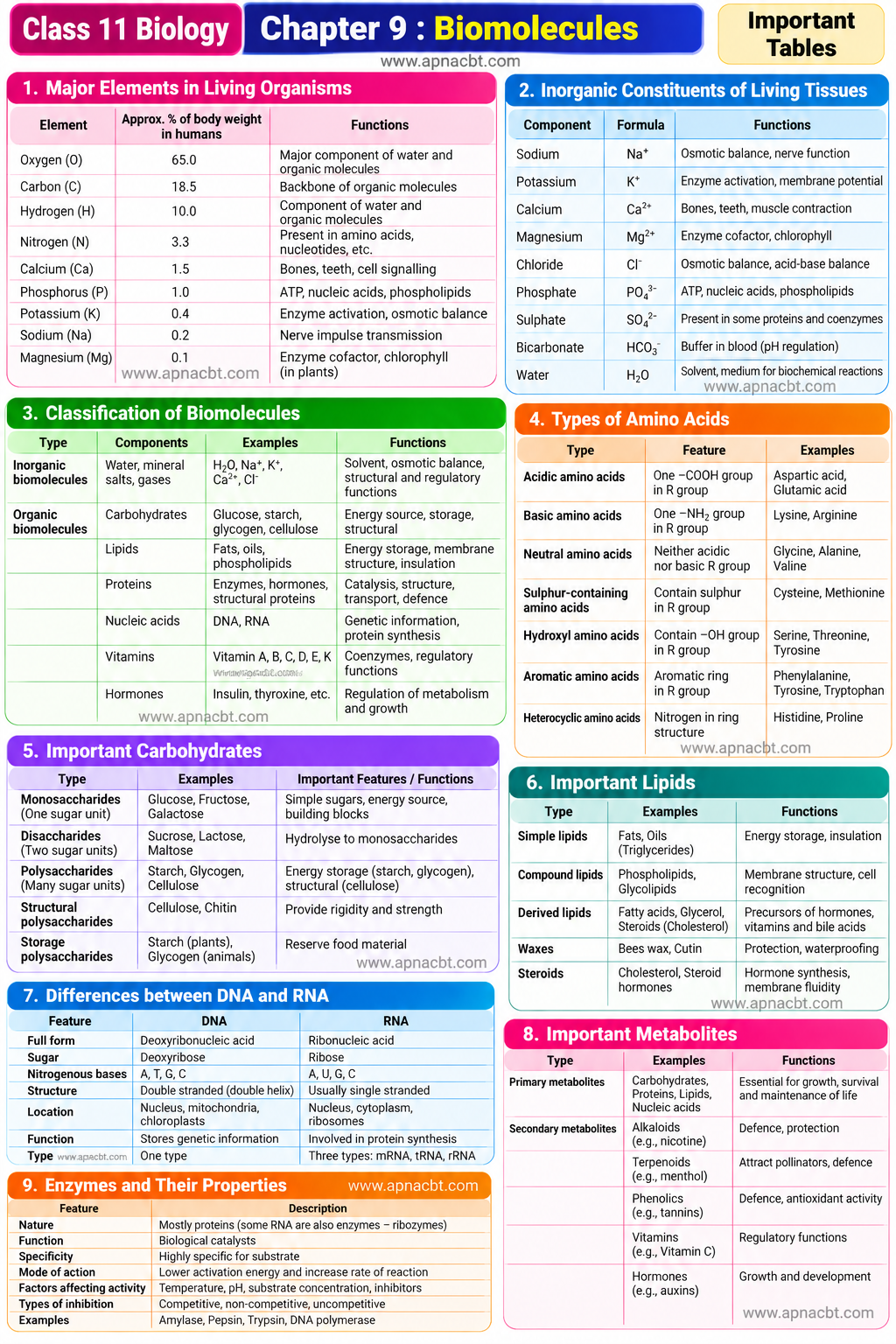
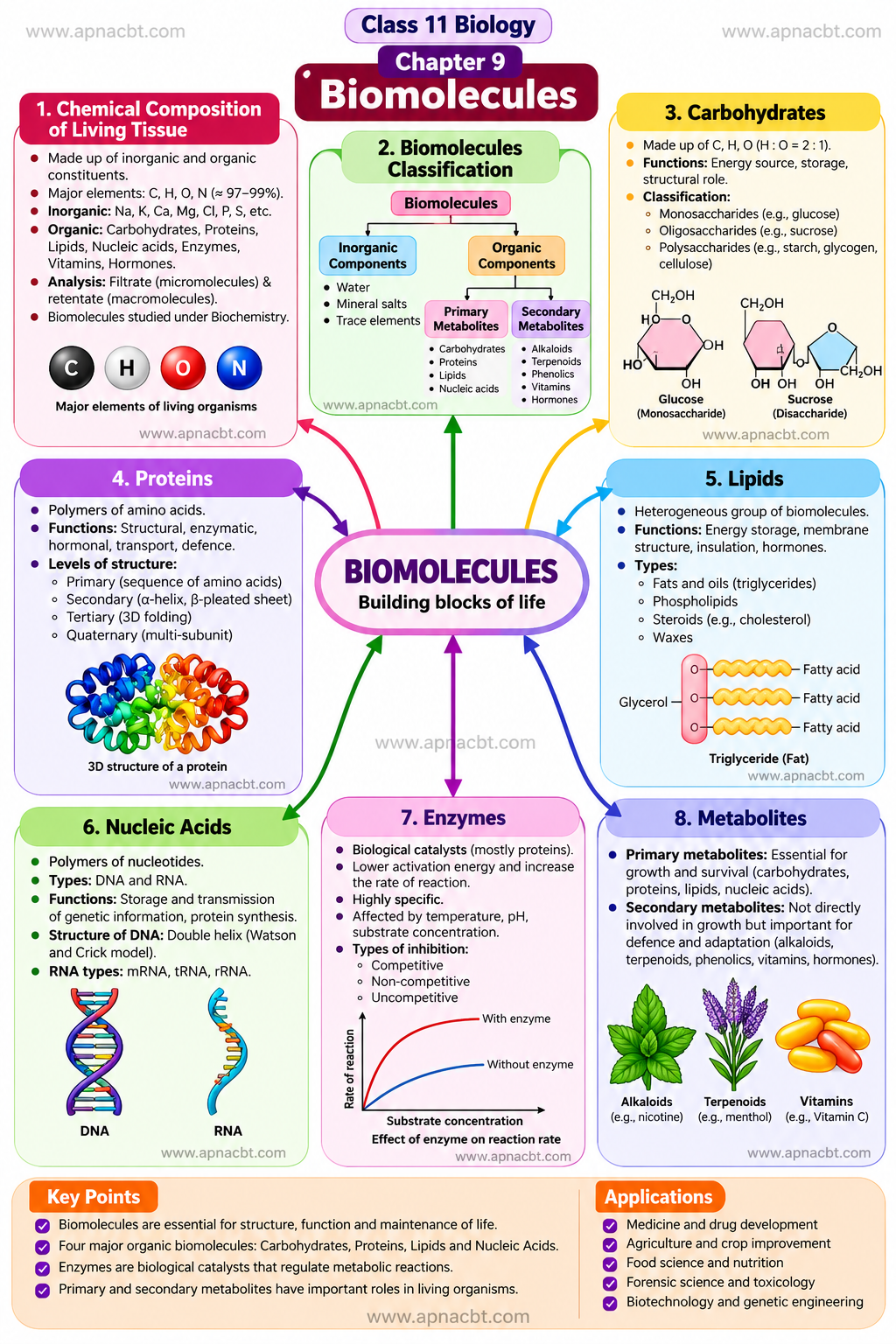
Biomolecules Mind Map – Class 11 Biology Chapter 9 | APNA CBT
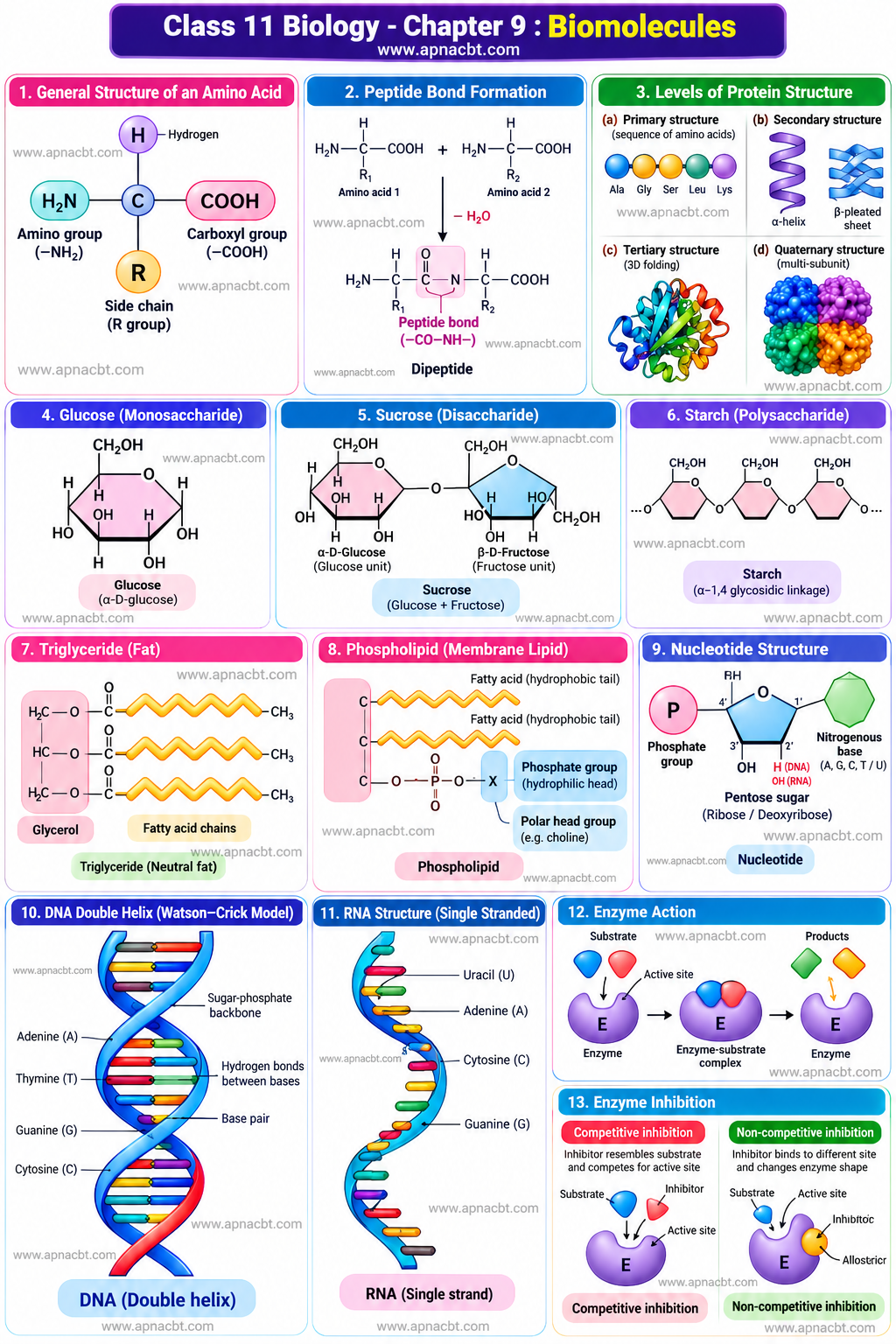
Biomolecules – Important Biology Diagrams for Class 11 | APNA CBT
Biomolecules Important Tables – Class 11 Biology Chapter 9 | APNA CBT