Alcohols, Phenols and Ethers – Class 12 Chemistry
This Level 01 lesson is prepared for CBSE, Class 12 Board Exams, NEET and concept revision.
Table of Contents
- Introduction and chapter focus
- Classification and nomenclature
- Structure and important physical properties
- Preparation of alcohols
- Chemical reactions and oxidation of alcohols
- Phenols: preparation, acidity and reactions
- Ethers: preparation, properties and reactions
- Commercially important alcohols and exam revision
- High-yield comparisons, mechanisms and common mistakes
- Short-Answer Questions – 30 Questions with Detailed Answers
- Long-Answer Questions – 15 Questions with Detailed Answers
Introduction and chapter focus
Alcohols, Phenols and Ethers – Class 12 Chemistry
Alcohols, Phenols and Ethers form an important group of oxygen-containing organic compounds. The NCERT unit introduces their nomenclature, classification, preparation, physical properties and chemical reactions, and connects these concepts with industrial and everyday applications. For CBSE Board Exams and NEET, the chapter is especially useful for reaction prediction, acidity comparisons, oxidation, substitution, dehydration and electrophilic substitution.
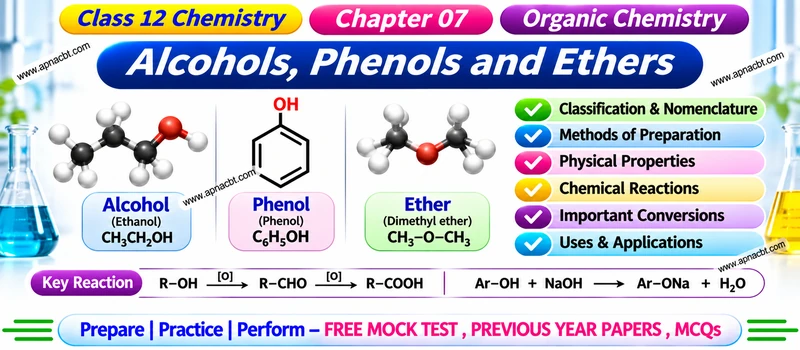
An alcohol contains one or more hydroxyl groups directly attached to an aliphatic carbon atom, whereas in a phenol the hydroxyl group is directly attached to an aromatic carbon. Ethers contain an oxygen atom bonded to two alkyl or aryl groups. These apparently simple differences produce major changes in acidity, boiling point, reactivity and reaction mechanism.
The supplied NCERT material also emphasises the relationship between structure and properties, including hydrogen bonding, resonance, steric effects and the nature of the carbon–oxygen bond.
Classification and nomenclature
Classification of alcohols, phenols and ethers
Alcohols and phenols may be classified according to the number of hydroxyl groups as monohydric, dihydric, trihydric or polyhydric compounds. Monohydric alcohols are further classified according to the hybridisation and environment of the carbon bearing the –OH group. A primary alcohol has the –OH-bearing carbon attached to one other carbon, a secondary alcohol to two carbons and a tertiary alcohol to three carbons.
For IUPAC nomenclature of alcohols, the longest chain containing the carbon attached to –OH is selected and numbered to give the hydroxyl group the lowest possible locant. The suffix -ol is used. For ethers, one group is treated as an alkoxy substituent on the parent hydrocarbon; for example, CH3OCH2CH3 is methoxyethane. Common names of ethers are formed by naming the two groups attached to oxygen followed by “ether”.
| Class | Defining feature | Example |
|---|---|---|
| Primary alcohol | –OH carbon attached to one carbon | CH3CH2OH |
| Secondary alcohol | –OH carbon attached to two carbons | CH3CHOHCH3 |
| Tertiary alcohol | –OH carbon attached to three carbons | (CH3)3COH |
| Phenol | –OH directly on aromatic carbon | C6H5OH |
| Ether | R–O–R′ linkage | CH3OCH3 |
Structure and important physical properties
Structure–property relationships
The hydroxyl group is polar because oxygen is more electronegative than carbon and hydrogen. Alcohols and phenols can form intermolecular hydrogen bonds. This is why their boiling points are generally higher than those of hydrocarbons, ethers and haloalkanes of comparable molecular mass. In alcohols, increasing carbon chain length generally raises boiling point because dispersion forces increase, while increased branching tends to lower boiling point because the molecular surface area decreases.
In alcohols, the bond angle around oxygen is slightly less than the tetrahedral angle because of lone-pair repulsion. In phenol, the C–O bond has partial double-bond character due to conjugation of the oxygen lone pair with the aromatic ring. The NCERT material gives a phenolic C–O bond length of about 136 pm. In ethers, oxygen has two bond pairs and two lone pairs arranged approximately tetrahedrally, and the C–O–C angle is slightly greater than the tetrahedral angle because of repulsion between the two carbon groups.
Preparation of alcohols
Major methods of preparation of alcohols
1. Hydration of alkenes: Alkenes react with water in the presence of an acid catalyst to give alcohols. With unsymmetrical alkenes, the addition generally follows Markovnikov’s rule. The mechanism involves protonation of the alkene, formation of the more stable carbocation, nucleophilic attack by water and deprotonation.
2. Hydroboration–oxidation: Alkenes react with diborane or a related borane reagent followed by oxidation. This route gives alcohols with anti-Markovnikov orientation and is therefore an important contrast with acid-catalysed hydration.
3. From carbonyl compounds: Aldehydes and ketones can be reduced to alcohols. Aldehydes give primary alcohols and ketones give secondary alcohols. Common reducing systems include catalytic hydrogenation and hydride reagents such as LiAlH4 or NaBH4, depending on the substrate and desired conditions.
4. Grignard reagents: Grignard reagents react with carbonyl compounds and, after hydrolysis, give alcohols. Methanal gives primary alcohols, other aldehydes generally give secondary alcohols and ketones give tertiary alcohols. The carbon–magnesium bond behaves as a strong nucleophilic carbon species, so the carbonyl carbon is attacked before acidic work-up.
5. From carboxylic acids and esters: Suitable reduction can convert carboxylic acids and esters into primary alcohols. The choice of reagent and reaction conditions must be remembered for examination questions.
| Starting material | Typical transformation | Major alcohol class |
|---|---|---|
| Alkene | Hydration | Depends on alkene and orientation |
| Methanal + RMgX | Grignard addition followed by hydrolysis | Primary |
| Aldehyde + RMgX | Nucleophilic addition followed by hydrolysis | Secondary |
| Ketone + RMgX | Nucleophilic addition followed by hydrolysis | Tertiary |
| Aldehyde reduction | Reduction of C=O | Primary |
| Ketone reduction | Reduction of C=O | Secondary |
Chemical reactions and oxidation of alcohols
Important reactions of alcohols
Alcohols undergo several reactions because the O–H and C–O bonds can participate in acid–base, substitution, elimination and oxidation processes. With hydrogen halides, alcohols form alkyl halides. The ease of reaction depends on alcohol structure and the mechanism involved. Lucas reagent, a mixture of concentrated HCl and anhydrous ZnCl2, is associated with the distinction between primary, secondary and tertiary alcohols by the rate of turbidity formation.
Dehydration: Alcohols can lose water to form alkenes under acidic conditions. The ease of dehydration generally follows tertiary > secondary > primary when the mechanism permits carbocation formation. For ethanol, controlled dehydration gives ethene at higher temperature, while lower-temperature acidic conditions can favour ether formation.
Reaction with sodium: Alcohols react with active metals such as sodium to release hydrogen and form sodium alkoxides. This demonstrates the acidic character of the O–H bond, although alcohols are much weaker acids than water and phenols are generally more acidic than alcohols.
Oxidation: Primary alcohols can be oxidised to aldehydes by mild oxidising agents and further to carboxylic acids under stronger or prolonged oxidation. Secondary alcohols give ketones. Tertiary alcohols resist oxidation under ordinary conditions because oxidation would require cleavage of a carbon–carbon bond adjacent to the carbon bearing the hydroxyl group.
Esterification: Alcohols react with carboxylic acids in the presence of an acid catalyst to form esters and water. Esters often have characteristic pleasant odours and are important in flavour and fragrance chemistry.
Alcohols, Phenols and Ethers: phenols – preparation, acidity and reactions
Phenols: preparation, acidity and characteristic reactions
Phenols can be prepared by several routes. Important methods include replacement of the halogen atom in haloarenes by hydroxyl group under suitable alkaline conditions, conversion of aryl sulphonic acids to phenols by fusion with sodium hydroxide followed by acidification, hydrolysis of diazonium salts and industrial preparation from cumene. The source material highlights these routes as core preparation methods.
Acidic nature: Phenol is more acidic than aliphatic alcohols because the phenoxide ion formed after loss of H+ is stabilised by resonance. Electron-withdrawing substituents increase acidity by stabilising the negative charge, whereas electron-releasing substituents generally decrease acidity. This is a frequent comparison question.
Electrophilic substitution: The –OH group strongly activates the benzene ring and directs incoming electrophiles mainly to the ortho and para positions through resonance. Nitration with dilute nitric acid gives a mixture of ortho- and para-nitrophenols. Concentrated nitric acid can lead to 2,4,6-trinitrophenol, commonly called picric acid. Bromination of phenol under suitable conditions is another characteristic reaction.
Kolbe’s reaction: Sodium phenoxide reacts with carbon dioxide under suitable conditions and, after acidification, gives salicylic acid as the major product. Reimer–Tiemann reaction: Phenol treated with chloroform and aqueous sodium hydroxide followed by acidification gives salicylaldehyde as the major product. These named reactions are high-priority for both board and entrance examinations.
Ethers: preparation, properties and reactions
Preparation and reactions of ethers
Dehydration of alcohols: Primary alcohols can undergo acid-catalysed bimolecular dehydration at controlled temperature to form ethers. For ethanol, lower-temperature dehydration favours ethoxyethane, whereas higher temperature favours ethene. Secondary and tertiary alcohols generally favour elimination rather than clean ether formation because competing mechanisms lead to alkene formation.
Williamson synthesis: An alkyl halide reacts with sodium alkoxide to form an ether by an SN2 pathway. The method is particularly effective when the alkyl halide is primary and unhindered. Secondary or tertiary halides can favour elimination, so substrate choice matters. Williamson synthesis is important for preparing both symmetrical and unsymmetrical ethers.
Ethers have no O–H bond and therefore cannot form strong intermolecular hydrogen bonds with themselves. Their boiling points are consequently lower than those of corresponding alcohols. Ether oxygen can, however, accept hydrogen bonds from water, explaining their appreciable solubility.
Cleavage: Ethers are relatively unreactive but undergo cleavage with concentrated hydrogen halides, particularly HI and HBr, at elevated temperature. The order of reactivity of hydrogen halides is HI > HBr > HCl. Dialkyl ethers can ultimately give alkyl halides, while alkyl aryl ethers are generally cleaved at the alkyl–oxygen bond, producing a phenol and an alkyl halide.
Aromatic ethers: The alkoxy group activates the aromatic ring toward electrophilic substitution and directs incoming groups mainly to ortho and para positions. Thus anisole undergoes characteristic electrophilic substitution reactions more readily than benzene under appropriate conditions.
Commercially important alcohols and exam revision
Commercial importance and applications
Board revision checklist: revise IUPAC naming, primary/secondary/tertiary classification, preparation of alcohols, oxidation products, dehydration, phenol acidity, Kolbe and Reimer–Tiemann reactions, electrophilic substitution of phenol, Williamson ether synthesis and cleavage of ethers.
NEET revision checklist: focus on reagent–product matching, acidity order, alcohol reactivity, oxidation, mechanism-based questions, orientation in phenol and anisole substitution, and the substrate limitations of Williamson synthesis.
APNA CBT: APNA CBT Chemistry and exam preparation resources.
Authoritative reference: NCERT Chemistry Exemplar Problems.
High-yield comparisons, mechanisms and common mistakes
High-yield comparisons for CBSE and NEET
| Comparison | Key idea | Exam takeaway |
|---|---|---|
| Phenol vs alcohol acidity | Phenoxide ion is resonance stabilised | Phenol is more acidic |
| Alcohol vs ether boiling point | Alcohols form intermolecular H-bonds | Alcohols generally boil higher |
| Primary vs secondary oxidation | Primary → aldehyde/acid; secondary → ketone | Identify class first |
| Tertiary alcohol oxidation | No easy oxidation without C–C bond cleavage | Generally resistant |
| Williamson synthesis | Alkoxide attacks alkyl halide by SN2 | Primary halides are preferred |
| Phenol substitution | –OH activates ring by resonance | Ortho/para direction |
| Ether cleavage | Strong HI/HBr under severe conditions | HI is most effective |
Common mistake 2: Do not assume all alcohols give the same oxidation product. The carbon skeleton and alcohol class determine the product.
Common mistake 3: Do not use Williamson synthesis indiscriminately with tertiary halides. Elimination can compete strongly, making the method unsuitable for many tertiary substrates.
Common mistake 4: Do not confuse Kolbe’s reaction of phenoxide with Reimer–Tiemann reaction of phenol. Kolbe introduces a carboxyl group, whereas Reimer–Tiemann introduces a formyl group under the standard conditions.
Short-Answer Questions – 30 Questions with Detailed Answers
Short-answer practice
1. What is an alcohol?
Answer: An alcohol is an organic compound containing one or more hydroxyl groups directly attached to an aliphatic carbon atom.
2. How are phenols different from alcohols?
Answer: In phenols, the –OH group is directly attached to an aromatic carbon of a benzene ring or related aromatic system. In alcohols, the –OH group is attached to an aliphatic carbon.
3. What is a monohydric alcohol?
Answer: A monohydric alcohol contains one hydroxyl group in its molecule.
4. What is a primary alcohol?
Answer: A primary alcohol has the carbon bearing the –OH group attached to only one other carbon atom, except methanol which is treated separately as a primary alcohol in common classification.
5. What is an ether?
Answer: An ether is a compound containing an oxygen atom bonded to two alkyl and/or aryl groups, represented as R–O–R′.
6. What is a symmetrical ether?
Answer: A symmetrical ether has identical groups on both sides of oxygen, such as C2H5–O–C2H5.
7. Why do alcohols have relatively high boiling points?
Answer: Alcohol molecules form intermolecular hydrogen bonds through their hydroxyl groups, requiring more energy to separate the molecules.
8. Why are ethers lower boiling than alcohols of comparable mass?
Answer: Ethers lack an O–H bond and therefore do not form strong intermolecular hydrogen-bond networks with themselves.
9. What is an allylic alcohol?
Answer: It is an alcohol in which the carbon bearing –OH is an sp3 carbon adjacent to a carbon–carbon double bond.
10. What is a benzylic alcohol?
Answer: It is an alcohol in which the hydroxyl-bearing sp3 carbon is directly adjacent to an aromatic ring.
11. State Markovnikov’s rule in alcohol preparation.
Answer: During acid-catalysed hydration of an unsymmetrical alkene, the orientation generally gives the more stable carbocation intermediate and the OH group appears on the more substituted carbon.
12. What is hydroboration–oxidation?
Answer: It is a two-step conversion of an alkene into an alcohol using a borane reagent followed by oxidation; the overall addition gives anti-Markovnikov orientation.
13. What product is obtained by reduction of an aldehyde?
Answer: Reduction of an aldehyde gives a primary alcohol.
14. What product is obtained by reduction of a ketone?
Answer: Reduction of a ketone gives a secondary alcohol.
15. What does a Grignard reagent contain?
Answer: A Grignard reagent has the general formula RMgX, where R is an alkyl or aryl group and X is a halogen.
16. Why is phenol more acidic than ethanol?
Answer: Phenol forms a resonance-stabilised phenoxide ion after loss of H+, whereas the corresponding ethoxide ion lacks this resonance stabilisation.
17. What is Kolbe’s reaction of phenol?
Answer: Sodium phenoxide reacts with carbon dioxide and, after acidification, gives salicylic acid as the major product.
18. What is the Reimer–Tiemann reaction?
Answer: Phenol reacts with chloroform and aqueous sodium hydroxide, followed by acidification, to give salicylaldehyde as the major product.
19. What happens when phenol reacts with sodium hydroxide?
Answer: Phenol reacts with sodium hydroxide to form sodium phenoxide and water.
20. Why does phenol undergo ortho and para substitution?
Answer: The –OH group donates electron density to the ring by resonance, increasing electron density especially at the ortho and para positions.
21. What is Williamson ether synthesis?
Answer: It is the preparation of ethers by reacting an alkyl halide with a sodium alkoxide through an SN2 reaction.
22. Which alkyl halides are preferred in Williamson synthesis?
Answer: Primary, unhindered alkyl halides are preferred because they undergo SN2 substitution efficiently with fewer competing elimination reactions.
23. How are ethers cleaved?
Answer: Ethers are cleaved by strong hydrogen halides, especially concentrated HI or HBr, under suitable high-temperature conditions.
24. What is the order of reactivity of hydrogen halides toward ether cleavage?
Answer: The order is HI > HBr > HCl.
25. What is the oxidation product of a secondary alcohol?
Answer: A secondary alcohol is oxidised to a ketone.
26. What happens to a primary alcohol on strong oxidation?
Answer: A primary alcohol can be oxidised first to an aldehyde and then to a carboxylic acid.
27. Why are tertiary alcohols resistant to oxidation?
Answer: Oxidation would require cleavage of a carbon–carbon bond because the carbon bearing –OH has no hydrogen available for the usual oxidation pathway.
28. What is rectified spirit?
Answer: Rectified spirit is an ethanol–water mixture containing a high proportion of ethanol obtained by repeated distillation.
29. What is denatured alcohol?
Answer: Denatured alcohol is ethanol made unsuitable for drinking by adding substances that make it unfit for consumption.
30. Why is methanol dangerous?
Answer: Methanol is highly toxic; ingestion can cause severe poisoning, including damage to the optic system and potentially death.
Long-Answer Questions – 15 Questions with Detailed Answers
Long-answer and board-style practice
These questions are designed for structured answers. In a Board Exam, present definitions, equations, mechanisms and comparisons in a logical sequence. In NEET preparation, use the same questions to strengthen reaction recognition and product prediction.
1. Explain the classification of alcohols, phenols and ethers with suitable examples.
Answer: Alcohols and phenols are classified according to the number of hydroxyl groups as mono-, di-, tri- or polyhydric compounds. Monohydric alcohols can further be primary, secondary or tertiary according to the carbon attached to –OH. Allylic and benzylic alcohols are identified by the position of the hydroxyl-bearing sp3 carbon relative to a double bond or aromatic ring. Phenols may be mono-, di- or trihydric depending on the number of –OH groups on the aromatic ring. Ethers are classified as symmetrical when the two groups attached to oxygen are identical and unsymmetrical when they are different. Examples include ethanol, propan-2-ol, tert-butanol, phenol, diethyl ether and methyl ethyl ether.
2. Describe the IUPAC nomenclature of these oxygen-containing compounds.
Answer: For alcohols, select the longest chain containing the carbon bearing –OH, number it to give the hydroxyl group the lowest locant and use the suffix -ol. Phenol is retained as a parent name, while substituted phenols are numbered from the carbon bearing –OH. Dihydric phenols include benzene-1,2-diol, benzene-1,3-diol and benzene-1,4-diol. Ethers are named as alkoxyalkanes in IUPAC nomenclature, with the larger hydrocarbon as parent and the smaller group as an alkoxy substituent. Common ether names use the two alkyl or aryl groups followed by the word ether.
3. Explain the important methods of preparation of alcohols.
Answer: Alcohols can be prepared by hydration of alkenes, hydroboration–oxidation, reduction of aldehydes and ketones, reaction of Grignard reagents with carbonyl compounds, and suitable reductions of carboxylic acids or esters. Acid-catalysed hydration of an unsymmetrical alkene generally follows Markovnikov orientation. Hydroboration–oxidation gives anti-Markovnikov alcohols. Aldehydes give primary alcohols on reduction and ketones give secondary alcohols. Grignard reagents give primary alcohols with methanal, secondary alcohols with other aldehydes and tertiary alcohols with ketones after hydrolysis.
4. Explain the physical properties of alcohols and phenols.
Answer: The hydroxyl group is responsible for much of the physical behaviour of alcohols and phenols. Intermolecular hydrogen bonding raises their boiling points compared with hydrocarbons, ethers and haloalkanes of similar molecular mass. Boiling point generally increases with carbon chain length and decreases with branching in alcohols. Lower alcohols are appreciably soluble in water because the hydroxyl group forms hydrogen bonds with water; solubility decreases as the hydrocarbon portion becomes larger. Phenols also form hydrogen bonds but are less water-soluble than lower aliphatic alcohols.
5. Discuss the important chemical reactions of alcohols.
Answer: Alcohols react with sodium to form alkoxides and liberate hydrogen, with hydrogen halides to form alkyl halides, and under acidic conditions they undergo dehydration to give alkenes. They undergo oxidation according to their class: primary alcohols give aldehydes and then carboxylic acids, while secondary alcohols give ketones. Tertiary alcohols resist ordinary oxidation. Alcohols also undergo esterification with carboxylic acids. In reaction-based questions, the alcohol class and the reagent must both be identified before predicting the product.
6. Explain oxidation of primary, secondary and tertiary alcohols.
Answer: Primary alcohols contain two hydrogen atoms on the carbon bearing –OH and can be oxidised to aldehydes under controlled conditions. Further oxidation gives carboxylic acids. Secondary alcohols contain one such hydrogen and are oxidised to ketones. Tertiary alcohols lack the required hydrogen on the hydroxyl-bearing carbon and are generally resistant to oxidation under ordinary conditions. Strong oxidative conditions can cause carbon–carbon bond cleavage, but such reactions are not the standard simple oxidation pathway tested for classification.
7. Explain why phenol is more acidic than an alcohol.
Answer: Phenol loses a proton to form the phenoxide ion. The negative charge in phenoxide is delocalised over the aromatic ring through resonance, stabilising the conjugate base. In contrast, an alkoxide ion formed from an alcohol has the negative charge largely localised on oxygen. Greater conjugate-base stability makes phenol more acidic. Electron-withdrawing substituents further increase phenol acidity by stabilising negative charge, while electron-releasing groups generally reduce it.
8. Describe the preparation of phenol.
Answer: Phenol can be prepared from haloarenes by alkaline hydrolysis under suitable conditions followed by acidification. It can also be prepared from benzene sulphonic acid or its salts by fusion with sodium hydroxide and subsequent acidification. Diazonium salts on hydrolysis give phenol. Industrially, phenol is produced from cumene through oxidation to cumene hydroperoxide followed by acid cleavage. These routes should be remembered with their starting materials, reagents and products.
9. Explain electrophilic substitution reactions of phenol.
Answer: The hydroxyl group strongly activates the benzene ring by resonance donation of the oxygen lone pair. Electron density increases especially at the ortho and para positions, so electrophilic substitution is directed to these positions. Dilute nitric acid at low temperature gives a mixture of ortho- and para-nitrophenols. Concentrated nitric acid can give 2,4,6-trinitrophenol, or picric acid. Bromination is another important electrophilic substitution reaction. Intramolecular hydrogen bonding makes o-nitrophenol more volatile than p-nitrophenol, which can form intermolecular hydrogen bonds.
10. Explain Kolbe’s and Reimer–Tiemann reactions of phenol.
Answer: In Kolbe’s reaction, phenol is first converted into sodium phenoxide. Carbon dioxide reacts with sodium phenoxide under suitable conditions, and acidification gives salicylic acid as the major product. In the Reimer–Tiemann reaction, phenol reacts with chloroform and aqueous sodium hydroxide. The reaction generates the reactive intermediate and introduces a formyl group mainly at the ortho position; acidification gives salicylaldehyde. The two reactions are distinguished by their introduced functional groups: –COOH in Kolbe and –CHO in Reimer–Tiemann.
11. Describe the preparation of ethers by dehydration and Williamson synthesis.
Answer: Primary alcohols can undergo acid-catalysed intermolecular dehydration at controlled temperature to form ethers. For ethanol, lower temperature favours ethoxyethane while higher temperature favours ethene. Williamson synthesis is more versatile: sodium alkoxide reacts with a suitable alkyl halide through an SN2 pathway to form an ether. Primary alkyl halides are preferred because secondary and tertiary substrates can undergo elimination. The method can prepare symmetrical or unsymmetrical ethers depending on the reactants.
12. Explain the physical properties of ethers and compare them with alcohols.
Answer: Ethers have polar C–O bonds but no O–H bond. Therefore they cannot form strong intermolecular hydrogen-bond networks among themselves, and their boiling points are much lower than those of corresponding alcohols. Their boiling points are comparable to those of alkanes of similar molecular mass. Ether oxygen can accept hydrogen bonds from water, so ethers have appreciable water solubility. The absence of self hydrogen bonding is the main reason for their lower boiling points.
13. Explain the cleavage of ethers by hydrogen halides.
Answer: Ethers undergo cleavage with concentrated HI or HBr under strong conditions. The ether oxygen is protonated first, making the C–O bond easier to break. Depending on the structure, the reaction proceeds through an appropriate substitution pathway. In dialkyl ethers, alkyl halides are formed. In alkyl aryl ethers, cleavage generally occurs at the alkyl–oxygen bond because the aryl–oxygen bond has partial double-bond character and is not readily cleaved by SN2 attack at the aromatic carbon. The order of hydrogen halide reactivity is HI > HBr > HCl.
14. Write a comprehensive comparison of these three oxygen-containing classes for examination revision.
Answer: Alcohols contain an aliphatic C–OH group, phenols contain an aromatic C–OH group and ethers contain an R–O–R′ linkage. Alcohols and phenols can form intermolecular hydrogen bonds because they have O–H bonds; ethers cannot donate hydrogen bonds but can accept them. Phenol is more acidic because phenoxide is resonance stabilised. Alcohols undergo substitution, dehydration, oxidation and esterification. Phenols undergo acid–base reactions and activated electrophilic substitution, including Kolbe and Reimer–Tiemann reactions. Ethers are less reactive but undergo cleavage with strong hydrogen halides.
15. Discuss the commercial importance of methanol and ethanol.
Answer: Methanol is used as a solvent, fuel and industrial raw material, but it is highly toxic and must never be consumed. Ethanol is widely used as a solvent, antiseptic component, fuel and chemical feedstock. Commercial forms include rectified spirit, absolute alcohol and denatured alcohol. Their uses and safety aspects are important factual revision points.