Haloalkanes and Haloarenes – Class 12 Chemistry
This Level 01 lesson on Haloalkanes and Haloarenes is designed for CBSE, Class 12 Board Exams, NEET and concept revision. It follows the NCERT chapter sequence and focuses on definitions, structures, reactions, mechanisms, named reactions and exam-oriented comparisons.
Table of Contents
- Introduction and Classification
- Nomenclature and Important Examples
- Nature of the Carbon–Halogen Bond
- Preparation of Haloalkanes
- Preparation of Haloarenes
- Physical Properties
- Chemical Reactions of Haloalkanes
- Reactions with Metals and Grignard Reagents
- Reactions of Haloarenes
- Stereochemistry, Ambident Nucleophiles and Reaction Trends
- Polyhalogen Compounds and Environmental Effects
- Chapter Revision and Exam Strategy
Introduction and Classification
Chapter Introduction
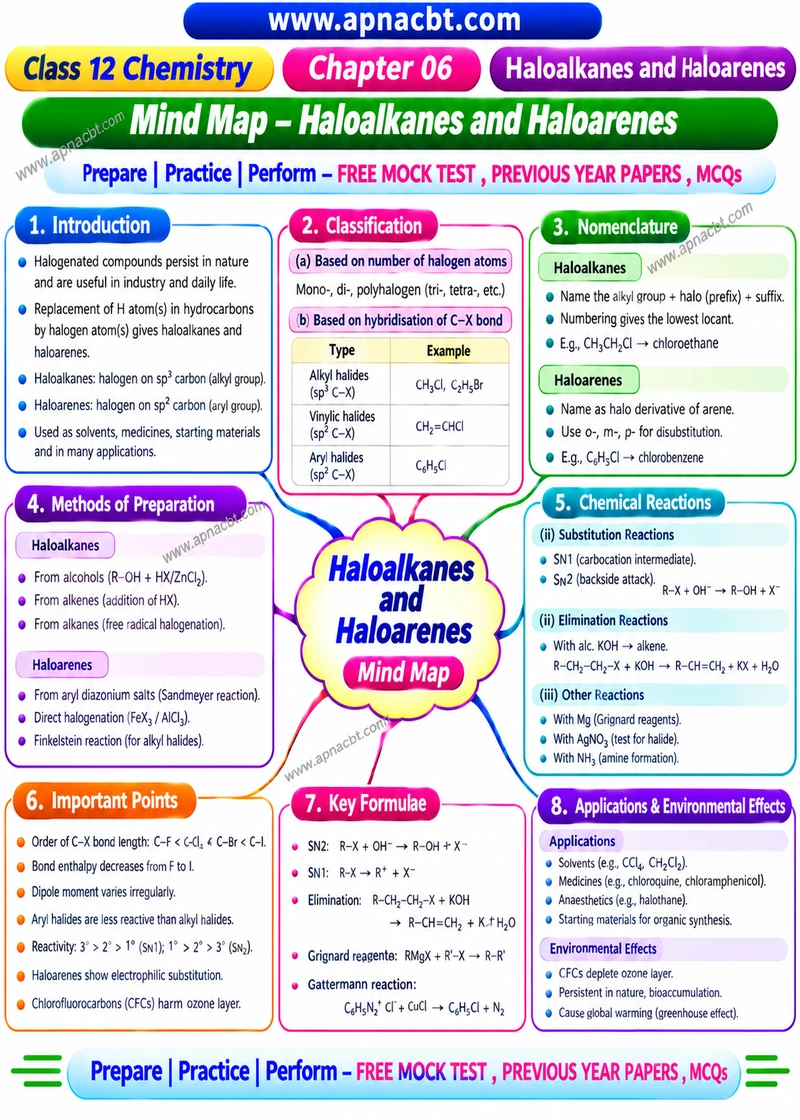
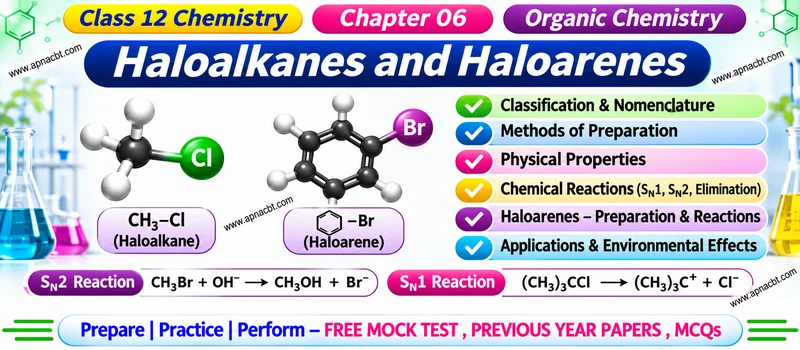
Haloalkanes and Haloarenes are important organohalogen compounds formed when one or more hydrogen atoms of aliphatic or aromatic hydrocarbons are replaced by halogen atoms such as fluorine, chlorine, bromine or iodine. This chapter connects structure, nomenclature, preparation, physical properties, reaction mechanisms and applications, making it important for Class 12 Chemistry, CBSE Board Exams and NEET preparation.
Haloalkanes contain a halogen attached to an sp3-hybridised carbon of an alkyl group, whereas haloarenes contain a halogen directly attached to an sp2-hybridised carbon of an aromatic ring. The nature and polarity of the carbon–halogen bond control much of their chemical behaviour.
On the basis of the number of halogen atoms, compounds may be monohalo, dihalo or polyhalo derivatives. On the basis of the carbon bearing halogen, alkyl halides are primary, secondary or tertiary. Allylic and benzylic halides contain halogen on an sp3 carbon adjacent to a double bond or attached to an aromatic ring, respectively. Vinylic halides have halogen attached directly to an sp2 carbon of C=C, while aryl halides have halogen directly attached to an aromatic sp2 carbon.
Exam focus
- Classify compounds from their structures.
- Distinguish alkyl, allylic, benzylic, vinylic and aryl halides.
- Relate carbon hybridisation and bond polarity to reactivity.
- Remember the special behaviour of haloarenes and polyhalogen compounds.
Nomenclature and Important Examples
Nomenclature of Haloalkanes and Haloarenes
In the common system, an alkyl group is named first followed by the name of the halide. In the IUPAC system, halogen atoms are treated as substituents on the parent hydrocarbon and are indicated by prefixes such as fluoro-, chloro-, bromo- and iodo-. The longest suitable carbon chain is selected and numbering is chosen to give substituents the lowest possible locants.
For haloarenes, the halogen is named as a substituent on the aromatic parent. In common nomenclature, ortho (o-), meta (m-) and para (p-) describe 1,2-, 1,3- and 1,4-disubstitution patterns. In IUPAC nomenclature, numerical locants are preferred.
| Compound | Common name | IUPAC name |
|---|---|---|
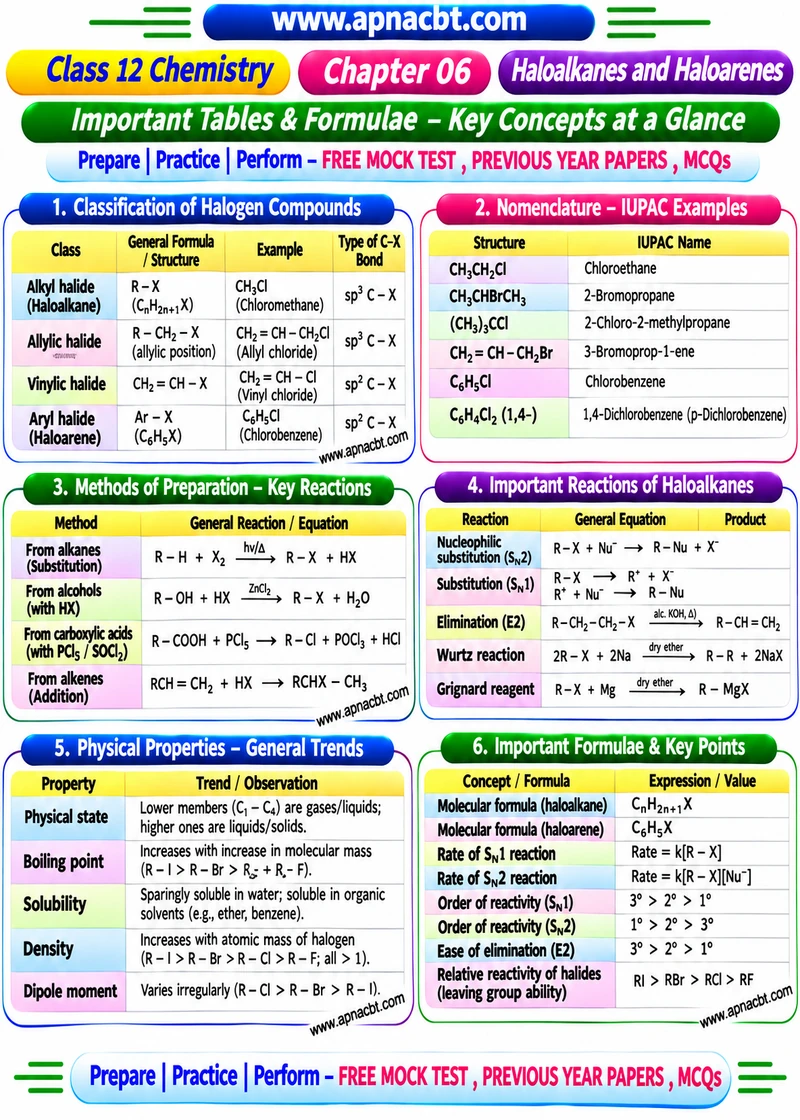
| CH3CH2CH(Cl)CH3 | sec-Butyl chloride | 2-Chlorobutane |
| (CH3)3CBr | tert-Butyl bromide | 2-Bromo-2-methylpropane |
| CH2=CHCl | Vinyl chloride | Chloroethene |
| CH2=CHCH2Br | Allyl bromide | 3-Bromopropene |
| CH2Cl2 | Methylene chloride | Dichloromethane |
| CHCl3 | Chloroform | Trichloromethane |
| CHBr3 | Bromoform | Tribromomethane |
| CCl4 | Carbon tetrachloride | Tetrachloromethane |
Board tip: Practise identifying the parent chain before assigning the position of the halogen. For aromatic compounds, clearly distinguish a halogen directly bonded to the ring from a halogen bonded to a benzylic carbon.
Nature of the Carbon–Halogen Bond
Nature and Properties of the C–X Bond
Halogens are more electronegative than carbon, so the carbon–halogen bond is polarised. Carbon carries a partial positive charge and the halogen carries a partial negative charge. This polarity makes the carbon atom susceptible to attack by electron-rich nucleophiles.
| Bond | Approx. bond length (pm) | Bond enthalpy (kJ mol−1) |
|---|---|---|
| CH3–F | 139 | 452 |
| CH3–Cl | 178 | 351 |
| CH3–Br | 193 | 293 |
| CH3–I | 214 | 234 |
Down the halogen group, atomic size increases. Therefore, the C–X bond length increases from C–F to C–I, while bond strength generally decreases. This trend helps explain why alkyl iodides are generally more reactive than corresponding chlorides and fluorides in many substitution reactions.
Haloalkanes usually have higher boiling points than the corresponding hydrocarbons because of dipole–dipole interactions and van der Waals forces. They are only slightly soluble in water but dissolve readily in many organic solvents.
Preparation of Haloalkanes
Methods of Preparation of Haloalkanes
Haloalkanes can be prepared from alcohols, hydrocarbons and by halogen-exchange reactions. Conversion of alcohols into haloalkanes is particularly useful because alcohols are readily accessible starting materials.
From alcohols
The hydroxyl group can be replaced by halogen using hydrogen halides, phosphorus halides or thionyl chloride. Thionyl chloride is preferred for preparing alkyl chlorides because gaseous SO2 and HCl escape from the reaction mixture, helping to obtain a pure product.
For a given haloacid, the reactivity of alcohols follows approximately 3° > 2° > 1°. Primary and secondary alcohols reacting with HCl generally require ZnCl2 catalyst, whereas tertiary alcohols react readily with concentrated HCl at room temperature.
From hydrocarbons
Alkanes undergo free-radical halogenation under suitable conditions. Chlorination and bromination can produce mixtures of isomeric products. Alkenes undergo addition reactions with hydrogen halides, while the presence or absence of peroxide can affect the orientation of HBr addition.
Halogen exchange
Alkyl chlorides or bromides can be converted into alkyl iodides using iodide salts in suitable solvents. Fluorides can be prepared by halogen-exchange methods such as the Swarts reaction.
Preparation of Haloarenes
Preparation of Haloarenes
Aryl chlorides and bromides can be prepared from arenes by electrophilic substitution in the presence of Lewis acid catalysts such as FeCl3 or FeBr3. The aromatic ring is activated towards electrophilic substitution, while halogen is introduced as the substituent.
Iodination is reversible because the hydrogen iodide formed can drive the reaction backward. Therefore, an oxidising agent is used to remove HI and promote iodination. Direct fluorination is generally unsuitable because fluorine is extremely reactive.
Diazonium salt routes
Aryl halides can also be obtained from aromatic diazonium salts. Sandmeyer reactions use copper(I) salts to introduce chlorine or bromine, while potassium iodide is used to prepare aryl iodides. The Schiemann reaction provides aryl fluorides through a suitable diazonium tetrafluoroborate intermediate.
These named reactions are important for board examinations and objective questions. Learn the reagent, substrate and product together rather than memorising isolated names.
Physical Properties
Physical Properties of Haloalkanes and Haloarenes
Pure alkyl halides are generally colourless. Bromides and iodides may develop colour on exposure to light. Many volatile organohalogen compounds have characteristic sweet smells, although they should never be inhaled deliberately.
Boiling point
Boiling points generally increase with increasing molecular mass and surface area. For the same alkyl group, the order of boiling points often follows the increasing polarizability of the halogen-containing molecule. Branching tends to lower boiling point because it reduces surface contact.
Density
Bromo, iodo and many polychloro derivatives are denser than water. Density generally increases with increasing number of carbon and halogen atoms and with increasing atomic mass of the halogen.
Solubility
Haloalkanes are only slightly soluble in water. Considerable energy is required to disrupt the hydrogen-bonded structure of water, while the new interactions between haloalkane and water are comparatively weak. Haloalkanes therefore dissolve better in organic solvents.
Chemical Reactions of Haloalkanes
Important Reactions of Haloalkanes
The main reactions of haloalkanes are nucleophilic substitution, elimination and reactions with metals. The polar C–X bond allows electron-rich species to attack the carbon bearing halogen.
Nucleophilic substitution
A nucleophile replaces the leaving group X. Typical nucleophiles include OH−, CN−, NH3 and alkoxide ions. Aqueous KOH tends to favour substitution and gives alcohols, while alcoholic KOH generally promotes elimination and gives alkenes.
SN2 mechanism
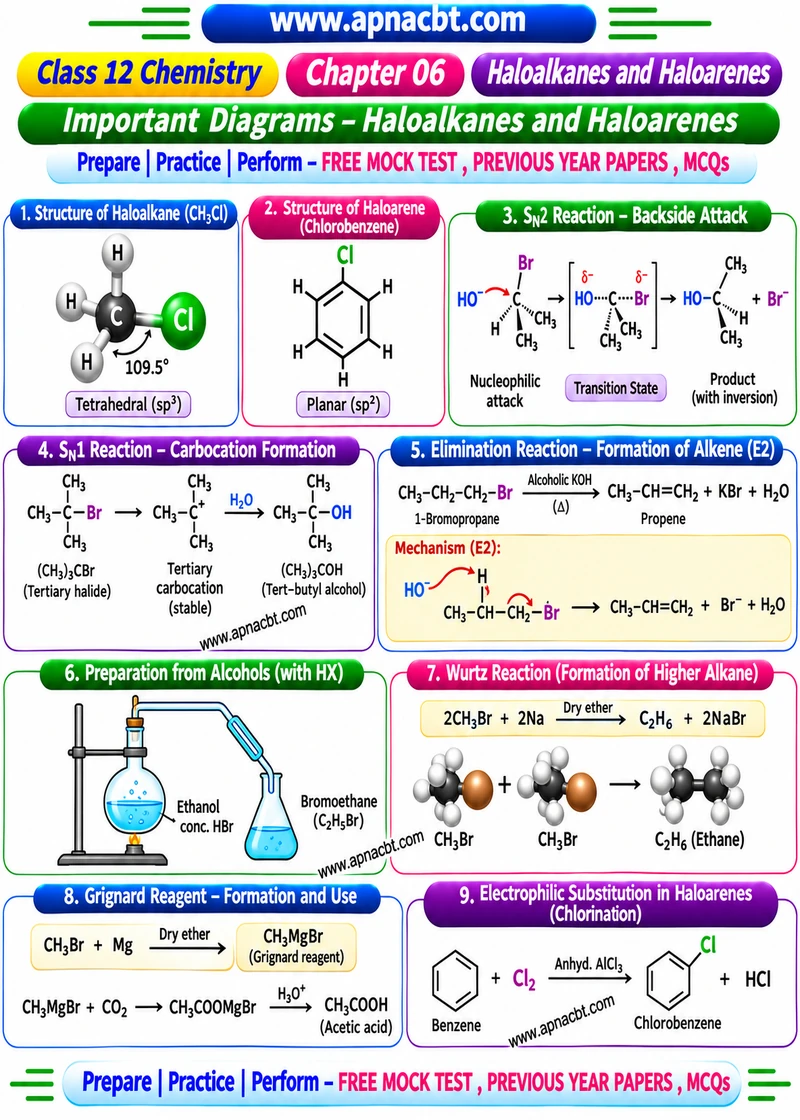
SN2 is a one-step bimolecular substitution. The nucleophile attacks from the side opposite the leaving group and the C–X bond breaks simultaneously. A chiral substrate generally undergoes inversion of configuration. Steric hindrance strongly affects the rate, so primary substrates are usually most favourable.
SN1 mechanism
SN1 occurs in two main steps. First, the C–X bond ionises to form a carbocation; nucleophile attack then gives the substituted product. The rate depends mainly on the concentration of the substrate. Tertiary carbocations are more stable than secondary and primary carbocations, so tertiary substrates favour SN1 conditions.
Elimination
When a haloalkane with a β-hydrogen is heated with alcoholic KOH, hydrogen halide is removed and an alkene forms. This is a β-elimination or dehydrohalogenation reaction. When more than one alkene is possible, the more substituted alkene is generally the major product under the usual conditions described in the chapter.
Reactions with Metals and Grignard Reagents
Grignard Reagents and Reactions with Metals
Most organic chlorides, bromides and iodides react with magnesium in dry ether to form Grignard reagents, represented as R–MgX. The absence of moisture is essential because Grignard reagents are highly reactive towards proton sources.
A general preparation is:
R–X + Mg → R–MgX (dry ether)
Grignard reagents behave as powerful nucleophiles and bases. A proton source such as water, alcohol or an acidic compound converts the reagent into the corresponding hydrocarbon. Therefore, glassware and solvents must be dry during preparation and use.
Wurtz reaction
Two molecules of an alkyl halide react with sodium in dry ether to form a higher alkane:
2R–X + 2Na → R–R + 2NaX
Organolithium compounds
Alkyl halides can also react with lithium in dry ether to give organolithium compounds. These reagents are useful synthetic intermediates and share the moisture sensitivity of Grignard reagents.
Reactions of Haloarenes
Reactions and Special Reactivity of Haloarenes
Haloarenes are less reactive than haloalkanes towards nucleophilic substitution. In chlorobenzene, for example, the lone pair of chlorine participates in resonance with the aromatic ring. This gives the C–Cl bond partial double-bond character and makes it shorter and stronger than a normal alkyl C–Cl bond.
The carbon attached to halogen in an aryl halide is sp2-hybridised and more electronegative than an sp3 carbon. The phenyl cation required for a conventional SN1 pathway is highly unstable, while direct backside attack in an SN2 pathway is hindered by the aromatic ring and its electron-rich environment.
Electrophilic substitution
Halogens are deactivating groups because of their strong −I effect, but they are ortho- and para-directing because of resonance donation. Thus chlorobenzene can undergo nitration, sulphonation and further halogenation to give mainly ortho and para products.
Replacement by hydroxyl group
Chlorobenzene can be converted to phenol under severe conditions using concentrated NaOH at high temperature and pressure, followed by acidification. Electron-withdrawing groups such as −NO2 at suitable positions increase the reactivity of aryl halides towards nucleophilic substitution.
Stereochemistry, Ambident Nucleophiles and Reaction Trends
Reaction Mechanisms, Stereochemistry and Key Trends
Understanding substitution reactions requires attention to substrate structure, nucleophile, leaving group, solvent and steric effects. Primary, secondary and tertiary haloalkanes do not behave identically under all conditions.
| Feature | SN1 | SN2 |
|---|---|---|
| Steps | Two main stages | One concerted stage |
| Rate law | Rate ∝ substrate | Rate ∝ substrate × nucleophile |
| Intermediate | Carbocation | None |
| Favoured substrate | Usually tertiary | Usually primary |
| Stereochemical result | Racemisation tendency | Inversion of configuration |
Ambident nucleophiles can attack through two different atoms. Cyanide ion can give nitriles with ionic cyanides, whereas silver cyanide tends to give isocyanides. Nitrite ion can similarly form different products depending on the reagent and reaction conditions.
For elimination, compare the available β-hydrogens and possible alkenes. For substitution, compare carbocation stability for SN1 or steric accessibility for SN2. These comparisons are frequently tested in NEET and board examinations.
Polyhalogen Compounds and Environmental Effects
Polyhalogen Compounds and Environmental Concerns
Several polyhalogen compounds have useful applications but some persist in the environment because they are resistant to degradation. Important examples include dichloromethane, chloroform, iodoform, carbon tetrachloride, freons and DDT.
Chloroform has been used as a solvent and was historically used as an anaesthetic. Carbon tetrachloride has been used as a solvent and in fire extinguishers, although its toxicity and environmental impact limit such uses. Iodoform is associated with its characteristic smell and has antiseptic applications.
Chlorofluorocarbons, commonly called freons, were widely used as refrigerants and propellants. Some chlorine-containing compounds can release reactive chlorine species in the stratosphere, contributing to ozone depletion. DDT is an insecticide that is persistent and can accumulate through food chains, creating ecological concerns.
Exam point: Learn both the application and environmental consequence of important polyhalogen compounds. Do not treat every halogen compound as equally hazardous; the concern depends on its structure, stability, persistence and biological effects.
Chapter Revision and Exam Strategy
Haloalkanes and Haloarenes – Complete Revision
For rapid revision of Haloalkanes and Haloarenes, connect the chapter as a sequence: classification → nomenclature → C–X bond → preparation → physical properties → substitution → elimination → metal reactions → haloarene reactions → stereochemistry → polyhalogen compounds.
- Classification: primary, secondary, tertiary, allylic, benzylic, vinylic and aryl.
- Bond trend: C–F is shortest and strongest; C–I is longest and weakest among the common methyl halides.
- Preparation: alcohols, hydrocarbons, halogen exchange and diazonium routes.
- SN1: carbocation intermediate, unimolecular rate law and racemisation tendency.
- SN2: concerted attack, bimolecular rate law and inversion.
- Elimination: alcoholic KOH commonly gives alkenes by β-elimination.
- Grignard: R–MgX must be protected from moisture.
- Haloarenes: less reactive in nucleophilic substitution but ortho/para directing in electrophilic substitution.
- Environment: some polyhalogen compounds are persistent and can cause ozone depletion or ecological harm.
For CBSE, practise balanced equations, mechanisms, reasons and named reactions. For NEET, focus on reactivity orders, product prediction, stereochemical outcomes, reagent identification and comparison of SN1, SN2 and elimination pathways.
For additional APNA CBT practice, use the APNA CBT Chemistry practice resources and the APNA CBT exam practice platform. For the authoritative textbook reference, consult the official NCERT textbook portal.
Short-Answer Questions – 30 Questions with Detailed Answers
Short-Answer Questions – 30 Questions with Detailed Answers
- What are haloalkanes?
Haloalkanes are aliphatic compounds in which one or more hydrogen atoms of a hydrocarbon are replaced by halogen atoms and the halogen is attached to an sp3-hybridised carbon of an alkyl group.
- What are haloarenes?
Haloarenes are aromatic compounds in which a halogen atom is directly attached to an sp2-hybridised carbon atom of an aromatic ring.
- What is a primary alkyl halide?
A primary alkyl halide has the halogen attached to a primary carbon atom, which is bonded to only one other carbon atom.
- What is an allylic halide?
An allylic halide has halogen attached to an sp3 carbon atom adjacent to a carbon-carbon double bond.
- What is a benzylic halide?
A benzylic halide has halogen attached to an sp3-hybridised carbon directly connected to an aromatic ring.
- What is a vinylic halide?
A vinylic halide has halogen directly attached to an sp2 carbon atom of a carbon-carbon double bond.
- Why is the C–X bond polar?
Halogens are more electronegative than carbon, so electron density is displaced towards halogen. Carbon becomes partially positive and halogen partially negative.
- Which C–X bond is longest among CH3F, CH3Cl, CH3Br and CH3I?
The C–I bond is longest because iodine has the largest atomic radius among the four halogens.
- Why is thionyl chloride preferred for preparing alkyl chlorides?
The reaction produces SO2 and HCl gases that escape from the reaction mixture, helping the alkyl chloride product to be obtained in a comparatively pure form.
- What is the order of alcohol reactivity with a given haloacid?
The order is generally 3° > 2° > 1° because tertiary substrates form more stable carbocation-like transition states or intermediates under suitable conditions.
- What is a nucleophile?
A nucleophile is an electron-rich species that donates an electron pair to an electron-deficient centre.
- What is an SN1 reaction?
SN1 is a unimolecular nucleophilic substitution in which the rate-determining ionisation of the substrate is followed by nucleophile attack.
- What is an SN2 reaction?
SN2 is a bimolecular nucleophilic substitution occurring in one concerted step through backside attack by the nucleophile.
- What is the stereochemical result of SN2?
SN2 attack gives inversion of configuration at a chiral carbon, commonly called Walden inversion.
- What is racemisation?
Racemisation is the formation of a mixture of enantiomers from an optically active substrate, associated with attack on a planar carbocation in SN1 reactions.
- Why do tertiary halides favour SN1 reactions?
Tertiary halides can form relatively stable tertiary carbocations, making ionisation more favourable.
- Why do primary halides favour SN2 reactions?
Primary substrates have low steric hindrance around the carbon attacked by the nucleophile, allowing efficient backside attack.
- What is dehydrohalogenation?
Dehydrohalogenation is the elimination of hydrogen halide from a haloalkane, usually producing an alkene.
- What is a β-hydrogen?
A β-hydrogen is a hydrogen atom attached to the carbon atom adjacent to the carbon bearing the halogen or leaving group.
- What is a Grignard reagent?
A Grignard reagent is an organomagnesium halide represented by R–MgX, usually prepared by reacting an alkyl halide with magnesium in dry ether.
- Why must Grignard reagents be protected from moisture?
They react rapidly with proton sources such as water and alcohols, destroying the Grignard reagent and producing the corresponding hydrocarbon.
- What is the Wurtz reaction?
It is the coupling of two alkyl halide molecules with sodium in dry ether to form a higher alkane and sodium halide.
- Why are haloarenes less reactive towards nucleophilic substitution?
Resonance gives the aryl C–X bond partial double-bond character, while the sp2 carbon and aromatic ring make substitution less favourable.
- Why are halogens ortho- and para-directing?
Their −I effect deactivates the ring, but resonance donation of the lone pair stabilises ortho and para intermediates, directing incoming electrophiles mainly to those positions.
- What is the role of alcoholic KOH in haloalkane reactions?
Alcoholic KOH promotes β-elimination, removing hydrogen halide and forming an alkene.
- What is an ambident nucleophile?
An ambident nucleophile can attack through two different atoms and therefore can produce different products depending on the reagent and conditions.
- What is the Swarts reaction?
It is a halogen-exchange method used to prepare alkyl fluorides from suitable alkyl chlorides or bromides using fluorinating agents.
- What is the Sandmeyer reaction?
It is a diazonium-salt substitution in which an aryl diazonium group is replaced by Cl or Br using suitable copper(I) salts.
- What is the Schiemann reaction?
It is a method for preparing aryl fluorides through decomposition of an aryl diazonium tetrafluoroborate.
- Why are some polyhalogen compounds environmental hazards?
Some are highly stable and persistent, so they resist degradation, may accumulate in organisms and, in the case of certain chlorofluorocarbons, contribute to ozone depletion.
Long-Answer Questions – 15 Questions with Detailed Answers
Long-Answer Questions – 15 Questions with Detailed Answers
- Explain the classification of these halogenated compounds.
They are classified by number of halogen atoms and by the type of carbon–halogen bond. Monohalo, dihalo and polyhalo compounds contain one, two or several halogens. Alkyl halides contain an sp3 C–X bond and may be primary, secondary or tertiary. Allylic and benzylic halides have halogen on sp3 carbon adjacent to C=C or attached to an aromatic ring. Vinylic halides have halogen on an sp2 carbon of C=C, while aryl halides have halogen directly bonded to an aromatic sp2 carbon.
- Describe IUPAC nomenclature of haloalkanes and haloarenes.
For haloalkanes, select the appropriate parent hydrocarbon and use fluoro-, chloro-, bromo- or iodo- as prefixes with locants. Number the chain to give the lowest appropriate set of locants. In haloarenes, the aromatic parent is selected and substituent positions are indicated numerically. The common o-, m- and p- notation corresponds to 1,2-, 1,3- and 1,4-disubstitution.
- Explain the nature of the carbon–halogen bond and its effect on reactivity.
The C–X bond is polar because halogen is more electronegative than carbon. Carbon bears partial positive character and is attacked by nucleophiles. C–X bond length increases from C–F to C–I as halogen size increases, while bond strength generally decreases. The weaker C–I bond therefore favours cleavage more readily. In haloarenes, resonance introduces partial double-bond character and strengthens the aryl C–X bond.
- Describe important methods for preparation of haloalkanes.
Haloalkanes are commonly prepared from alcohols using hydrogen halides, phosphorus halides or thionyl chloride. They can also be formed by free-radical halogenation of alkanes, addition of hydrogen halides to alkenes and halogen exchange. Thionyl chloride is preferred for alkyl chlorides because gaseous products escape. Fluoro and iodo compounds are often prepared by specialised exchange methods.
- Explain the preparation of haloarenes from hydrocarbons and diazonium salts.
Aryl chlorides and bromides can be prepared by electrophilic substitution of arenes using halogen and a Lewis acid catalyst. Iodination is promoted by an oxidising agent because the process is reversible. Diazonium salts provide versatile routes: Sandmeyer reactions give aryl chlorides or bromides with copper(I) salts, potassium iodide gives aryl iodides, and the Schiemann reaction provides aryl fluorides.
- Discuss the physical properties of haloalkanes.
Haloalkanes are generally colourless when pure. Their boiling points are influenced by molecular mass, polarizability and branching. They are only slightly soluble in water because interactions with water are not strong enough to compensate for disruption of hydrogen bonding. They dissolve well in organic solvents. Density often increases with increasing halogen content and atomic mass.
- Compare SN1 and SN2 mechanisms.
SN1 proceeds through ionisation of the substrate followed by nucleophile attack, so its rate depends mainly on substrate concentration. It is favoured by substrates that form stable carbocations and commonly gives racemisation tendency. SN2 is a single concerted step in which nucleophile attack and leaving-group departure occur together. It is favoured by less hindered substrates and gives inversion at a chiral centre.
- Explain nucleophilic substitution reactions of haloalkanes.
The polar C–X bond leaves the carbon electrophilic. A nucleophile attacks this carbon and replaces X. Depending on substrate and conditions, substitution may occur by SN1 or SN2. Aqueous hydroxide gives alcohols, cyanide gives nitriles under suitable ionic conditions, ammonia gives amines and alkoxide ions can give ethers. The mechanism is controlled by substrate structure, nucleophile, solvent and steric effects.
- Explain dehydrohalogenation of haloalkanes.
When haloalkanes containing β-hydrogen are heated with alcoholic KOH, hydrogen halide is eliminated. The base removes a β-hydrogen while the leaving group departs, producing an alkene. If more than one alkene can form, the more substituted alkene is commonly favoured under standard conditions. This reaction is important for distinguishing substitution conditions from elimination conditions.
- Explain Grignard reagent formation and its importance.
Alkyl chlorides, bromides or iodides react with magnesium in dry ether to form R–MgX. The reagent is highly reactive and must be protected from water, alcohols and other proton sources. Grignard reagents act as strong nucleophiles and bases and are valuable carbon–carbon bond-forming intermediates. Reaction with a proton source gives the corresponding hydrocarbon.
- Explain the Wurtz reaction and organolithium formation.
In the Wurtz reaction, two alkyl halide molecules react with sodium in dry ether to couple their alkyl groups, giving R–R and NaX. Alkyl halides can also react with lithium in dry ether to form organolithium compounds. Both reactions demonstrate the usefulness of haloalkanes as precursors to organometallic reagents.
- Why are haloarenes less reactive than haloalkanes towards nucleophilic substitution?
In haloarenes, the halogen lone pair overlaps with the aromatic π system, giving the C–X bond partial double-bond character. The aryl carbon is sp2-hybridised and more electronegative, making the bond less susceptible to ordinary cleavage. A phenyl carbocation is highly unstable, ruling out a normal SN1 route, while backside attack is hindered in the aromatic framework. Strong conditions are therefore often needed.
- Explain the directive influence of halogens in electrophilic substitution of haloarenes.
Halogens have a strong −I effect and therefore deactivate the aromatic ring toward electrophilic substitution. However, their lone pairs can donate by resonance and stabilise the intermediates formed by ortho and para attack. Consequently halogens are deactivating but ortho- and para-directing substituents.
- Describe important polyhalogen compounds and their environmental effects.
Dichloromethane, chloroform, iodoform, carbon tetrachloride, freons and DDT are important examples. Some have useful solvent, refrigerant, propellant or insecticidal applications. However, persistence and toxicity can create environmental problems. Certain chlorofluorocarbons contribute to stratospheric ozone depletion, while persistent insecticides such as DDT can accumulate through food chains.
- Write a comprehensive exam-oriented summary of the chapter.
The chapter begins with classification and nomenclature, followed by the polar C–X bond and physical properties. Preparation includes alcohols, hydrocarbons, exchange reactions and diazonium routes. Chemical behaviour centres on nucleophilic substitution, SN1/SN2 mechanisms, elimination and organometallic reactions. Haloarenes show lower nucleophilic substitution reactivity because of resonance and sp2 carbon, yet halogens direct electrophilic substitution to ortho and para positions. Finally, polyhalogen compounds and environmental effects connect organic chemistry with real-world applications.