Table of Contents
- Introduction and Position in the Periodic Table
- Electronic Configuration and Transition Series
- General Physical Properties and Trends
- Oxidation States and Stability
- Ionisation Enthalpy, Electrode Potentials and Reactivity
- Magnetic Properties and Spin-Only Formula
- Colour, Complex Formation, Catalysis, Interstitial Compounds and Alloys
- Oxides and Oxoanions of Transition Metals
- Potassium Dichromate – Preparation, Properties and Reactions
- Potassium Permanganate – Preparation, Properties and Reactions
- Lanthanoids and Lanthanoid Contraction
- Actinoids, Comparison and Applications
- Short-Answer Questions – 30 Questions
- Long-Answer Questions – 15 Questions
Introduction and Position in the Periodic Table
Introduction to The d- and f-Block Elements Class 12 Chemistry
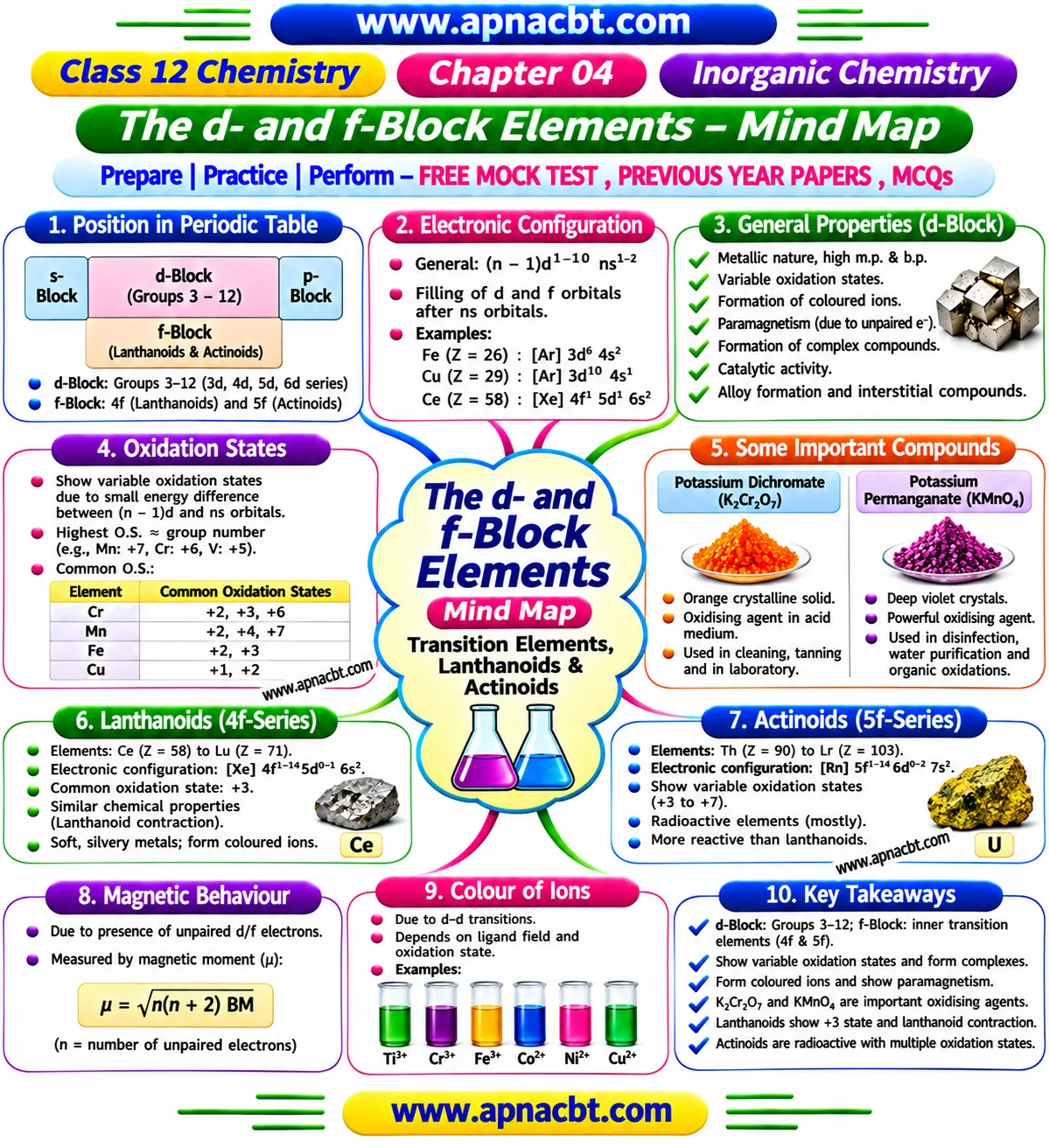
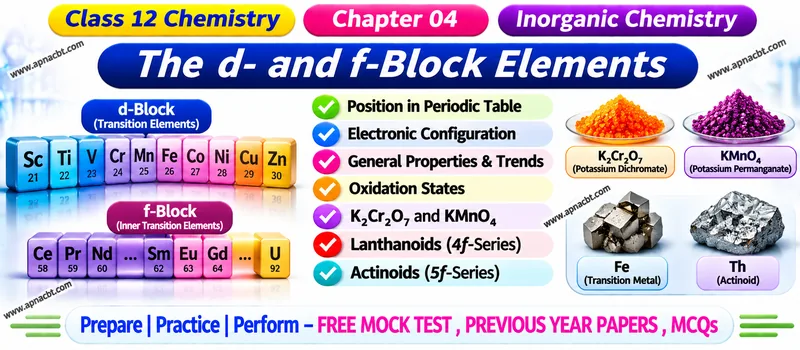
The d- and f-Block Elements Class 12 Chemistry is an important chapter for understanding transition and inner-transition elements. The d-block occupies Groups 3–12 in the middle of the periodic table, while the f-block is displayed separately at the bottom because the 4f and 5f orbitals are progressively filled. These elements show variable oxidation states, coloured ions, magnetic behaviour, complex formation and catalytic activity.
The transition series include the 3d series from Sc to Zn, 4d series from Y to Cd, 5d series from La and Hf to Hg, and the 6d series beginning with Ac. The f-block contains the lanthanoids and actinoids. According to the NCERT definition, a transition metal has an incomplete d subshell in its atom or in at least one of its ions. Thus Zn, Cd and Hg are not transition metals in the strict sense.
Electronic Configuration and Transition Series
Electronic Configuration of d-Block Elements
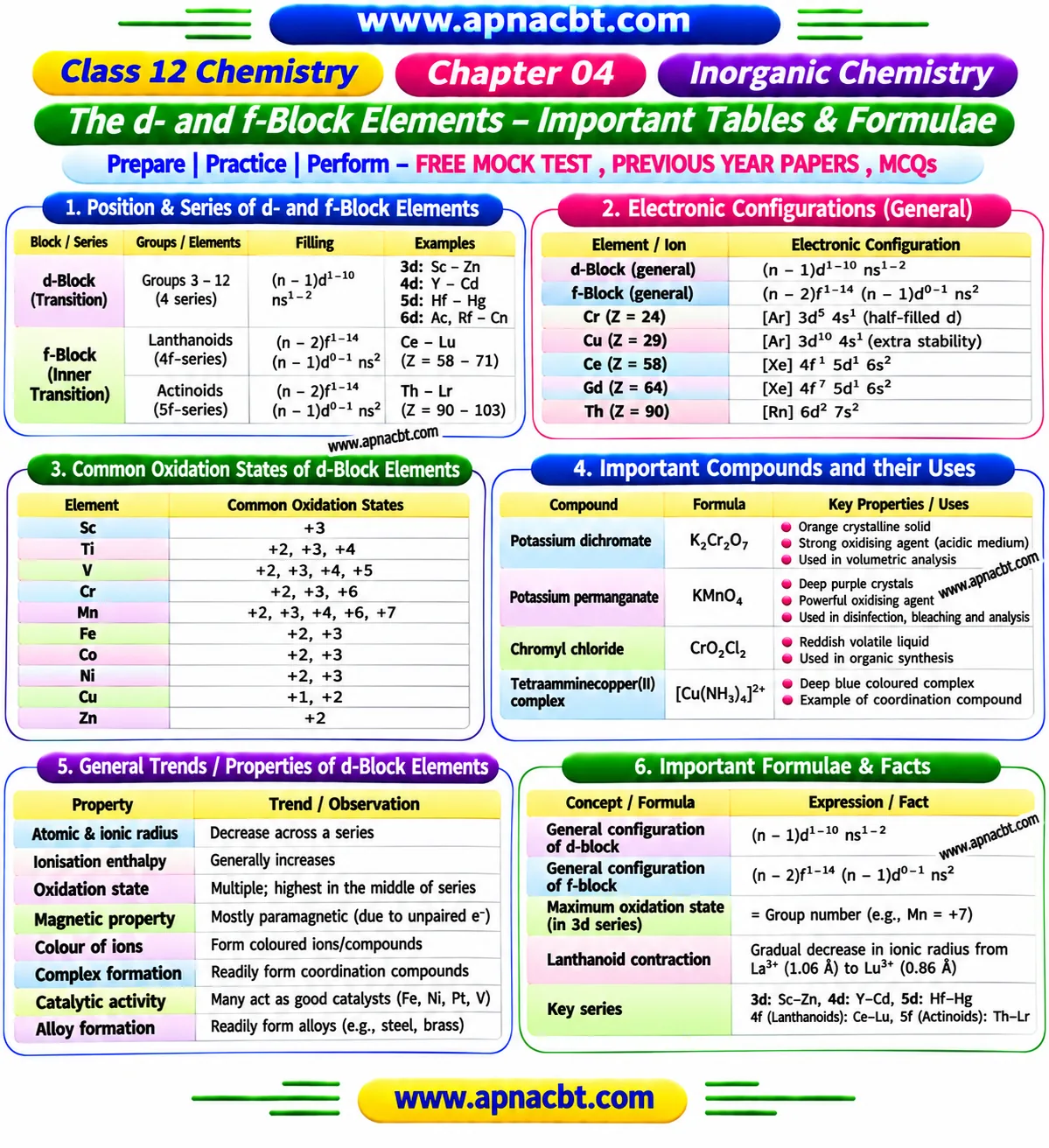
The general outer configuration is (n−1)d1–10ns1–2. Because the d and s orbitals have similar energies, important exceptions occur. Chromium has [Ar] 3d54s1, while copper has [Ar] 3d104s1. Half-filled and completely filled subshells provide extra stability.
When transition-metal ions form, ns electrons are normally removed before (n−1)d electrons. For example, Fe is [Ar]3d64s2, whereas Fe2+ is [Ar]3d6. This rule is essential for predicting magnetic behaviour, oxidation states and colours.
Sc versus Zn: Sc has an incomplete 3d subshell in its ground state, whereas Zn has 3d10 in both the atom and its common Zn2+ ion.
General Physical Properties and Trends
Physical Properties of Transition Elements
Transition metals generally show metallic lustre, high tensile strength, ductility, malleability and good thermal and electrical conductivity. Their melting and boiling points are generally high because d and s electrons contribute to strong interatomic bonding. Zn, Cd, Hg and Mn show notable exceptions.
Atomic and ionic radii usually decrease only slightly across a transition series. Added d electrons do not shield nuclear charge very effectively, so effective nuclear attraction increases gradually. Enthalpies of atomisation are also generally high and often reach a maximum near the middle of a series, where unpaired d electrons strengthen metallic bonding.
Oxidation States and Stability
Oxidation States in Transition and Inner-Transition Elements
Variable oxidation states arise because ns and (n−1)d electrons are close in energy. The first transition series therefore displays several oxidation states, with higher states prominent near the middle of the series. The +2 state is especially important because the two ns electrons are removed relatively easily.
Electronic configuration strongly influences stability. Half-filled d5 and filled d10 arrangements can provide extra stability. Oxygen and fluorine can stabilise high oxidation states because of their small size, high electronegativity and strong metal–ligand bonding.
Disproportionation occurs when one oxidation state is converted into both a higher and a lower state. Manganate(VI) can disproportionate to permanganate(VII) and manganese dioxide(IV) under suitable conditions. Cu+ can also disproportionate in aqueous solution: 2Cu+ → Cu2+ + Cu.
Ionisation Enthalpy, Electrode Potentials and Reactivity
Redox Behaviour and Chemical Reactivity
Ionisation enthalpies show irregular variation because d0, d5 and d10 configurations have special stability. Standard electrode potentials also show irregularities because they depend on sublimation enthalpy, ionisation enthalpy and hydration enthalpy together.
Many first-row transition metals dissolve in mineral acids, although some are comparatively noble. Copper does not liberate hydrogen from dilute non-oxidising acids under ordinary conditions. Titanium and vanadium can appear passive in some dilute acids because protective surface films form.
For redox comparisons, use the relevant standard electrode potentials. Cr2+ is a strong reducing agent because oxidation to Cr3+ gives a particularly stable d3 configuration.
Magnetic Properties and Spin-Only Formula
Magnetic Behaviour of Transition Ions
Paramagnetism results from unpaired electrons, while diamagnetism results when all electrons are paired. Many transition-metal ions are paramagnetic because their d subshells are partly filled. For first-row ions, the orbital contribution is largely quenched, so the spin-only formula is commonly applied.
Magnetic moment: μ = √[n(n + 2)] BM, where n is the number of unpaired electrons. A d5 ion has five unpaired electrons and therefore μ ≈ 5.92 BM. A d10 ion has zero unpaired electrons and is diamagnetic.
For numerical questions, write the ion configuration, apply Hund’s rule, count unpaired electrons and then substitute into the formula.
Colour, Complex Formation, Catalysis, Interstitial Compounds and Alloys
Characteristic Properties of d-Block Elements
Many transition ions are coloured because electrons absorb visible light and undergo transitions between split d levels. The observed colour is complementary to the wavelength absorbed. d0 and d10 ions are commonly colourless because a suitable d–d transition is absent.
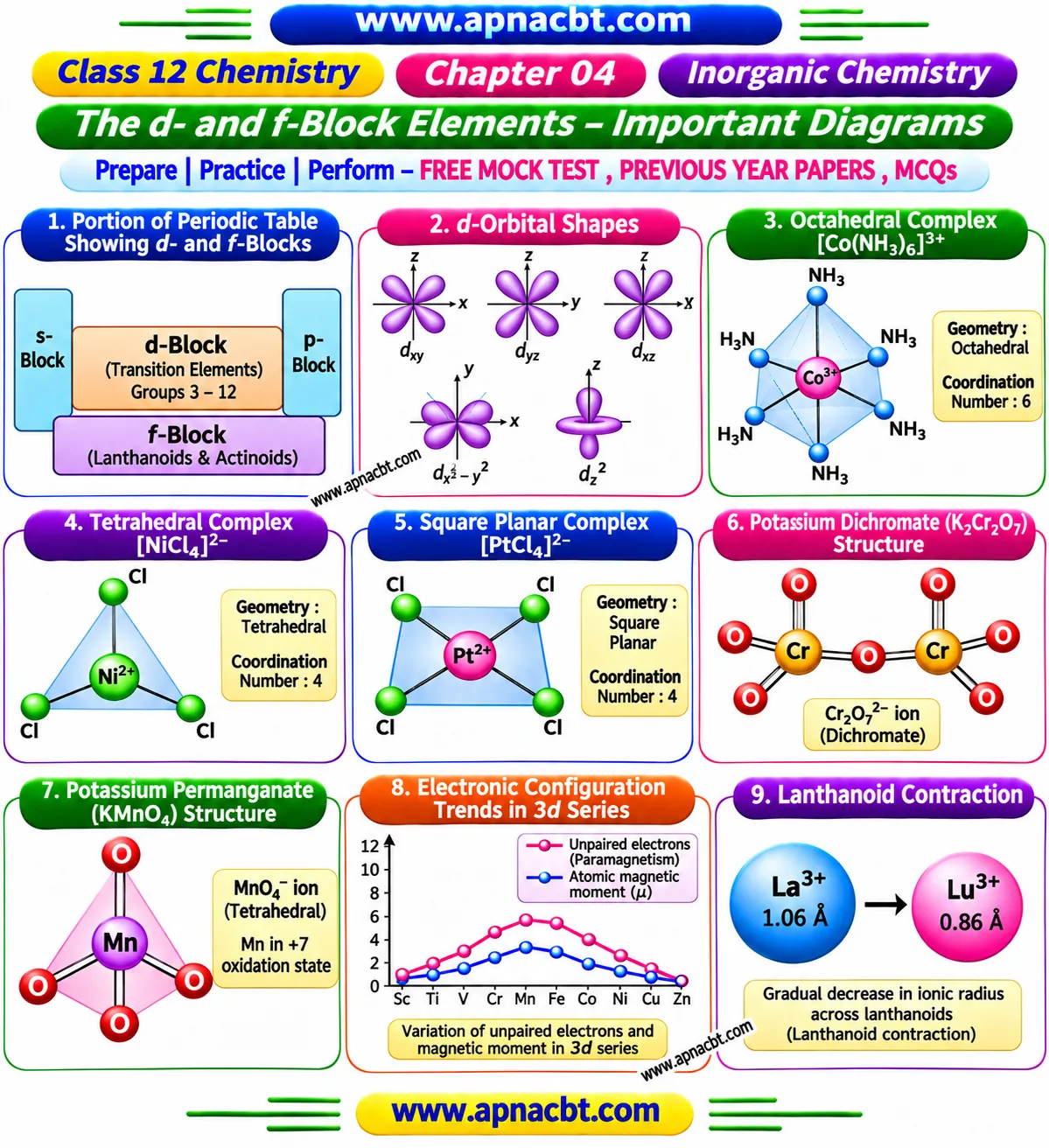
Transition metals form many complexes because their ions are relatively small, often highly charged and have suitable orbitals for bonding with ligands. Examples include [Fe(CN)6]3−, [Cu(NH3)4]2+ and [PtCl4]2−.
Their catalytic activity is related to variable oxidation states and complex formation. Important examples are V2O5 in the Contact Process, Fe in the Haber Process and Ni in catalytic hydrogenation. Interstitial compounds contain small atoms such as H, C or N trapped in metal lattices. They are often hard, high-melting and electrically conductive. Similar metallic radii favour alloy formation.
Oxides and Oxoanions of Transition Metals
Oxides and Oxoanions
Lower oxidation-state oxides are generally basic, while higher oxidation-state oxides tend to become amphoteric or acidic. In vanadium, V2O3 is basic, V2O4 is less basic and V2O5 is mainly acidic but amphoteric. Higher oxides such as CrO3 and Mn2O7 show substantial covalent and acidic character.
Oxygen and fluorine can stabilise high oxidation states. Oxoanions such as VO43−, CrO42− and MnO4− are important high-oxidation-state species.
Potassium Dichromate – Preparation, Properties and Reactions
Potassium Dichromate K₂Cr₂O₇
Potassium dichromate is an orange crystalline compound and a strong oxidising agent in acidic medium. It is prepared from chromite ore, FeCr2O4. Fusion with sodium carbonate in excess air gives sodium chromate. Acidification converts chromate into sodium dichromate, and treatment with KCl precipitates less-soluble orange K2Cr2O7.
Chromate and dichromate are interconvertible according to pH. Acid favours dichromate: 2CrO42− + 2H+ ⇌ Cr2O72− + H2O. Alkali shifts the equilibrium towards chromate.
In acidic solution, Cr2O72− is reduced to Cr3+: Cr2O72− + 14H+ + 6e− → 2Cr3+ + 7H2O. It oxidises iodide, Fe2+, Sn2+ and H2S.
Potassium Permanganate – Preparation, Properties and Reactions
Potassium Permanganate KMnO₄
Potassium permanganate is a dark purple strong oxidising agent. MnO2 is fused with KOH in the presence of an oxidising agent to produce manganate(VI), which is converted to permanganate(VII). The permanganate ion is tetrahedral and has no unpaired electron.
In acidic medium, MnO4− is reduced to Mn2+: MnO4− + 8H+ + 5e− → Mn2+ + 4H2O. In neutral or faintly alkaline medium, MnO2 is commonly formed. The product therefore depends on the reaction medium.
Acidified permanganate oxidises Fe2+ to Fe3+, oxalate to CO2, nitrite to nitrate and iodide to iodine. Hydrochloric acid is unsuitable for permanganate titrations because chloride can be oxidised to chlorine.
Reaction-Focused Exam Points
In dichromate and permanganate questions, always identify the reaction medium before selecting the reduction product. For dichromate, acidic conditions lead to Cr3+. For permanganate, acidic conditions favour Mn2+, while neutral or faintly alkaline conditions commonly give MnO2. These medium-dependent products are high-yield concepts for both assertion-reasoning and multiple-choice questions.
When writing ionic equations, balance atoms other than hydrogen and oxygen first, then balance oxygen with water, hydrogen with H+ in acidic medium, and finally charge with electrons. This method is especially useful for the oxidising reactions of Cr2O72− and MnO4−.
Lanthanoids and Lanthanoid Contraction
Lanthanoids and the Lanthanoid Contraction
Lanthanoids involve progressive filling of the 4f orbitals. Their most stable oxidation state is generally +3, although some members show +2 or +4 when a particularly stable configuration results.
Lanthanoid contraction is the gradual decrease in atomic and ionic radii from La to Lu. It occurs because 4f electrons shield the increasing nuclear charge poorly. Consequently effective nuclear attraction rises and the size decreases.
The contraction makes lanthanoids very similar and makes their separation difficult. It also contributes to the close similarity between corresponding elements of the second and third transition series. The basicity of lanthanoid hydroxides generally decreases from La(OH)3 to Lu(OH)3.
Actinoids, Comparison and Applications
Actinoids and Applications
Actinoids involve progressive filling of 5f orbitals and are radioactive. Their chemistry is more complicated than that of lanthanoids because several oxidation states are possible and 5f electrons participate more readily in bonding. Early actinoids therefore show greater variation in oxidation state and chemical behaviour.
Actinoid contraction is generally greater than lanthanoid contraction because 5f electrons shield nuclear charge less effectively. Actinoids are highly reactive metals, especially when finely divided, and many react with acids. Their magnetic behaviour is more complex than that of lanthanoids.
Important applications include steels, catalysts, batteries, pigments, alloys and analytical chemistry. V2O5 is used in sulphuric-acid manufacture, Fe in the Haber Process, Ni in hydrogenation, MnO2 in dry cells and AgBr in photographic applications.
CBSE and NEET Revision Strategy
For board examinations, learn the definition of a transition element, the general electronic configuration, the important exceptions of chromium and copper, and the reasons for variable oxidation states. In numerical questions, write the d-electron configuration before calculating magnetic moment. In reaction-based questions, identify the oxidation state of the central metal before balancing the redox equation.
For competitive examinations, focus on quick comparisons: Sc versus Zn, Cr versus Cu configurations, basic versus acidic oxides, chromate versus dichromate in different pH conditions, and the different reduction products of permanganate in acidic and neutral media. Also remember that lanthanoid contraction is caused by poor 4f shielding, whereas actinoid chemistry is complicated by radioactive elements and greater involvement of 5f electrons.
A good revision sequence is: electronic configuration → oxidation states → magnetic behaviour → colour and complexes → catalytic properties → important oxides → dichromate → permanganate → lanthanoids → actinoids → applications. This sequence connects the chapter logically and helps avoid memorising isolated facts.
Short-Answer Questions – 30 Questions with Detailed Answers
Short Questions for CBSE, Board Exams and NEET Revision
Use these questions for rapid revision of definitions, trends, formulae and reactions from The d- and f-Block Elements Class 12 Chemistry.
1. What is the general outer electronic configuration of d-block elements?
Answer: It is generally (n−1)d¹–¹⁰ns¹–².
2. Why does chromium have 3d⁵4s¹ configuration?
Answer: The half-filled 3d⁵ arrangement is especially stable and the d–s energy gap is small.
3. Why does copper have 3d¹⁰4s¹ configuration?
Answer: A completely filled 3d¹⁰ subshell gives extra stability.
4. Why is zinc not a transition element?
Answer: Zn and Zn²⁺ have completely filled 3d¹⁰ configurations.
5. Why do transition elements show variable oxidation states?
Answer: The ns and (n−1)d electrons have similar energies and different numbers can participate in bonding.
6. Why are many transition ions paramagnetic?
Answer: They contain one or more unpaired d electrons.
7. Write the spin-only magnetic moment formula.
Answer: μ = √[n(n + 2)] BM.
8. What is the magnetic moment of a d⁵ ion?
Answer: It has five unpaired electrons, so μ = √35 ≈ 5.92 BM.
9. Why are many transition compounds coloured?
Answer: Partially filled d levels permit electronic transitions that absorb visible light.
10. Why are d⁰ and d¹⁰ ions commonly colourless?
Answer: They do not have an appropriate d–d transition.
11. Why do transition metals form complexes?
Answer: Small, charged metal ions and available orbitals allow bonding with ligands.
12. Give two transition-metal catalysts.
Answer: V₂O₅ in the Contact Process and Fe in the Haber Process.
13. What are interstitial compounds?
Answer: Compounds in which small atoms such as H, C or N occupy spaces in a metal lattice.
14. State two properties of interstitial compounds.
Answer: They are often hard and high-melting while retaining metallic conductivity.
15. What is an alloy?
Answer: An alloy is a blend of metals, commonly a solid solution.
16. How does oxide character change with oxidation state?
Answer: Lower oxides are generally basic; higher oxides become amphoteric or acidic.
17. What is lanthanoid contraction?
Answer: The gradual decrease in atomic and ionic radii from La to Lu.
18. What causes lanthanoid contraction?
Answer: Poor shielding by 4f electrons as nuclear charge increases.
19. State one consequence of lanthanoid contraction.
Answer: It makes lanthanoids similar and contributes to similarity of second- and third-row transition elements.
20. What is the common oxidation state of lanthanoids?
Answer: +3 is the characteristic and most stable oxidation state.
21. How do actinoids differ in oxidation states?
Answer: They show a wider range of oxidation states than lanthanoids.
22. Why is actinoid chemistry more complicated?
Answer: Radioactivity and greater participation of 5f electrons produce complex chemistry.
23. Which ion is favoured in acidic chromate solution?
Answer: Dichromate, Cr₂O₇²⁻, is favoured.
24. What is the colour of K₂Cr₂O₇?
Answer: Orange.
25. What is the colour of KMnO₄?
Answer: Dark purple or almost black.
26. What is the main acidic-medium reduction product of permanganate?
Answer: Mn²⁺.
27. Why is HCl unsuitable for KMnO₄ titration?
Answer: Permanganate can oxidise chloride to chlorine.
28. What is disproportionation?
Answer: One oxidation state is simultaneously oxidised and reduced.
29. Give one disproportionation example.
Answer: Manganate(VI) can form permanganate(VII) and MnO₂(IV).
30. Name two uses of KMnO₄.
Answer: It is used as an oxidant and for bleaching or decolourisation.
Long-Answer Questions – 15 Questions with Detailed Answers
Long Questions for CBSE and Board Exam Preparation
Write the principle first, then the relevant configuration, trend, equation or comparison and finally the conclusion.
1. Explain the characteristic properties of transition elements.
Answer: Partly filled d orbitals produce variable oxidation states, paramagnetism, coloured ions, complexes and catalytic activity. Strong metallic bonding gives generally high melting points and hardness. They also form alloys and interstitial compounds.
2. Explain the Cr and Cu electronic configuration exceptions.
Answer: The general configuration is (n−1)d¹–¹⁰ns¹–². Cr becomes 3d⁵4s¹ to obtain a stable half-filled d subshell, while Cu becomes 3d¹⁰4s¹ to obtain a stable filled d subshell.
3. Discuss oxidation-state variation in the first transition series.
Answer: The close energies of 3d and 4s electrons permit several oxidation states. Higher states are prominent near the middle of the series, while +2 becomes important because two ns electrons are readily removed. Oxygen and fluorine can stabilise high states.
4. Explain magnetic behaviour and calculate Mn²⁺ magnetic moment.
Answer: Mn²⁺ is [Ar]3d⁵ and has five unpaired electrons. Using μ = √[n(n+2)], μ = √35 ≈ 5.92 BM, so Mn²⁺ is strongly paramagnetic.
5. Explain why transition ions are often coloured.
Answer: Ligands split the d levels. Absorption of visible radiation can promote an electron between these levels, and the complementary colour is observed. The colour depends on the ion and ligand environment.
6. Explain catalytic activity of transition metals.
Answer: They can change oxidation states and form intermediate complexes. Surface adsorption increases reactant concentration and weakens bonds, providing a lower-energy pathway. V₂O₅, Fe and Ni are standard examples.
7. Explain interstitial compounds and their properties.
Answer: Small H, C or N atoms occupy interstitial sites in metal lattices. Such compounds are often non-stoichiometric, hard, high-melting, metallic and relatively inert.
8. Describe preparation of K₂Cr₂O₇ from chromite.
Answer: Chromite is fused with sodium carbonate in excess air to form sodium chromate. The extract is acidified to sodium dichromate, which is treated with KCl to crystallise less-soluble orange K₂Cr₂O₇.
9. Explain the pH effect on chromate–dichromate equilibrium.
Answer: Acid converts chromate to dichromate: 2CrO₄²⁻ + 2H⁺ ⇌ Cr₂O₇²⁻ + H₂O. Base shifts it back to chromate: Cr₂O₇²⁻ + 2OH⁻ ⇌ 2CrO₄²⁻ + H₂O.
10. Describe the oxidising action of acidified K₂Cr₂O₇.
Answer: Cr₂O₇²⁻ accepts six electrons in acid and forms Cr³⁺: Cr₂O₇²⁻ + 14H⁺ + 6e⁻ → 2Cr³⁺ + 7H₂O. It oxidises Fe²⁺, iodide, Sn²⁺ and H₂S.
11. Describe preparation and oxidising behaviour of KMnO₄.
Answer: MnO₂ is oxidatively fused with KOH to form manganate, which is converted to permanganate. In acid MnO₄⁻ is reduced to Mn²⁺ and strongly oxidises Fe²⁺, oxalate, nitrite and iodide.
12. Compare permanganate reduction in different media.
Answer: In acidic medium MnO₄⁻ gives Mn²⁺. In neutral or faintly alkaline medium it commonly gives MnO₂. In strongly alkaline conditions manganate can be formed. Thus the medium determines the reduction product.
13. Explain lanthanoid contraction and consequences.
Answer: Poor shielding by 4f electrons causes effective nuclear charge to rise across the series and radii to decrease. The contraction makes lanthanoids similar, complicates separation, changes hydroxide basicity and contributes to similarity of second- and third-row transition elements.
14. Compare lanthanoids and actinoids.
Answer: Lanthanoids involve 4f filling and mainly show +3. Actinoids involve 5f filling, are radioactive and show more oxidation states because 5f, 6d and 7s levels are closer in energy. Actinoids are generally more reactive.
15. Discuss important applications of d- and f-block elements.
Answer: They are used in steels, catalysts, batteries, pigments, alloys and analytical chemistry. V₂O₅ is used in sulphuric-acid manufacture, Fe in the Haber Process, Ni in hydrogenation, MnO₂ in dry cells and AgBr in photography.
Authoritative Reference
Refer to the official NCERT textbook portal for the prescribed Chemistry text.
Explore additional resources on APNA CBT.