Class XII Physics | Chapter 04 | Moving Charges and Magnetism | Level 01 – Prepare
Table of Contents
- Introduction: Moving Charges and Magnetism
- Magnetic Field and Lorentz Force
- Motion of a Charged Particle in a Magnetic Field
- Combined Electric and Magnetic Fields: Velocity Selector and Cyclotron
- Magnetic Force on a Current-Carrying Conductor
- Biot-Savart Law
- Magnetic Field Due to a Circular Current Loop
- Ampere’s Circuital Law
- Solenoid and Toroid
- Force Between Two Parallel Current-Carrying Conductors
- Torque on a Current Loop and Magnetic Dipole
- Moving Coil Galvanometer
- High-Yield Formula Revision and Exam Strategy
- Short-Answer Questions – 30 Questions
- Long-Answer Questions – 15 Questions
Introduction: Moving Charges and Magnetism
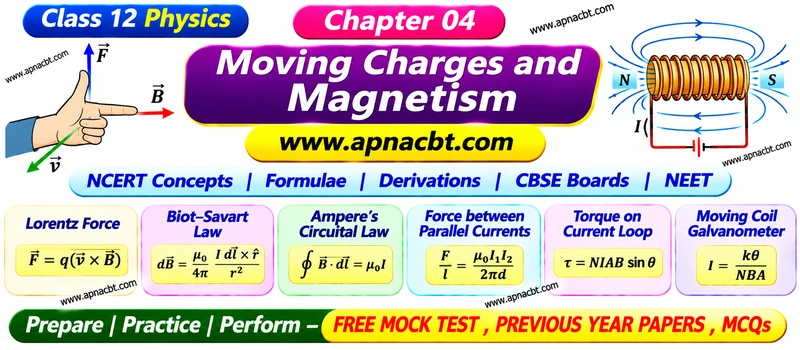
Moving Charges and Magnetism – Class 12 Physics for CBSE Board Exams and NEET Preparation
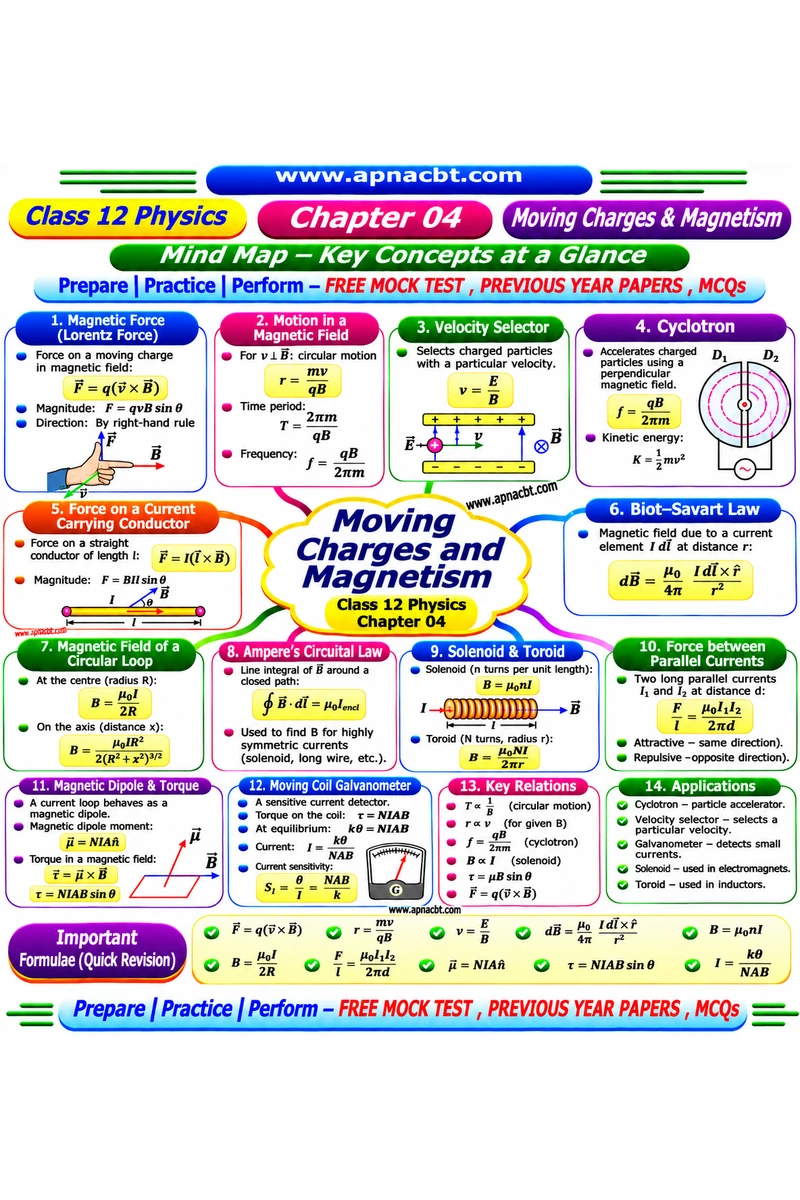
Moving Charges and Magnetism explains the magnetic effects of moving charges and electric currents. This Class 12 Physics chapter is important for CBSE Board Exams, NEET and other competitive examinations. The Moving Charges and Magnetism chapter connects current electricity with magnetic fields, Lorentz force, motion of charged particles, Biot-Savart law, Ampere’s circuital law, magnetic dipoles and the moving coil galvanometer.
For Moving Charges and Magnetism preparation, students should master vector directions, right-hand rules, force equations, circular and helical motion, velocity selector, cyclotron, magnetic-field calculations, torque and galvanometer applications. The lesson is organised for concept preparation, board-exam revision and objective-question practice.
For related preparation, students can also review Current Electricity practice on APNA CBT and Electrostatic Potential and Capacitance resources.
Oersted’s observation showed that a current-carrying conductor produces a magnetic field. For exam preparation, students should master vector directions, right-hand rules, force equations, circular and helical motion, velocity selector, cyclotron, magnetic field calculations, torque and galvanometer applications.
Magnetic Field and Lorentz Force
In Moving Charges and Magnetism, the magnetic field is treated as a vector quantity and its direction is essential for numerical and conceptual questions.
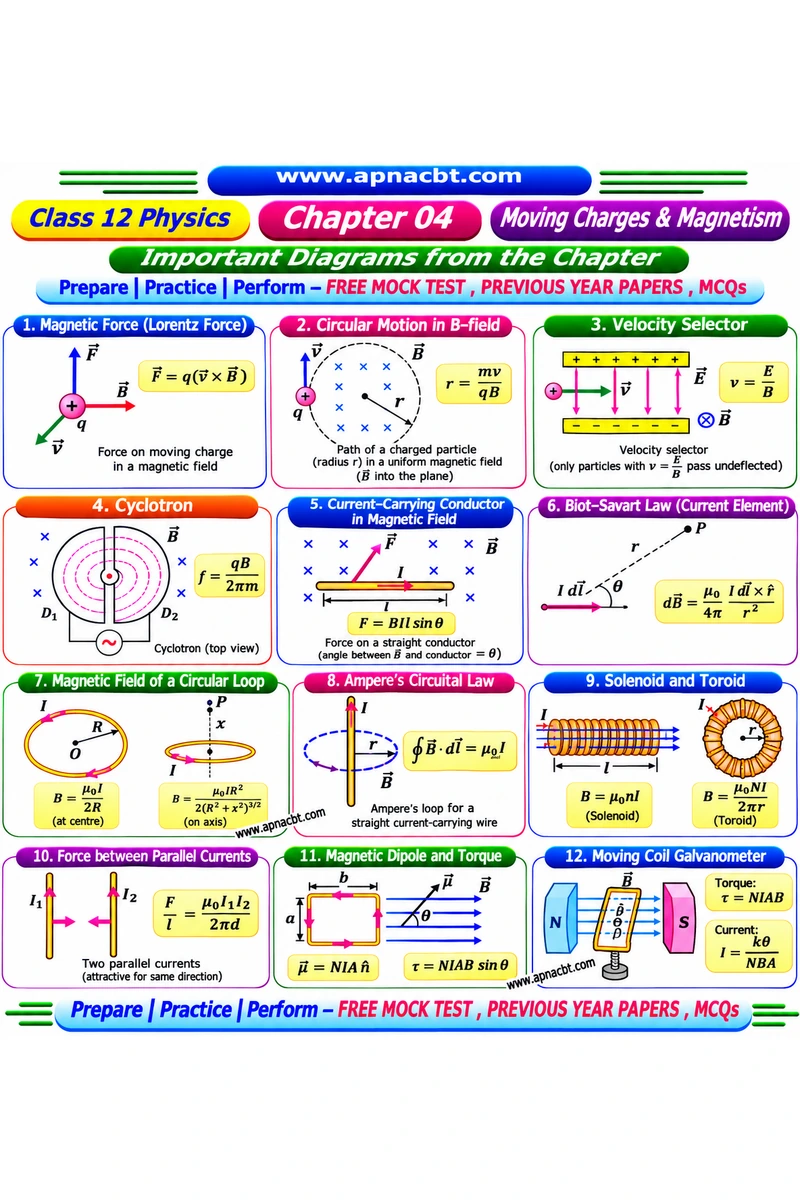
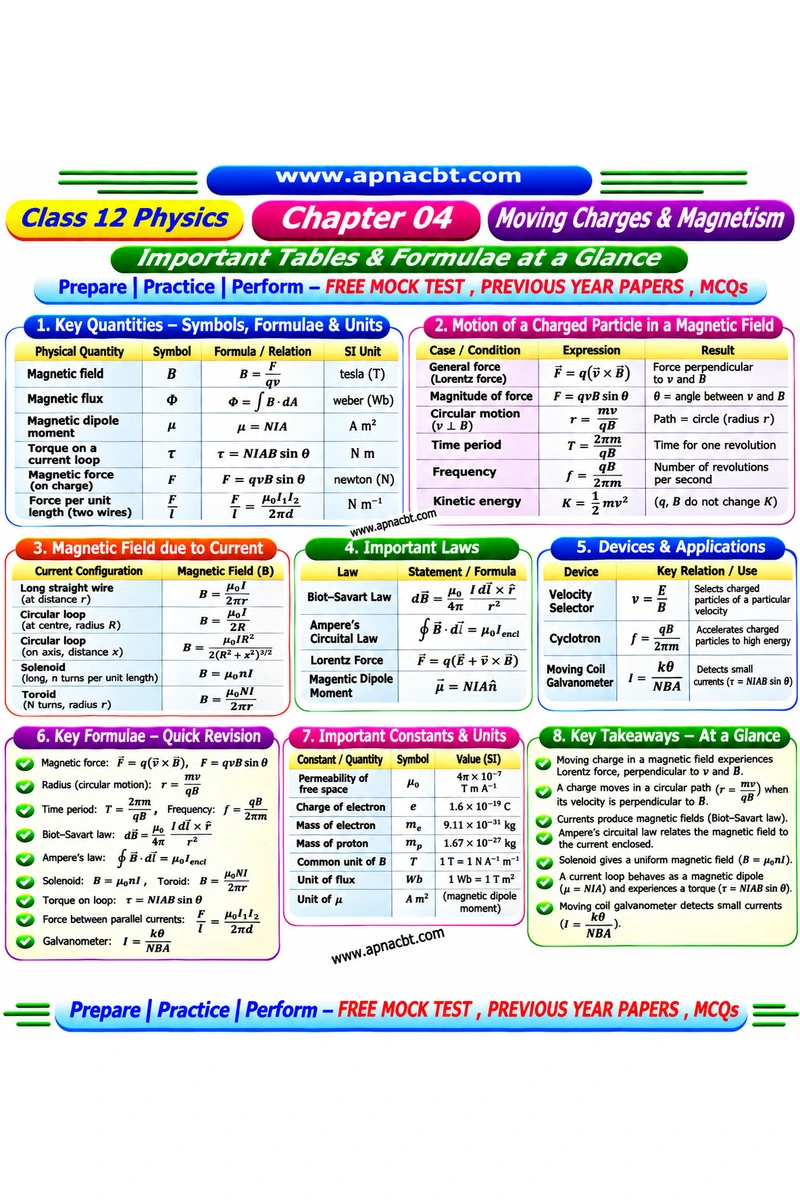
A magnetic field B is a vector field produced by moving charges, electric currents and magnetic moments. A charge q in electric and magnetic fields experiences the Lorentz force F = q(E + v × B). The magnetic part is FB = q(v × B), with magnitude F = qvB sin θ.
Magnetic force is perpendicular to both velocity and magnetic field. It is zero for a stationary charge and when v is parallel or antiparallel to B. The magnetic field does no work because the magnetic force is perpendicular to the instantaneous velocity. The SI unit is tesla (T); 1 gauss = 10−4 T.
Motion of a Charged Particle in a Magnetic Field
For a charged particle entering a uniform magnetic field perpendicular to B, the magnetic force provides centripetal force: |q|vB = mv²/r. Therefore r = mv/(|q|B), ω = |q|B/m, T = 2πm/(|q|B) and f = |q|B/(2πm).
The speed and kinetic energy remain constant because magnetic force does no work. If the particle enters at an angle, its perpendicular velocity produces circular motion while its parallel component remains uniform, giving a helical path.
Combined Electric and Magnetic Fields: Velocity Selector and Cyclotron
In mutually perpendicular electric and magnetic fields, the forces can cancel for a particular velocity. For undeflected motion, qE = qvB, hence v = E/B. This is the principle of a velocity selector.
A cyclotron uses a magnetic field to bend charged particles into semicircular paths and an alternating electric field to accelerate them across the gap between the dees. Its non-relativistic frequency is f = |q|B/(2πm). The cyclotron is not suitable for neutral particles and its simple operation is limited at very high relativistic speeds.
Magnetic Force on a Current-Carrying Conductor
A current-carrying conductor in a magnetic field experiences a force because its moving charge carriers experience magnetic force. For a straight conductor, F = I(l × B) and F = IlB sin θ. The force is maximum at 90° and zero when the conductor is parallel to B.
The direction follows the vector cross product or Fleming’s left-hand rule. This principle is the basis of the force experienced by conductors in electric motors.
Biot-Savart Law
The Biot-Savart law is one of the core calculation tools in Moving Charges and Magnetism, especially for current elements and circular loops.
Biot-Savart law gives the magnetic field produced by a current element: dB = (μ0/4π) I(dl × r)/r³. In magnitude, dB = (μ0/4π)(I dl sin θ/r²). The field direction is perpendicular to the plane containing dl and r.
For vacuum, μ0/4π = 10−7 T m A−1. The law is applied by integrating contributions from all current elements.
Magnetic Field Due to a Circular Current Loop
For a circular loop of radius R carrying current I, the magnetic field on its axis at distance x is B = μ0IR²/[2(x² + R²)3/2]. At the centre, B = μ0I/(2R). For N turns, B = μ0NI/(2R) at the centre.
Transverse components cancel by symmetry and axial components add. The direction follows the right-hand thumb rule. A current loop behaves approximately as a magnetic dipole at large axial distances.
Ampere’s Circuital Law
A major Moving Charges and Magnetism exam skill is choosing an Amperian loop that uses the symmetry of the current distribution.
Ampere’s circuital law states ∮ B · dl = μ0Ienclosed. The current sign is determined by the right-hand rule. The law is especially useful for symmetric current distributions.
For a long straight wire, a circular Amperian loop gives B = μ0I/(2πr). The choice of an Amperian loop should exploit symmetry so that B is constant or otherwise easy to integrate.
Solenoid and Toroid
For a long solenoid with n turns per unit length carrying current I, the magnetic field inside is approximately uniform: B = μ0nI. The field outside an ideal infinitely long solenoid is approximately zero.
For a toroid with N turns and mean radius r, B = μ0NI/(2πr) inside the winding. Direction is obtained using the right-hand rule.
Force Between Two Parallel Current-Carrying Conductors
Two long parallel conductors carrying currents I1 and I2, separated by distance d, exert forces on each other. The force per unit length is F/l = μ0I1I2/(2πd).
Currents in the same direction attract and currents in opposite directions repel. The result follows by calculating the magnetic field of one wire and applying the force-on-conductor equation to the second wire.
Torque on a Current Loop and Magnetic Dipole
A current loop in a uniform magnetic field can experience zero net force but a torque. For N turns, area A and current I, the magnetic dipole moment is m = NIA. The torque is τ = m × B, with magnitude τ = NIAB sin θ.
The torque tends to align the magnetic moment with the magnetic field. The direction of m is normal to the loop and follows the right-hand thumb rule.
Moving Coil Galvanometer
The galvanometer is an important application in Moving Charges and Magnetism and is frequently tested through sensitivity and conversion questions.
A moving coil galvanometer works because a current-carrying coil in a magnetic field experiences torque. Deflecting torque is NIAB and restoring torque is kφ. At equilibrium, NIAB = kφ.
Current sensitivity is φ/I = NAB/k. To convert a galvanometer into an ammeter, a low resistance shunt is connected in parallel. To convert it into a voltmeter, a high resistance is connected in series.
High-Yield Formula Revision and Exam Strategy
Important formulas:
- F = qvB sin θ
- F = q(E + v × B)
- r = mv/(|q|B)
- T = 2πm/(|q|B)
- v = E/B
- F = IlB sin θ
- dB = (μ0/4π)(I dl sin θ/r²)
- Bwire = μ0I/(2πr)
- Bloop centre = μ0NI/(2R)
- Bsolenoid = μ0nI
- Btoroid = μ0NI/(2πr)
- F/l = μ0I1I2/(2πd)
- m = NIA
- τ = NIAB sin θ
- kφ = NIAB
CBSE: practise derivations, diagrams, definitions, units and numerical problems. NEET: practise rapid formula application, direction rules, conceptual questions and mixed numerical problems.
CBSE, NEET and NCERT Preparation Resources
For Moving Charges and Magnetism, use the NCERT chapter as the primary source for definitions, derivations, diagrams and standard examples. Students preparing for CBSE should practise derivations and numerical problems, while NEET aspirants should focus on rapid formula application, direction rules and mixed conceptual questions.
Useful official resources include the NCERT textbooks and CBSE Academic resources. APNA CBT also provides Class 12 Physics practice resources for additional preparation.
Short-Answer Questions – 30 Questions with Detailed Answers
1. What is a magnetic field?
Answer: A vector field produced by moving charges, currents and magnetic moments; its SI unit is tesla.
2. State the Lorentz force.
Answer: F = q(E + v × B). The magnetic part is q(v × B).
3. When is magnetic force maximum?
Answer: For fixed q, v and B, it is maximum when θ = 90°.
4. When is magnetic force zero?
Answer: For v = 0 or when v is parallel/antiparallel to B, and also when q or B is zero.
5. Does magnetic force do work?
Answer: No. It is perpendicular to velocity, so its work is zero.
6. What is the SI unit of B?
Answer: Tesla (T).
7. Convert 1 gauss into tesla.
Answer: 1 G = 10⁻⁴ T.
8. Write the radius of circular motion.
Answer: r = mv/(|q|B).
9. Write the cyclotron frequency.
Answer: f = |q|B/(2πm).
10. Why is the path circular for v perpendicular to B?
Answer: Magnetic force acts as centripetal force and continually changes only the direction of velocity.
11. What is a velocity selector?
Answer: Crossed electric and magnetic fields that allow only particles with v = E/B to pass undeflected.
12. What is the principle of a cyclotron?
Answer: A magnetic field bends the particle and an alternating electric field accelerates it across the dee gap.
13. Write force on a current-carrying conductor.
Answer: F = I(l × B), magnitude IlB sin θ.
14. When is conductor force maximum?
Answer: When the conductor is perpendicular to B.
15. State Biot-Savart law.
Answer: dB = (μ₀/4π)(I dl sin θ/r²).
16. Field at centre of N-turn circular coil?
Answer: B = μ₀NI/(2R).
17. State Ampere’s law.
Answer: ∮B·dl = μ₀I_enclosed.
18. Field due to long straight wire?
Answer: B = μ₀I/(2πr).
19. Field inside long solenoid?
Answer: B = μ₀nI.
20. How do parallel currents interact?
Answer: Same-direction currents attract; opposite-direction currents repel.
21. Force per unit length between parallel wires?
Answer: F/l = μ₀I₁I₂/(2πd).
22. Define magnetic dipole moment.
Answer: m = NIA for an N-turn current loop.
23. Torque on current loop?
Answer: τ = NIAB sin θ.
24. What is the net force on a current loop in a uniform field?
Answer: For a closed loop in a uniform magnetic field, the net force is zero.
25. Principle of galvanometer?
Answer: A current-carrying coil in a magnetic field experiences torque proportional to current.
26. Galvanometer equilibrium equation?
Answer: NIAB = kφ.
27. Current sensitivity?
Answer: φ/I = NAB/k.
28. How is galvanometer converted to ammeter?
Answer: By connecting a low resistance shunt in parallel.
29. How is galvanometer converted to voltmeter?
Answer: By connecting a high resistance in series.
30. Why is Ampere’s law useful for a solenoid?
Answer: The high symmetry makes the magnetic field simple along a suitable Amperian loop.
Long-Answer Questions – 15 Questions with Detailed Answers
1. Derive radius and time period of a charged particle moving perpendicular to a uniform magnetic field.
Detailed Answer: Equate magnetic force and centripetal force: |q|vB = mv²/r. Hence r = mv/(|q|B). Using v = 2πr/T gives T = 2πm/(|q|B).
2. Explain helical motion of a charged particle in a magnetic field.
Detailed Answer: Resolve velocity into parallel and perpendicular components. The perpendicular component produces circular motion and the parallel component produces uniform motion along B. Their combination is a helix.
3. Explain velocity selector and obtain selected velocity.
Detailed Answer: Electric and magnetic forces oppose each other. For undeflected motion qE = qvB, giving v = E/B.
4. Explain cyclotron and derive its frequency.
Detailed Answer: The magnetic field produces semicircular motion and the alternating electric field accelerates the particle at each gap crossing. From circular motion T = 2πm/(|q|B), hence f = |q|B/(2πm).
5. State and explain Biot-Savart law.
Detailed Answer: For current element I dl, dB = (μ₀/4π)(I dl × r/r³), or in magnitude dB = (μ₀/4π)(I dl sinθ/r²). Direction follows the right-hand rule.
6. Derive magnetic field on axis of a circular loop.
Detailed Answer: Apply Biot-Savart law to each element. By symmetry transverse components cancel and axial components add, giving B = μ₀IR²/[2(x²+R²)^(3/2)] for one turn.
7. Derive field due to a long straight wire using Ampere’s law.
Detailed Answer: For a circular Amperian loop, B is constant. Thus B(2πr) = μ₀I, so B = μ₀I/(2πr).
8. Derive field inside a long solenoid.
Detailed Answer: Use a rectangular Amperian loop. Enclosed current is n l I. Therefore Bl = μ₀n l I and B = μ₀nI.
9. Derive force between parallel current-carrying wires.
Detailed Answer: Wire 1 produces B = μ₀I₁/(2πd). Force on length l of wire 2 is I₂lB, giving F/l = μ₀I₁I₂/(2πd).
10. Derive torque on a rectangular current loop.
Detailed Answer: Opposite sides experience equal opposite forces forming a couple. The net force is zero and torque for N turns is τ = NIAB sinθ.
11. Explain magnetic dipole moment of a current loop.
Detailed Answer: For N turns, current I and area A, m = NIA. Its direction is normal to the loop according to the right-hand thumb rule.
12. Explain moving coil galvanometer.
Detailed Answer: Current in a coil in a magnetic field produces torque NIAB. Spring restoring torque is kφ. At equilibrium NIAB = kφ, so deflection is proportional to current.
13. Derive shunt resistance for converting galvanometer into ammeter.
Detailed Answer: If G is galvanometer resistance and I_g full-scale current, equal voltage across galvanometer and shunt gives I_gG = (I−I_g)S, so S = I_gG/(I−I_g).
14. Derive series resistance for converting galvanometer into voltmeter.
Detailed Answer: For desired voltage V, V = I_g(G+R), hence R = V/I_g − G.
15. Compare current and voltage sensitivity.
Detailed Answer: Current sensitivity is φ/I = NAB/k. Voltage sensitivity is φ/V = NAB/(kG). Thus voltage sensitivity is current sensitivity divided by G.