Chapter 03: Current Electricity
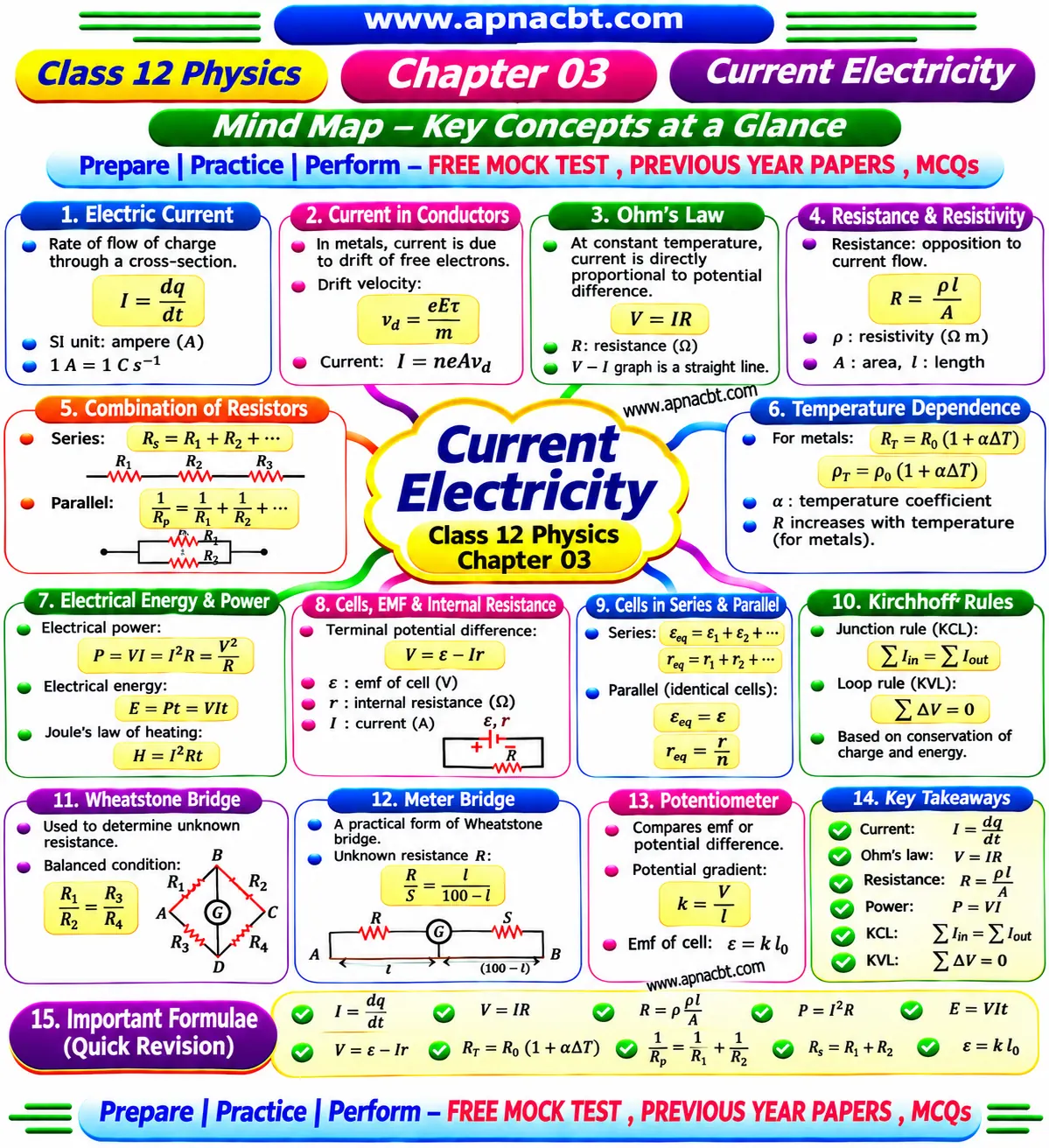
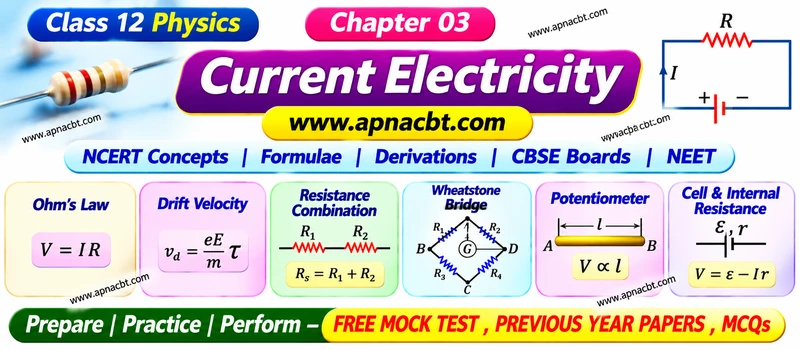
Current Electricity is an important Class 12 Physics chapter for CBSE Board Exams, board examinations and NEET preparation. This NCERT-based lesson covers electric current, drift of electrons, Ohm’s law, resistance, resistivity, conductivity, electrical energy and power, combinations of resistors, temperature dependence of resistance, cells, internal resistance, Kirchhoff’s laws and Wheatstone bridge. Use this Current Electricity lesson to prepare concepts, formulas, circuit applications and exam-oriented questions.
Prepare | Practice | Perform — Revise the NCERT concepts first, learn the important Current Electricity formulas, practise circuit-based problems and then attempt the short- and long-answer questions. For additional learning resources, visit APNA CBT and refer to the NCERT learning resources.
Current Electricity – Chapter Overview
- Electric current and its direction
- Current density, drift velocity and mobility
- Ohm’s law, resistance and resistivity
- Conductivity and microscopic form of Ohm’s law
- Electrical energy, power and heating effect
- Series and parallel combinations of resistors
- Temperature dependence of resistance
- Cells, emf and internal resistance
- Series, parallel and mixed grouping of cells
- Kirchhoff’s junction and loop rules
- Wheatstone bridge and balance condition
- Meter bridge and potentiometer applications
1. Electric Current – Definition, Direction and Basic Formula
Electric current is the rate of flow of electric charge through a cross-section of a conductor. For a steady current, the current is the charge flowing per unit time.
Formula: I = Q/t. For a non-steady current, I = dQ/dt.
- SI unit of current: ampere (A).
- 1 A = 1 C s−1.
- Conventional current is taken in the direction of motion of positive charge.
- In a metallic conductor, electrons move opposite to the conventional current.
If a charge q completes a circular orbit with period T, the corresponding current is I = q/T. For an electron of charge magnitude e, I = e/T.
Exam focus: CBSE questions commonly test the definition, SI unit and direction of current. NEET problems often combine charge, time and number of electrons.
2. Electric Currents in Conductors – Drift Velocity and Mobility
Free electrons in a metal are in continuous random motion. In the absence of an external electric field, their average velocity is zero. When an electric field is applied, the electrons acquire a small average velocity opposite to the field. This average velocity is called drift velocity.
For an electron of charge magnitude e in an electric field E, the magnitude of acceleration is a = eE/m. If τ is the mean relaxation time between collisions, the drift speed is:
vd = eEτ/m
For a conductor of length l connected across potential difference V, E = V/l and therefore:
vd = eVτ/(ml)
If n is the number density of free electrons and A is the cross-sectional area, then:
I = neAvd
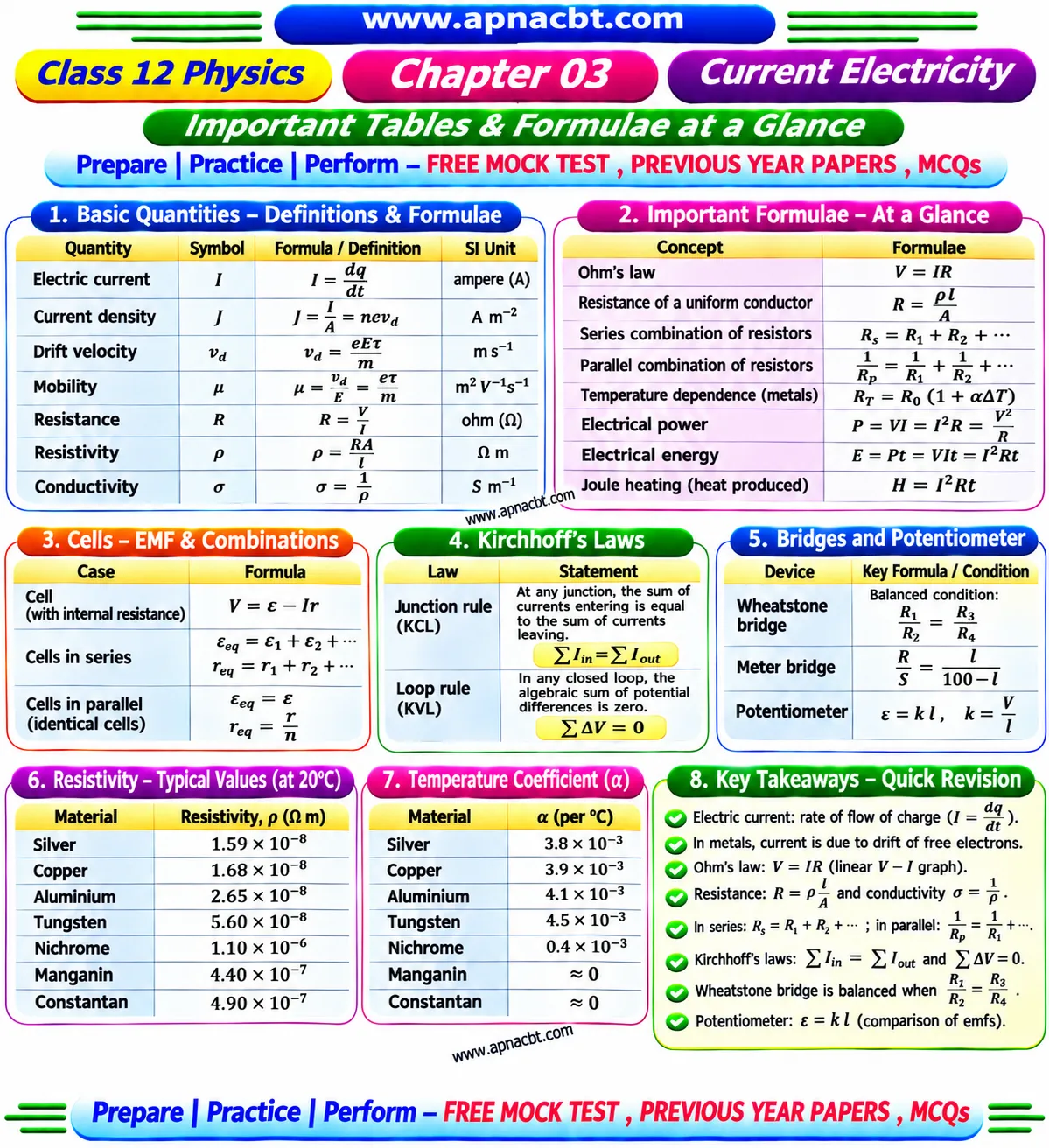
Current density is J = I/A = nevd. Hence J = σE, where σ is conductivity. Mobility is the drift velocity per unit electric field: μ = vd/E = eτ/m.
Important: Drift velocity is very small compared with the random thermal speed of electrons. The establishment of current in a circuit is not the same as an individual electron travelling from the source to the load at the speed of light.
3. Ohm’s Law – Resistance, Resistivity and Conductivity
Ohm’s law states that, at constant physical conditions such as temperature, the potential difference across a conductor is directly proportional to the current through it.
V = IR
Here R is the resistance of the conductor. For a uniform conductor of length l and cross-sectional area A:
R = ρl/A
where ρ is the resistivity or specific resistance of the material.
- Resistance depends on length, cross-sectional area, material and physical conditions.
- Resistivity is a property of the material at a specified temperature.
- SI unit of resistance: ohm (Ω).
- SI unit of resistivity: Ω m.
- Conductivity σ = 1/ρ.
The microscopic form of Ohm’s law is J = σE. A conductor is ohmic when its V-I graph is a straight line passing through the origin under constant physical conditions.
4. Origin of Resistivity and Microscopic Form of Ohm’s Law
In a metal, electrons repeatedly collide with the atoms or ions of the lattice. The average time between successive collisions is called the relaxation time, represented by τ. Under an applied electric field, electrons acquire a small drift velocity.
Using vd = eEτ/m and I = neAvd, the current density becomes:
J = ne2τE/m
Therefore, conductivity is:
σ = ne2τ/m
and resistivity is:
ρ = m/(ne2τ)
This microscopic picture explains why resistance is associated with collisions and why the electrical properties of a conductor depend on material, temperature and the density and relaxation behaviour of charge carriers.
5. Electrical Energy, Power and Heating Effect of Current
When charge moves through a potential difference, electrical energy is transferred. If a current I flows through a potential difference V for time t, the electrical work is:
W = VIt
Electrical power is the rate of electrical energy transfer:
P = VI = I2R = V2/R
The electrical energy consumed in time t is W = Pt. The SI unit of power is watt (W), while electrical energy may be expressed in joule or kilowatt-hour for practical consumption.
For a resistor, electrical energy appears as heat. This is the Joule heating effect:
H = I2Rt = VIt = V2t/R
Exam focus: Remember the three equivalent power expressions and choose the form that matches the quantities given in a numerical problem.
6. Combination of Resistors – Series and Parallel
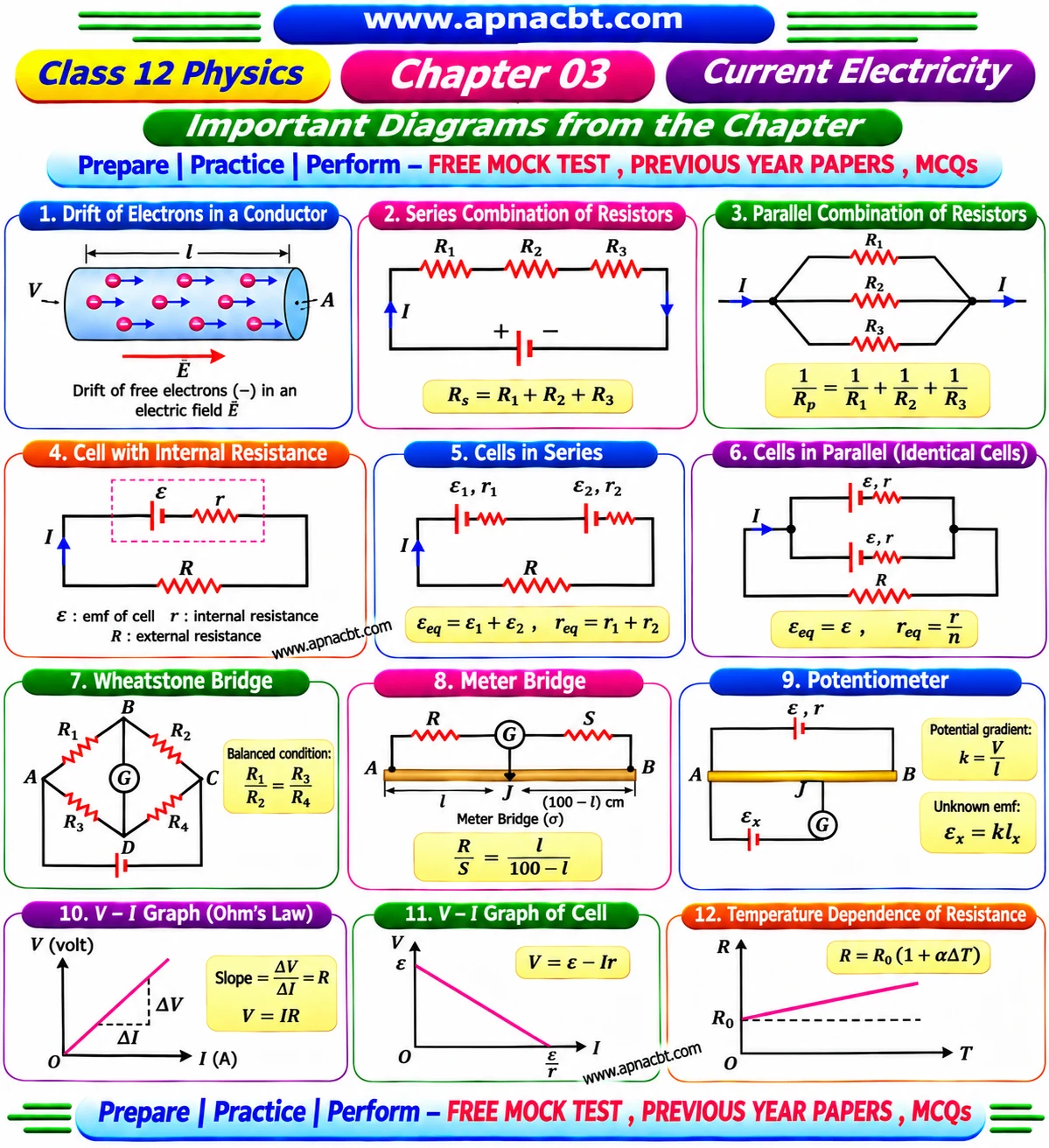
Resistors in series
When resistors are connected end-to-end, the same current flows through each resistor. The equivalent resistance is:
Rs = R1 + R2 + R3 + …
The potential differences add: V = V1 + V2 + V3 + …
Resistors in parallel
When the same two nodes connect the resistors, the potential difference across every branch is the same. The equivalent resistance is:
1/Rp = 1/R1 + 1/R2 + 1/R3 + …
For two resistors in parallel:
Rp = R1R2/(R1 + R2)
In series, equivalent resistance is greater than every individual resistance. In parallel, equivalent resistance is less than the smallest branch resistance.
7. Temperature Dependence of Resistance and Resistivity
The resistance of a conductor generally changes with temperature. For many metallic conductors over a limited temperature range:
RT = R0[1 + α(T − T0)]
Here α is the temperature coefficient of resistance.
For metals, resistance generally increases with temperature because increased lattice vibrations increase electron scattering. For many semiconductors, resistance decreases as temperature rises because the number of charge carriers increases.
The temperature coefficient may be positive, negative or small depending on the material. In numerical problems, always use the same temperature scale and pay attention to the reference temperature.
8. Electromotive Force, Terminal Voltage and Internal Resistance of a Cell
An electrochemical cell converts chemical energy into electrical energy. Its emf ε is the energy supplied by the source per unit charge and is equal to the terminal potential difference when no current is drawn from the cell.
If a cell of emf ε and internal resistance r supplies current I to an external circuit, its terminal voltage is:
V = ε − Ir
For an external resistance R:
I = ε/(R + r)
The internal resistance represents the opposition offered inside the cell to current flow. It depends on factors such as the nature and concentration of the electrolyte, temperature, electrode separation and effective electrode area.
When the cell is being charged, the terminal voltage can be written as V = ε + Ir.
9. Cells in Series, Parallel and Mixed Grouping
Identical cells in series
For n identical cells, each of emf ε and internal resistance r, connected in series:
εeq = nε, req = nr
Current through an external resistance R is I = nε/(R + nr).
Identical cells in parallel
For n identical cells connected in parallel:
εeq = ε, req = r/n
Current through R is I = ε/(R + r/n).
Mixed grouping
If m identical cells are in series in each row and n such rows are connected in parallel, then:
εeq = mε, req = mr/n
Thus I = mε/(R + mr/n). The choice of grouping depends on the external resistance and the desired current.
10. Kirchhoff’s Laws – Junction Rule and Loop Rule
Kirchhoff’s rules are used to analyse circuits that cannot be reduced simply to series and parallel combinations.
Junction rule
The algebraic sum of currents at a junction is zero:
ΣI = 0
This follows from conservation of electric charge. The total current entering a junction equals the total current leaving it.
Loop rule
The algebraic sum of all potential changes around a closed loop is zero:
Σε − ΣIR = 0
This follows from conservation of energy. While applying the rule, choose a loop direction and follow consistent sign conventions for emfs and potential changes across resistors.
Exam focus: Draw the circuit clearly, assign current directions, write one junction equation and the required independent loop equations, then solve simultaneously.
11. Wheatstone Bridge – Principle and Balance Condition
A Wheatstone bridge consists of four resistances arranged in a bridge network with a galvanometer between the middle junctions. When the bridge is balanced, no current flows through the galvanometer.
For arms P, Q, R and S, the balance condition is:
P/Q = R/S
At balance, the two galvanometer junctions are at the same potential. Therefore, the galvanometer current is zero.
The bridge principle is useful for accurate comparison of resistances and forms the basis of the meter bridge. Numerical questions may ask for an unknown resistance using the balance condition.
12. Meter Bridge – Resistance Comparison
A meter bridge is a practical form of the Wheatstone bridge. It uses a uniform resistance wire, usually of one metre length. The resistance of a uniform wire is proportional to its length.
If an unknown resistance X and a known resistance R are placed in the two gaps and the balance point is at length l from one end, then the ratio of resistances is related to the ratio of wire lengths:
X/R = l/(100 − l)
The exact arrangement of X and R determines which ratio is used, so identify the two gaps and the balance lengths before substituting values.
Practical point: A null method is used; at balance, the galvanometer shows zero deflection. Accurate contact and a uniform wire are important.
13. Potentiometer – Principle and Important Applications
A potentiometer works on the principle that the potential drop across a uniform wire carrying a steady current is proportional to its length. It is a null method and can be used to compare emfs, determine internal resistance and measure small potential differences.
If k is the potential gradient, the potential difference across a length l is:
V = kl
For comparison of two emfs using balance lengths l1 and l2:
ε1/ε2 = l1/l2
Because the potentiometer uses a null condition, it does not draw current from the source being measured at the balance point. This makes it more accurate than direct potential-difference measurement in suitable applications.
14. High-Value Current Electricity Formula Revision
- I = Q/t and I = dQ/dt
- I = neAvd
- J = I/A = nevd
- vd = eEτ/m
- μ = vd/E = eτ/m
- J = σE
- σ = ne2τ/m
- ρ = m/(ne2τ)
- V = IR
- R = ρl/A
- σ = 1/ρ
- P = VI = I2R = V2/R
- H = I2Rt
- Rs = R1 + R2 + …
- 1/Rp = 1/R1 + 1/R2 + …
- RT = R0[1 + α(T − T0)]
- I = ε/(R + r)
- For n identical series cells: εeq = nε, req = nr
- For n identical parallel cells: εeq = ε, req = r/n
- Kirchhoff junction rule: ΣI = 0
- Kirchhoff loop rule: Σε − ΣIR = 0
- Wheatstone balance: P/Q = R/S
- Meter bridge: X/R = l/(100 − l), for the stated standard arrangement
- Potentiometer: V = kl
15. CBSE Board and NEET Preparation Strategy
For Current Electricity, CBSE Board preparation should emphasise definitions, derivations, circuit diagrams, laws, formula-based numericals and stepwise reasoning. NEET preparation should focus on rapid application of formulas, resistor networks, drift velocity, cells, Kirchhoff equations, bridge problems and power calculations.
- Memorise the conditions under which Ohm’s law applies.
- Practise conversion between microscopic and macroscopic forms of current.
- Master series and parallel resistor reductions before attempting mixed circuits.
- Practise cell combinations and internal resistance numericals.
- Use a consistent sign convention in Kirchhoff problems.
- Remember the Wheatstone bridge balance condition and meter bridge length ratio.
- Revise the formula list before solving numerical questions.
- For Board Exams, show formula, substitution, unit and final answer clearly.
16. Short-Answer Questions – 30 Questions with Detailed Answers
- What is electric current?
Answer: Electric current is the rate of flow of electric charge through a cross-section of a conductor. For steady current, I = Q/t. - What is the SI unit of current?
Answer: The SI unit is ampere (A), where 1 A = 1 C s−1. - What is conventional current?
Answer: Conventional current is taken in the direction in which positive charge would move. In a metal, it is opposite to electron drift. - Define drift velocity.
Answer: Drift velocity is the average velocity acquired by free charge carriers in a conductor due to an applied electric field. - Write the relation between current and drift velocity.
Answer: I = neAvd, where n is carrier number density, e is charge magnitude and A is cross-sectional area. - What is current density?
Answer: Current density is current per unit cross-sectional area: J = I/A. For a metal, J = nevd. - State Ohm’s law.
Answer: At constant physical conditions, the potential difference across a conductor is directly proportional to current through it: V = IR. - Define resistance.
Answer: Resistance is the opposition offered by a conductor to the flow of electric current. It is given by R = V/I. - What is resistivity?
Answer: Resistivity is the resistance of a material sample of unit length and unit cross-sectional area. For a uniform conductor, R = ρl/A. - What is the SI unit of resistivity?
Answer: The SI unit is ohm metre (Ω m). - What is conductivity?
Answer: Conductivity is the reciprocal of resistivity: σ = 1/ρ. Its SI unit is siemens per metre (S m−1). - Write the microscopic form of Ohm’s law.
Answer: J = σE, where J is current density, σ conductivity and E electric field. - What is relaxation time?
Answer: Relaxation time is the average time between two successive collisions of a charge carrier with the lattice or scattering centres. - Write the expression for drift velocity.
Answer: vd = eEτ/m for an electron in a simple metal model. - What is electrical power?
Answer: Electrical power is the rate of electrical energy transfer: P = VI = I2R = V2/R. - State Joule’s law of heating.
Answer: Heat produced in a resistor is H = I2Rt for current I flowing for time t. - What happens to equivalent resistance when resistors are connected in series?
Answer: Resistances add: Rs = R1 + R2 + … - What happens to equivalent resistance in parallel?
Answer: Reciprocals add: 1/Rp = 1/R1 + 1/R2 + … - How does resistance of a metal generally change with temperature?
Answer: It generally increases with temperature because lattice vibrations and scattering increase. - What is emf of a cell?
Answer: Emf is the energy supplied by the source per unit charge; it equals terminal voltage when no current is drawn. - Write the terminal voltage of a discharging cell.
Answer: V = ε − Ir. - Write the current supplied by a cell of emf ε and internal resistance r to resistance R.
Answer: I = ε/(R + r). - What is the equivalent emf of n identical cells in series?
Answer: εeq = nε. - What is the equivalent internal resistance of n identical cells in parallel?
Answer: req = r/n. - State Kirchhoff’s junction rule.
Answer: The algebraic sum of currents at a junction is zero, expressing conservation of charge. - State Kirchhoff’s loop rule.
Answer: The algebraic sum of potential changes around a closed loop is zero, expressing conservation of energy. - What is a balanced Wheatstone bridge?
Answer: It is a bridge in which no current flows through the galvanometer because the two galvanometer junctions are at the same potential. - Write the Wheatstone bridge balance condition.
Answer: For arms P, Q, R and S, P/Q = R/S. - What is the principle of a potentiometer?
Answer: The potential drop along a uniform wire carrying steady current is proportional to its length: V = kl. - Why is a potentiometer called a null method?
Answer: At balance, the detector shows zero deflection and the measured source does not supply current through the detector branch, allowing accurate comparison.
17. Long-Answer Questions – 15 Questions with Detailed Answers
- Explain electric current and derive I = neAvd.
Answer: Consider a conductor of cross-sectional area A containing n free electrons per unit volume. In time Δt, electrons with drift speed vd move through a length vdΔt. The volume crossing the section is AvdΔt, so the number of electrons is nAvdΔt. Charge crossing is neAvdΔt. Dividing by Δt gives I = neAvd. - Derive the expression for drift velocity.
Answer: An electron in an electric field E experiences force of magnitude eE. Its acceleration magnitude is a = eE/m. If τ is the mean relaxation time, the average drift speed acquired is vd = aτ = eEτ/m. The electron drift direction is opposite to the electric field because the electron is negatively charged. - Derive the microscopic form of Ohm’s law.
Answer: Using vd = eEτ/m and I = neAvd, we get I = neA(eEτ/m) = ne2AτE/m. Therefore J = I/A = ne2τE/m = σE, where σ = ne2τ/m. Thus J is proportional to E. - Explain Ohm’s law and obtain R = ρl/A.
Answer: For an ohmic conductor under constant physical conditions, V ∝ I, so V = IR. Since the electric field in a uniform conductor is E = V/l and current density is J = I/A, using J = σE gives I/A = σV/l. Hence V/I = l/(σA) = ρl/A, because ρ = 1/σ. Therefore R = ρl/A. - Derive the expressions for electrical power and heat produced.
Answer: Electrical work done in moving charge Q through potential difference V is W = VQ. Since Q = It, W = VIt. Power P = W/t = VI. Using V = IR gives P = I2R, and using I = V/R gives P = V2/R. Therefore heat produced in time t is H = I2Rt. - Derive the equivalent resistance of resistors in series.
Answer: The same current I flows through each series resistor. If their resistances are R1, R2 and R3, the total voltage is V = IR1 + IR2 + IR3 = I(R1 + R2 + R3). Hence Rs = R1 + R2 + R3. - Derive the equivalent resistance of two resistors in parallel.
Answer: The voltage V is the same across both resistors. Total current I = I1 + I2 = V/R1 + V/R2. If equivalent resistance is Rp, I = V/Rp. Therefore 1/Rp = 1/R1 + 1/R2, giving Rp = R1R2/(R1 + R2). - Explain temperature dependence of resistance.
Answer: For many metallic conductors over a limited range, resistance varies approximately linearly with temperature. If R0 is resistance at T0, then RT = R0[1 + α(T − T0)]. Metals usually have positive α. Semiconductors generally show a decrease in resistance as temperature increases. - Derive the current supplied by a cell with internal resistance.
Answer: Let emf be ε, internal resistance r and external resistance R. The same current I flows through the complete series path. The total resistance is R + r. By the circuit equation, ε = I(R + r). Hence I = ε/(R + r). The terminal voltage is V = IR = ε − Ir. - Explain series and parallel grouping of identical cells.
Answer: For n identical cells in series, emfs and internal resistances add, giving εeq = nε and req = nr. For n identical cells in parallel, the emf remains ε while internal resistance becomes r/n. For mixed grouping with m cells in series per row and n rows in parallel, εeq = mε and req = mr/n. - State and explain Kirchhoff’s two rules.
Answer: The junction rule is ΣI = 0 and follows from conservation of charge. The loop rule is Σε − ΣIR = 0 and follows from conservation of energy. In practical circuit analysis, assign current directions, choose a junction, write the current equation and then write independent loop equations using consistent sign conventions. - Explain the Wheatstone bridge and derive its balance condition.
Answer: In a bridge with resistances P, Q, R and S, balance occurs when no current flows through the galvanometer. Therefore the potentials at the two middle junctions are equal. Comparing potential drops in the two branches gives P/Q = R/S. This is the Wheatstone bridge balance condition and can be used to determine an unknown resistance. - Explain the working principle of a meter bridge.
Answer: A meter bridge applies the Wheatstone bridge principle to a uniform one-metre wire. Since resistance of the uniform wire is proportional to length, the resistance ratio of the two gaps equals the ratio of the corresponding wire lengths at balance. For the standard arrangement, X/R = l/(100 − l). At balance the galvanometer has zero deflection. - Explain the principle and applications of a potentiometer.
Answer: In a uniform wire carrying steady current, potential drop per unit length is constant, so V = kl. At balance, the emf of a cell is proportional to the balancing length. Thus ε1/ε2 = l1/l2. A potentiometer can compare emfs, determine internal resistance and measure small potential differences. Its null method provides high accuracy. - Describe an effective strategy for solving Current Electricity circuit numericals.
Answer: First redraw the circuit clearly and identify series, parallel and bridge portions. Label currents and polarities. Reduce simple resistor combinations where possible. For complex networks, use Kirchhoff’s junction and loop rules. For cell problems include internal resistance. Check units, signs and limiting cases. Finally verify that the calculated current, voltage or resistance is physically reasonable.
Current Electricity – Final Revision Checklist
Before the examination, revise I = Q/t, I = neAvd, V = IR, R = ρl/A, P = VI, resistor combinations, temperature dependence, cell emf and internal resistance, cell grouping, Kirchhoff’s rules, Wheatstone bridge, meter bridge and potentiometer. Practise both conceptual and numerical questions so that Current Electricity can be handled confidently in CBSE Board Exams and NEET.