

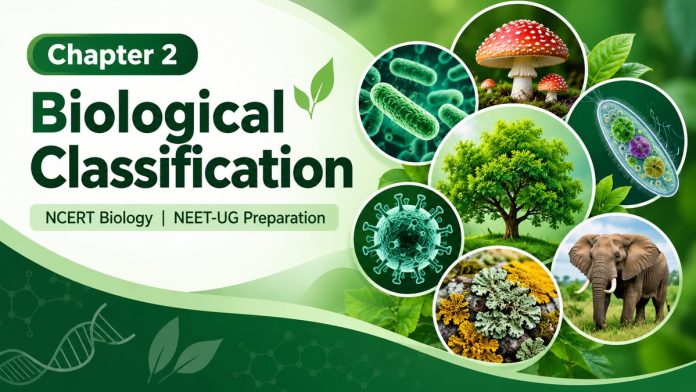
Chapter 2: Biological Classification
NCERT Biology | NEET-UG Preparation | Chapter Summary
Short Answer Questions
Answer the following questions in a few sentences.
Q1. Why is biological classification necessary?
Q2. Who proposed the five-kingdom classification, and in which year?
Q3. Name the five kingdoms proposed by R. H. Whittaker.
Q4. What are archaebacteria? Name three groups of archaebacteria.
Q5. What are cyanobacteria? What is the function of heterocysts in some cyanobacteria?
Q6. Why are mycoplasmas considered unusual among prokaryotes?
Q7. What are diatoms? What is the composition of their cell walls?
Q8. What are dinoflagellates? What is a red tide?
Q9. Define hyphae and mycelium.
Q10. Distinguish between ascospores and basidiospores.
Q11. What are viruses? Why are they called obligate intracellular parasites?
Q12. What are viroids? Name the scientist associated with their discovery.
Q13. What are prions?
Q14. What are lichens? Identify their two partners.
Q15. Why can lichens be used as indicators of air pollution?
Answers to Short Answer Questions
Answer 1: Biological classification organises the diversity of living organisms into groups based on shared characteristics. It helps in identification, systematic study and understanding relationships among organisms.
Answer 2: R. H. Whittaker proposed the five-kingdom classification in 1969.
Answer 3: Monera, Protista, Fungi, Plantae and Animalia.
Answer 4: Archaebacteria are prokaryotic organisms with distinctive characteristics, including differences in their cell walls. The three groups are methanogens, halophiles and thermoacidophiles.
Answer 5: Cyanobacteria are photosynthetic prokaryotes. In some cyanobacteria, heterocysts are specialised cells involved in nitrogen fixation.
Answer 6: Mycoplasmas lack a cell wall. They are also among the smallest cellular organisms known.
Answer 7: Diatoms are photosynthetic protists classified among the chrysophytes. Their cell walls contain silica and consist of two overlapping halves.
Answer 8: Dinoflagellates are mainly marine protists, many of which possess two flagella. A red tide occurs when certain pigmented dinoflagellates multiply rapidly and discolour the water.
Answer 9: Hyphae are thread-like filaments forming the body of many fungi. A network of hyphae is called a mycelium.
Answer 10: Ascospores are sexual spores formed inside sac-like structures called asci. Basidiospores are sexual spores formed externally on club-shaped structures called basidia.
Answer 11: Viruses are acellular infectious agents containing DNA or RNA enclosed in a protein coat. They are obligate intracellular parasites because they reproduce only inside suitable living host cells.
Answer 12: Viroids are infectious agents consisting of small, naked RNA molecules without a protein coat. T. O. Diener discovered viroids in 1971.
Answer 13: Prions are infectious agents composed of abnormally folded proteins. They are associated with certain transmissible neurodegenerative diseases.
Answer 14: Lichens are symbiotic associations between a fungus and a photosynthetic partner, which may be a green alga or a cyanobacterium. The fungal partner is the mycobiont, and the photosynthetic partner is the photobiont.
Answer 15: Lichens are sensitive to many forms of air pollution, particularly sulphur dioxide. Their presence or absence can therefore provide information about air quality.