

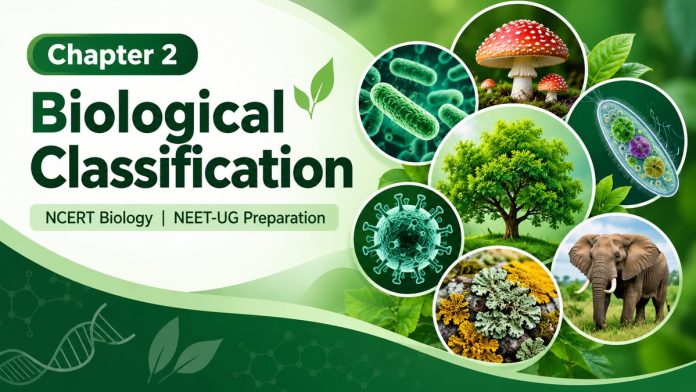
Chapter 2: Biological Classification
NCERT Biology | NEET-UG Preparation | Chapter Summary
Learning objective: Understand the development of biological classification, the five-kingdom system, the major characteristics of different kingdoms, and the differences between viruses, viroids, prions and lichens.
NEET Quick Revision
Scientists and key facts
- R. H. Whittaker (1969): Five-kingdom classification.
- W. M. Stanley (1935): Crystallisation of tobacco mosaic virus.
- T. O. Diener (1971): Discovery of viroids.
High-yield concepts
- Monera includes prokaryotes in the traditional five-kingdom system.
- Protista includes mainly unicellular eukaryotes.
- Fungi absorb nutrients and commonly possess chitin-containing cell walls.
- Diatoms have silica-rich cell walls.
- Many dinoflagellates have two flagella; some cause red tides.
- Mycoplasma lacks a cell wall.
- Ascospores are formed in asci; basidiospores are formed on basidia.
- Viruses have DNA or RNA enclosed in a protein coat.
- Viroids consist of naked RNA.
- Prions are infectious proteins.
- Lichens consist of a fungal partner and a photosynthetic partner.
Final study checklist
- Revise the five kingdoms and the criteria used to classify organisms.
- Learn the distinguishing characteristics of Monera, Protista and Fungi.
- Practise matching examples with their respective groups.
- Compare viruses, viroids and prions.
- Revise the important scientists, years and terminology.