

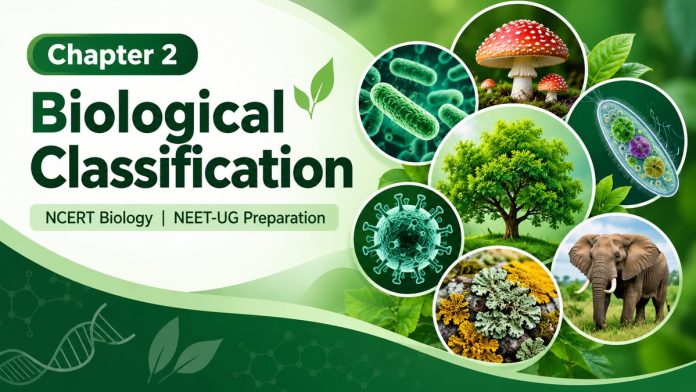
Chapter 2: Biological Classification
NCERT Biology | NEET-UG Preparation | Chapter Summary
Long Answer Questions
Answer the following questions with suitable explanations and examples.
Q1. Explain the need for biological classification and describe the development of classification systems leading to Whittaker’s five-kingdom classification.
Q2. Describe the major characteristics of Kingdom Monera. Include archaebacteria, eubacteria, cyanobacteria and mycoplasmas in your answer.
Q3. Explain the major groups of Kingdom Protista and give suitable examples of each.
Q4. Describe the general characteristics of fungi and explain the major groups traditionally described in NCERT.
Q5. Explain the structure and important characteristics of viruses. How do viruses differ from viroids and prions?
Q6. Describe lichens, explain the roles of their partners and discuss their ecological importance.
Answers to Long Answer Questions
Answer 1: Need and development of classification
The living world contains an enormous diversity of organisms. Biological classification arranges organisms into groups based on shared characteristics, making identification and study easier.
- Early classification: Aristotle classified organisms using observable features. Plants were grouped into herbs, shrubs and trees.
- Two-kingdom system: Organisms were placed in Plantae or Animalia. This system did not adequately distinguish prokaryotes from eukaryotes, unicellular from multicellular organisms, or fungi from plants.
- Five-kingdom system: R. H. Whittaker proposed this system in 1969.
The five kingdoms are Monera, Protista, Fungi, Plantae and Animalia. The system considers cell structure, body organisation, nutrition, reproduction and evolutionary relationships.
Answer 2: Kingdom Monera
Monera includes prokaryotic organisms, which lack a true nucleus enclosed by a nuclear membrane and membrane-bound organelles. Most are unicellular and reproduce by binary fission.
- Archaebacteria: Include methanogens, halophiles and thermoacidophiles. They are adapted to different environments, and their cell walls have distinctive characteristics.
- Eubacteria: Known as true bacteria. Many possess a rigid cell wall and occur in different shapes.
- Cyanobacteria: Photosynthetic prokaryotes that may be unicellular, colonial or filamentous. Some have heterocysts involved in nitrogen fixation.
- Mycoplasmas: Lack a cell wall. Some cause diseases in plants and animals.
Monerans show varied modes of nutrition. Some are autotrophic, while others obtain nutrients from organic matter or other organisms.
Answer 3: Kingdom Protista
Protista includes mainly unicellular eukaryotic organisms. They possess a true nucleus and membrane-bound organelles. Their nutrition may be autotrophic or heterotrophic.
- Chrysophytes: Include diatoms and golden algae. Diatoms have silica-rich cell walls.
- Dinoflagellates: Mostly marine; many possess two flagella. Some species cause red tides.
- Euglenoids: Commonly found in freshwater. They have a protein-rich pellicle instead of a typical cell wall. Euglena can show both autotrophic and heterotrophic nutrition.
- Slime moulds: Saprophytic protists that feed on decaying organic matter and form reproductive structures under suitable conditions.
- Protozoans: Heterotrophic protists traditionally classified as amoeboid, flagellated, ciliated and sporozoan forms.
Protists are important components of aquatic ecosystems and display considerable diversity in structure, nutrition and movement.
Answer 4: Kingdom Fungi
Fungi are eukaryotic heterotrophs that absorb nutrients from their surroundings. Most are multicellular, although yeast is unicellular. Their cell walls commonly contain chitin. The body of many fungi consists of hyphae forming a mycelium.
- Phycomycetes: Traditionally include forms such as Rhizopus and Mucor. Their hyphae are generally aseptate and coenocytic.
- Ascomycetes: Called sac fungi. Sexual spores called ascospores are produced inside asci. Examples include yeast, Aspergillus and Penicillium.
- Basidiomycetes: Sexual spores called basidiospores develop on basidia. Examples include mushrooms, puffballs and rust fungi.
- Deuteromycetes: Traditionally called imperfect fungi because only their asexual or vegetative stages were known.
Fungi play important roles as decomposers, in food production and fermentation, and in the production of useful substances. Some also cause diseases.
Answer 5: Viruses, viroids and prions
Viruses: Viruses are acellular infectious agents. They contain either DNA or RNA surrounded by a protein coat called a capsid. Some possess an outer envelope. They lack the independent cellular machinery required for reproduction and multiply only inside suitable host cells. W. M. Stanley crystallised tobacco mosaic virus in 1935.
Viroids: Viroids consist of small, naked RNA molecules without a protein coat. They are known to cause plant diseases. T. O. Diener discovered viroids in 1971.
Prions: Prions are infectious agents consisting of abnormally folded proteins. They are associated with certain transmissible neurodegenerative diseases and lack a conventional nucleic-acid genome.
Thus, viruses contain genetic material and a protein coat, viroids consist of naked RNA, and prions are infectious proteins.
Answer 6: Lichens and their ecological importance
Lichens are symbiotic associations between a fungus and a photosynthetic partner, which may be a green alga or a cyanobacterium.
- Mycobiont: The fungal partner provides structure and helps retain or absorb water and minerals.
- Photobiont: The photosynthetic partner manufactures organic food. If the partner is a cyanobacterium, it may also fix nitrogen.
Lichens contribute to ecological processes, help colonise certain surfaces and can participate in the early stages of soil formation. Many lichens are sensitive to air pollutants, making them useful bioindicators of air quality.