

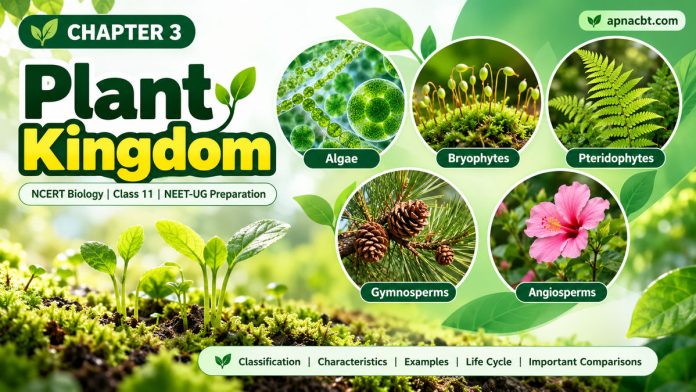
Plant Kingdom
NCERT Biology | Class 11 CBSE | NEET-UG Preparation
Long Answer Questions
Write organised answers using definitions, characteristics, comparisons and suitable examples. The answers are provided after all questions.
Q1. Explain the major criteria used to classify plants and compare algae, bryophytes, pteridophytes, gymnosperms and angiosperms.
Q2. Describe the characteristics of Chlorophyceae, Phaeophyceae and Rhodophyceae. Compare their pigments, stored food and examples.
Q3. Describe the general characteristics, reproduction and importance of bryophytes. Distinguish between liverworts and mosses.
Q4. Explain the important characteristics of pteridophytes. What are homospory and heterospory, and why is heterospory evolutionarily significant?
Q5. Describe the general characteristics and reproduction of gymnosperms. Give examples of important genera.
Q6. Explain double fertilisation in angiosperms and describe the roles of syngamy and triple fusion.
Q7. Explain the haplontic, diplontic and haplo-diplontic life cycles, giving suitable examples.
Q8. Compare bryophytes and pteridophytes with reference to vascular tissues, dominant generation, plant body and reproduction.
Answers to Long Answer Questions
Answer 1: Classification of the plant kingdom
Plants are classified using features such as body differentiation, vascular tissues, seed formation, enclosure of ovules and the dominant generation in the life cycle.
- Algae: Simple photosynthetic organisms, mainly aquatic, without true roots, stems and leaves.
- Bryophytes: Non-vascular plants with a dominant gametophyte. They reproduce through spores and generally require water for fertilisation.
- Pteridophytes: Seedless vascular plants with a dominant sporophyte. They reproduce through spores.
- Gymnosperms: Vascular seed plants with ovules not enclosed within an ovary.
- Angiosperms: Flowering plants with ovules enclosed within ovaries and seeds usually enclosed within fruits.
These groups illustrate important differences in plant structure, reproduction and the relative development of gametophyte and sporophyte generations.
Answer 2: Major classes of algae
- Chlorophyceae: Green algae with chlorophyll a and b. Their stored food is mainly starch. Examples include Chlamydomonas, Volvox and Spirogyra.
- Phaeophyceae: Brown algae with chlorophyll a, chlorophyll c and fucoxanthin. Their stored food includes laminarin and mannitol. Examples include Fucus, Laminaria and Sargassum.
- Rhodophyceae: Red algae containing chlorophyll a, chlorophyll d and phycobilin pigments, particularly phycoerythrin. Their stored food is floridean starch. Examples include Porphyra, Gracilaria and Gelidium.
Algae are important primary producers. Some are used as food, while agar, algin and carrageenan obtained from certain algae have commercial applications.
Answer 3: Bryophytes
Bryophytes are small, non-vascular plants that commonly grow in moist and shaded places. Their gametophyte is the dominant plant body, while the sporophyte remains attached to and dependent on the gametophyte to varying degrees.
- They lack true vascular tissues and true roots.
- Rhizoids help with attachment.
- Antheridia produce male gametes, and archegonia contain female gametes.
- Water is generally necessary for fertilisation.
- The zygote develops into an embryo within the archegonium.
Liverworts: May have a thalloid or leafy gametophyte. Vegetative reproduction may occur through fragmentation or gemmae. Example: Marchantia.
Mosses: Have a protonema stage followed by a leafy gametophore. Their sporophyte commonly includes a foot, seta and capsule. Examples: Funaria and Sphagnum.
Bryophytes contribute to soil formation, moisture retention and ecological succession. Sphagnum is associated with peat formation.
Answer 4: Pteridophytes and heterospory
Pteridophytes are seedless vascular plants. They possess true roots, stems and leaves and have a dominant, independent sporophyte. Their sporangia produce spores, which develop into gametophytes.
Major groups include Psilopsida, Lycopsida, Sphenopsida and Pteropsida. Examples include Psilotum, Lycopodium, Selaginella, Equisetum and Pteris.
- Homosporous plants: Produce one general type of spore.
- Heterosporous plants: Produce microspores and megaspores. Microspores develop into male gametophytes, while megaspores develop into female gametophytes.
Examples of heterosporous pteridophytes include Selaginella and Salvinia. Heterospory is evolutionarily significant because it is associated with the differentiation of male and female gametophytes and is relevant to the evolution of the seed habit.
Answer 5: Gymnosperms
Gymnosperms are vascular seed-producing plants whose ovules are not enclosed within an ovary. Their seeds are therefore naked. The sporophyte is the dominant generation, and the plant body is differentiated into roots, stems and leaves.
- Many gymnosperms are woody and perennial.
- They are heterosporous, producing microspores and megaspores.
- Microspores develop into pollen grains, representing the male gametophyte.
- Megaspores develop within ovules and give rise to female gametophytes.
- Reproductive structures commonly occur in cones or strobili.
- Fertilisation leads to embryo development within a seed.
Examples: Cycas has coralloid roots; Pinus has needle-like leaves and cones; Gnetum possesses some features resembling those of angiosperms.
Answer 6: Double fertilisation in angiosperms
Double fertilisation is a characteristic feature of flowering plants. The pollen grain delivers two male gametes to the embryo sac.
- Syngamy: One male gamete fuses with the egg cell to form a diploid zygote. The zygote develops into the embryo.
- Triple fusion: The other male gamete fuses with the two polar nuclei, or their secondary nucleus, to form the primary endosperm nucleus, usually triploid.
The occurrence of syngamy and triple fusion in the same embryo sac is called double fertilisation. The endosperm provides nourishment to the developing embryo. After fertilisation, the ovule develops into a seed and the ovary usually develops into a fruit.
Answer 7: Types of plant life cycles
- Haplontic life cycle: The haploid phase is dominant. The zygote is the main diploid stage and undergoes meiosis. Examples include Spirogyra and Volvox.
- Diplontic life cycle: The diploid sporophyte is dominant, while the haploid phase is limited. Examples include Fucus and seed plants.
- Haplo-diplontic life cycle: Both haploid gametophyte and diploid sporophyte phases are multicellular. Examples include bryophytes and pteridophytes, in which the relative development and independence of the generations differ.
In alternation of generations, the gametophyte produces gametes, fertilisation forms a diploid zygote, and the sporophyte produces haploid spores through meiosis.
Answer 8: Bryophytes versus pteridophytes
- Vascular tissues: Absent in bryophytes but present in pteridophytes.
- Plant body: Bryophytes lack true roots, stems and leaves; pteridophytes generally possess all three.
- Dominant generation: Gametophyte in bryophytes; sporophyte in pteridophytes.
- Sporophyte: Attached to and nutritionally dependent on the bryophyte gametophyte to varying degrees; independent in typical pteridophytes.
- Reproduction: Both groups reproduce through spores and generally require water for fertilisation because their male gametes are motile.
The development of vascular tissues and an independent sporophyte distinguishes pteridophytes from bryophytes.