


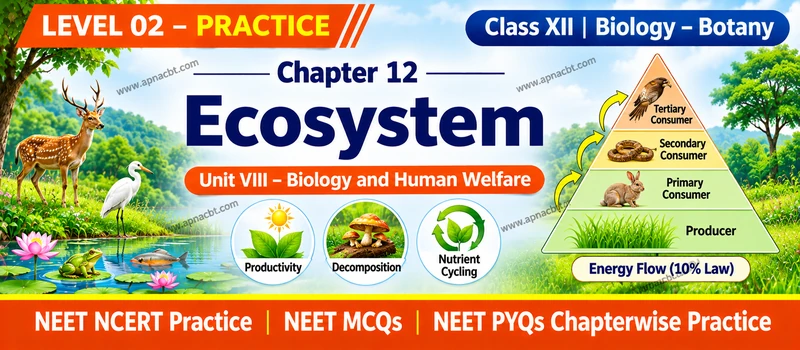
Level 02 – Practice
Class 12 Biology Practice Chapter 12: Ecosystem – NEET NCERT Practice, MCQs & PYQs | Class 12 Biology
Important Tables for Chapter Revision
NEET NCERT Practice – Ecosystem | Chapter 12
NEET NCERT Practice for Ecosystem helps Class 12 Biology students revise important NCERT concepts related to ecosystem structure, productivity, decomposition, energy flow, ecological pyramids, nutrient cycling and ecological succession. These important revision points are useful for NEET MCQs and NEET PYQs chapterwise.
1. Ecosystem Components
| Component | Important Points |
|---|---|
| Abiotic components | Physical and chemical factors such as light, temperature, water, soil and nutrients |
| Producers | Autotrophs that convert solar or chemical energy into organic matter |
| Consumers | Heterotrophic organisms that obtain food from other organisms |
| Decomposers | Organisms such as bacteria and fungi that decompose dead organic matter |
2. Important Ecosystem Functions
| Function | NEET NCERT Revision Point |
|---|---|
| Productivity | Rate of biomass production in an ecosystem |
| Decomposition | Breakdown of complex organic matter into simpler substances |
| Energy flow | Transfer of energy through different trophic levels |
| Nutrient cycling | Movement and recycling of nutrients between biotic and abiotic components |
3. Productivity – Important Terms
| Term | Meaning |
|---|---|
| Gross Primary Productivity (GPP) | Rate of production of organic matter during photosynthesis |
| Net Primary Productivity (NPP) | Primary productivity available as biomass after plant respiration |
| Secondary productivity | Rate of formation of new organic matter by consumers |
4. Decomposition – Major Steps
| Process | Important Point |
|---|---|
| Fragmentation | Detritivores break detritus into smaller particles |
| Leaching | Water-soluble substances are removed from detritus and enter the soil |
| Catabolism | Microbial enzymes break down complex organic matter |
| Humification | Formation of a dark, amorphous substance called humus |
| Mineralisation | Release of inorganic nutrients from organic matter |
5. Factors Affecting Decomposition
| Factor | Effect |
|---|---|
| Temperature | Warm and moist conditions generally favour decomposition |
| Moisture | Water availability influences microbial activity |
| Detritus quality | Material rich in lignin and chitin decomposes more slowly |
| Oxygen availability | Influences the decomposition process |
6. Energy Flow in an Ecosystem
| Trophic Level | Example |
|---|---|
| First trophic level | Producers |
| Second trophic level | Primary consumers |
| Third trophic level | Secondary consumers |
| Fourth trophic level | Tertiary consumers |
NEET NCERT Practice Point: Energy flow in an ecosystem is unidirectional. Energy enters the ecosystem mainly through producers and passes through successive trophic levels with substantial loss at each transfer.
7. Ecological Pyramids
| Pyramid | Represents | Important Point |
|---|---|---|
| Pyramid of number | Number of organisms | Shape varies according to the ecosystem |
| Pyramid of biomass | Biomass at each trophic level | Can be inverted in certain aquatic ecosystems |
| Pyramid of energy | Energy at each trophic level | Always upright |
8. Ecological Succession
| Term | Important Point |
|---|---|
| Primary succession | Begins in an area where there was no previous vegetation and soil development is absent initially |
| Secondary succession | Begins in an area where a previously existing community has been destroyed but soil remains |
| Pioneer species | First organisms to colonise a newly exposed or disturbed area |
| Climax community | Relatively stable community established at the end of succession |
9. Food Chain and Food Web
| Concept | Important Point |
|---|---|
| Food chain | Linear sequence of organisms through which food and energy are transferred |
| Grazing food chain | Begins with producers |
| Detritus food chain | Begins with dead organic matter or detritus |
| Food web | Network of interconnected food chains |
10. Important Nutrient Cycles
| Cycle | Important Reservoir / Feature |
|---|---|
| Carbon cycle | Involves movement of carbon between atmosphere, organisms and other reservoirs |
| Phosphorus cycle | Major reservoir is rocks and sediments; lacks a significant atmospheric phase |
11. High-Yield NEET NCERT Practice Points
- Producers form the first trophic level of an ecosystem.
- Decomposers play an important role in nutrient recycling.
- Energy flow through an ecosystem is unidirectional.
- Only a fraction of energy is transferred from one trophic level to the next.
- GPP is the total rate of production of organic matter by producers.
- NPP represents the biomass available to consumers after plant respiration.
- Humification results in the formation of humus.
- Mineralisation releases inorganic nutrients during decomposition.
- The pyramid of energy is always upright.
- Primary succession begins on a previously unoccupied or barren area.
- Secondary succession occurs where a previous community existed and soil is already present.
- Food webs provide greater connectivity between organisms than individual food chains.
12. NEET MCQs and NEET PYQs Chapterwise Focus
For NEET MCQs, focus on productivity, decomposition, trophic levels, energy flow, ecological pyramids, food chains, food webs, nutrient cycles and ecological succession. For NEET PYQs chapterwise, revise the NCERT terminology, sequences and important comparisons given in this chapter.
Important Formulas for Chapter Revision
NEET NCERT Practice – Important Formulas | Ecosystem
NEET NCERT Practice for Ecosystem includes a few important biological relationships and equations related to productivity, energy transfer and ecological efficiency. These are useful for solving conceptual and numerical NEET MCQs and revising NEET PYQs chapterwise.
1. Net Primary Productivity
NPP = GPP − R
| Symbol | Meaning |
|---|---|
| GPP | Gross Primary Productivity |
| R | Respiratory losses of plants |
| NPP | Net Primary Productivity |
NEET Concept: NPP is the biomass available to heterotrophs after the respiratory loss of producers.
2. Gross Primary Productivity
GPP = NPP + R
Gross primary productivity represents the total rate of organic matter production by producers before accounting for respiratory losses.
3. Energy Transfer Between Trophic Levels
Energy available at next trophic level ≈ 10% of energy available at the previous trophic level
This is commonly referred to as the 10% law. Most of the remaining energy is lost through metabolic activities, respiration and other processes.
4. Energy Transfer Formula
Enext = Eprevious × 10/100
or
Enext = 0.1 × Eprevious
| Trophic Transfer | Approximate Energy Available |
|---|---|
| Producers → Primary consumers | 10% of producer-level energy |
| Primary consumers → Secondary consumers | 10% of primary-consumer energy |
| Secondary consumers → Tertiary consumers | 10% of secondary-consumer energy |
5. Ecological Efficiency
Ecological Efficiency (%) = (Energy transferred to next trophic level / Energy available at previous trophic level) × 100
The value is approximately 10% when applying the 10% law as a simplified NEET calculation.
6. Trophic-Level Energy Relationship
En = E1 × (0.1)n−1
This relationship can be used for quick calculations when estimating energy available at successive trophic levels under the 10% transfer principle.
7. Important Formula Revision Table
| Concept | Formula / Relationship |
|---|---|
| Net primary productivity | NPP = GPP − R |
| Gross primary productivity | GPP = NPP + R |
| Energy transfer | Enext = 0.1 × Eprevious |
| Energy transfer percentage | Approximately 10% |
| Ecological efficiency | (Energy transferred / Energy available) × 100 |
8. Important NEET Concept – Energy Flow
Sun → Producers → Primary Consumers → Secondary Consumers → Tertiary Consumers
Energy flow is unidirectional. Unlike nutrients, energy is not recycled through the ecosystem.
9. High-Yield Formula Points
- NPP = GPP − R
- GPP = NPP + R
- Approximately 10% of energy is transferred to the next trophic level according to the 10% law.
- The remaining energy is largely lost through metabolic activities and respiration.
- The pyramid of energy is always upright.
- Energy flow is unidirectional, whereas nutrients undergo cycling.
10. NEET MCQs – Formula Focus
For NEET MCQs, practise calculations based on NPP, GPP, respiratory loss and the 10% energy transfer principle. Also revise the distinction between energy flow and nutrient cycling.
11. NEET PYQs Chapterwise – Formula Revision
Before attempting NEET PYQs chapterwise, revise the productivity equations, energy transfer relationship and trophic-level sequence. Understanding these relationships makes numerical, statement-based and assertion-type questions from Ecosystem easier to solve.
Level 02 – Practice
Class 11 Chemistry Practice Chapter 8: Organic Chemistry: Some Basic Principles and Techniques – NEET NCERT Practice, MCQs & PYQs | Class 11 Chemistry
Haven’t Prepared This Chapter? Study Here ↗
Chapter-wise NCERT Textbook MCQs
EASYBuild your basics with NCERT-based questions and strengthen your understanding of the chapter.
START PRACTICE →Chapter-wise MCQs
MEDIUMTest your conceptual understanding with NEET-oriented MCQs covering important concepts and applications.
START PRACTICE →Chapter-wise NEET PYQs
DIFFICULTPractice previous NEET questions from this chapter and experience the question pattern and difficulty of the actual examination.
START PYQ PRACTICE →
