


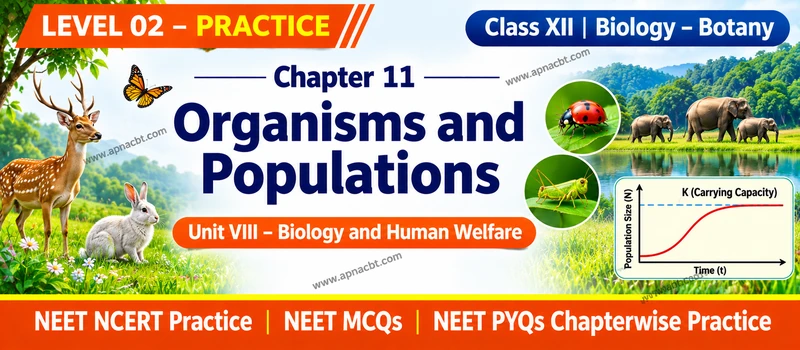
Level 02 – Practice
Class 12 Biology Practice Chapter 11: Organisms and Populations – NEET NCERT Practice, MCQs & PYQs | Class 12 Biology
Level 02 – Practice
Class 12 Biology Practice Chapter 11: Organisms and Populations – NEET NCERT Practice, MCQs & PYQs | Class 12 Biology
Important Tables for Chapter Revision
NEET NCERT Practice – Organisms and Populations | Chapter 11
NEET NCERT Practice for Organisms and Populations helps Class XII Biology students revise important NCERT concepts related to organisms, environmental factors, population attributes, population growth, adaptations and species interactions. These chapter revision points are especially useful for NEET MCQs and NEET PYQs chapterwise.
1. Important Population Attributes
| Population Attribute | Important Point |
|---|---|
| Population density | Number of individuals of a population per unit area or volume |
| Birth rate | Number of births per individual of the population per unit time |
| Death rate | Number of deaths per individual of the population per unit time |
| Sex ratio | Ratio of males to females in a population |
| Age distribution | Proportion of individuals belonging to different age groups |
| Population size | Number of individuals present in the population |
2. Important Environmental Factors
| Factor | Important Effect |
|---|---|
| Temperature | Affects enzyme activity, metabolism, survival and distribution |
| Water | Essential for physiological processes and strongly influences distribution |
| Light | Important for photosynthesis, reproduction and biological rhythms |
| Soil | Influences vegetation and distribution of organisms |
| Salinity | Important environmental factor for aquatic organisms |
3. Organisms and Their Responses
| Category | Meaning |
|---|---|
| Regulators | Maintain homeostasis by regulating internal conditions |
| Conformers | Internal conditions change with external environmental conditions |
| Migrants | Move temporarily to more favourable habitats |
| Suspenders | Reduce activity or enter a dormant state during unfavourable conditions |
4. Important Adaptations
| Organism / Example | Adaptation |
|---|---|
| Desert plants | Reduced water loss and specialised adaptations for water conservation |
| Kangaroo rat | Highly efficient water conservation |
| Desert mammals | Adaptations that minimise water loss |
| Arctic mammals | Thick fur and body insulation against low temperature |
| Allen’s rule | Shorter appendages help reduce heat loss in colder climates |
5. Population Growth Models
| Growth Model | Important Feature |
|---|---|
| Exponential growth | Occurs under unlimited resources and produces a J-shaped growth curve |
| Logistic growth | Occurs when resources become limiting and produces an S-shaped growth curve |
| Carrying capacity (K) | Maximum population size that the environment can sustain for a given period |
6. Population Interactions
| Interaction | Species A | Species B | Effect |
|---|---|---|---|
| Mutualism | + | + | Both species benefit |
| Competition | − | − | Both species are negatively affected |
| Predation | + | − | Predator benefits; prey is harmed |
| Parasitism | + | − | Parasite benefits; host is harmed |
| Commensalism | + | 0 | One benefits; the other is unaffected |
| Amensalism | − | 0 | One is harmed; the other is unaffected |
7. Important NCERT Examples of Species Interactions
| Interaction | NCERT Example |
|---|---|
| Mutualism | Lichen, mycorrhiza |
| Predation | Tiger and deer |
| Parasitism | Cuscuta and host plant |
| Commensalism | Orchid growing on a mango tree |
| Competition | Species competing for limited resources |
8. High-Yield NEET NCERT Practice Points
- Population density is an important population attribute.
- Birth rate and death rate directly influence population size.
- Age distribution can be represented using age pyramids.
- Exponential growth produces a J-shaped curve under unlimited resources.
- Logistic growth produces an S-shaped curve when environmental resistance operates.
- K represents the carrying capacity of the environment.
- Mutualism benefits both interacting species.
- Competition has a negative effect on both competing populations.
- Predation benefits the predator and negatively affects the prey.
- Parasitism benefits the parasite while harming the host.
- Commensalism benefits one species while the other remains unaffected.
9. NEET MCQs and NEET PYQs Chapterwise Focus
For NEET MCQs, concentrate on population attributes, age pyramids, exponential and logistic growth, carrying capacity, adaptations and species interactions. For NEET PYQs chapterwise, revise the NCERT examples and the positive, negative and neutral effects of each population interaction.
Important Formulas for Chapter Revision
NEET NCERT Practice – Important Formulas | Organisms and Populations
NEET NCERT Practice for Organisms and Populations includes important population growth equations that are frequently useful for NEET MCQs and NEET PYQs chapterwise. Revise the symbols, conditions and meaning of each equation carefully.
1. Population Density
Population Density = Number of individuals / Unit area or volume
Population density represents the number of individuals of a population present per unit area or volume.
2. Population Change
Nt+1 = Nt + B + I − D − E
| Symbol | Meaning |
|---|---|
| Nt | Population density at time t |
| Nt+1 | Population density at the next time interval |
| B | Births |
| I | Immigration |
| D | Deaths |
| E | Emigration |
Quick relationship: Population increase = Births + Immigration − Deaths − Emigration
3. Exponential Growth
dN/dt = rN
The exponential growth equation describes population growth when resources are effectively unlimited.
The integrated form is:
Nt = N0ert
| Symbol | Meaning |
|---|---|
| Nt | Population size at time t |
| N0 | Initial population size |
| r | Intrinsic rate of natural increase |
| t | Time |
| e | Base of natural logarithms |
Growth curve: Exponential growth produces a J-shaped curve.
4. Intrinsic Rate of Natural Increase
r = b − d
| Symbol | Meaning |
|---|---|
| r | Intrinsic rate of natural increase |
| b | Per capita birth rate |
| d | Per capita death rate |
NEET Concept: When birth rate exceeds death rate, the population has the potential to increase, assuming other population processes are not offsetting the increase.
5. Logistic Growth
dN/dt = rN[(K − N)/K]
The logistic growth equation considers environmental resistance and limited resources.
| Symbol | Meaning |
|---|---|
| N | Population size |
| r | Intrinsic rate of natural increase |
| K | Carrying capacity |
| t | Time |
Growth curve: Logistic growth produces an S-shaped curve.
6. Carrying Capacity
K = Carrying Capacity
Carrying capacity is the maximum population size that the environment can sustain for a given period with the available resources and environmental conditions.
NEET revision: As population size approaches K, population growth slows because environmental resistance and resource limitation become increasingly important.
7. Population Growth – Quick Comparison
| Feature | Exponential Growth | Logistic Growth |
|---|---|---|
| Resources | Unlimited or effectively unlimited | Limited |
| Environmental resistance | Not considered in the ideal model | Considered |
| Curve | J-shaped | S-shaped |
| Carrying capacity | Not incorporated | Incorporated as K |
8. Important Population Interaction Symbols
The symbols below are important for NEET MCQs:
| Interaction | Effect |
|---|---|
| Mutualism | (+ , +) |
| Competition | (− , −) |
| Predation | (+ , −) |
| Parasitism | (+ , −) |
| Commensalism | (+ , 0) |
| Amensalism | (− , 0) |
9. High-Yield Formula Revision
- Population change: Births + Immigration − Deaths − Emigration
- Intrinsic rate: r = b − d
- Exponential growth: dN/dt = rN
- Exponential population size: Nt = N0ert
- Logistic growth: dN/dt = rN[(K − N)/K]
- K: Carrying capacity
- Exponential growth curve: J-shaped
- Logistic growth curve: S-shaped
10. NEET MCQs – Formula Focus
For NEET MCQs, practise identifying the correct equation from the population growth conditions. Pay particular attention to the difference between exponential and logistic growth, the meaning of r, and the role of K as carrying capacity.
11. NEET PYQs Chapterwise – Formula Revision
Before attempting NEET PYQs chapterwise, revise the population change equation, exponential growth equation, logistic growth equation, intrinsic rate of natural increase and population interaction symbols. These concepts form an important numerical and conceptual revision base for NEET NCERT Practice.
Haven’t Prepared This Chapter? Study Here ↗
Chapter-wise NCERT Textbook MCQs
EASYBuild your basics with NCERT-based questions and strengthen your understanding of the chapter.
START PRACTICE →Chapter-wise MCQs
MEDIUMTest your conceptual understanding with NEET-oriented MCQs covering important concepts and applications.
START PRACTICE →Chapter-wise NEET PYQs
DIFFICULTPractice previous NEET questions from this chapter and experience the question pattern and difficulty of the actual examination.
START PYQ PRACTICE →
