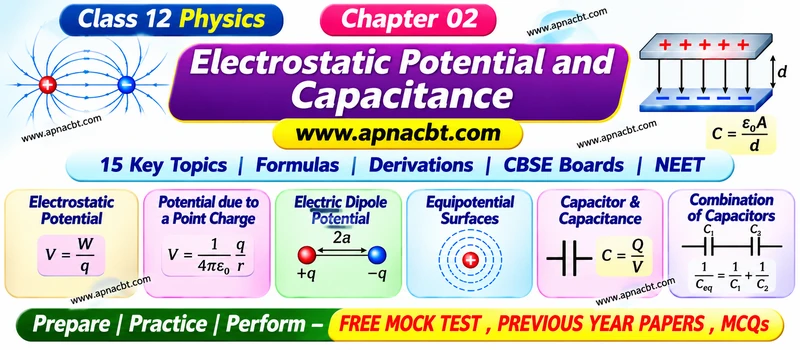
Electrostatic Potential and Capacitance is an important Class 12 Physics chapter for CBSE Board Exams, school examinations and NEET preparation for CBSE Board Exams and NEET preparation. This lesson covers electrostatic potential, potential difference, electric dipole potential, equipotential surfaces, potential energy, conductors, dielectrics, capacitors, capacitance, capacitor combinations and energy stored in a capacitor with exam-focused concepts and formulas.
Image SEO: When adding the lesson image, use the focus keyword Electrostatic Potential and Capacitance naturally in the image alternative text.
Lesson focus: Build strong conceptual understanding of Electrostatic Potential and Capacitance and numerical problem-solving skills for Electrostatic Potential and Capacitance. The sequence follows the NCERT chapter from electrostatic potential through capacitors and stored energy.
Electrostatic Potential and Capacitance – Exam Preparation Guide
Electrostatic Potential and Capacitance is a high-value Class 12 Physics topic for concept building, numerical practice and board-exam derivations. Use this lesson together with the other Physics preparation resources on APNA CBT.
For the prescribed NCERT framework, students can also refer to the NCERT textbook resources. Focus on definitions, derivations, diagrams, formula application, sign conventions and capacitor case-based questions.
Quick Navigation – 15 Key Topics
- Electrostatic Potential and Potential Difference
- Potential due to a Point Charge
- Potential due to an Electric Dipole
- Potential due to a System of Charges
- Equipotential Surfaces
- Relation between Electric Field and Potential
- Potential Energy of a System of Charges
- Potential Energy of an Electric Dipole
- Electrostatics of Conductors
- Dielectrics and Polarisation
- Capacitors and Capacitance
- Parallel Plate Capacitor
- Effect of Dielectric on Capacitance
- Combination of Capacitors
- Energy Stored in a Capacitor
1. Electrostatic Potential and Capacitance: Potential and Potential Difference
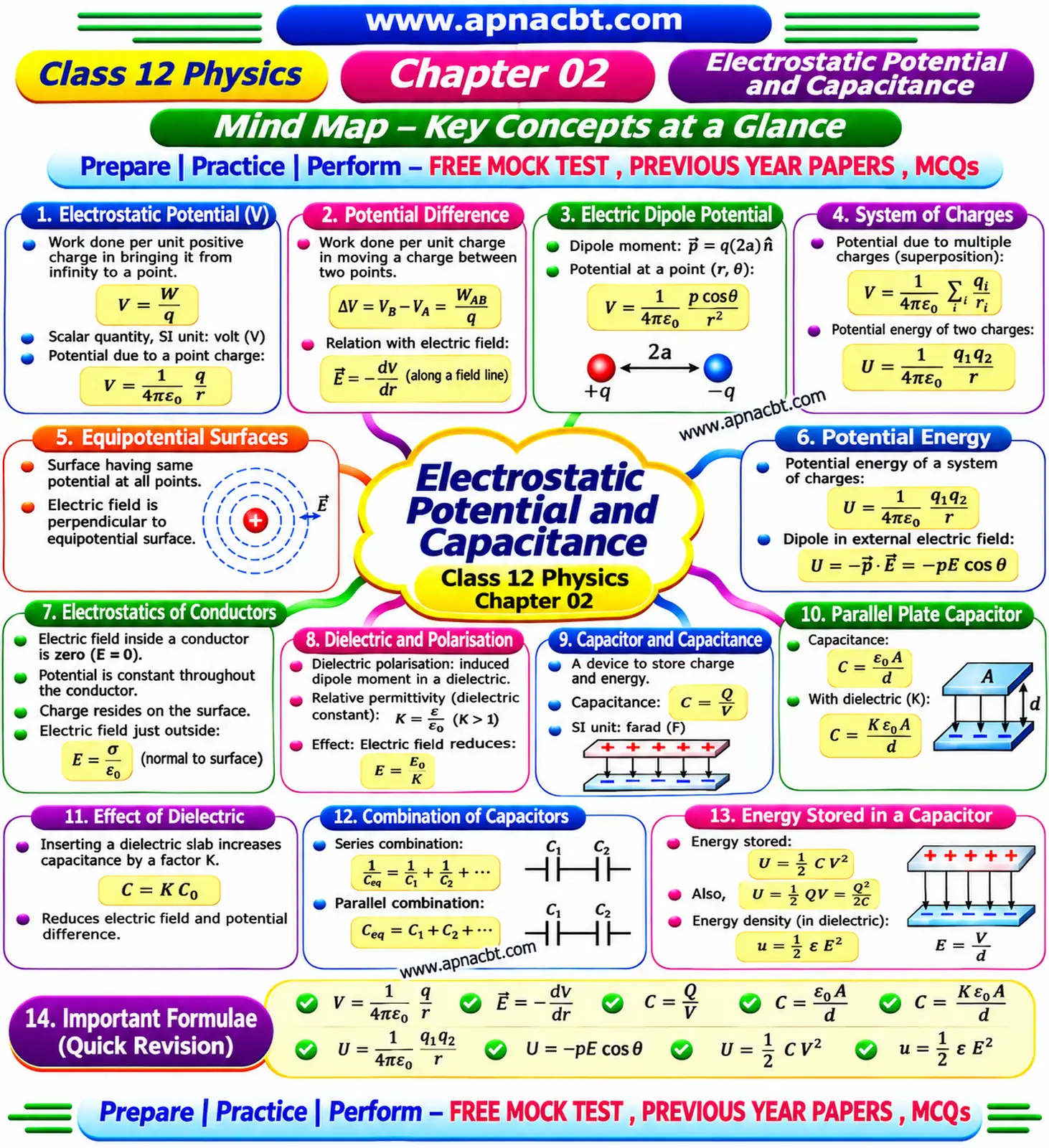
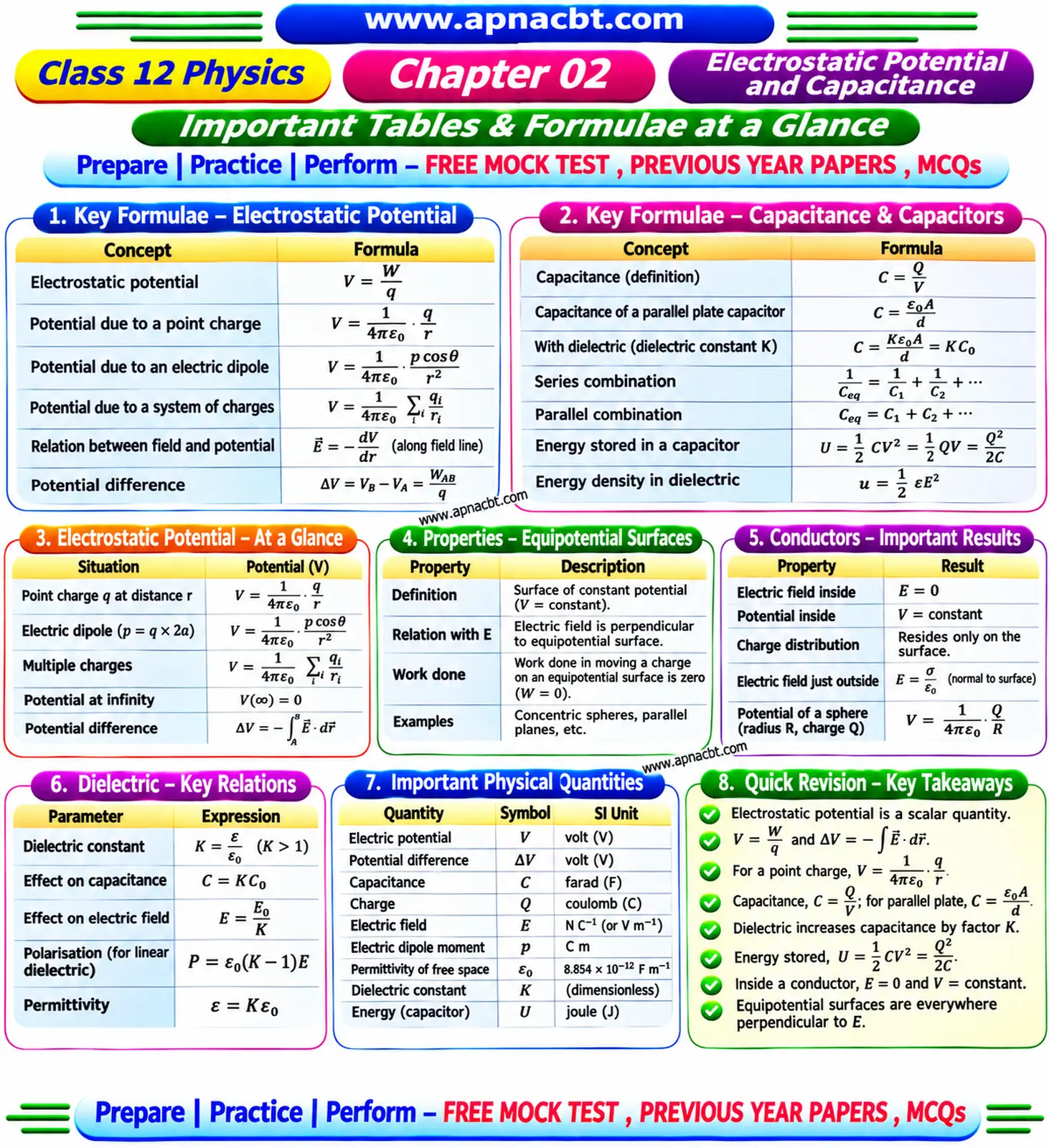
Electrostatic potential at a point is the work done by an external force in bringing a unit positive test charge from infinity to that point, taking infinity as the zero-potential reference. Potential is a scalar quantity and its SI unit is volt. Potential difference between two points is the work done per unit positive test charge in moving it between the points against the electrostatic force. Since electrostatic force is conservative, the work depends only on the initial and final points.
- Potential: V = W/q.
- Potential difference is physically significant; the absolute reference may be chosen conveniently.
- 1 volt = 1 joule per coulomb.
- For CBSE, learn the definition and sign convention. For NEET, practise direct potential-difference questions.
2. Potential due to a Point Charge
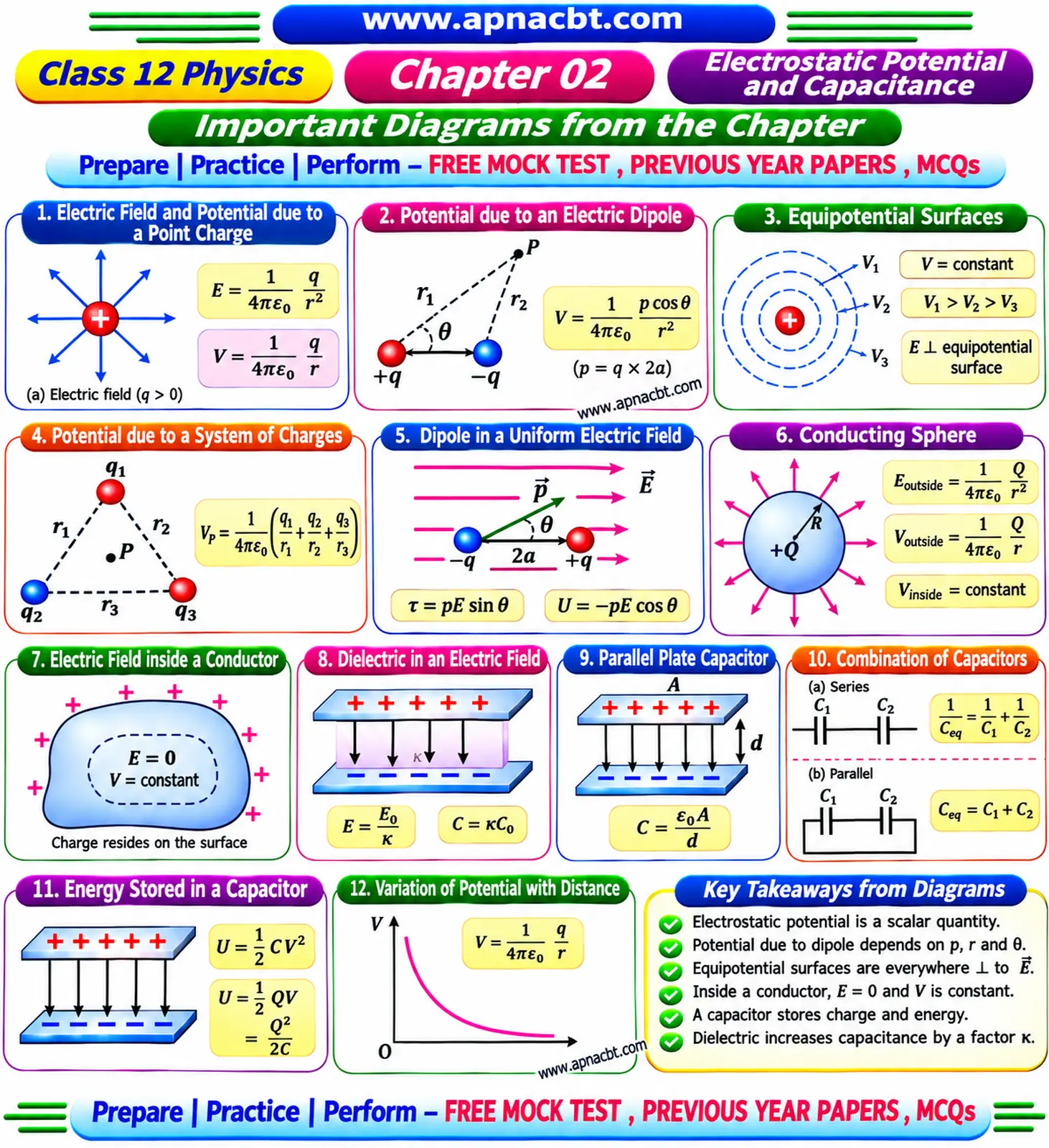
For a point charge q, the potential at distance r from the charge, with zero potential at infinity, is V = (1/4πε0)(q/r). The potential is positive for a positive charge and negative for a negative charge. It varies inversely with distance and, unlike electric field, has no direction.
Key formula: V = (1/4πε0)(q/r). For an isolated spherical conductor, the external potential is equivalent to that of a point charge at its centre.
3. Potential due to an Electric Dipole
An electric dipole consists of equal and opposite charges separated by a small distance. Its dipole moment is p = q(2a), directed from the negative charge to the positive charge. For a short dipole, V = (1/4πε0)(p cosθ/r2). Therefore dipole potential depends on distance and angular position.
- Axial position: V = ±(1/4πε0)(p/r2).
- Equatorial position: V = 0.
- At large distance, dipole potential varies as 1/r2.
4. Potential due to a System of Charges
By superposition, the total potential at a point due to a system of charges is the algebraic sum of the individual potentials. Since potential is scalar, vector addition is unnecessary.
Formula: V = (1/4πε0) Σ(qi/ri). Preserve the sign of each charge in numerical problems.
5. Equipotential Surfaces
An equipotential surface is a surface on which electric potential is the same at every point. No work is done in moving a test charge along it because ΔV = 0. The electric field is always perpendicular to an equipotential surface.
- Equipotential surfaces never intersect.
- Closer surfaces indicate a stronger electric field.
- For a point charge they are concentric spheres.
- For a uniform field they are parallel planes perpendicular to the field.
6. Relation between Electric Field and Potential
Electric field and potential are related by dV = −E·dl. In one dimension, E = −dV/dr. The negative sign indicates that electric field points towards decreasing potential. For a uniform field, the magnitude is E = |ΔV|/d when the potential changes uniformly along the field.
Exam focus: know that electric field is the negative gradient of potential and potential is scalar.
7. Potential Energy of a System of Charges
Electrostatic potential energy is the work required to assemble a charge configuration from infinity. For two point charges q1 and q2 separated by r, U = (1/4πε0)(q1q2/r). For many charges, add the pairwise interaction energies.
- Like charges contribute positive potential energy.
- Unlike charges contribute negative potential energy.
- For a charge q in an external potential V, U = qV.
8. Potential Energy of an Electric Dipole in an External Field
A dipole in a uniform electric field experiences torque that tends to align its dipole moment with the field. Its potential energy is U = −p·E = −pE cosθ.
- θ = 0°: U = −pE, minimum and stable equilibrium.
- θ = 90°: U = 0.
- θ = 180°: U = +pE, maximum and unstable equilibrium.
- Torque magnitude: τ = pE sinθ.
9. Electrostatics of Conductors
In electrostatic equilibrium, the electric field inside conducting material is zero because free charges rearrange until no net internal force remains. Excess charge resides on the surface and the conductor is an equipotential body. The electric field immediately outside a charged conductor is normal to the surface.
- Inside conductor: E = 0.
- Potential throughout the conductor is constant.
- Surface field is normal to the conductor.
- Surface charge density is greater near sharp regions of a conductor.
10. Dielectrics and Polarisation
A dielectric is an insulating material that becomes polarised in an external electric field. Its bound charges shift slightly, producing an induced field that opposes the applied field. The net field is reduced compared with vacuum.
The dielectric constant K is dimensionless. For a fully filled capacitor, K = C/C0, and the permittivity is ε = Kε0. Polarisation involves bound charges rather than free conduction charges.
11. Electrostatic Potential and Capacitance: Capacitors and Capacitance
A capacitor is a system of two conductors separated by an insulator. If the conductors carry equal and opposite charges ±Q and have potential difference V, capacitance is C = Q/V. For fixed geometry and dielectric, C does not directly depend on Q or V.
- SI unit: farad (F).
- Isolated spherical conductor in vacuum: C = 4πε0R.
- Capacitance depends on geometry and dielectric medium.
12. Parallel Plate Capacitor
For a parallel plate capacitor with plate area A and separation d, neglecting edge effects, C = ε0A/d in vacuum. With a dielectric completely filling the gap, C = Kε0A/d = εA/d.
- C is directly proportional to A.
- C is inversely proportional to d.
- C increases K times when a dielectric fully fills the gap.
- A conducting slab of thickness t inside the gap has zero electric field within the slab and reduces the field-filled separation to d − t.
13. Effect of Dielectric on Capacitance
When a dielectric completely occupies the space between capacitor plates, capacitance becomes K times its vacuum value. The effect on charge, voltage and energy depends on whether the battery remains connected.
- Battery connected: V constant, C becomes KC, Q becomes KQ and U becomes KU.
- Battery disconnected: Q constant, C becomes KC, V becomes V/K and U becomes U/K.
14. Combination of Capacitors
In a series combination, every capacitor carries the same charge and potential differences add. In a parallel combination, potential difference is common and charges add.
- Series: 1/Ceq = 1/C1 + 1/C2 + …; for n identical capacitors Ceq = C/n.
- Parallel: Ceq = C1 + C2 + …; for n identical capacitors Ceq = nC.
- Series equivalent is smaller than the smallest capacitor.
- Parallel equivalent is larger than the largest capacitor.
15. Electrostatic Potential and Capacitance: Energy Stored in a Capacitor
During charging, work is done against the repulsion of the charge already stored. The energy stored is U = 1/2 QV = 1/2 CV² = Q²/(2C). For a linear dielectric medium, electrostatic energy density is u = 1/2 εE².
- U = 1/2 CV² = 1/2 QV = Q²/(2C).
- u = 1/2 εE².
- With a disconnected battery, Q remains fixed during dielectric insertion.
- With an ideal connected battery, V remains fixed.
16. Short Questions – 30 Questions with Detailed Answers
1. Define electrostatic potential.
Answer: It is the work done by an external force in bringing a unit positive test charge from infinity to a point, taking infinity as zero potential.
2. What is the SI unit of potential?
Answer: The SI unit is volt, equal to joule per coulomb.
3. Why is electrostatic potential a scalar?
Answer: It has magnitude and sign but no direction, so potentials add algebraically.
4. Write the potential due to a point charge.
Answer: V = (1/4πε0)(q/r), with zero potential at infinity.
5. What is an equipotential surface?
Answer: It is a surface on which electric potential has the same value at every point.
6. Why is no work done along an equipotential surface?
Answer: The potential difference is zero, so work qΔV is zero.
7. State the relation between electric field and potential.
Answer: E = −∇V; in one dimension E = −dV/dr.
8. Define electric dipole moment.
Answer: p = q(2a), directed from the negative charge to the positive charge.
9. What is the dipole potential on the equatorial plane?
Answer: It is zero because the potentials due to equal and opposite charges cancel.
10. How does dipole potential vary at large distance?
Answer: For a short dipole it varies as 1/r².
11. State superposition for potential.
Answer: Total potential is the algebraic sum of potentials due to all individual charges.
12. Write potential energy of two point charges.
Answer: U = (1/4πε0)(q1q2/r).
13. What is dipole potential energy in a uniform field?
Answer: U = −pE cosθ.
14. When is dipole potential energy minimum?
Answer: At θ = 0°, when p is parallel to E.
15. What is the electric field inside a conductor in electrostatic equilibrium?
Answer: It is zero.
16. What is capacitance?
Answer: Capacitance is C = Q/V, the charge-to-potential-difference ratio.
17. State the SI unit of capacitance.
Answer: The SI unit is farad (F).
18. Write the capacitance of an isolated spherical conductor.
Answer: In vacuum, C = 4πε0R.
19. Write the parallel plate capacitance in vacuum.
Answer: C = ε0A/d, neglecting edge effects.
20. What happens if plate area is doubled?
Answer: Capacitance doubles because C is directly proportional to A.
21. What happens if plate separation is doubled?
Answer: Capacitance becomes half because C is inversely proportional to d.
22. What is dielectric constant?
Answer: K = ε/ε0 and, for a fully filled capacitor, K = C/C0.
23. What happens when a dielectric fully fills the gap?
Answer: Capacitance increases K times.
24. Give the series formula for capacitors.
Answer: 1/Ceq = 1/C1 + 1/C2 + … .
25. Give the parallel formula for capacitors.
Answer: Ceq = C1 + C2 + … .
26. Equivalent capacitance of n identical capacitors in series?
Answer: Ceq = C/n.
27. Equivalent capacitance of n identical capacitors in parallel?
Answer: Ceq = nC.
28. Write energy stored in a capacitor.
Answer: U = 1/2 CV² = 1/2 QV = Q²/(2C).
29. Write energy density of an electric field.
Answer: u = 1/2 εE².
30. What changes when a dielectric is inserted into an isolated charged capacitor?
Answer: Q remains constant, C becomes KC, V becomes V/K and U becomes U/K.
17. Long Questions – 15 Questions with Detailed Answers
1. Explain electrostatic potential and potential difference and derive the potential due to a point charge.
Detailed Answer: Electrostatic potential is work per unit positive test charge from infinity. For a point charge, integrating E = (1/4πε0)(q/r²) from infinity to r gives V = (1/4πε0)(q/r). Potential difference is work per unit charge between two points. Potential is scalar and depends on the chosen reference.
2. Derive the potential of a short electric dipole.
Detailed Answer: Add the potentials of +q and −q at a distant point. For r much greater than a, the algebraic sum gives V = (1/4πε0)(p cosθ/r²), where p = 2aq. At θ = 90°, the potential is zero.
3. Explain equipotential surfaces and their relation with electric field.
Detailed Answer: An equipotential surface has constant V. Moving a charge along it gives zero work. From dV = −E·dl, the field has no tangential component and is perpendicular to the surface. Closer surfaces represent stronger fields.
4. Explain potential energy of a system of point charges.
Detailed Answer: It is the work required to assemble the configuration from infinity. For two charges U = (1/4πε0)(q1q2/r). For many charges, sum the energy of every distinct pair. Like charges give positive and unlike charges negative pair energy.
5. Derive potential energy of a dipole in a uniform field.
Detailed Answer: The torque is τ = pE sinθ. Integrating the work required to rotate the dipole gives U = −pE cosθ. Energy is minimum at θ = 0° and maximum at θ = 180°.
6. Explain properties of a conductor in electrostatic equilibrium.
Detailed Answer: The field inside the conducting material is zero, excess charge resides on the surface, and the conductor is equipotential. The external field immediately outside is normal to the surface. These results follow from redistribution of free charges.
7. Explain dielectric polarisation and dielectric constant.
Detailed Answer: A dielectric polarises in an external field because bound charges shift slightly. The induced field opposes the applied field. The dielectric constant is K = ε/ε0 and, for a fully filled capacitor, K = C/C0.
8. Derive the capacitance of a parallel plate capacitor.
Detailed Answer: For area A and separation d, E = σ/ε0 and V = Ed = Qd/(ε0A). Since C = Q/V, C = ε0A/d. With a dielectric, C = Kε0A/d.
9. Explain dielectric insertion when the battery remains connected.
Detailed Answer: The battery keeps V constant. If C changes to KC, then Q = CV becomes KQ and U = 1/2 CV² becomes KU. Thus capacitance, charge and stored energy increase by factor K.
10. Explain dielectric insertion into an isolated charged capacitor.
Detailed Answer: The isolated capacitor keeps Q constant. If C becomes KC, V = Q/C becomes V/K and U = Q²/(2C) becomes U/K. No charge flows from the isolated capacitor.
11. Derive equivalent capacitance for capacitors in series.
Detailed Answer: Series capacitors carry the same charge Q and total potential is V = ΣVi = QΣ(1/Ci). Hence 1/Ceq = Σ(1/Ci).
12. Derive equivalent capacitance for capacitors in parallel.
Detailed Answer: Parallel capacitors have common V. Total charge is Q = ΣQi = VΣCi. Therefore Ceq = ΣCi.
13. Derive energy stored in a capacitor.
Detailed Answer: For an incremental charge dq, dW = Vdq = (q/C)dq. Integrating from zero to Q gives U = Q²/(2C). Using Q = CV gives U = 1/2 QV = 1/2 CV².
14. Derive energy density of an electric field.
Detailed Answer: For a parallel plate capacitor U = 1/2 CV². Substituting C = εA/d and V = Ed gives U = 1/2 εE²Ad. Dividing by volume Ad gives u = 1/2 εE².
15. Compare battery-connected and isolated capacitors when a dielectric is inserted.
Detailed Answer: Battery connected: V constant, C becomes KC, Q becomes KQ and U becomes KU. Battery disconnected: Q constant, C becomes KC, V becomes V/K and U becomes U/K. This distinction is important in numerical problems.
Electrostatic Potential and Capacitance – Formula Checklist
- Point charge: V = (1/4πε0)(q/r)
- Short dipole: V = (1/4πε0)(p cosθ/r²)
- Two-charge energy: U = (1/4πε0)(q1q2/r)
- Dipole energy: U = −pE cosθ
- Capacitance: C = Q/V
- Parallel plate: C = ε0A/d; with dielectric C = Kε0A/d
- Series: 1/Ceq = Σ(1/Ci)
- Parallel: Ceq = ΣCi
- Stored energy: U = 1/2 CV² = 1/2 QV = Q²/(2C)
- Energy density: u = 1/2 εE²
Revise the NCERT concepts first, then practise chapter-wise CBSE and NEET numerical questions for speed and accuracy. Continue your Physics preparation on APNA CBT.