

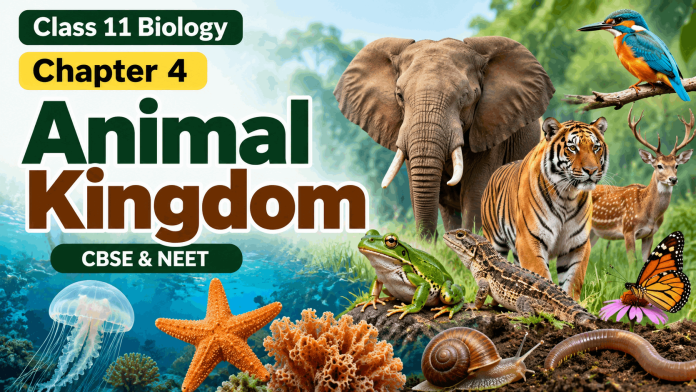
Animal Kingdom
NCERT Class 11 Biology | CBSE | NEET-UG Preparation
Study the basis of animal classification, the major non-chordate phyla, chordate characteristics and vertebrate classes. Revise important definitions, identifying features, examples and comparisons for CBSE examinations and NEET-UG.
Annelida and Arthropoda
Phylum Annelida
- They are bilaterally symmetrical, triploblastic and coelomate.
- The body shows metameric segmentation.
- Longitudinal and circular muscles assist movement.
- Nephridia perform excretion and osmoregulation.
- A closed circulatory system is generally present.
- Parapodia help locomotion in Nereis.
Examples: Nereis, Pheretima and Hirudinaria.
Phylum Arthropoda
Arthropoda is the largest phylum of Kingdom Animalia.
- The body is segmented and has jointed appendages.
- A chitinous exoskeleton covers the body.
- The circulatory system is open.
- Respiration occurs through gills, book gills, book lungs or tracheae, depending on the group.
- Malpighian tubules perform excretion in many terrestrial arthropods.
- Sensory structures may include antennae and compound eyes.
Examples: Apis, Bombyx, Anopheles, Palaemon, spiders and scorpions.
| Feature | Annelida | Arthropoda |
|---|---|---|
| Segmentation | Metameric segmentation is prominent. | Segments may be grouped into body regions. |
| Appendages | Jointed appendages absent in typical examples. | Jointed appendages present. |
| Circulation | Closed system generally present. | Open system. |
| Excretion | Nephridia | Malpighian tubules in many terrestrial forms |
| Examples | Earthworm, Nereis | Cockroach, prawn, honeybee |
NEET focus: Remember the jointed appendages, chitinous exoskeleton and open circulatory system of Arthropoda.