Atoms Class 12 Physics – Level 01 Preparation for CBSE Board Exams & NEET
Atoms Class 12 Physics is a complete Level 01 study lesson based primarily on the NCERT Chapter 12: Atoms. It explains atomic models, Rutherford alpha-particle scattering, the nuclear model, hydrogen spectral series, Bohr’s postulates, energy levels, ionisation, hydrogen-like atoms and de Broglie standing waves. The lesson is designed for concept building before chapter-wise MCQs, previous-year questions and mock tests.
For CBSE Board preparation, focus on definitions, explanations, derivations, diagrams and reasoning. For NEET preparation, focus on formulas, energy-level transitions, spectral series, hydrogenic scaling and quick numerical applications. This structured Atoms Class 12 Physics lesson keeps the progression from classical atomic models to Bohr’s quantum ideas clear.
Table of Contents
- Atomic Structure and the Need for Atomic Models
- Rutherford Alpha-Particle Scattering Experiment
- Rutherford Model: Successes and Limitations
- Atomic Spectra and Hydrogen Spectral Series
- Bohr Model of the Hydrogen Atom
- Bohr Orbit Radius, Speed and Energy
- Energy Levels, Excitation and Ionisation
- Rydberg Formula and Hydrogen Spectral Series
- Hydrogen-Like Atoms and Scaling with Z
- de Broglie Explanation of Bohr Quantisation
- Comparison of Thomson, Rutherford and Bohr Models
- CBSE Board and NEET High-Yield Revision
- Short Questions – 30 Questions with Detailed Answers
- Long Questions – 15 Questions with Detailed Answers
Atomic Structure and the Need for Atomic Models
Atoms Class 12 Physics begins with the question of how positive charge and electrons are arranged inside an atom. The chapter follows the historical development from Thomson’s model to Rutherford’s nuclear model and finally to Bohr’s model for hydrogen-like atoms.
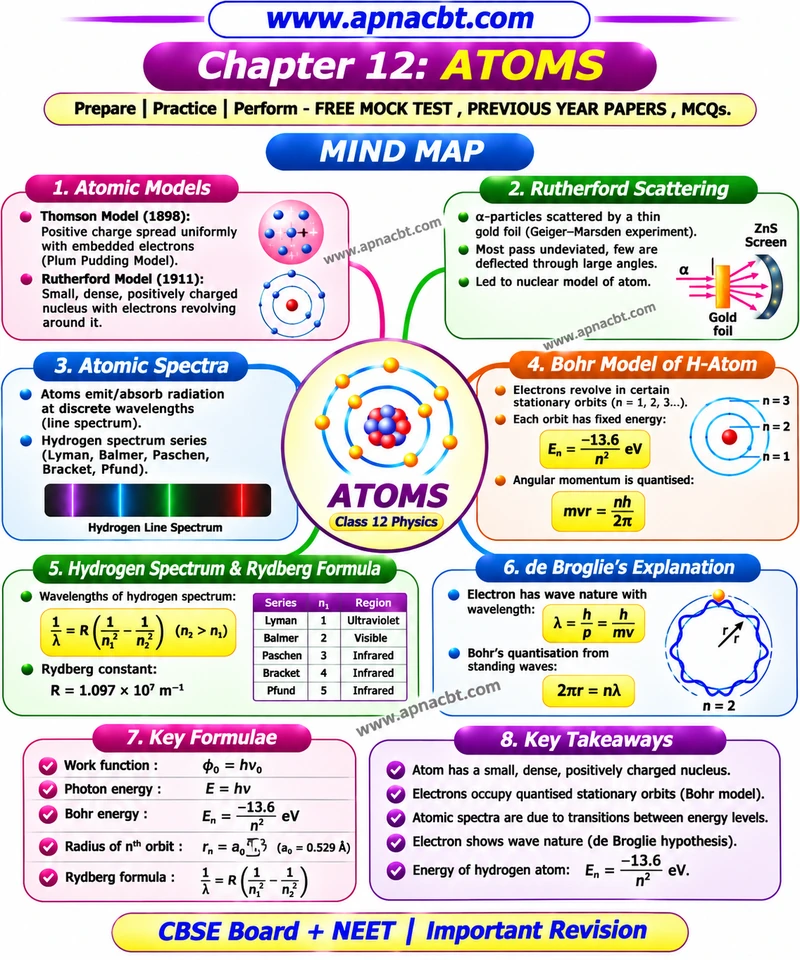
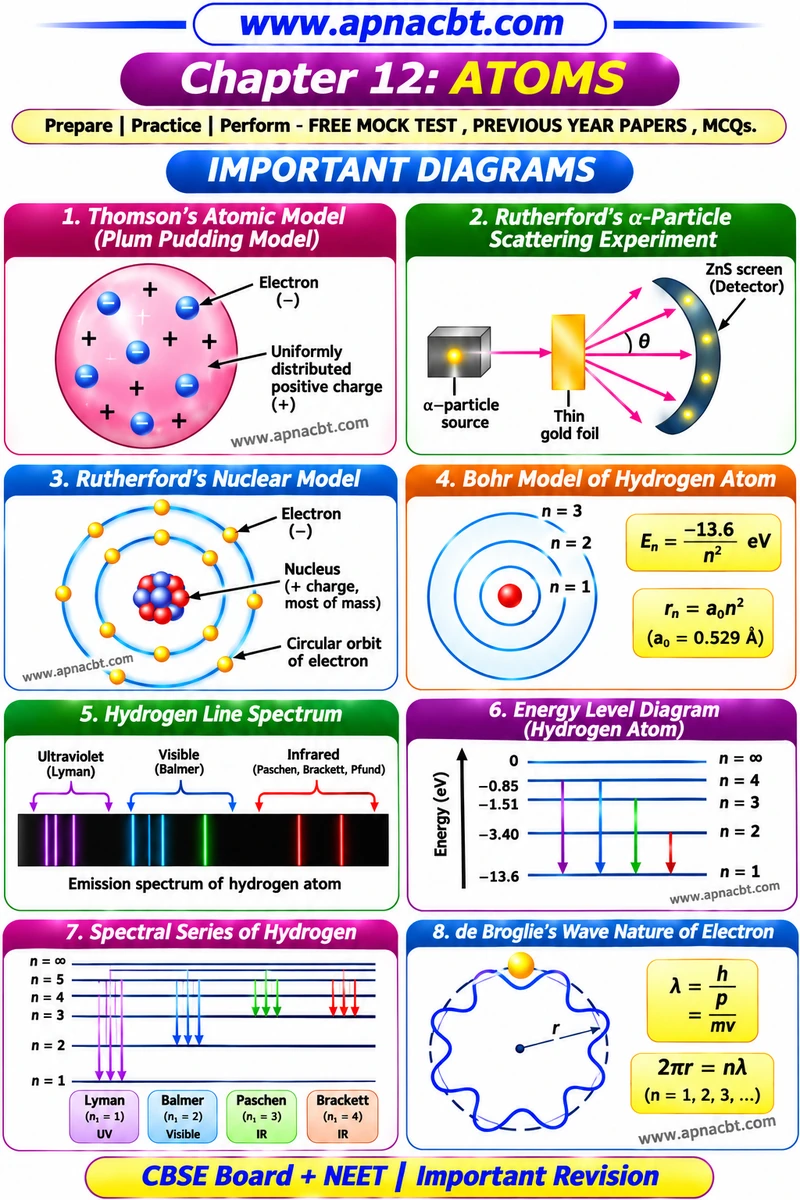
J. J. Thomson’s experiments on electric discharge through gases established the electron as a common negatively charged constituent of atoms. Since atoms are electrically neutral, positive charge must also be present. Thomson proposed a model in which positive charge was distributed throughout the atom and electrons were embedded in it.
Later scattering experiments showed that this picture was inadequate. Rutherford’s nuclear model placed almost all positive charge and most of the mass in a tiny nucleus, with electrons occupying the much larger surrounding region. This was a major step toward the modern understanding of atomic structure.
CBSE + NEET focus: Remember the sequence Thomson model → Rutherford scattering → nuclear model → Bohr model → hydrogen spectrum. Questions often test the limitation of one model and the feature introduced by the next.
Rutherford Alpha-Particle Scattering Experiment
Atoms Class 12 Physics exam preparation should connect this concept with the hydrogen spectrum and quantised energy levels.
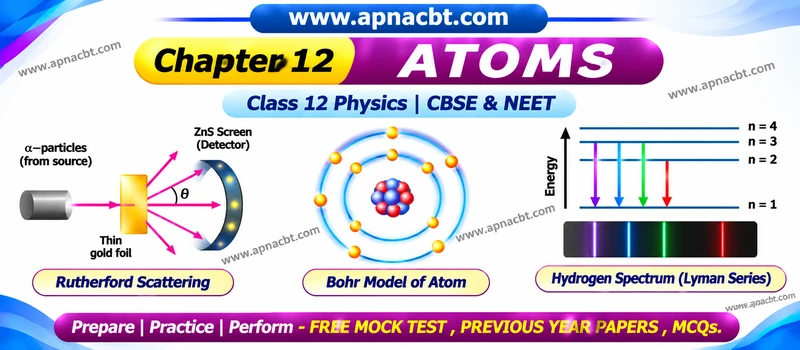
Rutherford, Geiger and Marsden studied the scattering of alpha particles from a thin gold foil. Alpha particles are positively charged helium nuclei. The experimental arrangement used a radioactive alpha source, a thin gold foil and a fluorescent screen to detect scattered particles.
Most alpha particles passed through the foil without significant deflection. A small fraction were deflected through appreciable angles, and a very small fraction were scattered backward. These observations could not be explained if positive charge were spread uniformly through the atom.
The observations led to the nuclear model: the positive charge and nearly all the mass are concentrated in a very small nucleus, while electrons occupy the surrounding space. The chapter notes that nuclear size is of order 10−15 to 10−14 m whereas atomic size is of order 10−10 m, so most of the atom is empty space.
Exam point: A large-angle deflection occurs when an alpha particle passes close to the positively charged nucleus. Atomic electrons are too light to appreciably affect the alpha-particle trajectory in this experiment.
Rutherford Model: Successes and Limitations
The Rutherford model successfully explained the existence of a tiny dense nucleus and the fact that most of the atom is empty space. It also gave a natural explanation for large-angle alpha-particle scattering.
However, classical electromagnetic theory creates a serious stability problem. An electron moving in a circular orbit is accelerated. A classical accelerating charge should radiate electromagnetic energy, lose orbital energy and spiral toward the nucleus. Stable atoms would therefore not exist under the classical picture.
The Rutherford model also could not explain why atoms emit characteristic line spectra rather than a continuous range of frequencies. These limitations motivated the introduction of quantisation into atomic theory.
For Atoms Class 12 Physics, distinguish the two major limitations clearly: atomic stability and line spectra. These are frequent conceptual questions.
Atomic Spectra and Hydrogen Spectral Series
Atoms Class 12 Physics exam preparation should connect this concept with the hydrogen spectrum and quantised energy levels.
Atoms Class 12 Physics connects atomic structure with spectroscopy. When excited atoms emit radiation, the spectrum contains discrete lines rather than a continuous distribution. Each element has a characteristic spectrum, so spectral lines can act as a fingerprint for identifying a substance.
An emission spectrum consists of bright lines on a dark background. An absorption spectrum contains dark lines at wavelengths absorbed from an otherwise continuous spectrum. For hydrogen, the lines are grouped into spectral series.
The Balmer series lies in the visible region. Its empirical wavelength relation is 1/λ = R(1/22 − 1/n2), where n = 3, 4, 5, … and R ≈ 1.097 × 10⁷ m−1. The Hα line is about 656.3 nm and the series limit is about 364.6 nm.
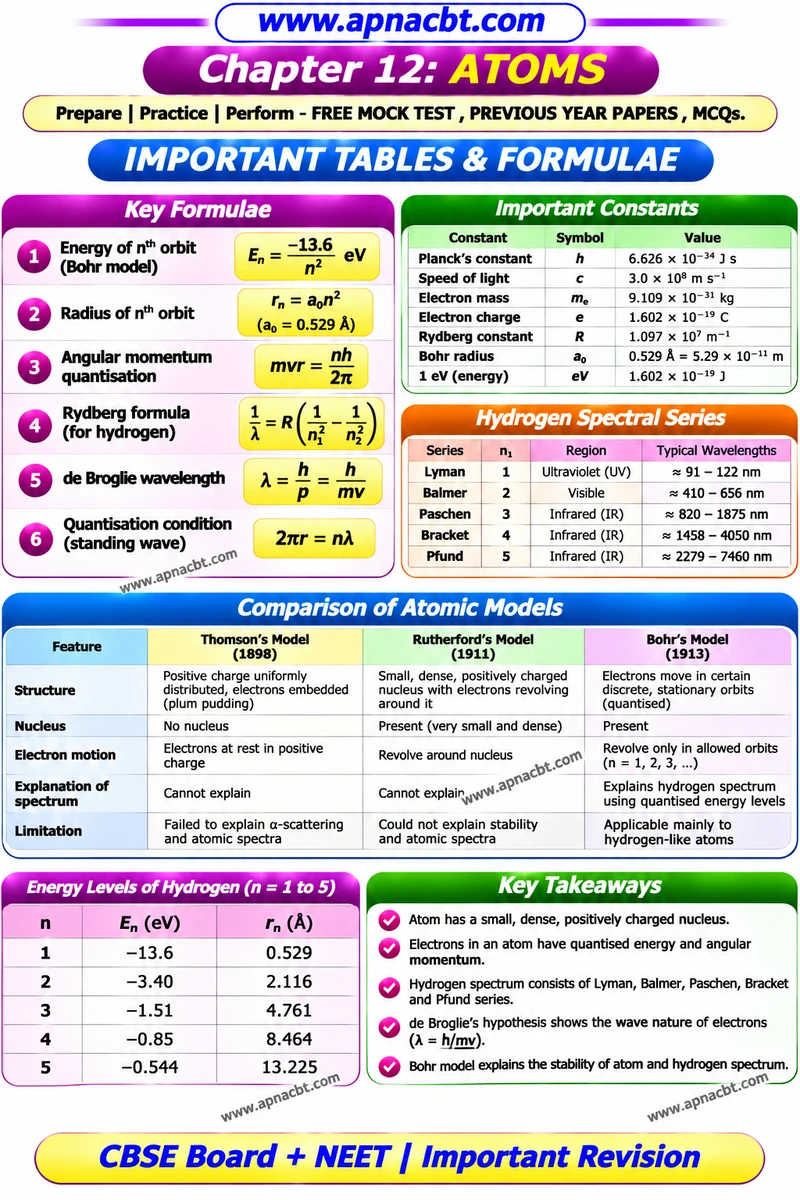
Other hydrogen series are Lyman (nf = 1), Balmer (nf = 2), Paschen (nf = 3), Brackett (nf = 4) and Pfund (nf = 5). Lyman lies in the ultraviolet region, while Paschen and Brackett are in the infrared region.
Bohr Model of the Hydrogen Atom
Niels Bohr combined Rutherford’s nuclear picture with early quantum ideas. The Bohr model is designed for hydrogen and hydrogen-like atoms containing a single electron around a positively charged nucleus.
First postulate: an electron can occupy certain stable stationary orbits without continuously radiating energy. Each allowed orbit corresponds to a definite energy.
Second postulate: the angular momentum of the electron is quantised: L = mvr = nh/(2π), where n = 1, 2, 3, … is the principal quantum number.
Third postulate: radiation is emitted or absorbed only when an electron makes a transition between stationary states. For emission, hν = Ei − Ef; for absorption, the atom gains the same energy difference.
The Bohr model explains why hydrogen has discrete spectral lines and why the atom can have stable stationary states. Its limitations should also be remembered: it does not successfully describe multi-electron atoms and is not the complete quantum-mechanical description.
Bohr Orbit Radius, Speed and Energy
Atoms Class 12 Physics exam preparation should connect this concept with the hydrogen spectrum and quantised energy levels.
For a hydrogen atom, the electron is attracted to the nucleus by Coulomb force. Equating the electrostatic force to the centripetal force and applying the angular-momentum condition gives the allowed orbit sizes.
The radius of the nth orbit is rn = a0n2, where a0 is the Bohr radius, approximately 0.529 Å. Thus the orbit radius increases as n2.
The electron speed varies inversely with n: vn ∝ 1/n. Therefore, higher stationary states have larger radius and lower orbital speed.
The total energy of the nth hydrogen state is En = −13.6/n2 eV. The ground state has E1 = −13.6 eV. The negative sign indicates a bound state. At n → ∞, the energy approaches zero and the electron is free from the atom.
For hydrogen-like ions of nuclear charge +Ze, the corresponding relations scale as rn ∝ n2/Z and En ∝ −Z2/n2.
Energy Levels, Excitation and Ionisation
The energy-level diagram is central to Atoms Class 12 Physics. Lower n corresponds to a more negative energy and a more tightly bound electron. The n = 1 state is the ground state; n = 2, 3, … are excited states.
For hydrogen, the first excited state has E2 = −3.40 eV and the second excited state has E3 ≈ −1.51 eV. The excitation energy from n = 1 to n = 2 is 10.2 eV.
When an electron falls from a higher level to a lower level, a photon is emitted. The photon frequency is ν = (Ei − Ef)/h. When the atom absorbs the exact required energy, the electron moves to a higher level.
Ionisation from the ground state requires 13.6 eV for hydrogen. From an excited state the required ionisation energy is smaller because the electron is already less tightly bound.
Rydberg Formula and Hydrogen Spectral Series
Atoms Class 12 Physics exam preparation should connect this concept with the hydrogen spectrum and quantised energy levels.
The Bohr model provides a theoretical basis for the hydrogen spectrum. For a transition from ni to nf, with ni > nf, the emitted photon satisfies hν = Ei − Ef.
The resulting wavelength relation can be written as 1/λ = RH(1/nf2 − 1/ni2). The final quantum number identifies the spectral series.
- Lyman: nf = 1; ultraviolet.
- Balmer: nf = 2; mainly visible.
- Paschen: nf = 3; infrared.
- Brackett: nf = 4; infrared.
- Pfund: nf = 5; infrared.
In numerical problems, first identify ni and nf, then substitute into the Rydberg relation. Keep units consistent and remember that wavelength decreases as the transition energy increases.
Hydrogen-Like Atoms and Scaling with Z
Hydrogenic atoms contain a nucleus of charge +Ze and only one electron. Examples include H, He+ and Li2+. Because there is no electron–electron interaction, the Bohr model can be extended to these systems.
For a hydrogenic atom, the radius of the nth orbit is proportional to n2/Z, while the energy is En = −13.6 Z2/n2 eV. Thus increasing Z makes the electron more tightly bound.
The spectral formula also contains Z2: 1/λ = RHZ2(1/nf2 − 1/ni2). This is important for numerical questions involving He+ or Li2+.
de Broglie Explanation of Bohr Quantisation
de Broglie proposed that a moving particle has wave character. For an electron with momentum p, its wavelength is λ = h/p. In a stable circular orbit, the matter wave must form a standing wave around the circumference.
The standing-wave condition is 2πrn = nλ. Substituting λ = h/(mvn) gives m vn rn = nh/(2π), which is exactly Bohr’s angular-momentum quantisation condition.
This interpretation gives a physical wave explanation for why only certain orbits are allowed. Non-resonant matter waves do not form persistent standing waves around the orbit.
For exam preparation, connect the ideas: matter waves → standing wave condition → angular momentum quantisation → discrete energy levels.
Comparison of Thomson, Rutherford and Bohr Models
Thomson’s model treated the atom as a positively charged sphere with electrons embedded in it. It could account for overall electrical neutrality but failed to explain the scattering results.
Rutherford’s model introduced the nucleus and successfully explained alpha-particle scattering, but classical radiation theory predicted unstable electron orbits and it could not explain line spectra.
Bohr’s model introduced stationary states and quantised angular momentum. It explained the stability and gross spectral features of hydrogen-like atoms, but it is not adequate for multi-electron atoms and is superseded by quantum mechanics.
A high-scoring answer should not simply list the models. State the key idea, success and limitation of each model.
CBSE Board and NEET High-Yield Revision
Atoms Class 12 Physics exam preparation should connect this concept with the hydrogen spectrum and quantised energy levels.
Atoms Class 12 Physics is highly formula-driven but also contains important conceptual links. Revise Rutherford scattering, the limitations of the nuclear model, Bohr’s three postulates, energy levels, hydrogen spectral series and de Broglie standing waves together.
Must-remember formulas: L = nh/(2π); rn = a0n2/Z; En = −13.6Z2/n2 eV; hν = Ei − Ef; 1/λ = RHZ2(1/nf2 − 1/ni2); 2πr = nλ.
Board strategy: practise derivations and explain diagrams in words. NEET strategy: memorise series, scaling with Z and the energy-level relationships, then solve short numerical questions rapidly.
Use the APNA CBT chapter-wise preparation resources, the online CBT exams, and the NEET preparation hub to continue from Prepare to Practice and Perform.
Short Questions – 30 Questions with Detailed Answers
1. What is the main purpose of an atomic model?
Answer: An atomic model provides a physical picture of how charge, mass and electrons are arranged inside an atom and helps explain observed phenomena such as stability and spectra.
2. What did Thomson's experiments reveal?
Answer: They revealed that atoms contain negatively charged electrons that are common constituents of matter.
3. What is Thomson's plum pudding model?
Answer: It represents the atom as a sphere of uniformly distributed positive charge with electrons embedded within it.
4. Why was Thomson's model rejected?
Answer: It could not explain the large-angle scattering of alpha particles observed in Rutherford's experiment.
5. What was the key conclusion of Rutherford scattering?
Answer: Most positive charge and nearly all atomic mass are concentrated in a very small central nucleus.
6. Why do most alpha particles pass through the foil?
Answer: Most of the atom is empty space, so alpha particles usually do not encounter the small, dense nucleus closely.
7. What causes large-angle alpha-particle deflection?
Answer: Close approach to the positively charged nucleus produces strong Coulomb repulsion and hence large deflection.
8. State one major limitation of Rutherford's model.
Answer: Classical electrodynamics predicts that an accelerating orbiting electron should radiate energy and spiral into the nucleus.
9. What is a line spectrum?
Answer: A line spectrum consists of discrete wavelengths or frequencies characteristic of an atom or element.
10. What is the Balmer series?
Answer: It is the hydrogen spectral series corresponding to transitions ending at n = 2, with prominent lines in the visible region.
11. Write the Balmer wavelength formula.
Answer: 1/λ = R(1/2² − 1/n²), where n = 3, 4, 5, … and R is the Rydberg constant.
12. What is the Rydberg constant approximately?
Answer: For hydrogen, the empirical value is approximately 1.097 × 10⁷ m⁻¹.
13. State Bohr's angular momentum quantisation condition.
Answer: The allowed angular momentum is L = mvr = nh/(2π), where n is an integer.
14. What is a stationary orbit?
Answer: It is an allowed Bohr orbit in which the electron does not continuously radiate energy and has a definite energy.
15. What is the ground state of hydrogen?
Answer: The n = 1 state, which has the lowest energy, E₁ = −13.6 eV.
16. What is the ionisation energy of ground-state hydrogen?
Answer: 13.6 eV is required to remove the electron completely from the ground state of hydrogen.
17. What happens when an electron moves from a higher to a lower energy level?
Answer: A photon is emitted with energy hν = Eᵢ − E𝒇.
18. What happens when an atom absorbs the correct photon energy?
Answer: An electron can move from a lower energy level to a higher allowed level.
19. What is the energy of the hydrogen atom in the nth Bohr orbit?
Answer: Eₙ = −13.6/n² eV for hydrogen, and Eₙ = −13.6Z²/n² eV for a hydrogenic ion.
20. How does Bohr radius vary with principal quantum number?
Answer: For hydrogen, rₙ = a₀n², so the radius increases as the square of n.
21. How does electron speed vary with n in the Bohr model?
Answer: For hydrogenic atoms, the speed is proportional to Z/n; for hydrogen it decreases as 1/n.
22. What is a hydrogenic atom?
Answer: It is an atom or ion with a single electron around a nucleus of charge +Ze, such as H, He⁺ or Li²⁺.
23. How does energy scale with nuclear charge Z?
Answer: For a hydrogenic atom, Eₙ is proportional to −Z²/n².
24. State the de Broglie wavelength relation.
Answer: For a particle of momentum p, λ = h/p.
25. What is the standing-wave condition for an electron orbit?
Answer: 2πr = nλ, where n is a positive integer.
26. How does de Broglie theory explain Bohr quantisation?
Answer: Combining 2πr = nλ with λ = h/(mv) gives mvr = nh/(2π), the Bohr angular-momentum condition.
27. Which hydrogen series lies in the ultraviolet region?
Answer: The Lyman series.
28. Which hydrogen series is mainly in the visible region?
Answer: The Balmer series.
29. Which series are in the infrared region?
Answer: Paschen, Brackett and Pfund series are in the infrared region.
30. Why is Bohr's model not a complete atomic theory?
Answer: It works well for hydrogenic atoms and gross spectral features but does not adequately describe multi-electron atoms or the full quantum-mechanical nature of electrons.
Long Questions – 15 Questions with Detailed Answers
1. Explain Rutherford's alpha-particle scattering experiment and the nuclear model.
Answer: Rutherford's experiment directed alpha particles at a thin gold foil and detected their deflections with a fluorescent screen. Most particles passed nearly straight through, some were deflected, and a very small fraction were scattered through large angles. The observations showed that most of the atom is empty space while almost all positive charge and mass are concentrated in a tiny dense nucleus. Electrons occupy the surrounding region. The model explained scattering but later faced problems with atomic stability and line spectra.
2. Discuss the successes and limitations of Rutherford's atomic model.
Answer: The main success was the discovery of the nuclear structure: a tiny positive nucleus contains nearly all the atomic mass, while most of the atom is empty space. The model explains why most alpha particles pass through a foil and why a few undergo strong deflection. Its main limitations are that a classical orbiting electron is accelerated and should radiate energy, making the atom unstable, and the model gives no explanation for discrete atomic line spectra. These limitations led to Bohr's quantised model.
3. Explain the origin of hydrogen spectral series.
Answer: Hydrogen atoms have discrete energy states. When an electron falls from an initial level nᵢ to a lower level n𝒇, the energy difference is emitted as a photon: hν = Eᵢ − E𝒇. Because only certain energy levels are allowed, only certain photon frequencies and wavelengths occur. The transitions ending at n𝒇 = 1, 2, 3, 4 and 5 form the Lyman, Balmer, Paschen, Brackett and Pfund series respectively. Their wavelengths are described by the Rydberg relation.
4. State and explain Bohr's three postulates.
Answer: First, electrons can occupy stationary orbits without continuous radiation and each orbit has definite energy. Second, only those orbits are allowed for which angular momentum is quantised: mvr = nh/(2π). Third, radiation is emitted or absorbed only during transitions between stationary states, with photon energy equal to the energy difference: hν = |Eᵢ − E𝒇|. These postulates explain the stability and discrete spectrum of hydrogen.
5. Derive the expression for the radius of the nth Bohr orbit.
Answer: For a hydrogenic atom, Coulomb attraction supplies centripetal force: m v²/r = (1/4πε₀)(Ze²/r²). Bohr quantisation gives mvr = nh/(2π). Eliminating v gives rₙ = 4πε₀h² n²/(4π² m Z e²), commonly written rₙ = a₀ n²/Z. Thus the radius increases as n² and decreases as Z increases.
6. Derive the energy expression for a hydrogenic atom.
Answer: The kinetic energy is K = ½mv² and the electrostatic potential energy is U = −(1/4πε₀)(Ze²/r). Using the circular-orbit condition, K = +(1/2)(1/4πε₀)(Ze²/r), so total energy E = K + U = −(1/2)(1/4πε₀)(Ze²/r). Substituting the Bohr radius gives Eₙ = −13.6 Z²/n² eV. The negative sign indicates a bound electron.
7. Explain excitation energy and ionisation energy using the hydrogen energy levels.
Answer: The ground state of hydrogen has E₁ = −13.6 eV. Excitation energy from n = 1 to a higher level is the difference between the final and initial energies. For example, E₂ = −3.40 eV, so the first excitation energy is 10.2 eV. Ionisation means taking the electron to n = ∞, where E = 0. Therefore the ground-state ionisation energy is 0 − (−13.6) = 13.6 eV. From an excited state, less energy is required.
8. Derive the Rydberg formula from Bohr's model.
Answer: Bohr energies are Eₙ = −13.6Z²/n² eV. For a transition from nᵢ to n𝒇, hν = Eᵢ − E𝒇 = 13.6Z²[1/n𝒇² − 1/nᵢ²] eV. Using ν = c/λ and converting the energy scale into SI units gives 1/λ = R_H Z²(1/n𝒇² − 1/nᵢ²). For hydrogen, Z = 1. The final level determines the spectral series.
9. Explain the significance of the energy-level diagram of hydrogen.
Answer: The diagram represents allowed stationary energies as discrete horizontal levels. n = 1 is the ground state and higher n values represent excited states. As n increases, the levels get closer and approach zero energy. Downward transitions produce emission lines, while upward transitions require absorption. The energy difference between two levels determines the photon frequency, so the diagram directly connects atomic structure with the hydrogen spectrum.
10. Explain de Broglie's matter-wave interpretation of Bohr's quantisation.
Answer: de Broglie proposed λ = h/p for a moving electron. For a stable circular orbit, the electron matter wave must form a standing wave around the circumference, requiring 2πr = nλ. For non-relativistic motion p = mv, so 2πr = nh/(mv), giving mvr = nh/(2π). Thus Bohr's quantisation condition follows naturally from the standing-wave condition. Only resonant orbits persist.
11. Compare Thomson, Rutherford and Bohr atomic models.
Answer: Thomson proposed a positively charged sphere with embedded electrons and could explain neutrality, but not scattering. Rutherford introduced a tiny positive nucleus and explained alpha scattering, but could not explain stability or line spectra. Bohr retained the nucleus but added stationary quantised orbits and transitions, explaining the hydrogen spectrum and stability in its limited domain. Modern quantum mechanics provides the more complete description.
12. Explain the hydrogen spectral series and identify their regions.
Answer: The Lyman series ends at n = 1 and lies in the ultraviolet. The Balmer series ends at n = 2 and includes the visible hydrogen lines. The Paschen series ends at n = 3 and lies in the infrared. The Brackett series ends at n = 4 and the Pfund series at n = 5; both are infrared. All are described by the Rydberg transition formula with different final quantum numbers.
13. Explain why Bohr's model is useful despite its limitations.
Answer: Bohr's model is not the complete quantum theory, but it is valuable because its three postulates give a simple framework for understanding hydrogenic energy levels, orbital radii, ionisation energy and spectral transitions. It connects classical mechanics with early quantum ideas and gives correct gross features of hydrogen-like spectra. Its limitations include failure for multi-electron atoms and inability to provide the full quantum-mechanical description of atomic states.
14. Describe the most important numerical relationships for Atoms Class 12 Physics.
Answer: The key relationships are L = nh/(2π), rₙ = a₀n²/Z, vₙ ∝ Z/n, Eₙ = −13.6Z²/n² eV, hν = Eᵢ − E𝒇, 1/λ = R_H Z²(1/n𝒇² − 1/nᵢ²), and 2πr = nλ. In numerical problems, identify the atom or ion, the initial and final levels, and whether the question asks for radius, energy, wavelength, frequency or ionisation energy before selecting the formula.
15. How should a student approach Atoms Class 12 Physics for CBSE Board and NEET?
Answer: For CBSE Board preparation, first learn the sequence of atomic models, then practise Rutherford-scattering explanations, Bohr's postulates, derivations of radius and energy, and hydrogen-spectrum reasoning. For NEET, memorise the spectral series, scaling with Z and the core equations, then solve short numerical questions involving energy transitions, wavelength, radius and ionisation. A reliable revision order is: models → spectra → Bohr postulates → radius and energy → transitions → Rydberg formula → hydrogenic atoms → de Broglie standing waves. Finish by solving mixed questions without looking at the formula sheet.
Official study references: NCERT Physics Chapter 12 – Atoms and CBSE Class XII Physics Curriculum 2026–27.
After completing Level 01, continue with APNA CBT chapter-wise practice and online exams for timed revision and performance analysis.