Wave Optics is an important Class 12 Physics chapter for CBSE Board Exams and NEET preparation, covering Huygens principle, wavefronts, interference, Young’s double-slit experiment, diffraction, polarisation and Brewster’s law.
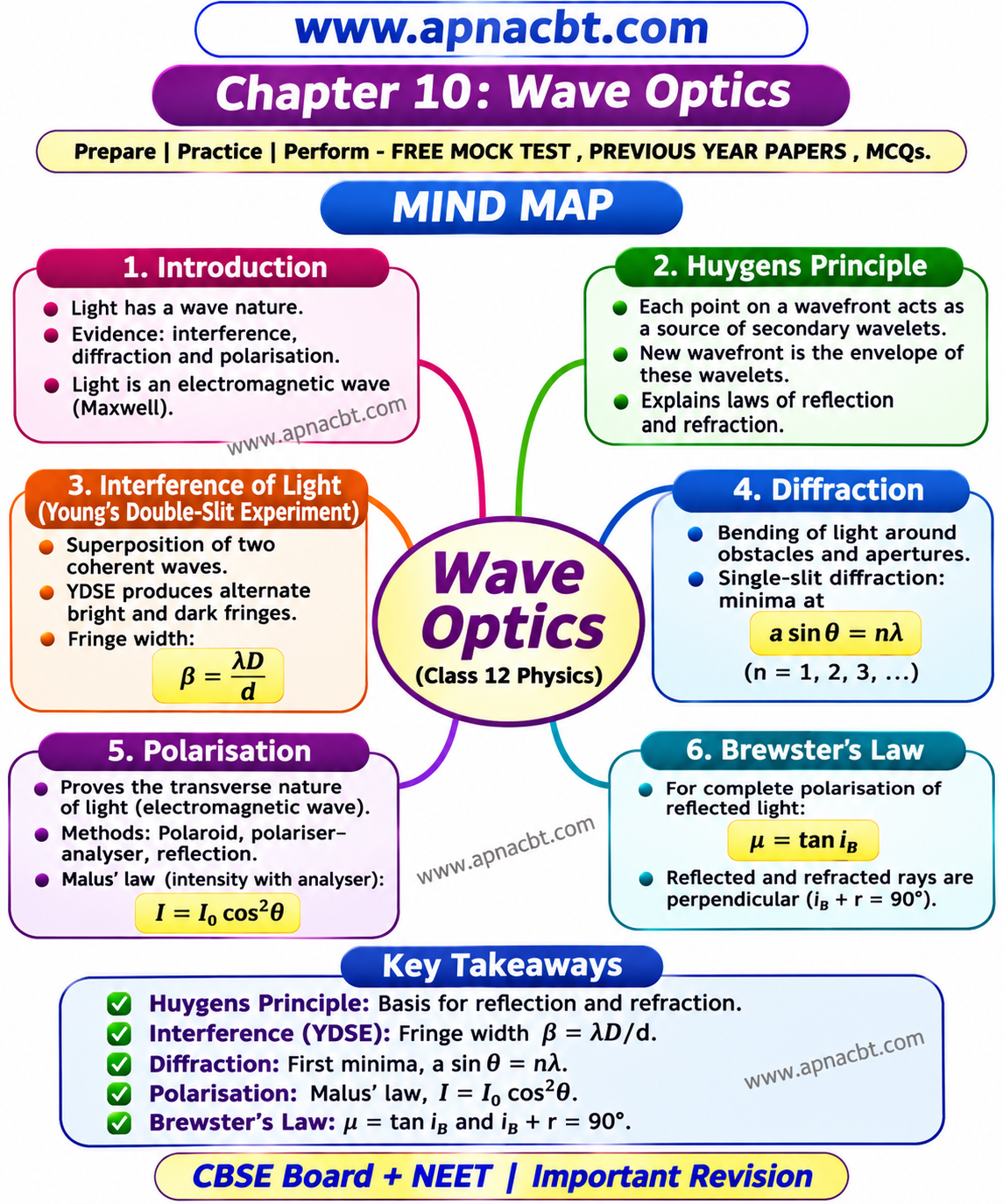
This Level 01 lesson follows the attached NCERT chapter and presents exam-focused concepts in short paragraphs for CBSE Board and NEET preparation. It covers the wave nature of light, Huygens principle, reflection and refraction, coherent sources, Young’s double-slit experiment, diffraction, resolution, polarisation and Brewster’s law.
Contents
1. Wave Optics: Wave Nature of Light and Basic Ideas
In Wave Optics, the wave model of light becomes firmly established through experiments on interference and diffraction. Young’s double-slit experiment showed that light can form a stable interference pattern when coherent sources are used. Ray optics is an approximation that works because visible-light wavelengths are very small compared with ordinary optical objects.
When an aperture or obstacle has dimensions comparable with wavelength, wave effects such as diffraction become important. Maxwell’s electromagnetic theory further connected light with changing electric and magnetic fields and showed that electromagnetic waves can propagate through vacuum.
Exam focus: remember v = fλ. On entering another medium, frequency remains unchanged while speed and wavelength change.
2. Huygens Principle and Wavefronts
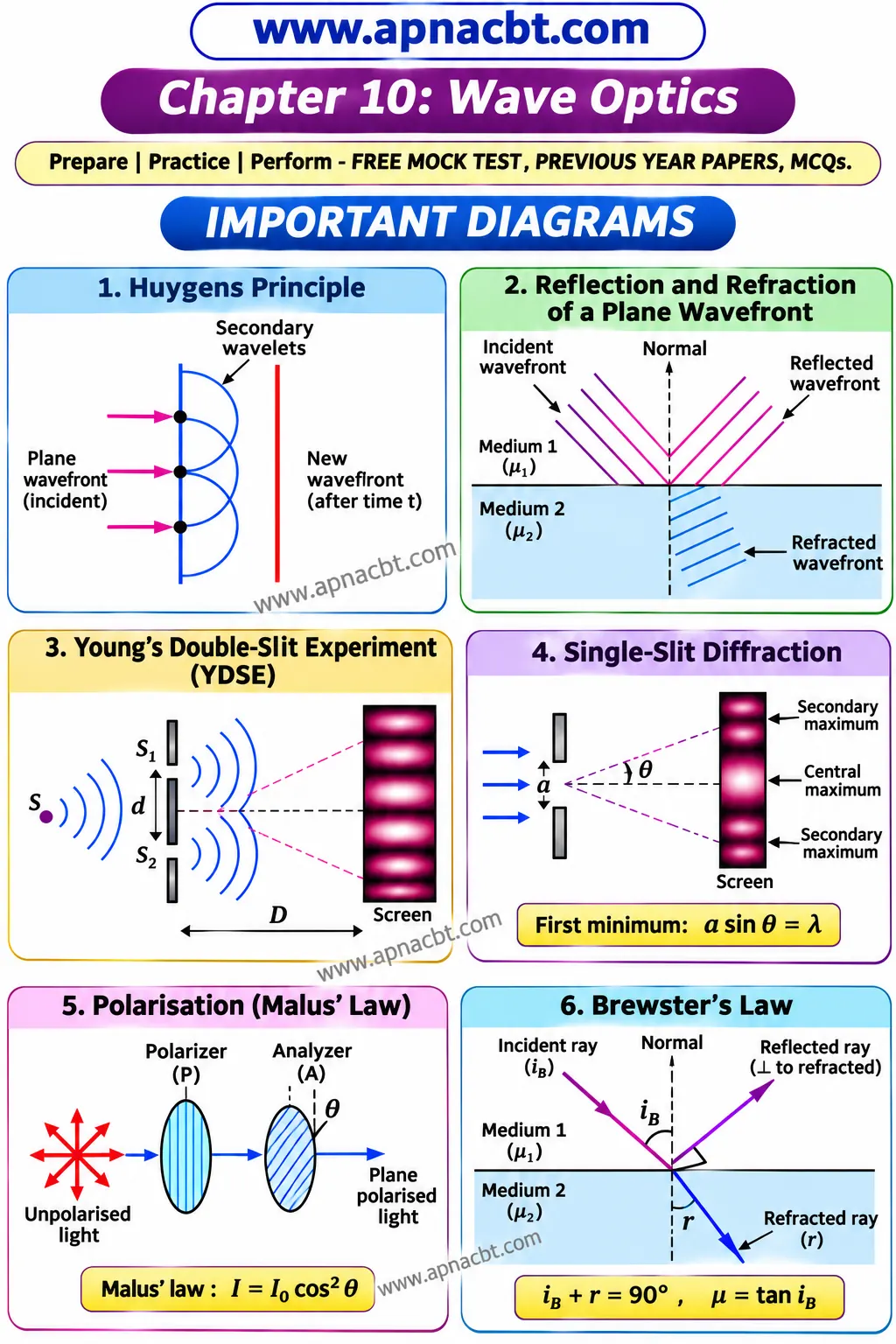
In Wave Optics, Huygens principle states that every point on a wavefront acts as a source of secondary wavelets. The new wavefront is the forward envelope of these wavelets. A wavefront is a surface of constant phase, and the direction of propagation is normal to it.
A point source in an isotropic medium produces a spherical wavefront. A distant source produces an approximately plane wavefront over a small region. A line source can produce a cylindrical wavefront.
CBSE tip: in Huygens diagrams, draw the incident wavefront, secondary wavelets, common tangent and rays normal to the wavefront.
3. Reflection and Refraction Using Huygens Principle
Huygens construction reproduces the law of reflection. Secondary wavelets from the reflecting surface form the reflected wavefront. Since rays are perpendicular to wavefronts, the construction gives i = r.
For refraction, different parts of a plane wavefront enter the second medium at different times. If speeds are v1 and v2, Huygens construction gives sin i / sin r = v1 / v2. This is consistent with Snell’s law because refractive index is inversely related to wave speed.
Frequency remains unchanged at the interface, while wavelength changes according to v = fλ. If speed is lower in the second medium, the wave bends towards the normal.
4. Coherent and Incoherent Addition of Waves
The principle of superposition states that the resultant displacement is the sum of the individual displacements. Stable interference requires sources having the same frequency and a constant phase difference; such sources are coherent.
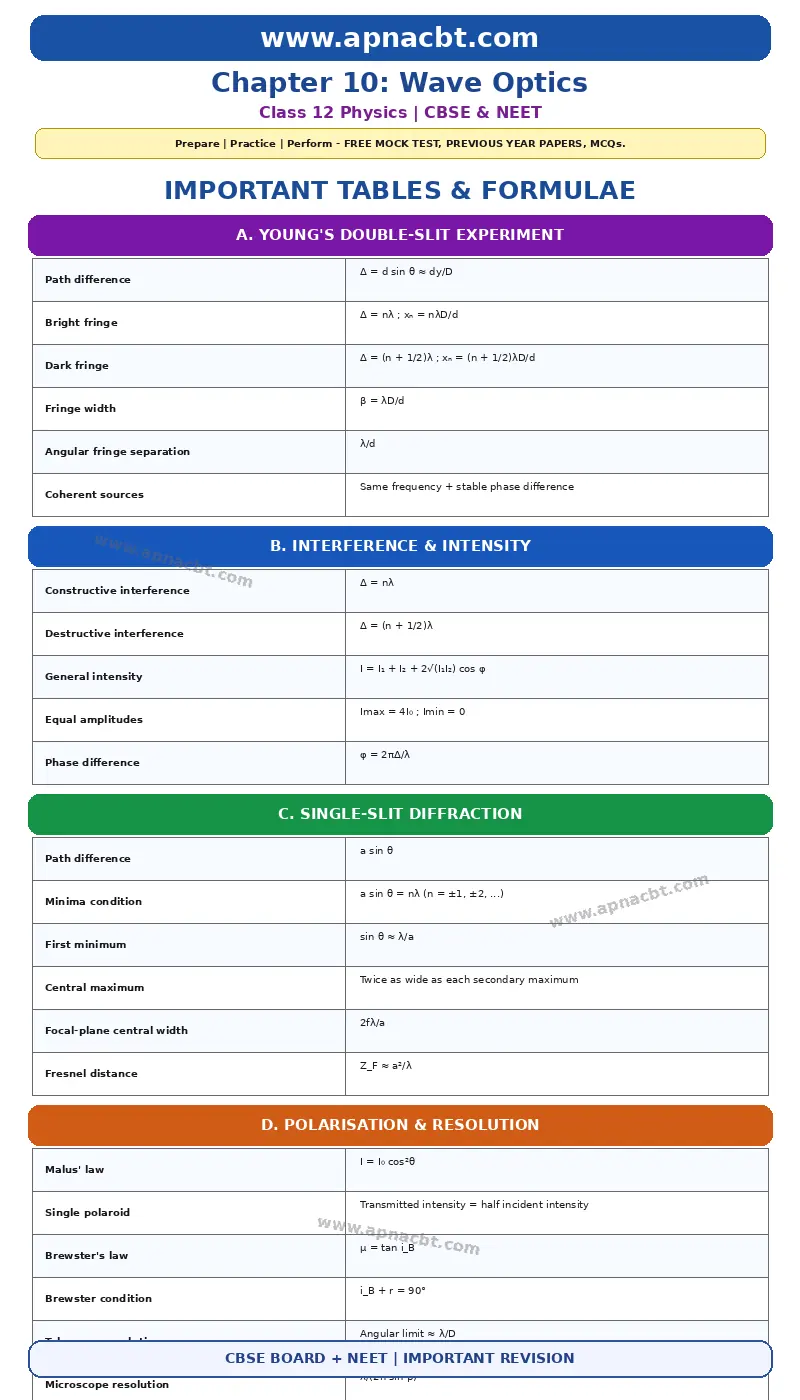
For two waves of intensities I1 and I2 with phase difference φ, I = I1 + I2 + 2√(I1I2)cosφ. Constructive interference occurs for phase difference 0, 2π, … and destructive interference for π, 3π, … .
For equal intensities I0, Imax = 4I0 and Imin = 0. Independent lamps generally do not maintain a stable phase relationship.
5. Wave Optics: Young’s Double-Slit Experiment
In Wave Optics, Young’s double-slit experiment is a key demonstration of the wave nature of light. A monochromatic source illuminates two narrow slits, which act as coherent secondary sources. Their waves overlap on a screen and form bright and dark fringes.
If slit separation is d, screen distance is D and wavelength is λ, the path difference at a point y from the central axis is approximately Δ = dy/D.
Bright fringes: Δ = nλ. Dark fringes: Δ = (n + 1/2)λ.
Bright-fringe position: yn = nλD/d. Dark-fringe position: yn = (n + 1/2)λD/d. Fringe width: β = λD/d. Angular fringe separation: λ/d.
With white light the central fringe is white because all wavelengths have zero path difference there. Coloured fringes appear away from the centre and soon overlap.
6. Interference Conditions, Fringe Width and Intensity
Interference maxima correspond to path difference nλ and minima correspond to (n + 1/2)λ. In the small-angle approximation, fringes are equally spaced.
From β = λD/d, fringe width increases with wavelength and screen distance and decreases with slit separation. If an extended source is too wide or too close, patterns from different source points overlap and fringe visibility decreases.
The NCERT discussion gives the approximate visibility condition s/S < λ/d, where s is source size and S is source distance from the double-slit plane.
7. Wave Optics: Single-Slit Diffraction
In Wave Optics, diffraction is the spreading of waves through a narrow aperture or around an obstacle whose size is comparable with wavelength. For a single slit of width a, dark bands occur when a sinθ = nλ, n = 1, 2, 3, … . For small angles, θ ≈ nλ/a.
The first minimum occurs at λ/a. The central maximum lies between the first minima and is therefore approximately twice as wide as the secondary maxima. Successive secondary maxima become weaker.
With a converging lens of focal length f, the distance from the central maximum to the first minimum is approximately fλ/a.
8. Resolution and Validity of Ray Optics
Diffraction limits the resolving power of telescopes and microscopes. For a circular telescope aperture of diameter D, the minimum angular separation under the Rayleigh criterion is approximately θ = 1.22λ/D.
A larger aperture improves resolution, while a longer wavelength reduces it. For a beam of width a, the NCERT chapter introduces Fresnel distance approximately as ZF = a²/λ. These results show why ray optics is an approximation and why optical instruments have finite resolving power.
9. Wave Optics: Polarisation of Light
In Wave Optics, polarisation is the restriction of transverse vibrations to a particular direction. Natural light is unpolarised, while a polaroid transmits the component of the electric field along its transmission axis.
For plane-polarised light passing through an analyser, Malus’ law is I = I0 cos²θ, where θ is the angle between transmission axes. Parallel axes give maximum intensity and crossed axes give zero ideal intensity.
Polarisation can be produced by selective absorption, reflection at Brewster angle and scattering. It is a key reason for identifying light as a transverse wave.
10. Brewster’s Law and Applications
In Wave Optics, at the Brewster or polarising angle, reflected light from a transparent surface becomes completely plane polarised. The reflected and refracted rays are perpendicular.
Brewster’s law is μ = tan iB. Hence for μ = 1.5, iB is approximately 56–57°. At Brewster incidence, iB + r = 90°.
Polarising sunglasses reduce glare from roads and water surfaces. Polarisation is also used in optical instruments, stress analysis and three-dimensional imaging.
11. CBSE + NEET Quick Revision
Core sequence: wavefront → Huygens principle → reflection/refraction → coherent sources → interference → Young’s double slit → diffraction → resolution → polarisation → Brewster’s law.
Formula set: v = fλ; β = λD/d; Δbright = nλ; Δdark = (n+1/2)λ; a sinθ = nλ; I = I0cos²θ; μ = tan iB; θmin ≈ 1.22λ/D; ZF ≈ a²/λ.
CBSE priorities: Huygens construction, reflection/refraction derivations, Young’s experiment, fringe-width derivation, diffraction, polarisation and Brewster law.
NEET priorities: fringe-width changes, path-difference conditions, intensity relation, single-slit minima, angular resolution, Malus law and Brewster angle.
For additional preparation, visit APNA CBT and its Physics preparation resources and chapter-wise practice resources.
Official sources: NCERT Textbooks and CBSE Academic.
12. Short Questions – 30 Questions with Detailed Answers
- What is a wavefront?
Answer: A wavefront is a surface of constant phase. The direction of propagation is normal to it. - State Huygens principle.
Answer: Every point on a wavefront acts as a source of secondary wavelets, whose forward envelope forms the new wavefront. - What is a spherical wavefront?
Answer: It is produced by a point source in an isotropic medium; all points are at equal distance from the source. - What is a plane wavefront?
Answer: It is an approximately flat wavefront obtained from a very distant source over a small region. - Why does frequency remain unchanged during refraction?
Answer: Frequency is fixed by the source and remains continuous across the interface; speed and wavelength change. - What are coherent sources?
Answer: Sources having the same frequency and a constant phase difference. - State the condition for constructive interference.
Answer: Path difference Δ = nλ. - State the condition for destructive interference.
Answer: Path difference Δ = (n + 1/2)λ. - What is fringe width?
Answer: It is the distance between consecutive bright or dark fringes; β = λD/d. - How does fringe width change if wavelength increases?
Answer: It increases directly with wavelength. - How does fringe width change if slit separation increases?
Answer: It decreases because β is inversely proportional to d. - What happens when the screen is moved farther away?
Answer: Fringe width increases because β is directly proportional to D. - Why is the central fringe white with white light?
Answer: Path difference is zero for every wavelength at the centre, so all colours reinforce there. - What is diffraction?
Answer: It is the spreading of waves at a narrow aperture or around an obstacle comparable with wavelength. - Write the condition for single-slit minima.
Answer: a sinθ = nλ, where n = 1, 2, 3, … . - What is special about the central diffraction maximum?
Answer: It is the brightest and approximately twice as wide as a secondary maximum. - Give one difference between interference and diffraction.
Answer: Interference is commonly treated as superposition from two coherent slits, while diffraction is superposition from different parts of one aperture. - What is polarisation?
Answer: It is the restriction of transverse vibrations to a particular direction. - State Malus’ law.
Answer: I = I₀ cos²θ, where θ is the angle between polariser and analyser axes. - What happens when polariser and analyser axes are crossed?
Answer: For ideal polarisers, θ = 90°, so transmitted intensity is zero. - What is Brewster angle?
Answer: It is the angle of incidence at which reflected light becomes completely plane polarised. - State Brewster’s law.
Answer: μ = tan iB. - What is the relation between reflected and refracted rays at Brewster angle?
Answer: They are perpendicular, so iB + r = 90°. - What is angular fringe separation?
Answer: For small angles it is λ/d radians. - What happens to wavelength in a denser medium?
Answer: It decreases while frequency remains unchanged. - Why is light diffraction usually not obvious in daily life?
Answer: Ordinary apertures and obstacles are much larger than visible-light wavelengths. - What limits telescope resolution?
Answer: Diffraction; for a circular aperture θmin ≈ 1.22λ/D. - What is Fresnel distance?
Answer: Approximately ZF = a²/λ for a beam of width a. - Why can longitudinal waves not be polarised?
Answer: They do not have transverse vibration directions that can be selectively restricted. - Why are two independent lamps not coherent sources?
Answer: Their phase difference fluctuates randomly, so a stable interference pattern is not maintained.
13. Long Questions – 15 Questions with Detailed Answers
- Explain Huygens principle and show how it gives the law of reflection.
Answer: Each point of a wavefront acts as a source of secondary wavelets and the new wavefront is their forward envelope. For a plane wave incident on a reflecting surface, the wavelets form a common tangent representing the reflected wavefront. Since rays are normal to wavefronts, the geometry gives i = r, which is the law of reflection. - Use Huygens principle to explain refraction.
Answer: If wave speeds are v1 and v2 in the two media, during time τ the wave travels v1τ in the first medium while a secondary wavelet of radius v2τ forms in the second. Geometry gives sin i/sin r = v1/v2. Frequency remains unchanged while wavelength changes. - Explain coherent sources and interference.
Answer: Coherent sources have the same frequency and constant phase difference. Superposition produces constructive interference for phase differences 0, 2π, … and destructive interference for π, 3π, … . A constant phase relationship is necessary for a stationary fringe pattern. - Derive fringe width in Young’s double-slit experiment.
Answer: With slit separation d and screen distance D, path difference at height y is Δ ≈ dy/D. For a bright fringe Δ = nλ, giving yn = nλD/d. The separation of successive bright fringes is β = λD/d. Thus β is directly proportional to λ and D and inversely proportional to d. - Derive the intensity relation for two interfering waves.
Answer: Vector addition of amplitudes followed by squaring gives I = I1 + I2 + 2√(I1I2)cosφ. For φ = 0, Imax = (√I1 + √I2)². For φ = π, Imin = (√I1 − √I2)². Equal intensities give 4I0 and zero. - Explain changes in Young’s experiment when parameters are varied.
Answer: From β = λD/d, increasing D or λ increases fringe width, while increasing d decreases it. White light gives a central white fringe and coloured fringes nearby. A source that is too wide or too close reduces visibility because patterns from different source points overlap. - Explain single-slit diffraction and the condition for minima.
Answer: Different parts of a slit have different path lengths to an off-axis point. The edge-to-edge path difference is a sinθ. Pairwise cancellation gives minima at a sinθ = nλ. The central maximum lies between the first minima and is therefore twice as wide as a secondary maximum. - Compare interference and single-slit diffraction.
Answer: Two-slit interference gives equally spaced bright and dark fringes in the ideal case. Single-slit diffraction has a broad central maximum and weaker secondary maxima with decreasing intensity. Interference uses two coherent sources, whereas diffraction involves contributions from a continuous aperture. - Explain the diffraction limit of a telescope.
Answer: A point object produces a finite diffraction pattern. Two point sources are resolved only if their angular separation is sufficiently large. For a circular aperture θmin ≈ 1.22λ/D. Increasing aperture improves resolution and increasing wavelength reduces it. - Explain polarisation and its significance.
Answer: Unpolarised light contains transverse electric-field vibrations in random directions. A polariser selects one direction and produces plane-polarised light. Since directional restriction is possible only for transverse vibrations, polarisation establishes the transverse nature of light. - Derive Malus’ law.
Answer: If plane-polarised light of intensity I0 falls on an analyser at angle θ, the transmitted electric-field amplitude is E0cosθ. Since intensity is proportional to amplitude squared, I = I0cos²θ. Parallel axes give maximum intensity; crossed axes give zero for ideal polarisers. - Explain Brewster’s law.
Answer: At the polarising angle, reflected and refracted rays are perpendicular and the reflected light is completely plane polarised. Thus iB + r = 90°. Combining this with Snell’s law gives μ = tan iB, known as Brewster’s law. - Explain how wave optics establishes the limits of ray optics.
Answer: Ray optics neglects wavelength. When aperture or obstacle dimensions become comparable with wavelength, diffraction becomes important and light spreads into regions not predicted by ideal rays. Diffraction also limits the resolving power of optical instruments. - A double-slit arrangement has d = 0.5 mm, D = 2 m and λ = 500 nm. Find fringe width.
Answer: β = λD/d = (500 × 10−9 × 2)/(0.5 × 10−3) = 2 × 10⁻³ m = 2 mm. Therefore the fringe width is 2 mm. - Light with refractive index 1.5 is incident from air. Find Brewster angle.
Answer: By μ = tan iB, tan iB = 1.5. Hence iB ≈ 56.3°. At this angle reflected and refracted rays are perpendicular and the reflected beam is plane polarised.