

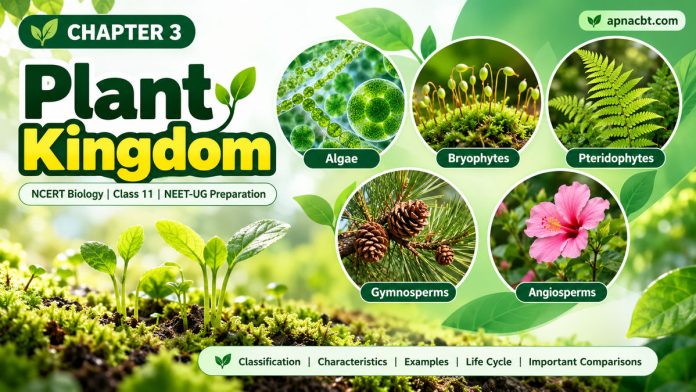
Plant Kingdom
NCERT Biology | Class 11 CBSE | NEET-UG Preparation
Chapter overview:
Learn the classification of the plant kingdom, major characteristics of algae, bryophytes, pteridophytes, gymnosperms and angiosperms, plant life cycles, and alternation of generations. This summary highlights important concepts for CBSE examinations and NEET-UG revision.
Bryophytes
Bryophytes are small, non-vascular plants commonly found in moist, shaded habitats. They are often called the amphibians of the plant kingdom because they are terrestrial but generally require water for sexual reproduction.
Important characteristics
- True vascular tissues are absent.
- True roots are absent; rhizoids help in attachment.
- The gametophyte is the dominant, photosynthetic plant body.
- The sporophyte remains attached to and nutritionally dependent on the gametophyte to varying degrees.
- Male reproductive organs are antheridia; female reproductive organs are archegonia.
- Fertilisation usually requires water because the male gametes are motile.
- The zygote develops into an embryo within the archegonium.
Liverworts
Liverworts often grow in moist, shady habitats. Their gametophyte may be thalloid or leafy.
- In thalloid liverworts, the body is flattened and dorsiventral.
- Vegetative reproduction may occur by fragmentation or gemmae.
- Gemmae are small, multicellular reproductive structures that can develop into new plants.
- Example: Marchantia.
Mosses
The life cycle of mosses includes a protonema stage followed by the leafy gametophore.
- The protonema develops from a spore and is usually green and filamentous.
- The leafy gametophore develops from the protonema.
- Rhizoids provide attachment.
- The sporophyte commonly consists of a foot, seta and capsule.
- Examples: Funaria, Polytrichum and Sphagnum.
Importance of bryophytes
- They help in soil formation and ecological succession.
- Some species help retain moisture in habitats.
- Sphagnum forms peat, which has several uses.
Remember: Bryophytes have a dominant gametophyte and a dependent sporophyte. Water is generally necessary for fertilisation.