Chapter 4: Animal Kingdom – Class 11 Biology
Exam-focused study material based on the supplied 29-page PDF. It covers the major non-chordate phyla, diagnostic features of chordates, subphyla and vertebrate classes, with high-yield comparisons and practice questions for CBSE, IPE and NEET.
How to prepare: For each phylum, revise symmetry, germ layers, body cavity, level of organisation, special structures, reproduction and representative examples. For vertebrate classes, compare skin, appendages, respiration, heart, excretion and reproduction.
1. Basis of Animal Classification
Animal classification groups organisms according to fundamental similarities and differences. Major criteria include level of organisation, symmetry, germ layers, body cavity (coelom), segmentation, notochord and patterns of organ-system organisation.
Important classification terms
- Cellular level: cells are loosely organised; seen in Porifera.
- Tissue level: similar cells form tissues; seen in Cnidaria and Ctenophora.
- Organ level: different tissues combine to form organs; seen in Platyhelminthes.
- Organ-system level: organs coordinate as systems; seen in Aschelminthes onwards.
- Asymmetry: body cannot be divided into equal halves through a plane.
- Radial symmetry: several planes through the central axis produce similar halves.
- Bilateral symmetry: only one plane divides the body into right and left halves.
- Diploblastic: two germ layers, ectoderm and endoderm, with mesoglea between them.
- Triploblastic: three germ layers, ectoderm, mesoderm and endoderm.
- Acoelomate: true body cavity absent; e.g. Platyhelminthes.
- Pseudocoelomate: body cavity not completely lined by mesoderm; e.g. Aschelminthes.
- Coelomate: true coelom completely lined by mesoderm; e.g. Annelida, Arthropoda, Mollusca, Echinodermata, Hemichordata and Chordata.
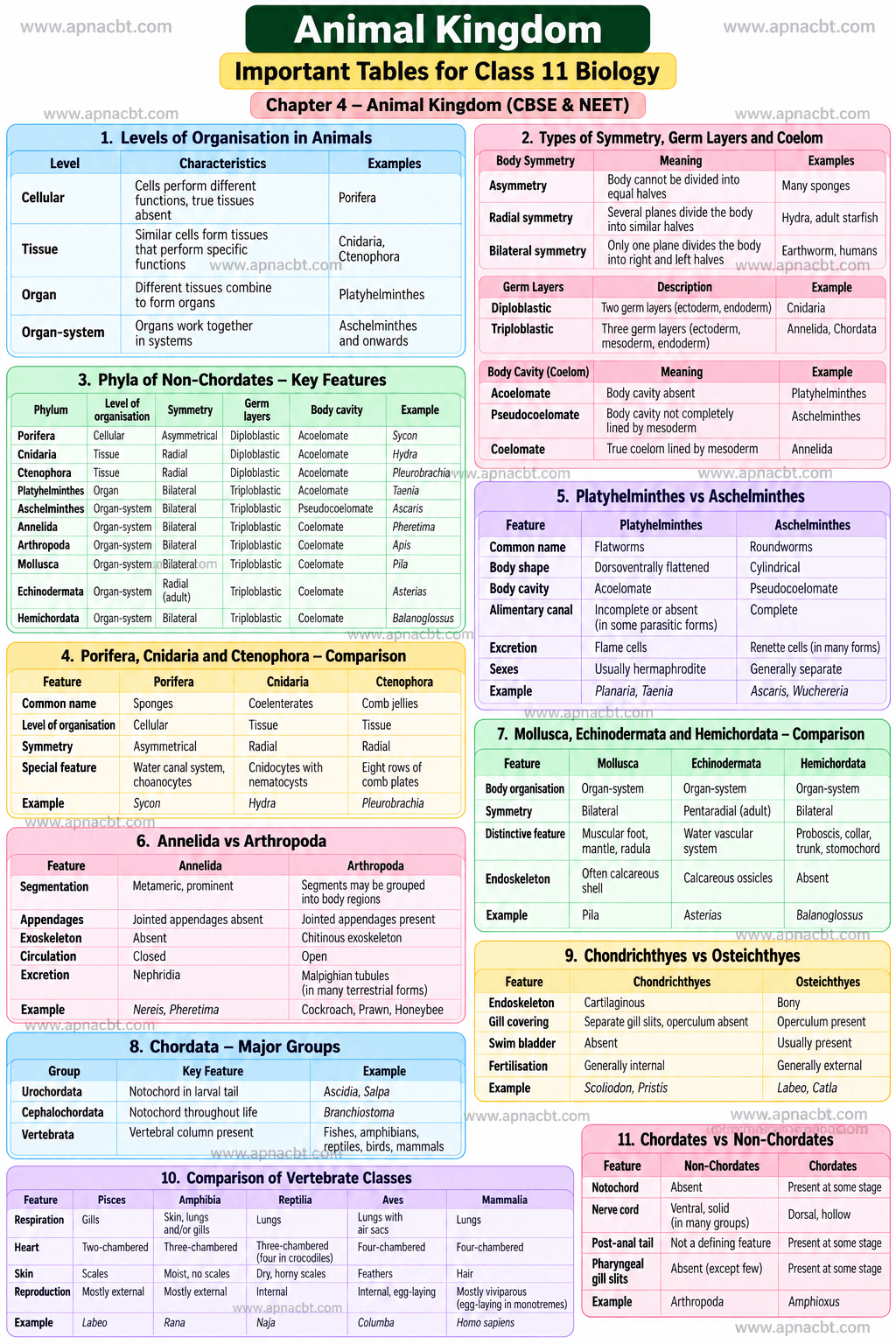
| Feature | Major condition / examples |
|---|---|
| Organisation | Cellular – Porifera; tissue – Cnidaria/Ctenophora; organ – Platyhelminthes; organ-system – Aschelminthes onwards |
| Symmetry | Asymmetrical – most sponges; radial – cnidarians/adult echinoderms; bilateral – most other animals |
| Germ layers | Diploblastic – Porifera and Cnidaria in the supplied text; triploblastic – Platyhelminthes onwards |
| Coelom | Acoelomate – Platyhelminthes; pseudocoelomate – Aschelminthes; true coelom – Annelida onwards |
| Segmentation | Metamerism is prominent in Annelida; also occurs in Arthropoda and Chordata |
2. Phylum Porifera – Sponges
Poriferans are the simplest multicellular animals and are commonly called sponges. They are mostly marine and sessile; Spongilla is a freshwater example. They show cellular level of organisation and are mostly asymmetrical.
- Body has numerous pores called ostia through which water enters and one or more oscula through which it leaves.
- Body wall has outer pinacoderm, inner choanoderm and a gelatinous mesohyl between them.
- Choanocytes are flagellated collar cells. Their flagella maintain water current and collars trap food particles.
- Water passes through the canal system and spongocoel; it supplies food and oxygen and removes carbon dioxide and wastes.
- Skeleton consists of calcareous or siliceous spicules, spongin fibres, or both.
- Digestion is intracellular. Asexual reproduction occurs by budding or gemmules; sexual reproduction is also common. Most are hermaphrodites; fertilisation is internal and development is indirect with a larval stage.
| Example | Common name / key point |
|---|---|
| Sycon (Scypha) | Simple marine sponge |
| Spongilla | Freshwater sponge |
| Euspongia | Bath sponge |
| Euplectella | Venus’ flower basket |
| Chalina | Dead man’s finger |
NEET focus: Ostia = entry; osculum = exit; choanocytes = water current and food capture; skeleton = spicules/spongin.
3. Phylum Cnidaria (Coelenterata)
Cnidarians are aquatic, mostly marine animals with tissue-level organisation and radial symmetry. They are diploblastic, with epidermis and gastrodermis separated by mesoglea.
- Characteristic stinging cells are cnidocytes/cnidoblasts, containing nematocysts used in defence and prey capture.
- Two body forms occur: polyp (sessile, cylindrical, mouth and tentacles directed upwards) and medusa (free-swimming, umbrella-shaped, mouth and tentacles directed downwards).
- Many species show both forms. Polyps commonly reproduce asexually by budding; medusae produce gametes sexually.
- Alternation of asexual polyp and sexual medusa phases in the life cycle of Obelia is called metagenesis.
- Polymorphism is the occurrence of structurally and functionally different zooids in a colony.
- Digestion begins extracellularly in the gastrovascular cavity and is completed intracellularly. The digestive cavity has a single opening.
| Example | Identification |
|---|---|
| Hydra | Freshwater polyp |
| Obelia | Colonial; shows metagenesis and polymorphism |
| Aurelia | Jellyfish; medusa form |
| Physalia | Portuguese man-of-war; floating colonial form |
| Adamsia | Sea anemone |
| Gorgonia | Sea fan |
| Pennatula | Sea pen |
4. Phylum Ctenophora
Ctenophores are exclusively marine, mostly free-swimming animals called comb jellies or sea walnuts. They are diploblastic, biradially symmetrical and show tissue-level organisation.
- Eight external rows of ciliated comb plates (ctenes) help in locomotion.
- Colloblasts are adhesive cells used to capture prey; cnidoblasts are absent.
- Bioluminescence is often well marked.
- They are usually hermaphrodites; fertilisation is generally external and development is indirect.
Examples: Pleurobrachia and Ctenoplana.
Distinguish: Cnidaria possess stinging cnidocytes; Ctenophora possess adhesive colloblasts and eight comb rows.
5. Phylum Platyhelminthes – Flatworms
Platyhelminthes are dorsoventrally flattened, bilaterally symmetrical, triploblastic, acoelomate animals with organ-level organisation. Many are endoparasites.
- Digestive tract is incomplete or absent in some parasitic forms.
- Excretion and osmoregulation occur through flame cells (protonephridia).
- Many are hermaphrodites. Fertilisation is usually internal; development may include larval stages.
- Parasitic adaptations include hooks and suckers for attachment, a thick protective tegument, high reproductive capacity and reduced sensory/locomotory structures.
| Example | Common name / feature |
|---|---|
| Planaria | Free-living flatworm; remarkable regeneration |
| Taenia | Tapeworm; endoparasite |
| Fasciola | Liver fluke |
| Schistosoma | Blood fluke; sexes separate |
6. Phylum Aschelminthes (Nematoda) – Roundworms
Aschelminthes are roundworms with elongated, cylindrical, unsegmented bodies. They are bilaterally symmetrical, triploblastic and pseudocoelomate, with organ-system level organisation.
- Body is covered by a tough cuticle; body cavity is a pseudocoel.
- Alimentary canal is complete, with separate mouth and anus and a muscular pharynx.
- Excretion occurs through excretory canals or renette cells, depending on the group.
- Sexes are usually separate; females are often longer than males. Fertilisation is internal.
| Example | Disease / common name |
|---|---|
| Ascaris | Intestinal roundworm; ascariasis |
| Wuchereria | Filarial worm; lymphatic filariasis |
| Ancylostoma | Hookworm |
| Enterobius | Pinworm |
7. Phylum Annelida – Segmented Worms
Annelids are bilaterally symmetrical, triploblastic, true coelomate animals with organ-system organisation. Their body is metamerically segmented externally and internally.
- They possess circular and longitudinal muscles for locomotion.
- Closed blood vascular system is present.
- Excretion and osmoregulation occur through nephridia.
- Locomotory structures vary: parapodia in many marine forms, setae in earthworms and suckers in leeches.
- Respiration occurs through body surface or gills in some aquatic forms.
| Example | Important feature |
|---|---|
| Nereis | Marine; parapodia; sexes separate |
| Pheretima | Earthworm; setae; hermaphrodite |
| Hirudinaria | Leech; suckers; no setae |
8. Phylum Arthropoda – Jointed-Legged Animals
Arthropoda is the largest phylum of Animalia. Members are bilaterally symmetrical, triploblastic, segmented and coelomate, with a chitinous exoskeleton and jointed appendages.
- Body is commonly divided into head, thorax and abdomen, or cephalothorax and abdomen.
- Circulatory system is open; the body cavity is a haemocoel.
- Respiration occurs through gills, book gills, book lungs or tracheae.
- Excretion occurs through Malpighian tubules in insects, green glands in many crustaceans and coxal glands in some arachnids.
- Compound eyes, antennae and other sensory structures are common. Sexes are usually separate.
| Example | Group / distinguishing feature |
|---|---|
| Periplaneta | Cockroach; tracheal respiration and Malpighian tubules |
| Apis | Honeybee |
| Bombyx | Silkworm |
| Anopheles | Mosquito |
| Palaemon | Prawn; crustacean |
| Limulus | King crab; horseshoe crab |
| Palamnaeus | Scorpion; book lungs |
| 蜘蛛 / Aranea | Spider; book lungs or tracheae |
Exam term: Haemocoel is the blood-filled body cavity associated with the open circulatory system.
9. Phylum Mollusca – Soft-Bodied Animals
Mollusca is generally regarded as the second-largest animal phylum. Members are mostly aquatic, soft-bodied and unsegmented, usually with a distinct head, muscular foot and visceral mass.
- A mantle covers the visceral mass and often secretes a calcareous shell.
- The mantle cavity contains respiratory organs (ctenidia/gills) and openings of digestive, excretory and reproductive systems.
- A rasping feeding organ called the radula is usually present, but absent in bivalves.
- Circulatory system is generally open; cephalopods have a closed system.
- Respiration is usually by gills; terrestrial forms may have a lung-like mantle cavity.
- Haemocyanin, a copper-containing respiratory pigment, may be present.
| Example | Common name |
|---|---|
| Pila | Apple snail |
| Unio | Freshwater mussel |
| Sepia | Cuttlefish |
| Loligo | Squid |
| Octopus | Devil fish |
| Aplysia | Sea hare |
| Pinctada | Pearl oyster |
Pearl formation: nacre secreted by the mantle coats an irritating foreign particle trapped between mantle and shell.
10. Phylum Echinodermata – Spiny-Skinned Animals
Echinoderms are exclusively marine, triploblastic, coelomate animals with organ-system organisation. Adults usually show pentamerous radial symmetry, while larvae are bilaterally symmetrical.
- Endoskeleton consists of calcareous ossicles; spines and pincer-like pedicellariae occur on the body surface.
- A complete digestive tract is usually present.
- A distinct excretory system is absent; nitrogenous waste, mainly ammonia, diffuses out.
- Respiration occurs through tube feet, dermal branchiae, bursae or respiratory trees, depending on the group.
- The characteristic water vascular (ambulacral) system is hydraulic and helps in locomotion, food capture and respiration.
- Sexes are usually separate; fertilisation is generally external and development indirect.
| Example | Common name |
|---|---|
| Asterias | Starfish |
| Echinus | Sea urchin |
| Ophiura | Brittle star |
| Cucumaria | Sea cucumber |
| Antedon | Sea lily |
| Pentaceros | Starfish |
11. Phylum Hemichordata
Hemichordates are marine, worm-like animals once grouped with chordates but now treated as a separate non-chordate phylum. They are bilaterally symmetrical, triploblastic, coelomate and show organ-system organisation.
- Body is divided into proboscis, collar and trunk.
- They have a complete digestive tract and pharyngeal gill slits.
- Circulatory system is open; excretory organ is a proboscis gland or glomerulus.
- The buccal diverticulum or stomochord is not a true notochord.
- Development may include a free-swimming tornaria larva.
Examples: Balanoglossus and Saccoglossus.
12. Phylum Chordata: Diagnostic Characters
Chordates possess the following fundamental features at least during some stage of their life cycle:
- Notochord: a flexible supporting rod on the dorsal side.
- Dorsal, hollow, tubular nerve cord: lies above the notochord; forms the central nervous system.
- Pharyngeal gill slits: openings in the pharynx, present at least in embryonic or larval stages.
- Post-anal tail: muscular tail extending behind the anus.
- Endostyle or thyroid gland: associated with feeding or endocrine function.
Chordates are bilaterally symmetrical, triploblastic, coelomate and deuterostomic animals with organ-system organisation. A ventral heart and usually closed circulation are characteristic of vertebrates.
13. Subphyla Urochordata and Cephalochordata
| Feature | Urochordata (Tunicata) | Cephalochordata |
|---|---|---|
| Notochord | Present in larval tail only | Extends from head to tail and persists throughout life |
| Adult body | Often enclosed in a leathery tunic/test | Small, fish-like, marine filter-feeding body |
| Metamorphosis | Retrogressive metamorphosis | Progressive metamorphosis |
| Examples | Ascidia, Herdmania, Salpa, Doliolum, Pyrosoma | Branchiostoma (Amphioxus / lancelet) |
Retrogressive metamorphosis: the active, chordate-like larva transforms into a simpler, sessile adult, with loss or reduction of several chordate features. It occurs in urochordates such as Herdmania.
Progressive metamorphosis: a less-developed larva transforms into a more developed adult, as described for cephalochordates.
14. Subphylum Vertebrata: General Features and Classification
Vertebrates are advanced chordates. The notochord is generally present during embryonic development and is replaced partly or wholly by a cartilaginous or bony vertebral column in the adult. The cranium protects the brain.
- Endoskeleton is cartilaginous or bony.
- Closed blood vascular system with a ventral heart; haemoglobin occurs in blood corpuscles.
- Paired kidneys are the chief excretory organs.
- Usually two pairs of appendages are present, modified as fins or limbs; they are absent in some groups.
- Sexes are generally separate.
| Division | Classes / groups |
|---|---|
| Agnatha (jawless) | Cyclostomata |
| Gnathostomata – Pisces | Chondrichthyes and Osteichthyes |
| Gnathostomata – Tetrapoda | Amphibia, Reptilia, Aves and Mammalia |
15. Class Cyclostomata
Cyclostomes are jawless, primitive vertebrates such as lampreys and hagfishes.
- Body is elongated and eel-like; paired fins and jaws are absent.
- Mouth is circular and suctorial, with horny teeth; stomach is absent.
- Endoskeleton is cartilaginous and notochord persists throughout life.
- Six to fifteen pairs of gill slits occur in gill pouches.
- Heart is two-chambered. Sexes are separate; fertilisation is external in the examples described.
- Many are marine parasites or scavengers; lampreys migrate to freshwater for breeding.
Examples: Petromyzon (lamprey) and Myxine (hagfish).
16. Class Chondrichthyes – Cartilaginous Fishes
- Mostly marine; endoskeleton is cartilaginous.
- Body is streamlined; mouth is usually ventral; skin bears placoid scales.
- Five to seven pairs of gill slits generally open separately; operculum is absent in typical forms.
- Air bladder is absent; animals must swim or use other adaptations to maintain buoyancy.
- Tail is usually heterocercal. Males possess pelvic claspers.
- Fertilisation is internal; many are viviparous or ovoviviparous. They are ureotelic.
- Some possess electric organs (Torpedo) or poison stings (Trygon).
| Example | Common name / feature |
|---|---|
| Scoliodon | Dogfish / shark |
| Carcharodon | Great white shark |
| Pristis | Sawfish |
| Trygon | Sting ray |
| Torpedo | Electric ray |
| Chimaera | Rat fish |
17. Class Osteichthyes – Bony Fishes
- Marine and freshwater fishes with a bony endoskeleton.
- Body is usually streamlined; mouth is generally terminal.
- Skin bears cycloid or ctenoid scales; gills are covered by an operculum.
- Air bladder is generally present and helps regulate buoyancy.
- Fins are supported by fin rays; heart is two-chambered.
- They are mostly ammonotelic; fertilisation is usually external and development direct.
| Example | Common name |
|---|---|
| Labeo | Rohu |
| Catla | Catla |
| Cirrhinus | Mrigal |
| Hippocampus | Sea horse |
| Exocoetus | Flying fish |
| Anabas | Climbing perch |
| Pterophyllum | Angel fish |
Quick comparison: Chondrichthyes – cartilage, placoid scales, separate gill slits, no air bladder, internal fertilisation. Osteichthyes – bone, cycloid/ctenoid scales, operculum, air bladder, usually external fertilisation.
18. Class Amphibia
- Amphibians live in water and on moist land; examples include frogs, toads and salamanders.
- Skin is moist, glandular, generally without scales and important in cutaneous respiration.
- Usually two pairs of pentadactyl limbs; skeleton is bony.
- Respiration may occur through gills, lungs and buccopharyngeal lining or skin, depending on stage and species.
- Heart is generally three-chambered; RBCs are nucleated.
- Kidneys are mesonephric; adults are generally ureotelic.
- Sexes are separate; fertilisation is often external, and development commonly includes a larval stage.
Examples: Rana (frog), Bufo (toad), Hyla (tree frog), Salamandra (salamander), Ichthyophis (caecilian).
19. Class Reptilia
- Reptiles are mostly terrestrial, ectothermic vertebrates with dry, cornified skin bearing epidermal scales or scutes.
- Usually two pairs of pentadactyl limbs with claws; limbs are absent in snakes.
- Skull is monocondylic. Fertilisation is internal; most are oviparous and lay cleidoic (shelled) eggs on land.
- Respiration occurs through lungs. Heart is generally three-chambered; crocodiles have a four-chambered heart.
- Kidneys are metanephric; most excrete uric acid (uricotelic).
- They have 12 pairs of cranial nerves.
Examples: Testudo (tortoise), Chelone (turtle), Calotes (garden lizard), Chameleon, Crocodilus, Alligator, Naja (cobra), Bangarus (krait), Vipera (viper), Python.
NEET recall: Reptiles are the first successful fully terrestrial vertebrates; crocodiles are the reptilian exception with a four-chambered heart.
20. Class Aves – Birds
- Body is streamlined and divided into head, neck, trunk and tail; jaws form a beak without teeth.
- Forelimbs are modified into wings; hindlimbs are adapted for walking, swimming or perching.
- Skin is dry and mostly glandless, except the preen/uropygial gland near the tail in many birds.
- Feathers cover the body. Endoskeleton is fully ossified; many long bones are hollow and pneumatic.
- Lungs are connected to air sacs, which support efficient airflow. Syrinx is the voice-producing organ.
- Heart is four-chambered; RBCs are oval and nucleated.
- Birds are endothermic (homeothermic); fertilisation is internal and eggs are cleidoic.
Examples: Columba (pigeon), Corvus (crow), Psittacula (parrot), Pavo (peacock), Neophron (vulture), Struthio (ostrich), Aptenodytes (penguin).
21. Class Mammalia
- Mammary glands produce milk to nourish young; this is the defining feature.
- Skin bears hair and glands including sweat and sebaceous glands. External ear pinnae are usually present.
- Two pairs of limbs are modified for walking, running, climbing, burrowing, swimming or flying.
- External ears and three middle-ear ossicles are characteristic; teeth are typically heterodont, thecodont and diphyodont.
- A muscular diaphragm separates thoracic and abdominal cavities.
- Heart is four-chambered; RBCs are generally non-nucleated. Mammals are endothermic.
- Most are viviparous with internal fertilisation; monotremes are egg-laying exceptions. Parental care is usually well developed.
| Example | Common name / special feature |
|---|---|
| Ornithorhynchus | Duck-billed platypus; egg-laying monotreme |
| Macropus | Kangaroo; marsupial |
| Pteropus | Flying fox; bat |
| Camelus | Camel |
| Canis | Dog |
| Panthera leo | Lion |
| Delphinus | Common dolphin |
| Balaenoptera | Blue whale |
22. High-Yield Comparison Tables and Diagram Practice
| Phylum / class | Symmetry / coelom | Key identifying feature |
|---|---|---|
| Porifera | Mostly asymmetrical; no true coelom | Ostia, osculum, canal system, choanocytes |
| Cnidaria | Radial; diploblastic | Cnidocytes / nematocysts; polyp and medusa |
| Ctenophora | Biradial; diploblastic | Eight comb rows; colloblasts; bioluminescence |
| Platyhelminthes | Bilateral; acoelomate | Flat body; flame cells |
| Aschelminthes | Bilateral; pseudocoelomate | Round unsegmented body; complete gut |
| Annelida | Bilateral; true coelom | Metameric segmentation; nephridia |
| Arthropoda | Bilateral; coelomate, haemocoel | Jointed appendages; chitinous exoskeleton |
| Mollusca | Bilateral; coelomate | Mantle, muscular foot, visceral mass; usually radula |
| Echinodermata | Adult radial, larva bilateral; coelomate | Calcareous ossicles; water vascular system |
| Hemichordata | Bilateral; coelomate | Proboscis, collar, trunk; stomochord |
| Chordata | Bilateral; coelomate | Notochord, dorsal hollow nerve cord, gill slits, post-anal tail |
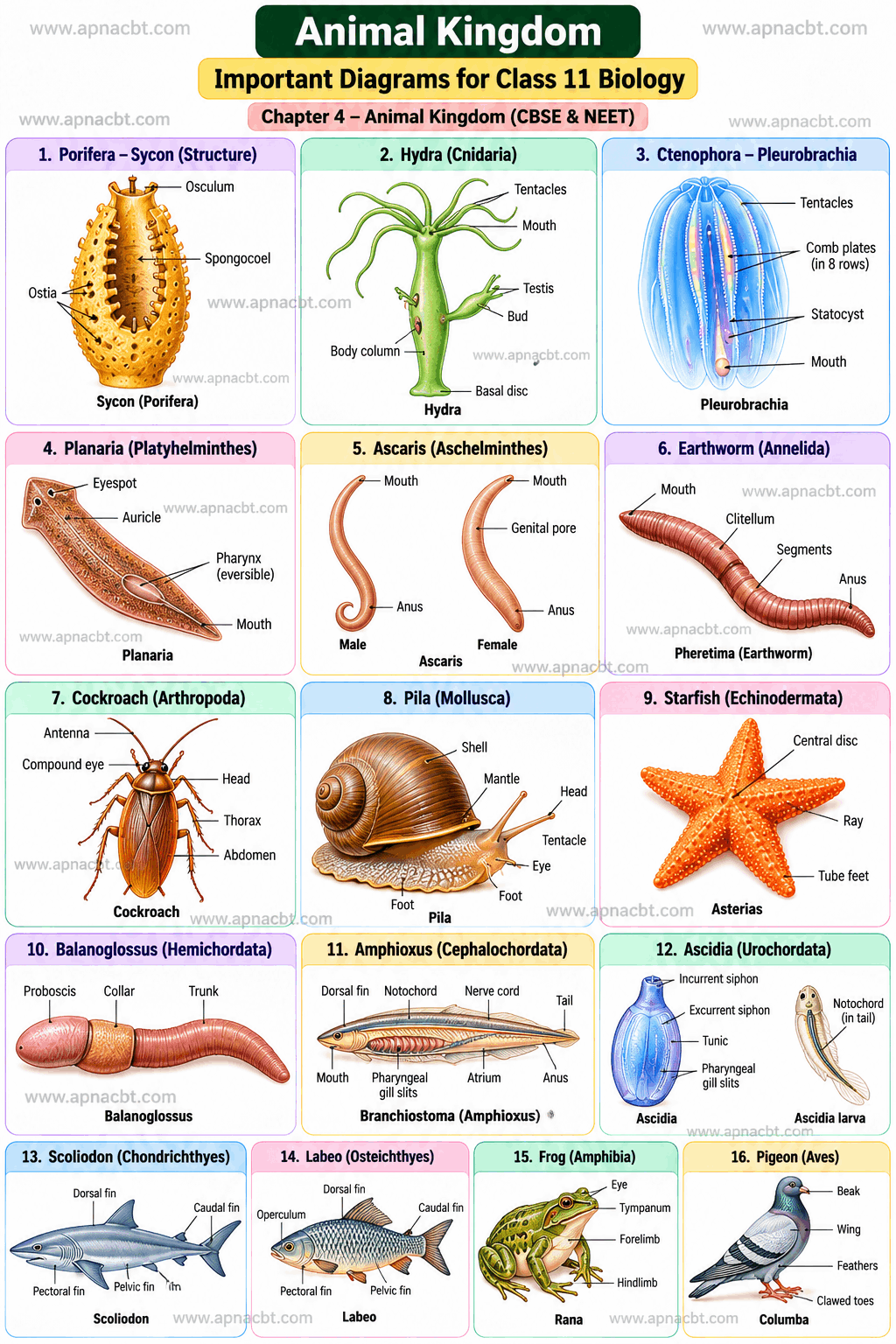
Essential diagrams to practise from the PDF
- Animal classification flowchart based on organisation, symmetry and coelom (page 1).
- Poriferan canal system and sponge forms (pages 1–2).
- Polyp and medusa forms; representative cnidarians (pages 3–4).
- Examples of annelids, arthropods, molluscs and echinoderms (pages 8–12).
- Chordate features and classification of vertebrates (pages 15 and 23–24).
- Representative fishes, amphibians, reptiles, birds and mammals (pages 16–20).
Revision priority: learn each phylum by habitat, symmetry, germ layers, coelom, level of organisation, body plan, special structures, reproduction and examples. For vertebrate classes, compare skin/scales, appendages, respiration, heart, excretion, fertilisation and development.
23. Short-Answer Questions (30)
Questions
- What is the basis for distinguishing chordates from non-chordates?
- Define radial symmetry with one example.
- What is a coelom?
- Name the three types of body cavity conditions with examples.
- What are ostia and oscula?
- What is the function of choanocytes?
- What is the skeleton of sponges made of?
- Define metagenesis. Give an example.
- What are cnidoblasts?
- Differentiate polyp and medusa.
- What are comb plates?
- What are colloblasts?
- Name the excretory structures of Platyhelminthes.
- What is the body cavity of Aschelminthes called?
- What is metamerism?
- What are parapodia?
- Name the excretory organs of annelids.
- Why is Arthropoda considered the largest animal phylum?
- What is haemocoel?
- What is radula?
- What is the function of the mantle in molluscs?
- What is the water vascular system?
- What is the symmetry of echinoderm larvae and adults?
- What is stomochord?
- Name the three main chordate subphyla.
- What is retrogressive metamorphosis?
- Give one example each of Urochordata and Cephalochordata.
- What is the main difference between Chondrichthyes and Osteichthyes?
- Why are bird bones called pneumatic?
- What is the characteristic feature of mammals?
Detailed Answers
- What is the basis for distinguishing chordates from non-chordates?
Chordates possess a notochord at least during some stage of life; non-chordates lack a notochord.
- Define radial symmetry with one example.
A body is radially symmetrical when several planes passing through its central axis divide it into similar halves. Hydra is an example.
- What is a coelom?
A coelom is a fluid-filled body cavity between the body wall and gut, completely lined by mesoderm in true coelomates.
- Name the three types of body cavity conditions with examples.
Acoelomate – Platyhelminthes; pseudocoelomate – Aschelminthes; coelomate – Annelida and other true coelomates.
- What are ostia and oscula?
Ostia are small inhalant pores through which water enters a sponge; oscula are larger exhalant openings through which water leaves.
- What is the function of choanocytes?
Choanocytes are flagellated collar cells that generate water currents and trap food particles in sponges.
- What is the skeleton of sponges made of?
It consists of calcareous or siliceous spicules, spongin fibres, or a combination of these.
- Define metagenesis. Give an example.
Metagenesis is alternation between asexual polyp and sexual medusa phases in a life cycle; Obelia is an example.
- What are cnidoblasts?
Cnidoblasts or cnidocytes are specialised stinging cells containing nematocysts, used for defence and capturing prey.
- Differentiate polyp and medusa.
Polyp is usually sessile and cylindrical with the mouth directed upwards; medusa is free-swimming and umbrella-shaped with the mouth directed downwards.
- What are comb plates?
Comb plates are eight rows of ciliated plates in ctenophores that help in locomotion.
- What are colloblasts?
Colloblasts are adhesive cells in ctenophores that help capture prey.
- Name the excretory structures of Platyhelminthes.
Flame cells or protonephridia perform excretion and osmoregulation.
- What is the body cavity of Aschelminthes called?
It is a pseudocoelom, a body cavity not completely lined by mesoderm.
- What is metamerism?
Metamerism is serial repetition of body segments along the longitudinal axis, as seen clearly in annelids.
- What are parapodia?
Parapodia are paired lateral appendages in many polychaete annelids, used for locomotion and often respiration.
- Name the excretory organs of annelids.
Nephridia.
- Why is Arthropoda considered the largest animal phylum?
It contains the greatest diversity and number of described animal species, with members adapted to terrestrial, aquatic and aerial habitats.
- What is haemocoel?
Haemocoel is the blood-filled body cavity in animals with an open circulatory system, such as arthropods.
- What is radula?
Radula is a rasping, file-like feeding organ present in most molluscs, used to scrape or cut food; it is absent in bivalves.
- What is the function of the mantle in molluscs?
The mantle covers the visceral mass, forms the mantle cavity and usually secretes the shell.
- What is the water vascular system?
It is a hydraulic canal system unique to echinoderms, used in locomotion, food capture and respiration.
- What is the symmetry of echinoderm larvae and adults?
Larvae are bilaterally symmetrical, while adults generally show pentamerous radial symmetry.
- What is stomochord?
Stomochord is a buccal diverticulum in hemichordates; it is not a true notochord.
- Name the three main chordate subphyla.
Urochordata (Tunicata), Cephalochordata and Vertebrata.
- What is retrogressive metamorphosis?
It is a transformation in which an active, complex larva develops into a simpler adult, as in urochordates.
- Give one example each of Urochordata and Cephalochordata.
Herdmania is a urochordate; Branchiostoma (Amphioxus) is a cephalochordate.
- What is the main difference between Chondrichthyes and Osteichthyes?
Chondrichthyes have a cartilaginous endoskeleton; Osteichthyes have a bony endoskeleton.
- Why are bird bones called pneumatic?
Many bird bones contain air spaces that make the skeleton lighter and support flight.
- What is the characteristic feature of mammals?
Mammary glands that produce milk to nourish the young are the defining mammalian feature.
24. Long-Answer Questions (15)
Questions
- Explain the major criteria used in the classification of animals.
- Describe the general characters of Phylum Porifera.
- Explain the body forms, special cells and reproduction in Cnidaria.
- Compare Cnidaria and Ctenophora.
- Describe the characteristic features of Platyhelminthes and their parasitic adaptations.
- Describe the general characters of Aschelminthes and Annelida, highlighting their differences.
- Explain why Arthropoda is the largest phylum and describe its important features.
- Describe the general characters of Mollusca and explain the role of mantle, radula and mantle cavity.
- Describe the characteristic features of Echinodermata and the water vascular system.
- Write an account of Phylum Hemichordata and distinguish it from Chordata.
- Explain the five diagnostic characters of Phylum Chordata.
- Differentiate Urochordata, Cephalochordata and Vertebrata.
- Describe the general features of vertebrates and outline their classification.
- Compare Chondrichthyes and Osteichthyes.
- Compare Amphibia and Reptilia and explain adaptations for terrestrial life in reptiles.
Detailed Answers
- Explain the major criteria used in the classification of animals.
Animals are classified using level of organisation, symmetry, germ layers, body cavity, segmentation and notochord. Organisation may be cellular, tissue, organ or organ-system level. Symmetry may be asymmetrical, radial or bilateral. Animals may be diploblastic or triploblastic according to germ layers. Body cavity conditions include acoelomate, pseudocoelomate and coelomate. Segmentation is serial repetition of body units. Presence of a notochord distinguishes chordates from non-chordates. These criteria help arrange animals into major phyla and establish evolutionary relationships.
- Describe the general characters of Phylum Porifera.
Poriferans are mostly marine, sessile, asymmetrical multicellular animals with cellular level of organisation. Their body has ostia and oscula and a canal system. The body wall consists of pinacoderm, choanoderm and mesohyl. Choanocytes maintain water current and capture food. The skeleton is made of calcareous or siliceous spicules and/or spongin fibres. Digestion is intracellular. Reproduction is asexual by budding or gemmules and sexual; most are hermaphrodites, fertilisation is internal and development is indirect with a larval stage. Examples include Sycon, Spongilla, Euspongia and Euplectella.
- Explain the body forms, special cells and reproduction in Cnidaria.
Cnidarians are mostly marine, radially symmetrical, diploblastic animals with tissue-level organisation. Their body wall has epidermis and gastrodermis separated by mesoglea. Cnidocytes contain nematocysts for prey capture and defence. The polyp is sessile, cylindrical and has its mouth directed upwards; the medusa is free-swimming and umbrella-shaped with its mouth directed downwards. Polyps commonly reproduce asexually by budding, while medusae produce gametes. In Obelia, alternation of polyp and medusa phases is metagenesis. Colonies may show polymorphism through specialised zooids. Examples include Hydra, Obelia, Aurelia and Physalia.
- Compare Cnidaria and Ctenophora.
Both groups are aquatic, mostly marine, diploblastic and show tissue-level organisation. Cnidarians generally have radial symmetry, cnidocytes with nematocysts, and polyp and/or medusa body forms. Ctenophores are biradially symmetrical, possess eight rows of ciliated comb plates for locomotion and adhesive colloblasts for prey capture. Cnidarians may show metagenesis and polymorphism; ctenophores are commonly hermaphroditic and show bioluminescence. Examples of cnidarians are Hydra and Obelia; examples of ctenophores are Pleurobrachia and Ctenoplana.
- Describe the characteristic features of Platyhelminthes and their parasitic adaptations.
Platyhelminthes are dorsoventrally flattened, bilaterally symmetrical, triploblastic, acoelomate animals with organ-level organisation. Many are endoparasites. The digestive tract is incomplete or absent in some parasitic forms. Flame cells or protonephridia perform excretion and osmoregulation. Many are hermaphrodites. Parasitic forms possess hooks and suckers for attachment, a protective tegument, high reproductive capacity and reduced locomotory and sensory structures. Examples include Taenia, Fasciola and Schistosoma; Planaria is free-living.
- Describe the general characters of Aschelminthes and Annelida, highlighting their differences.
Aschelminthes are cylindrical, unsegmented roundworms, bilaterally symmetrical, triploblastic and pseudocoelomate. Their alimentary canal is complete and sexes are usually separate. Examples include Ascaris and Wuchereria. Annelids are bilaterally symmetrical, triploblastic, true coelomate animals with metameric segmentation. They generally have a closed blood vascular system, nephridia for excretion and circular and longitudinal muscles. Parapodia, setae or suckers may aid locomotion. Examples include Nereis, Pheretima and Hirudinaria. The major differences are body segmentation, type of body cavity and circulatory organisation.
- Explain why Arthropoda is the largest phylum and describe its important features.
Arthropoda is the largest animal phylum because it includes an enormous diversity of species adapted to land, freshwater, marine and aerial environments. Members have a segmented body, chitinous exoskeleton and jointed appendages. The body may be divided into head, thorax and abdomen or cephalothorax and abdomen. Circulation is open and the body cavity is a haemocoel. Respiration occurs through gills, book gills, book lungs or tracheae. Excretion may occur through Malpighian tubules, green glands or coxal glands. Sensory structures include compound eyes and antennae. Examples include cockroach, prawn, honeybee, spider and scorpion.
- Describe the general characters of Mollusca and explain the role of mantle, radula and mantle cavity.
Molluscs are mostly aquatic, soft-bodied, unsegmented animals with a head, muscular foot and visceral mass. A mantle covers the visceral mass and usually secretes a calcareous shell. The mantle cavity houses gills and openings of several organ systems. The radula is a rasping feeding organ used to scrape food, but is absent in bivalves. Circulation is generally open, although cephalopods have a closed system. Respiration usually occurs through gills. Examples include Pila, Unio, Sepia, Loligo, Octopus and Pinctada.
- Describe the characteristic features of Echinodermata and the water vascular system.
Echinoderms are exclusively marine, triploblastic, coelomate animals with organ-system organisation. Larvae are bilateral and adults usually pentamerously radial. The endoskeleton consists of calcareous ossicles; spines and pedicellariae occur on the body surface. A distinct excretory system is absent and ammonia diffuses out. The water vascular system is a network of fluid-filled canals that typically receives water through the madreporite. Water passes through the stone canal, ring canal, radial canals and tube feet. Ampullae operate tube feet hydraulically. The system is used for locomotion, food capture and gas exchange. Examples include Asterias, Echinus and Ophiura.
- Write an account of Phylum Hemichordata and distinguish it from Chordata.
Hemichordates are marine, worm-like, bilaterally symmetrical, triploblastic, coelomate animals with organ-system organisation. Their body has proboscis, collar and trunk. They possess a complete digestive tract, pharyngeal gill slits, open circulation and a proboscis gland for excretion. The stomochord is a buccal diverticulum and is not homologous to the notochord of chordates. Development may include a tornaria larva. Examples are Balanoglossus and Saccoglossus. True chordates possess a notochord, dorsal hollow nerve cord and post-anal tail at some stage, whereas hemichordates lack the defining chordate notochord.
- Explain the five diagnostic characters of Phylum Chordata.
Chordates possess a notochord, a dorsal hollow tubular nerve cord, pharyngeal gill slits, a post-anal tail and an endostyle or its derivative, the thyroid gland, at some stage of life. The notochord provides axial support. The hollow dorsal nerve cord forms the central nervous system. Pharyngeal slits function in filter feeding or respiration in aquatic forms and may be embryonic remnants in terrestrial vertebrates. The post-anal tail assists locomotion in many forms. Chordates are bilaterally symmetrical, triploblastic, coelomate and deuterostomic.
- Differentiate Urochordata, Cephalochordata and Vertebrata.
In Urochordata, the notochord occurs only in the larval tail and adults are often enclosed in a tunic; retrogressive metamorphosis occurs. Examples are Herdmania and Ascidia. In Cephalochordata, the notochord extends from head to tail and persists throughout life; progressive metamorphosis is described. Branchiostoma is an example. In Vertebrata, the notochord is present in the embryo and is replaced by a vertebral column in adults; a cranium and advanced organ systems are present. Examples include fishes, amphibians, reptiles, birds and mammals.
- Describe the general features of vertebrates and outline their classification.
Vertebrates are chordates with a cranium and vertebral column. The notochord is generally embryonic and is replaced by cartilage or bone. They have a well-developed brain, dorsal spinal cord, paired kidneys, closed circulation and a ventral heart. Vertebrates are divided into jawless Agnatha, represented by Cyclostomata, and jawed Gnathostomata. Gnathostomata includes Pisces, with Chondrichthyes and Osteichthyes, and Tetrapoda, with Amphibia, Reptilia, Aves and Mammalia.
- Compare Chondrichthyes and Osteichthyes.
Chondrichthyes have a cartilaginous endoskeleton, placoid scales, usually ventral mouth, separate gill slits without an operculum, no air bladder and a usually heterocercal tail. Males have claspers and fertilisation is internal. Examples are Scoliodon, Trygon and Pristis. Osteichthyes have a bony endoskeleton, cycloid or ctenoid scales, generally terminal mouth, gills covered by an operculum and an air bladder. Their tail is generally homocercal, fertilisation is usually external and they are mostly ammonotelic. Examples are Labeo, Catla and Hippocampus.
- Compare Amphibia and Reptilia and explain adaptations for terrestrial life in reptiles.
Amphibians live in water and on moist land, have moist glandular skin, and may respire through skin, lungs, buccopharyngeal lining or gills. Their heart is generally three-chambered and fertilisation is often external. Reptiles are mainly terrestrial, with dry cornified skin bearing scales or scutes, internal fertilisation and shelled cleidoic eggs. Respiration is by lungs; kidneys are metanephric and most are uricotelic. Reptiles are better adapted to land because their waterproof skin reduces water loss, internal fertilisation and shelled eggs allow reproduction away from water, and efficient lungs support air breathing.
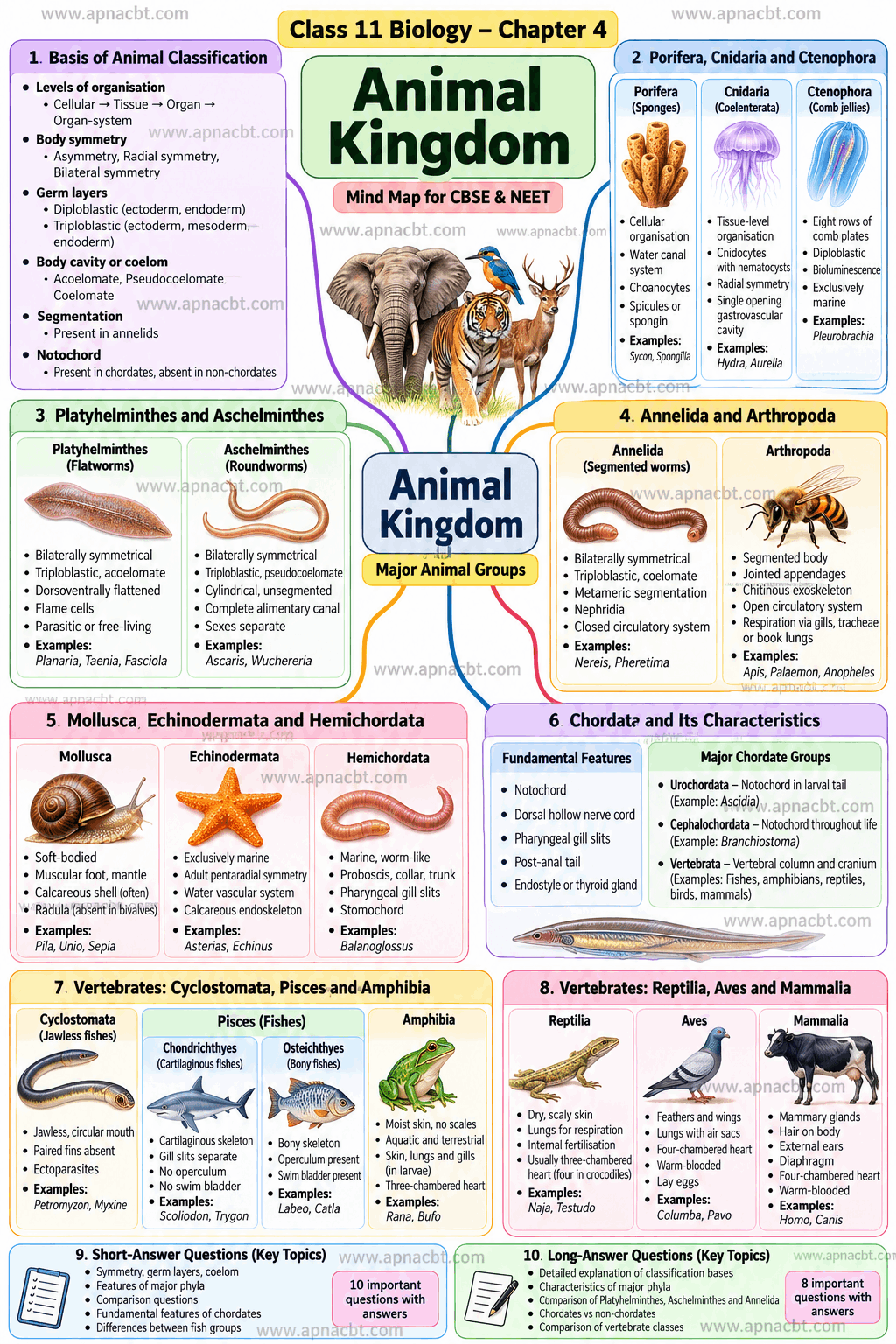
25. Mind Map – Animal Kingdom
26.Important Diagrams – Animal Kingdom
27.Important Tables – Animal Kingdom