

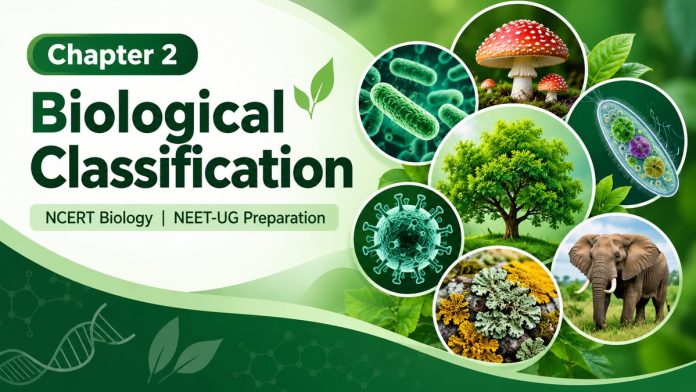

Chapter 2: Biological Classification
NCERT Biology | NEET-UG Preparation | Chapter Summary
Learning objective: Understand the development of biological classification, the five-kingdom system, the major characteristics of different kingdoms, and the differences between viruses, viroids, prions and lichens.
Five-Kingdom Classification
In 1969, R. H. Whittaker proposed five kingdoms: Monera, Protista, Fungi, Plantae and Animalia.
| Kingdom | Cell type | Organisation | General nutrition |
|---|---|---|---|
| Monera | Prokaryotic | Unicellular | Autotrophic or heterotrophic |
| Protista | Eukaryotic | Mainly unicellular | Autotrophic or heterotrophic |
| Fungi | Eukaryotic | Mainly multicellular; yeast is unicellular | Heterotrophic by absorption |
| Plantae | Eukaryotic | Multicellular | Mainly photosynthetic autotrophs |
| Animalia | Eukaryotic | Multicellular | Heterotrophic by ingestion |
Important criteria
- Cell structure: prokaryotic or eukaryotic.
- Body organisation: unicellular or multicellular.
- Mode of nutrition.
- Reproduction and life-cycle patterns.
- Evolutionary relationships.
NEET focus: Remember the scientist, the year and the names of all five kingdoms.