


Level 02 – Prepare
NEET NCERT Practice – Sexual Reproduction in Flowering Plants | Chapter 01
Important Tables From Lesson
NEET NCERT Practice Sexual Reproduction is designed for Class 12 Biology students preparing for NEET. This chapter-wise practice focuses on the important concepts from Sexual Reproduction in Flowering Plants, Unit VI – Reproduction, through NCERT-based questions, chapter-wise NEET MCQs and NEET PYQs.
Sexual Reproduction in Flowering Plants covers the flower as the site of sexual reproduction, androecium and gynoecium, stamen, microsporangium, microsporogenesis, pollen grain structure, pistil, ovule, megasporogenesis, embryo sac development, pollination, pollen–pistil interaction, fertilisation, post-fertilisation events, seeds, fruits, apomixis and polyembryony.
For effective NEET Online Practice, students should first revise the relevant NCERT concepts and then attempt the questions without immediately checking the answers. Analyse every incorrect answer and return to the corresponding NCERT concept before attempting similar questions again.
Important sequences should be revised repeatedly. On the male side, remember the sequence from sporogenous tissue to pollen mother cell, meiosis, microspore tetrad, pollen grain and male gametes. On the female side, revise the sequence from megaspore mother cell through meiosis, functional megaspore and embryo sac development.
Students should also revise the differences between autogamy, geitonogamy and xenogamy, along with cleistogamy, pollination agents, outbreeding devices, pollen–pistil interaction, emasculation and bagging.
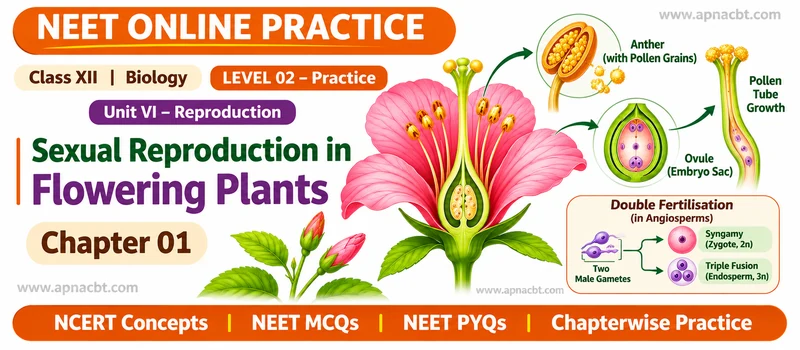
Double fertilisation is a particularly important NEET concept. One male gamete fuses with the egg to form the diploid zygote through syngamy, while the second male gamete fuses with the two polar nuclei to form the triploid primary endosperm nucleus through triple fusion.
Post-fertilisation concepts should also be revised systematically. The zygote develops into the embryo, the primary endosperm nucleus gives rise to endosperm, the ovule develops into a seed and the ovary develops into a fruit. Students should also revise parthenocarpy, apomixis and polyembryony.
Haven’t Prepared This Chapter? Study Here ↗
Chapter-wise NCERT Textbook MCQs
EASYStart your NEET NCERT Practice with NCERT-based questions from Sexual Reproduction in Flowering Plants. Revise important concepts, terminology, reproductive structures, processes and examples directly related to the chapter.
START NCERT PRACTICE →Chapter-wise NEET MCQs
MEDIUMTest your conceptual understanding with chapter-wise NEET MCQs from Sexual Reproduction in Flowering Plants. Practise questions covering microsporogenesis, megasporogenesis, pollen grains, embryo sac, pollination, fertilisation, seeds, fruits and other important NEET concepts.
START MCQ PRACTICE →Chapter-wise NEET PYQs
DIFFICULTPractise chapter-wise NEET PYQs from Sexual Reproduction in Flowering Plants to understand how important NCERT concepts are tested in previous NEET examinations. Analyse incorrect answers and revise the corresponding NCERT concept to improve accuracy.
START NEET PYQ PRACTICE →How to Use Sexual Reproduction in Flowering Plants Practice
Begin with the NCERT Practice section after completing your chapter revision. Attempt each question independently and avoid checking the answer before finishing the question. Mark difficult questions for later revision.
After completing the NCERT questions, move to the chapter-wise NEET MCQs. These questions should be used to test conceptual understanding rather than simple memorisation. Analyse every incorrect answer and identify whether the mistake was caused by a conceptual gap, misinterpretation or careless selection.
Finally, attempt the available NEET PYQs. Previous year questions help students understand how concepts from Sexual Reproduction in Flowering Plants are tested in NEET. Add incorrectly answered questions to your revision list.
NEET Preparation Strategy – Sexual Reproduction in Flowering Plants
Use NCERT as the primary reference while preparing this chapter. Revise the structure of a typical flower, androecium, gynoecium, anther, microsporangium, pollen grain, ovule and embryo sac carefully.
Pay special attention to the four wall layers of the microsporangium: epidermis, endothecium, middle layers and tapetum. Remember that a diploid pollen mother cell undergoes meiosis to produce four haploid microspores.
For the female reproductive process, revise megasporogenesis and the development of the mature embryo sac. The common mature embryo sac is 7-celled and 8-nucleate, containing the egg apparatus, three antipodals and a central cell with two polar nuclei.
For pollination, clearly differentiate autogamy, geitonogamy and xenogamy. Also revise cleistogamy, wind and water pollination, animal pollination, outbreeding devices and pollen–pistil interaction.
Revise the pollen tube pathway carefully: compatible pollen lands on the stigma, germinates, forms a pollen tube, grows through the style, reaches the ovule through the micropyle and enters a synergid to release two male gametes.
Double fertilisation is another high-priority area. Syngamy produces the diploid zygote, while triple fusion produces the triploid primary endosperm nucleus. Remember these ploidy relationships for NEET.
Finally, revise post-fertilisation changes, seed types, fruit formation, parthenocarpy, seed dormancy, apomixis and polyembryony before attempting full chapter-wise practice.
Important NEET Revision Areas
Before attempting a complete chapter test, revise the high-yield concepts from Sexual Reproduction in Flowering Plants. Important areas include microsporangium wall layers, microsporogenesis, pollen grain structure, sporopollenin, pollen viability, anatropous ovule, megasporogenesis, 7-celled 8-nucleate embryo sac, pollination types, outbreeding devices, pollen tube entry, double fertilisation, endosperm and embryo development, seed and fruit formation, apomixis and polyembryony.
Important sequences should also be revised regularly. Regular NEET Online Practice using NCERT Practice, NEET MCQs and NEET PYQs can help identify weak areas before moving to full-length Biology mock tests.
NEET NCERT Practice – Important Concepts
- Flower is the site of sexual reproduction in angiosperms.
- Stamen consists of filament and anther.
- Pistil consists of stigma, style and ovary.
- A typical anther is bilobed, dithecous and tetrasporangiate.
- The four wall layers of a microsporangium are epidermis, endothecium, middle layers and tapetum.
- Microsporogenesis produces haploid microspores through meiosis.
- Exine contains highly resistant sporopollenin.
- The mature embryo sac is 7-celled and 8-nucleate.
- Autogamy, geitonogamy and xenogamy represent different types of pollination based on pollen source.
- Syngamy produces a diploid zygote.
- Triple fusion produces a triploid primary endosperm nucleus.
- Syngamy and triple fusion together constitute double fertilisation.
- Ovule develops into seed and ovary develops into fruit after fertilisation.
- Parthenocarpy is fruit development without fertilisation.
- Apomixis is seed formation without fertilisation.
- Polyembryony is the occurrence of more than one embryo in a seed.
NCERT Biology Reference
For NCERT-based preparation, students should refer to the prescribed Biology textbook and official NCERT textbook resources while studying Sexual Reproduction in Flowering Plants.
Visit Official NCERT Textbooks

