Chapter 11: Dual Nature of Radiation and Matter
Dual Nature of Radiation and Matter is an important Class 12 Physics chapter for CBSE Board Exams and NEET preparation. This APNA CBT Level 01 lesson covers photoelectric effect, Einstein’s equation, photons, de Broglie matter waves and the Davisson–Germer experiment with exam-focused concepts and formulas.
Table of Contents
- Chapter Overview and Exam Focus
- Electron Emission and Cathode Rays
- Photoelectric Effect: Meaning and Basic Terms
- Experimental Laws of Photoelectric Effect
- Why Classical Wave Theory Fails
- Einstein's Photoelectric Equation
- Particle Nature of Light: Photon
- de Broglie Hypothesis and Matter Waves
- Davisson–Germer Experiment
- Dual Nature: Radiation and Matter
- Applications and Exam Connections
- Complete Chapter Revision: Must-Know Facts and Formulae
- 30 Short Questions with Answers
- 15 Long Questions with Answers
Use the APNA CBT learning platform for structured practice and revision. You can also return to the APNA CBT homepage after completing this chapter. For official curriculum reference, see the NCERT Physics Part-II textbook page and the CBSE Academic curriculum page.
Chapter Overview and Exam Focus
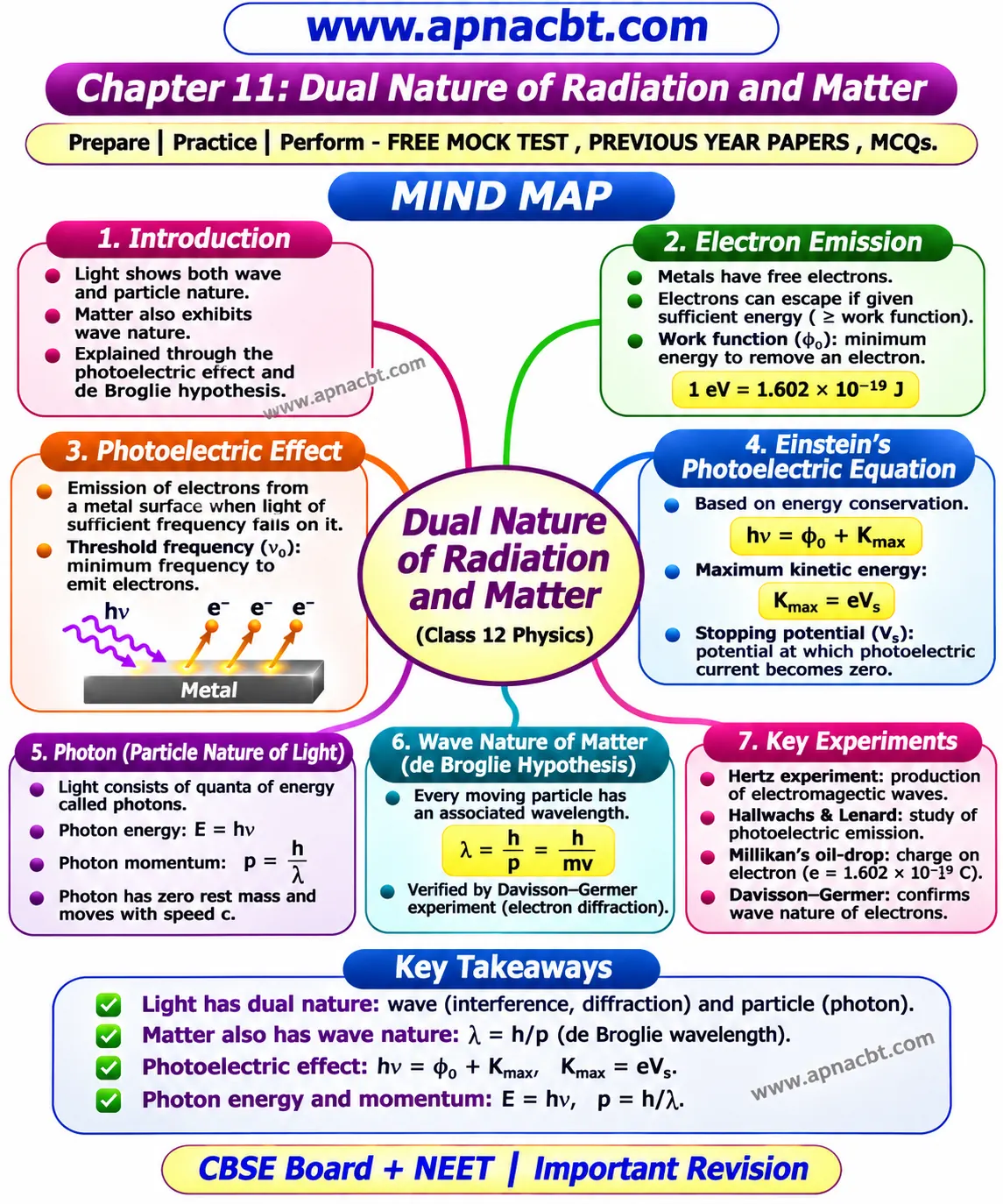
Dual Nature of Radiation and Matter is a high-value Class 12 Physics chapter for understanding how light and matter show both wave-like and particle-like behaviour. This Level 01 lesson is designed for CBSE Board Exams, school examinations and NEET preparation, with NCERT-aligned concepts, equations, observations, graphs and exam-focused revision.
The chapter connects the photoelectric effect with Einstein’s photon concept and then extends the same symmetry idea to matter through de Broglie waves. The most important scoring areas are photoelectric laws, work function, threshold frequency, stopping potential, Einstein’s photoelectric equation, photon momentum, de Broglie wavelength and the Davisson–Germer experiment.
For the current CBSE Class XII Physics curriculum, Chapter 11 appears under Unit VII, Dual Nature of Radiation and Matter. The official 2026–27 curriculum assigns 12 marks to the combined Unit VII block with Chapters 11–13. citeturn751563search24
Dual Nature of Radiation and Matter connects the photoelectric effect with matter waves and is essential for exam revision.
Dual Nature of Radiation and Matter connects the photoelectric effect with matter waves and is essential for exam revision.
Dual Nature of Radiation and Matter connects the photoelectric effect with matter waves and is essential for exam revision.
Dual Nature of Radiation and Matter connects the photoelectric effect with matter waves and is essential for exam revision.
Dual Nature of Radiation and Matter connects the photoelectric effect with matter waves and is essential for exam revision.
Dual Nature of Radiation and Matter connects the photoelectric effect with matter waves and is essential for exam revision.
Electron Emission and Cathode Rays in the Dual Nature of Radiation and Matter
Electron emission is the process in which electrons escape from a material surface. In the NCERT chapter, cathode-ray experiments provide the historical background for understanding electrons as negatively charged particles. William Crookes investigated cathode rays, while J. J. Thomson established their particle nature and measured the charge-to-mass ratio.
Electrons can be emitted by supplying sufficient energy. The important mechanisms are thermionic emission by heating, field emission using a strong electric field, and photoelectric emission caused by suitable electromagnetic radiation. For this chapter, photoelectric emission is the central mechanism.
The chapter also connects electron emission with the development of electron microscopes. Fast electrons can be focused using electric and magnetic fields, and their short de Broglie wavelength makes them useful for studying very small structures.
Photoelectric Effect in the Dual Nature of Radiation and Matter
The photoelectric effect is the phenomenon of emission of electrons from a metal surface when electromagnetic radiation of suitable frequency falls on it. The emitted electrons are called photoelectrons and the resulting current is called photoelectric current.
The minimum energy required to liberate an electron from a metal surface is called the work function, represented by φ₀. It is characteristic of the material. If ν₀ is the threshold frequency, then the work function is φ₀ = hν₀.
Photoelectric emission occurs only when the incident frequency is at least the threshold frequency. Increasing intensity at a frequency below threshold does not produce emission, however large the intensity may be.
Experimental Laws of Photoelectric Effect
The experimental observations are central to the Dual Nature of Radiation and Matter chapter. For a fixed frequency above threshold, photoelectric current increases with intensity because a more intense beam supplies more photons per unit time and therefore can eject more electrons.
The maximum kinetic energy of photoelectrons depends on the frequency of incident radiation, not on its intensity. Increasing frequency increases the maximum kinetic energy. For a fixed frequency, the stopping potential is independent of intensity.
There is a threshold frequency ν₀ for each photosensitive material. Below ν₀, no photoelectrons are emitted. Above ν₀, emission is essentially instantaneous, even for very weak incident light. These observations cannot be explained satisfactorily by the classical continuous-wave picture.
Why Classical Wave Theory Fails
Classical wave theory treats light energy as continuously distributed over the wavefront. It would therefore suggest that increasing intensity should increase the energy absorbed by an individual electron. Experiments instead show that maximum kinetic energy is controlled by frequency.
The wave picture also struggles with the existence of a threshold frequency. Classical reasoning would allow sufficiently intense radiation, acting for sufficient time, to transfer enough energy to electrons even at low frequency. This is not observed.
Finally, classical continuous absorption suggests a possible time delay for very weak light. Photoelectric emission is instead observed without an appreciable delay. Einstein’s photon model resolves all three difficulties.
Einstein's Photoelectric Equation
Einstein proposed that electromagnetic radiation consists of discrete quanta, or photons. Each photon has energy E = hν. In photoelectric emission, one photon transfers its energy to one electron. Part of the energy is used to overcome the work function and the remainder appears as maximum kinetic energy.
The energy balance is hν = φ₀ + Kmax. Therefore, Kmax = hν − φ₀ = h(ν − ν₀). Since the maximum kinetic energy is related to stopping potential, eV₀ = Kmax, giving eV₀ = hν − φ₀.
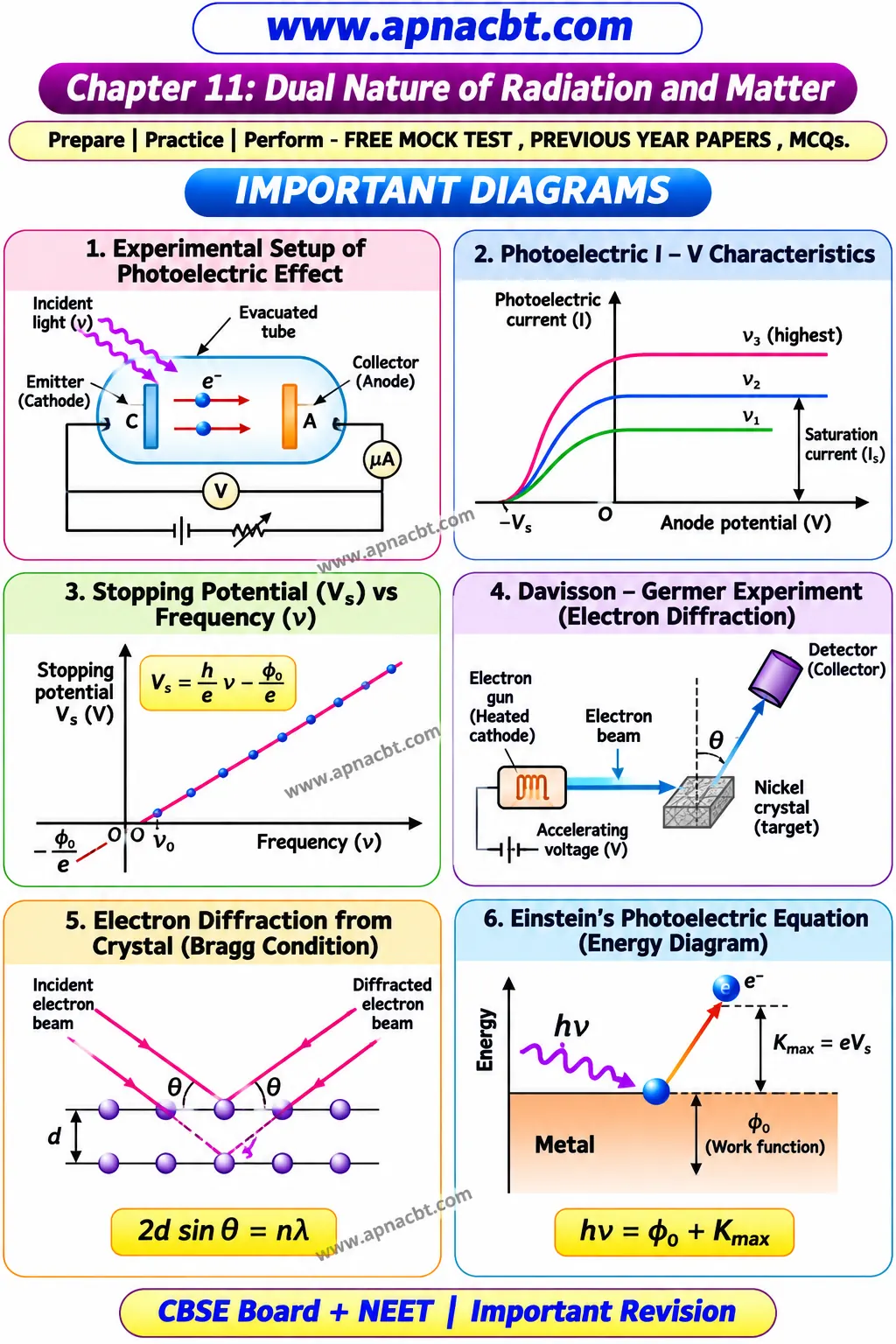
Thus the graph of stopping potential V₀ versus frequency ν is a straight line. Its slope is h/e and its frequency-axis intercept is the threshold frequency. The relation also shows directly why stopping potential is independent of intensity for fixed frequency.
Particle Nature of Light: Photon
A photon is the quantum or particle-like unit of electromagnetic radiation. Its energy is E = hν = hc/λ and its momentum is p = h/λ = E/c. A photon has zero rest mass, but it carries energy and momentum.
The photon picture explains the instantaneous nature of photoelectric emission. A single electron can absorb a photon in one elementary interaction. Intensity changes the number of photons arriving per unit time, whereas frequency changes the energy of each photon.
The particle nature of light is also supported by Compton scattering, although the main Class 12 focus in this chapter is the photoelectric effect and the photon interpretation of radiation.
de Broglie Hypothesis in the Dual Nature of Radiation and Matter
Louis de Broglie proposed that if radiation can show both wave and particle characteristics, matter particles should also possess wave-like properties. For a particle with momentum p, the de Broglie wavelength is λ = h/p.
For a non-relativistic particle of mass m moving with speed v, p = mv and hence λ = h/(mv). For a charged particle accelerated through a potential difference V, the kinetic energy relation gives λ = h/√(2mqV) for a particle of charge magnitude q.
For an electron accelerated through V volts, the commonly used non-relativistic relation is λ = h/√(2meV). This relation is important in numerical questions and in understanding why electrons are useful in electron microscopes.
Davisson–Germer Experiment
The Davisson–Germer experiment provided experimental evidence for the wave nature of electrons. Electrons were accelerated and scattered from a nickel crystal. The observed intensity variation showed a diffraction maximum, consistent with a wavelength comparable to the de Broglie wavelength.
The experiment is important because diffraction is a wave phenomenon. Agreement between the experimentally inferred wavelength and the de Broglie prediction established matter-wave behaviour for electrons.
For board examinations, remember the chain: accelerated electrons → nickel crystal → scattering/diffraction pattern → wavelength determined → agreement with λ = h/p → evidence for matter waves.
Dual Nature: Radiation and Matter
Radiation can behave as a wave in phenomena such as interference, diffraction and polarisation, while its interaction with matter can reveal particle-like behaviour through photons and the photoelectric effect. Matter particles can also display wave behaviour through de Broglie waves.
The correct description depends on the experiment. The chapter therefore does not say that light is simply a classical wave or simply a classical particle. Quantum objects require both complementary aspects to describe different experimental observations.
The central symmetry is: photon has particle properties with wave-associated wavelength, while material particles have particle properties and an associated matter wavelength. This idea forms the conceptual core of the chapter.
Applications and Exam Connections
The photoelectric effect has practical applications in photoelectric cells, automatic switching and light-sensitive devices. A photoelectric cell converts incident light energy into electrical response through photoemission.
Electron microscopes use accelerated electrons as probes. Because the de Broglie wavelength can be much smaller than the wavelength of visible light, electron microscopy can resolve much finer details than ordinary optical microscopy.
For CBSE Board preparation, practise derivations and graph interpretation. For NEET preparation, focus on threshold frequency, work function, stopping potential, photon energy, de Broglie wavelength and proportionality-based numerical questions.
Complete Chapter Revision: Must-Know Facts and Formulae
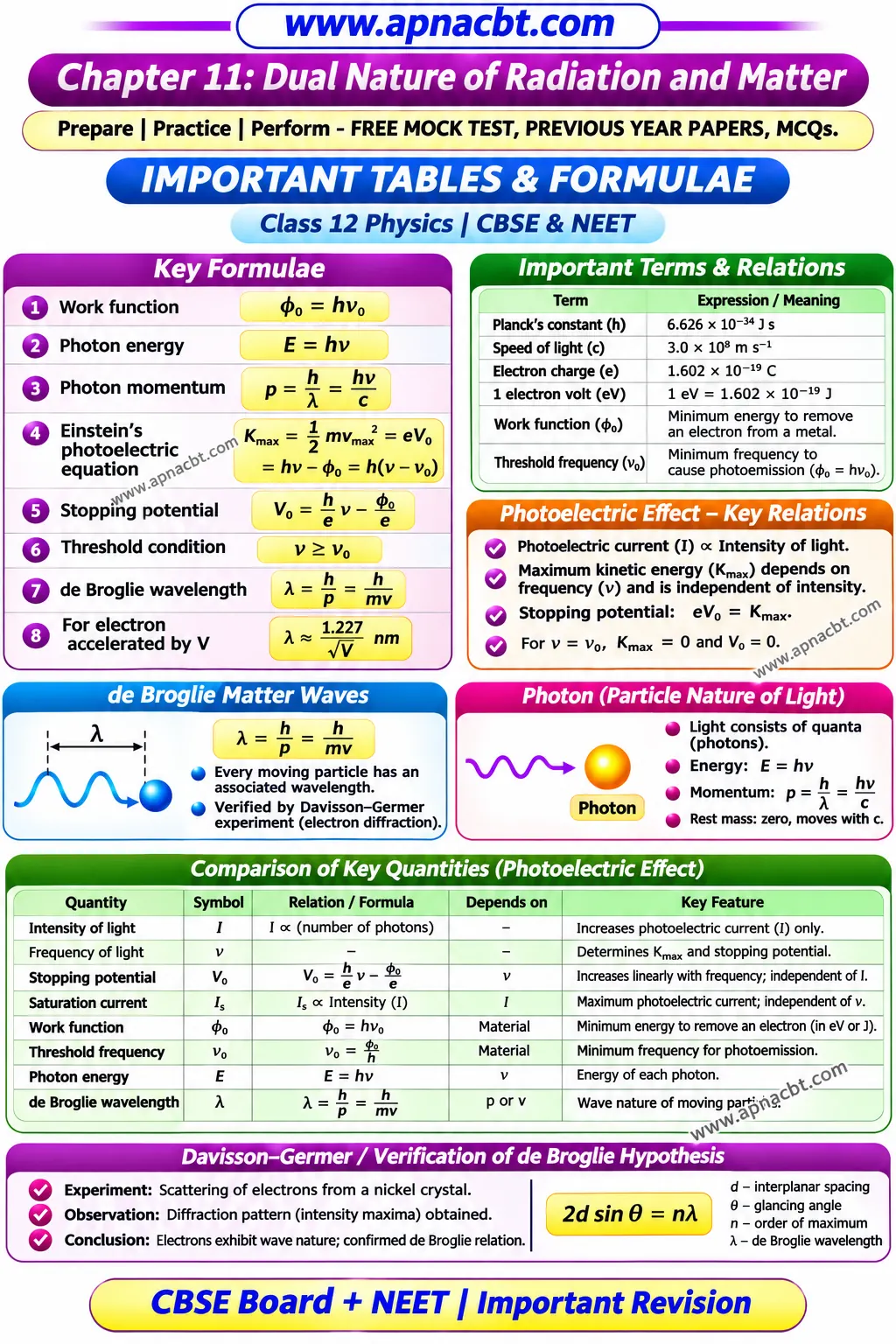
Photoelectric effect: emission requires ν ≥ ν₀. Work function φ₀ = hν₀. Einstein equation: hν = φ₀ + Kmax. Also Kmax = eV₀ = ½mvmax².
Photon: E = hν = hc/λ and p = h/λ = E/c. Matter wave: λ = h/p = h/(mv). For an electron accelerated through V, λ = h/√(2meV) in the non-relativistic limit.
Graph facts: V₀ versus ν is linear with slope h/e; the threshold frequency is the frequency-axis intercept. Increasing intensity increases photoelectric current but does not increase the maximum kinetic energy at fixed frequency.
30 Short Questions with Detailed Answers
1. What is photoelectric effect?
Answer: It is the emission of electrons from a material surface when radiation of suitable frequency falls on it.
2. What is a photoelectron?
Answer: An electron emitted from a material surface in the photoelectric effect is called a photoelectron.
3. Define work function.
Answer: Work function φ₀ is the minimum energy required to remove an electron from the surface of a material.
4. What is threshold frequency?
Answer: Threshold frequency ν₀ is the minimum frequency of incident radiation required to cause photoelectric emission from a given material.
5. Write the relation between work function and threshold frequency.
Answer: φ₀ = hν₀.
6. What happens below threshold frequency?
Answer: No photoelectric emission occurs, regardless of how large the intensity is.
7. What determines the maximum kinetic energy of photoelectrons?
Answer: For a fixed material, it is determined by the frequency of incident radiation, not its intensity.
8. What is stopping potential?
Answer: It is the minimum reverse potential that just stops the most energetic photoelectrons, so eV₀ = Kmax.
9. State Einstein's photoelectric equation.
Answer: hν = φ₀ + Kmax, or Kmax = hν − φ₀ = eV₀.
10. What is photon energy?
Answer: The energy of a photon is E = hν = hc/λ.
11. What is photon momentum?
Answer: Photon momentum is p = h/λ = E/c.
12. Why does intensity increase photoelectric current?
Answer: At fixed frequency above threshold, greater intensity means more photons incident per unit time, producing more photoelectrons and hence greater current.
13. Why does intensity not change stopping potential at fixed frequency?
Answer: Intensity changes the number of photons, not the energy hν of each photon, so Kmax and V₀ remain unchanged.
14. Why is photoelectric emission instantaneous?
Answer: A single photon transfers its energy to an electron in one elementary interaction, so emission does not require gradual energy accumulation.
15. What is de Broglie wavelength?
Answer: It is the wavelength associated with a moving material particle: λ = h/p.
16. Write de Broglie wavelength for a non-relativistic particle.
Answer: λ = h/(mv).
17. What is the de Broglie wavelength of an electron accelerated through V?
Answer: λ = h/√(2meV), for non-relativistic motion.
18. What did Davisson–Germer experiment prove?
Answer: It provided experimental evidence for the wave nature of electrons through electron diffraction from a nickel crystal.
19. Name the scientist who proposed matter waves.
Answer: Louis Victor de Broglie.
20. What is the relation between photon energy and wavelength?
Answer: E = hc/λ.
21. What is the slope of V₀ versus frequency graph?
Answer: The slope is h/e.
22. What is the frequency-axis intercept of V₀ versus ν graph?
Answer: It is the threshold frequency ν₀.
23. Does increasing light intensity increase maximum kinetic energy?
Answer: No. At fixed frequency, maximum kinetic energy is independent of intensity.
24. Does increasing frequency increase maximum kinetic energy?
Answer: Yes, above threshold, Kmax increases linearly with frequency.
25. What is the significance of work function?
Answer: It represents the minimum energy barrier that an electron must overcome to escape from the material surface.
26. Why can visible light eject electrons from some metals but not others?
Answer: Different metals have different work functions and therefore different threshold frequencies.
27. What is a photon?
Answer: A photon is a quantum of electromagnetic radiation carrying energy hν and momentum h/λ.
28. Why are electron microscopes useful for small objects?
Answer: Accelerated electrons can have very short de Broglie wavelengths, allowing much finer spatial resolution.
29. Name one wave phenomenon of light and one particle phenomenon.
Answer: Interference is a wave phenomenon; photoelectric effect is a particle-like interaction.
30. What is the central idea of dual nature?
Answer: Both radiation and matter can exhibit wave-like and particle-like properties depending on the experiment.
15 Long Questions with Detailed Answers
1. Explain the photoelectric effect and the main experimental observations.
Answer: The photoelectric effect is the emission of electrons from a material surface when radiation of suitable frequency falls on it. The important observations are: emission requires a threshold frequency; emission is essentially instantaneous; photoelectric current increases with intensity for fixed frequency above threshold; and maximum kinetic energy depends on frequency rather than intensity. These observations led to the photon explanation.
2. Define work function, threshold frequency and stopping potential and relate them.
Answer: Work function φ₀ is the minimum energy needed to liberate an electron. Threshold frequency ν₀ satisfies φ₀ = hν₀. Stopping potential V₀ is the reverse potential that just stops the fastest photoelectrons. Hence eV₀ = Kmax. Einstein's equation gives eV₀ = hν − φ₀ = h(ν − ν₀).
3. Derive Einstein's photoelectric equation.
Answer: A photon of energy hν is absorbed by an electron. The energy first supplies the work function φ₀. The remainder becomes maximum kinetic energy. Therefore hν = φ₀ + Kmax. Since Kmax = ½mvmax² = eV₀, hν = φ₀ + ½mvmax² = φ₀ + eV₀.
4. Explain why classical wave theory cannot explain photoelectric effect.
Answer: Classical theory predicts that energy should be absorbed continuously and that greater intensity should increase the energy delivered to each electron. It also does not naturally predict a threshold frequency and would allow a time delay at low intensity. Experiments show frequency controls Kmax, a threshold frequency exists, and emission is essentially instantaneous. The photon model explains these observations.
5. Describe the photon picture of electromagnetic radiation.
Answer: Radiation consists of photons or energy quanta. Each photon carries E = hν and p = h/λ. Intensity changes the number of photons arriving per unit time, while frequency determines the energy of each photon. Photoelectric emission occurs when a photon transfers its energy to an electron and the energy exceeds the work function.
6. Explain the variation of stopping potential with frequency.
Answer: From eV₀ = hν − φ₀, V₀ = (h/e)ν − φ₀/e. Thus V₀ varies linearly with ν. The slope is h/e and the frequency-axis intercept is ν₀ = φ₀/h. The relation is independent of intensity for a given material.
7. Explain the effect of intensity on photoelectric current and kinetic energy.
Answer: At a fixed frequency above threshold, greater intensity means more photons incident per unit time, so more electrons are emitted and current increases. However, photon energy hν is unchanged; therefore the maximum kinetic energy and stopping potential do not increase with intensity.
8. Explain de Broglie's hypothesis and derive λ = h/(mv).
Answer: De Broglie proposed that a moving particle has an associated wave. He assigned wavelength λ = h/p. For non-relativistic motion, p = mv. Therefore λ = h/(mv). This relation predicts that faster or more massive particles have shorter matter wavelengths.
9. Derive the de Broglie wavelength of a charged particle accelerated through potential V.
Answer: A particle of charge magnitude q accelerated through V gains kinetic energy qV. For non-relativistic motion, qV = ½mv², so p = mv = √(2mqV). Therefore λ = h/p = h/√(2mqV).
10. Explain the Davisson–Germer experiment.
Answer: Electrons were accelerated through a known potential and directed at a nickel crystal. The scattered electron intensity showed a diffraction maximum at particular angles. The wavelength inferred from the diffraction condition agreed with the de Broglie wavelength of the electrons. This confirmed the wave nature of matter.
11. Compare wave and particle aspects of radiation.
Answer: Radiation exhibits wave behaviour in interference, diffraction and polarisation. It exhibits particle-like behaviour in photoelectric interactions, where energy is exchanged in discrete photons. Thus a single classical description is insufficient for all experiments.
12. Why is an electron microscope capable of high resolution?
Answer: Resolution improves when the probe wavelength is small. Accelerated electrons can have very small de Broglie wavelengths, λ = h/p. Therefore an electron microscope can resolve structures much smaller than those accessible with visible-light microscopes.
13. Explain the significance of the threshold frequency.
Answer: Threshold frequency is the minimum frequency required for photoemission from a material. It is determined by the work function through φ₀ = hν₀. Below this frequency, no photoelectrons are emitted regardless of intensity. It is one of the key experimental facts supporting the photon model.
14. A metal has work function φ₀. Derive the threshold wavelength.
Answer: At threshold, Kmax = 0, so hν₀ = φ₀. Since ν₀ = c/λ₀, h c/λ₀ = φ₀. Hence λ₀ = hc/φ₀. Radiation with wavelength shorter than or equal to λ₀ can cause photoemission, subject to the material and idealised conditions.
15. Summarise the complete chapter in an exam-oriented chain.
Answer: Start with electron emission and photoelectric effect. Learn work function, threshold frequency and experimental laws. Use Einstein's equation to connect photon energy with maximum kinetic energy and stopping potential. Learn photon momentum. Then apply de Broglie's hypothesis λ = h/p to matter and study the Davisson–Germer verification. Finally connect the short wavelength of electrons with electron microscopy.
Official study references: NCERT Physics Part-II and CBSE Academic curriculum.